
Week 9: Staff Training and the 15-Minute Cycle
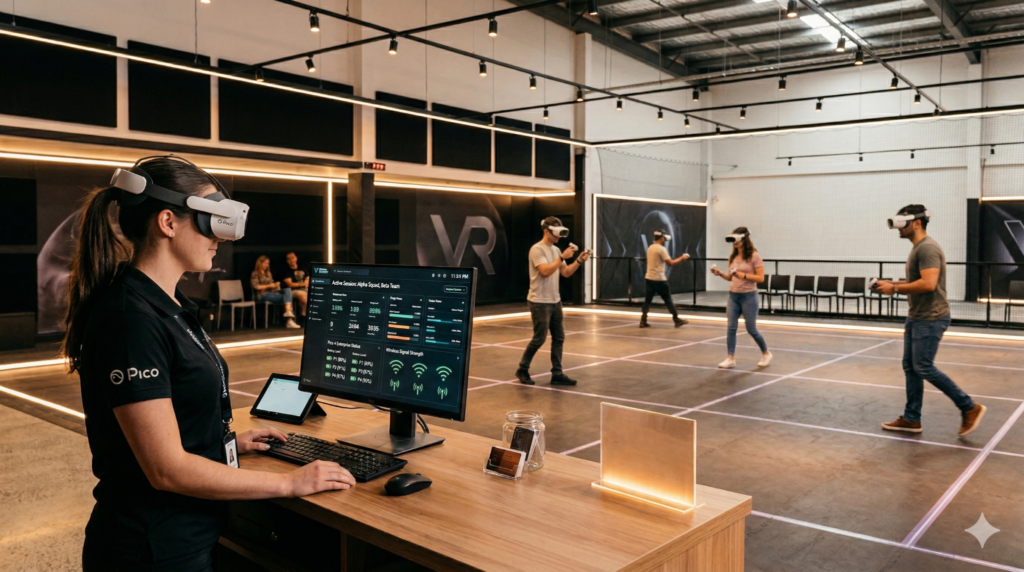
Part of the series: From First Headset to Fully Operational VR Arena Week 8 covered the launch sequence and why the gap between groups is where throughput is won or lost. Week 9 moves to the layer above that. A reliable launch sequence only holds if the person running it performs it the same way every time. Most free roam venues cannot guarantee that because they build operations that depend on individual knowledge rather than systems. The 15-minute cycle is the reset window between one group leaving and the next group entering an active experience. It covers headset collection, hardware checks, hygiene, space reset, and the full session launch sequence. In a venue running back-to-back bookings, that window defines how many groups you can serve in a day. Miss it consistently and the schedule slips. Miss it on a Saturday and you lose bookings. Throughput Is the Real Profit Driver Free roam VR sells time in a physical space. A venue running six to eight sessions a day in a single arena generates its revenue entirely through session volume and session quality. A session that starts late, runs short, or ends in confusion is not a recoverable situation. The guest has already paid. The time is already gone. The relationship between throughput and profitability is direct. Successful LBE operators focus on high throughput and repeat visitation, with the core business model relying on moving customers efficiently through premium experiences. In free roam VR specifically, where group sessions run sequentially throughout the day, the difference between a five-minute turnaround and a fifteen-minute one compounds across a full operating week into significant lost capacity. Every minute of that window that runs long is a minute the next group waits. Across six to eight sessions a day, a consistently slow 15-minute cycle does not just feel inefficient. It shows up in how many groups you can actually serve. The Problem with Depending on People The U.S. Bureau of Labor Statistics reports that the leisure and hospitality sector consistently sees annual turnover rates exceeding 70%. For a free roam VR venue, that figure carries a specific operational implication. Every time an experienced operator leaves, the institutional knowledge they built leaves with them: how to handle a headset that misses a launch signal, which session settings work best for a group of eight, how to reset the space efficiently between bookings. Venues that build operations around individuals rather than systems pay this cost repeatedly. Research from the Cornell Center for Hospitality Research puts the average cost of replacing a single hourly, non-management employee at over $2,300, covering recruiting, hiring, and training expenses. In a venue where staff turnover is common rather than exceptional, absorbing that cost on a recurring basis is not sustainable. The answer is not better staff. It is removing the dependency on individual knowledge. What a System Actually Is A system, in operational terms, is any process a new team member can follow without relying on memory or prior experience. It is a script, not a skill set. Instead of training staff to know everything, a well-designed VR venue management system trains staff to follow a defined sequence. In a well-run free roam VR operation, every customer-facing moment follows a documented workflow. A staff member arriving for their first shift follows the same steps as someone who has worked there for six months. The guest experience does not change depending on who happens to be working that day. A complete operator workflow might look like this: When each of these steps is documented and consistently followed, any staff member can run a shift to the same standard. That is what system-led LBE venue operations look like in practice. Reset Time as a Venue KPI Not all free roam venues formally track reset time between groups, and that gap is worth addressing. Reset time is a direct measure of VR venue operational efficiency. It surfaces information that session counts alone do not reveal. A venue running at apparent full capacity but losing significant time per turnaround may not see the problem in its daily numbers until it starts comparing across shifts. When reset time varies substantially depending on which staff member is running the floor, the gap usually reflects a training issue rather than a staffing one. Tracking it gives operators the data to distinguish between the two and act accordingly. Why Dashboards Change the Training Equation Training staff to navigate individual headsets produces knowledge that is device-specific, update-dependent, and tied to whoever learned it. When firmware updates change a menu, the training becomes outdated. When the person who learned it leaves, the training goes with them. This is not a reason to skip hardware knowledge entirely. Staff still need the physical basics covered in the briefing section above. What a centralized VR session management dashboard removes is the need for staff to troubleshoot software issues, navigate device menus under pressure, or launch content manually from inside each headset. That layer belongs in the system, not in a staff member’s memory. Dashboard-driven VR arcade operations work differently. Staff interact with a central interface showing every device in the fleet simultaneously: session status, battery level, connection state, and any exceptions requiring attention. What matters most for entertainment venues running multiple attractions is fast staff training, integrated management across experiences, and unified reporting. SynthesisVR’s Local Manager gives operators a live view of every connected station across their free roam VR setup. Session launches, fleet monitoring, device recovery, and reset preparation all happen from one place. A new team member following a dashboard-driven workflow reaches operational competence significantly faster than one navigating individual devices. When that team member eventually leaves, the next person follows the same workflow without a handover. What a Mature Free Roam Operation Looks Like The VR venues that run consistently tend to share the same operational foundations. Here is a practical checkpoint framework operators can adapt for their own shifts: Pre-shift Guest arrival Session Reset End of shift The goal is