
Free Roaming with PICO: What 12 Weeks of Building a VR Arena Actually Teaches You
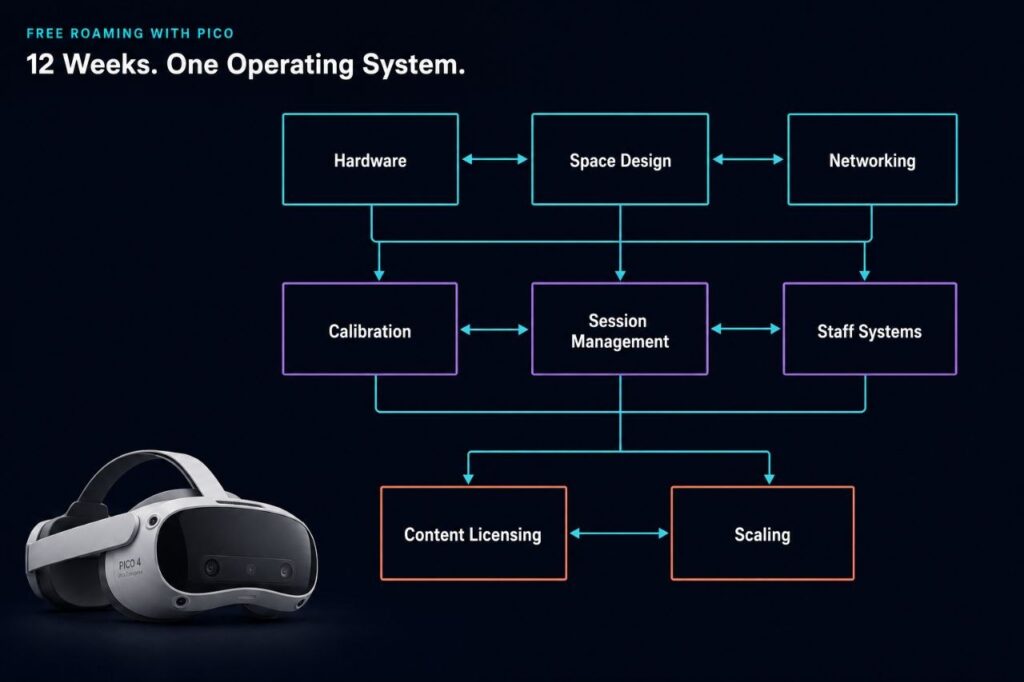
Twelve weeks of free roam content produced one finding that kept surfacing regardless of topic: the operators who struggle most are almost never fighting a hardware problem. This series started as a practical guide to running free roam VR with PICO hardware and ended as something more specific, a record of every place operators get stuck and why the fix rarely looks the way it did from the outside. If you are planning your first VR arena, or six months in and wondering why the gap between expectation and reality is wider than expected, what follows covers each of those gaps and links to the full article where the evidence lives. What Free Roam Actually Is, Before You Spend Anything Most operators arrive at free roam with room scale experience. The hardware looks familiar and the play area is larger, but what changes is the operating model underneath. Week 1 makes that distinction precise: free roam is not a floor size, it is a coordination problem. When six to eight players move simultaneously in a shared space, tracking alignment, session sync, safety boundaries, and staff response all become live constraints at once. The game almost never breaks first.That coordination demand is part of why the hardware choice matters earlier than most operators expect. Week 3 covers why PICO became the standard for free roam in location-based entertainment: the enterprise-first OS design, boundary sharing stable enough for multiplayer alignment, and separation from consumer firmware cycles that change device behaviour without notice. Standalone VR for LBE is built for a different primary user. The operator, not the player, is who the hardware has to serve. The Costs That Do Not Appear on a Spec Sheet Week 2 addresses the consumer trap, and the core argument is operational rather than legal. Consumer headsets in commercial environments require account management, cannot be controlled centrally, and are exposed to firmware updates that change the staff-facing UI overnight. Operators who started with consumer hardware to cut upfront costs consistently found the savings gone within the first year, absorbed into staff time and sessions that could not be recovered. The arithmetic behind that pattern is what Week 4 works through. Some of the least profitable free roam venues ran the newest hardware; the losses came from reset time between groups, staff intervention on sessions that should have launched automatically, and downtime that compounds across a full operating week. None of those costs appear in hardware comparisons, which is where most operators first build their business case. Space Design and Networking Are the Same Problem Operators treat arena design and networking as separate decisions because they happen at separate times, one at buildout and one closer to launch. Week 5 makes the case they should be planned together. Player movement patterns determine where congestion builds. Pillars and reflective surfaces affect tracking in ways that floor plans do not show. Dead zones, which most operators attribute to router placement or hardware range, are almost always design failures: places where actual movement patterns were not considered when the space was laid out. Network failures are the most misdiagnosed issue in free roam VR. Week 6 traces why: congestion, band steering, and roaming client behaviour produce symptoms that surface as tracking errors, so operators spend time on headsets when the problem is in the infrastructure. A session that breaks because of a network event the operator misread as a headset fault still ends as a refund conversation, regardless of where the fault actually was. Where Throughput Actually Gets Lost Locations that stopped re-mapping every morning consistently reported the same thing: they had not realised how much of their opening routine it consumed until the time came back. Week 7 covers what calibration drift is and why it happens, but the more operationally significant part is why operators were not using PICO boundary sharing across their fleet to maintain consistent environments, and what that gap cost them in daily throughput. Manual game launches are where sessions lose time in ways customers notice but cannot name. A 15-minute experience that takes 25 minutes because staff sync each headset individually does not produce a complaint about the wait; it produces a complaint about the confusion, which is harder to address and harder to stop from spreading. Week 8 covers how automation removes that failure mode and why one-click launch is a design principle about where error belongs in a session workflow, not a convenience feature. The staffing argument in Week 9 follows directly from that. Venues built around centralized dashboards can onboard new team members without rebuilding operational knowledge from scratch each time someone leaves, and in LBE, turnover is a structural constant rather than an exception. Throughput is the profit driver in free roam. Systems are what protect it when people change. The Legal Layer Most Operators Discover Too Late Week 10 documents what happens when operators assume a consumer game purchase covers commercial use: developers reach out directly, usually after the fact, and the resolution is rarely straightforward. The operators most exposed are those who built their content library early and never revisited the terms as the business scaled. Working with a platform that maintains direct licensing relationships with hundreds of developers removes the exposure that accumulates silently under a consumer-first content strategy. What 600 Locations Teach You That One Cannot Running patterns across hundreds of venues produces a different picture from what any single operator can observe. Week 11 covers which games hold repeat customers over time, why the most consistent locations refine a smaller catalog rather than chasing new releases, and which operational mistakes new operators repeat regardless of geography, hardware choice, or venue size. The conclusions are about content strategy under real operating conditions, not about ranking titles. Scaling is where every unresolved operational problem becomes expensive. Week 12 closes the series on that point. The barrier to expansion is almost never capital; it is the inability to reproduce the same setup reliably, a problem that does not
Standalone VR Arena Games Worth Adding to Your Lineup in 2026

Action free roam titles tend to generate a particular kind of session energy. Groups get loud, they communicate, and they leave with a shared story rather than just a score. That dynamic is one of the most reliable drivers of rebooking and referral. This post covers three standalone free roam action titles available on the SynthesisVR content marketplace for Pico, Quest, and Focus 3 hardware. A PvP bank heist that has been one of the most consistently booked standalone titles across venues worldwide. A horror escape with active combat and a boss fight that received a major content update in February 2026. And a co-op zombie survival experience built around a narrative mission that gives teams a shared goal beyond just staying alive. All three run through the same interface as the rest of your library, with no additional platform switching or separate session management required. Game Highlight: Cops vs Robbers Cops vs Robbers is the kind of title that earns its place on the booking sheet week after week. The premise is simple enough to explain at the front desk in one sentence: pick a side, Cop or Robber, and fight it out inside a bank vault. Walk-in groups understand it immediately. Competitive groups love it. First-timers get into it fast. The V2 update in October 2024 added meaningful depth without complicating the experience. A new PvE story-driven mode gives groups that prefer co-op an entirely different way to play the same title, which means one license covers both competitive and cooperative bookings. A new networking solution reduced latency and improved stability for back-to-back sessions. Multiple gun options in PvE add replay value for returning guests. Arena configurations scale from 4.5×4.5m up to 10x10m with 2 to 10 players. Cross-play between PICO, Meta Quest, and HTC Focus 3/ Vision is supported, so venues running mixed hardware fleets can run it across their full headset inventory without workarounds. Learn more: Cops vs Robbers Cops vs Robbers Community Page Alongside the game, SynthesisVR is keen to build communities based on games using Community Pages, an initiative designed specifically for Location-Based Entertainment VR operators, developers, and industry professionals. Check our Cops vs Robbers: Community Page These pages are built to serve as living knowledge hubs, where operators can: Unlike traditional consumer-focused communities, SynthesisVR Community Pages are purpose-built for professionals, helping operators make informed decisions, improve uptime, and deliver better experiences to guests. This initiative reflects SynthesisVR’s long-standing commitment to not just distributing content, but supporting the businesses that run it. About SynthesisVR SynthesisVR is a VR management platform built for LBE operators, with 350+ experiences available through one content marketplace. Every title here runs through the same interface as the rest of your library, with no additional platform switching or separate session management required. SynthesisVR has been supporting commercial VR venues since 2016 and operates across 600+ venues worldwide. Browse the full standalone free roam catalog Try SynthesisVR, No credit card required!