
PCVR vs Standalone VR for Commercial Venues
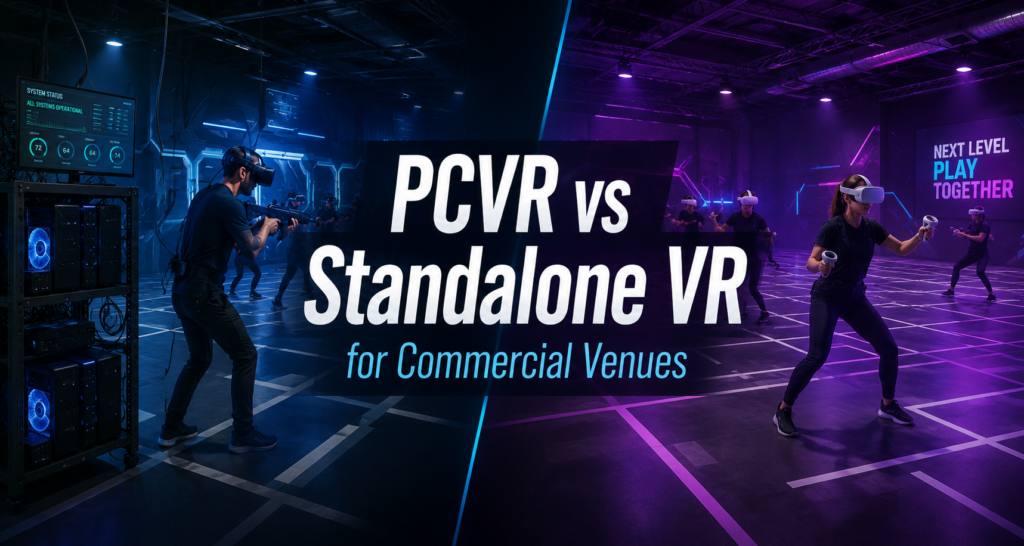
Choosing between PCVR and standalone VR used to be a tradeoff between quality and convenience. That tradeoff still exists, but it has changed shape, and most operators are no longer choosing one format from a blank slate. A large number of free-roam venues already run PCVR streamed wirelessly to the headset, and the real decision in front of them isn’t PCVR versus standalone. It’s whether adding standalone content alongside an existing PCVR setup makes sense, since the two can run side by side without requiring a venue to rebuild what it already has. Cables are no longer the dividing line PCVR headsets connect to an external computer that handles rendering, which still gives PCVR an edge in visual complexity and access to the broader Steam-based VR library. For years, that meant a physical tether, and tethers limited how freely a player could move, which made pure tethered PCVR a poor fit for arena-scale free-roam venues. That constraint has loosened. Wireless PCVR streaming, first popularized through headsets like the HTC Vive Focus 3 and now common on PICO devices, lets a PC render the game and stream it to the headset over the network instead of through a cable. A free-roam arena can run wireless PCVR streaming and get full, untethered movement while keeping PCVR’s rendering quality and library access. Plenty of arenas already operate exactly this way, and they run well. Standalone headsets take a different path to the same cable-free result. The headset renders the game itself, with no PC involved in the loop at all beyond whatever admin or server setup manages the fleet. The practical difference between standalone and wireless PCVR streaming isn’t cables anymore, since both can move freely around a free-roam space. It’s where the processing happens, and what that does to cost, hardware footprint, and content. What processing location actually changes The technical difference between the two formats comes down to what travels over the network. A standalone headset running free-roam renders the game locally on the device. The WiFi connection only carries session data: player positions, game state, and synchronization signals between headsets. Wireless PCVR streaming works the opposite way. A PC renders every frame and sends the full video stream to the headset over WiFi, which makes PCVR streaming considerably more bandwidth-intensive than standalone, even though both can run cable-free in the same arena. That bandwidth difference carries real infrastructure consequences. Wireless PCVR streaming still needs a capable gaming PC behind every station, or a shared rendering setup serving multiple headsets, plus the network capacity to carry that video traffic reliably, along with PC-side preparation: network configuration, and ongoing PC maintenance. Standalone needs none of that on the rendering side. The headset is the whole system for content, aside from the lighter admin infrastructure that coordinates the fleet and the session data passing between headsets. Setup reflects that same split. PCVR stations need a wired or properly configured wireless network connection and, for Steam-distributed titles, an individual Steam account per station, since Steam otherwise limits a licensed title to one machine at a time. Titles distributed through a dedicated content delivery network rather than Steam skip that requirement entirely, no Steam account needed at all, but you still need SteamVR running on all the PCs since SteamVR will be used to connect to the headsets wirelessly along with a program respective of the headset. For PICO it would be PICO BUSINESS STREAMING, for HTC FOCUS headsets you will use VIVE BUSINESS STREAMING etc. Standalone headsets need wireless debugging enabled and a shared network with the venue’s admin system, but carry no per-station account structure, since installation pushes directly to the headset. Neither path is harder than the other so much as different in where the complexity sits. PCVR, tethered or streamed, pushes more of it into PC, bandwidth, and account management per station. Standalone pushes more of it into device and connectivity management per headset. A venue running both ends up managing both kinds of complexity at once, which is one of the reasons centralized management tools matter more as a venue’s hardware mix grows rather than stays single-format. Content availability is the part hardware comparisons usually skip Most PCVR-versus-standalone comparisons stop at specs and never get into what an operator can actually deploy. This is the part that matters most for a venue planning content rotation, and it has changed faster than the hardware conversation has caught up with. A few things are true at the same time, and operators planning content strategy should hold all of them together: That last point matters for how operators should plan content rotation in practice. Checking format availability against current marketplace listings, rather than assuming based on a title’s reputation or its original platform, avoids building a rotation plan around a game that is not actually available in the format a venue runs. Licensing applies the same way to both Whichever format a venue runs, content needs commercial licensing rights, not consumer or personal-use licensing. This applies to PCVR and standalone titles equally, streamed or tethered. A venue running either format off a consumer content library carries legal and operational risk that has nothing to do with which headset is in the box, and everything to do with what rights came attached to the content itself. SynthesisVR’s content marketplace, the largest VR content marketplace for location-based entertainment, licenses titles across both PCVR and standalone through one system, with both formats installed and managed from the same Local Manager regardless of whether a station is a streaming PC setup or a standalone headset. That single management layer is part of why checking current availability by format is worth doing directly in the marketplace rather than relying on general reputation. Adding standalone to an existing PCVR venue Most operators evaluating standalone today are not starting from scratch. They are running a free-roam arena on wireless PCVR streaming already, and the real question is whether adding standalone headsets expands what the venue can offer without requiring