
How VR Entertainment Centers Attract Student Groups and Young Adult Audiences
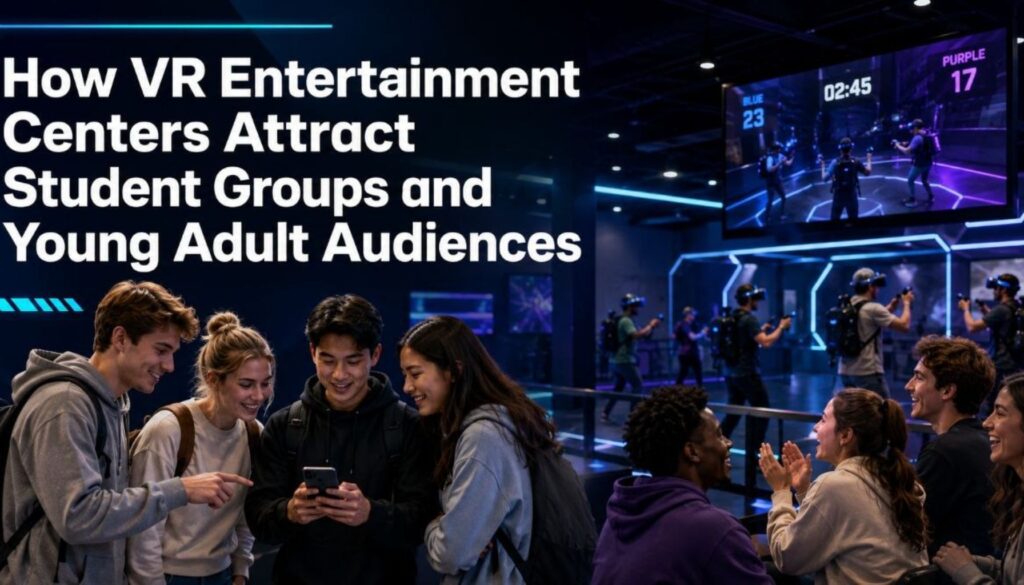
Weekday afternoons and evenings are the hardest slots for most VR arcades to fill. Family bookings cluster around weekends, birthday parties book out Saturdays, and the middle of the week sits half empty. VR arcade student groups and young adult audiences can fill that slower stretch, but most venue marketing doesn’t match how they discover, evaluate, and book entertainment. University groups and young adults planning a night out are solidly Gen Z. School groups can run a little younger, into Gen Alpha, though most VR attractions set an age floor around ten anyway. Across that range, the discovery and booking habits line up closely enough to plan around: social-first content, mobile booking, fast decisions. The old approach of a group discount and a Facebook post won’t reach any of them. The two segments still behave differently once they show up, though, and a venue that treats them as one generic “young people” bucket will misjudge both. Students need structure, whereas young adults seek social proof A school group, a scout troop, or a university club needs a decision-maker to feel confident before anyone books. That person, a teacher, parent, or club organizer, is asking whether the visit is safe, properly timed, and easy to approve. Clear group pricing, defined session blocks, supervised operations, and age-appropriate content answer that question before the group ever walks in. Young adults booking a night out care about a different set of things: whether they can play together, whether the format is competitive or cooperative, whether a spectator screen lets the waiting group watch and laugh, and whether the whole booking can happen from a phone in the same group chat where the plan started. For this audience, the venue is selling a shared moment, not a novelty. A 2024 study in Royal Society Open Science found that intense emotions produced stronger bonding between strangers only when both people were aware they were sharing the experience together, not just physically present for it. A spectator screen and a shared scoreboard create exactly that condition. Gen Z finds venues socially first Traditional local ads and static promo photos do a poor job of showing what a VR visit actually feels like. Gen Z audiences discover entertainment through short-form video, group chats, and peer recommendations, so the content that converts them looks different from a polished trailer. A twelve-second clip of four friends reacting after a failed co-op mission tells the story faster than a cinematic render ever could. Practical starting points for a venue’s content mix: Mobile booking is where the plan disappears Some operators found that students abandoned bookings once group coordination and payment got difficult on mobile, even when interest in the attraction itself was strong. Young adults organize plans in a group chat and expect to finish the booking from the same phone. If the flow forces someone to switch devices, call the venue, or guess the group size, the plan often dies before anyone pays. A booking page built for this audience shows group size and session length clearly, prices the visit in one scannable number, and lets the group confirm without a phone call. Reducing that friction is one of the more direct ways a VR gaming center management setup, or any location-based entertainment VR venue running its own booking page, can protect bookings that already had real intent behind them. Multiplayer content is what brings them back Student night packages and young adult social bookings both lean on the same mechanic: shared, replayable multiplayer formats. Co-op missions, team battles, and leaderboard nights give a group a reason to return that a single-player attraction cannot match. A university society running a monthly VR night wants rotating titles and a simple group payment process, not a single flagship experience they already tried. This is also where the two audiences create an operational challenge. A school group in the afternoon needs approachable, teacher-friendly content. A young adult group that evening wants competitive or horror titles with higher intensity. Running both well in the same day depends on how quickly a venue can rotate its lineup between sessions. Where SynthesisVR fits Serving a school group at 2pm and a student social night at 8pm is less a marketing problem than an execution one. Operators need to launch sessions reliably, rotate content by audience type, and keep the headset fleet ready across very different booking formats without rebuilding the setup each time. SynthesisVR gives venues that operational layer, drawing on a VR content marketplace to swap titles between sessions, whether the operator runs a single location based VR business or a multi-room arcade managing several concurrent groups. Learn how SynthesisVR helps venues create scalable group experiences. Related Reading How VR Arcades Fill Empty Weekday Sessions Without DiscountingHow Family Entertainment Centers Use VR Attractions During Heatwaves and Rainy DaysHow VR Arcade Operators Build a Balanced Attraction Mix