
How VR Entertainment Centers Market After-School and Autumn Group Activities
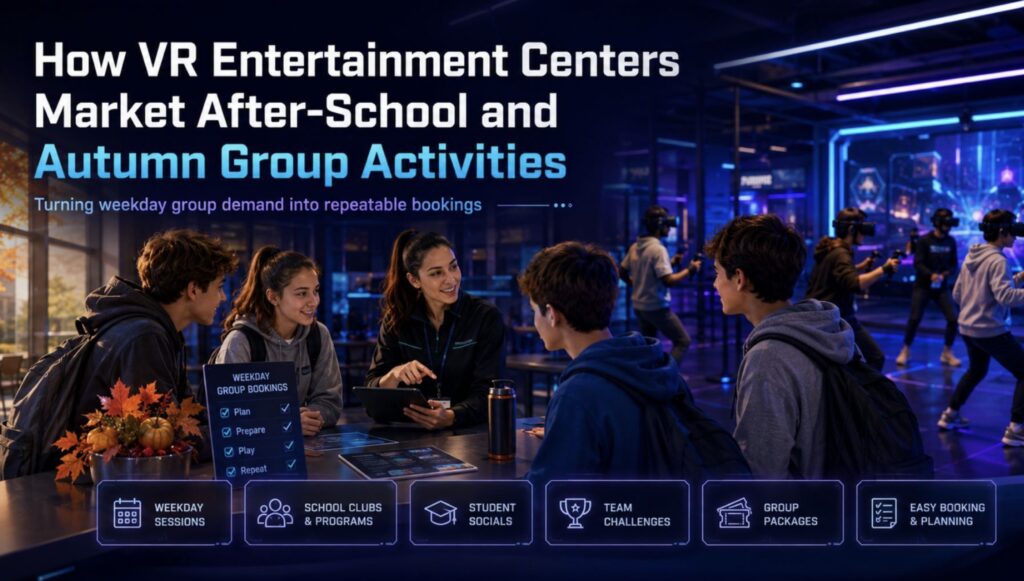
Summer traffic finds you, but autumn traffic has to be booked. The families and walk-ins that filled a Tuesday afternoon in July are back in classrooms and offices by late September, and the weekday hours that once ran near capacity turn into the quietest, least profitable stretch of your week. Advertising harder rarely moves them, because the people worth reaching now don’t buy on impulse. They buy against a calendar and a budget. Autumn belongs to organized groups. After-school clubs, youth organizations, sports teams, student societies, and parents planning something for a dozen kids usually book ahead, and they are the demand that can carry weekday utilization from October through the holidays. Winning that demand takes a different playbook than a summer promotion aimed at whoever happens to be nearby. Sell to the buyer, not the crowd Every group booking has one person who approves it, and that person has a single question standing between you and a confirmed slot. A teacher needs to know your venue is safe and supervised before she brings thirty students across town. A five-a-side coach wants to hear that all eighteen players get a real turn inside the hour he’s paying for. A student society organizer cares whether the night is competitive enough to be worth posting about. Send all three the same “group discount” email and you have answered none of them. Sort your prospects by who signs off on the booking, then lead with the thing that unblocks them: The session behind all four offers can be identical. What converts is opening with the buyer’s real concern instead of your price list. Weekday afternoons are inventory, not leftovers The reflex is to discount quiet weekday hours until something fills them. Fencing them off as group-only inventory works better. Attach rules: a fixed block, a minimum head count that makes staffing the room worthwhile, a deposit to hold the date, and a release deadline so an unconfirmed group frees the slot in time to resell it. That changes the conversation with an organizer completely. You stop asking whether you can squeeze thirty kids in somewhere on a busy floor. You start offering a defined product with a capacity, a price, and a booking window, which is exactly what an organization planning three weeks out needs before it can commit. Groups book an outcome, never a headset No coordinator wants to rent VR headsets. They want a result they can defend to whoever signed the check. Enrichment coordinators book structured learning and teamwork. A coach books a session that carries back to the pitch. A society books a competitive night with a leaderboard and a clear winner. Package around what the group walks out with, and price that outcome rather than the hardware. Present these as sample formats, not house standards. A forty-minute cooperative session for a youth club and a ninety-minute competitive bracket for a society give an organizer something concrete to picture, without you pretending there’s an industry rulebook behind it. Six stations can host eighteen people The objection that quietly kills group bookings is capacity. An organizer counts your six stations, divides eighteen players by six, and decides you’re too small for the group. You aren’t, and walking them through why is the most persuasive thing you can put on a booking page, because almost no venue bothers to explain it. Here is the math on six stations and eighteen players. Split them into three teams of six. One team plays while the other two track the leaderboard, plan their runs, and coach from the sideline. Run three rounds of twelve to fifteen minutes and rotate a fresh team in between each one, and every player gets a full turn inside the hour. The waiting teams are not dead weight; the heckling and the rivalry between rounds are where a group session gets its energy, and free-roam multiplayer and arena titles are built for exactly this team-versus-team format. That rotation is what lets a modest room sell to a party of eighteen with a straight face, and it hands your staff one structure they can run identically every time. When an organizer is deciding whether to trust you with a class of thirty, a clear plan beats raw station count every time. Group bookings come from a list, not a landing page Waiting for a coordinator to stumble onto your booking page is not a plan. Group business comes from a short, worked list of nearby schools, youth clubs, sports leagues, and student societies, and from getting their organizer through your door before they commit anyone. Invite coordinators in for a fifteen-minute preview so they see the space and the supervision for themselves. Send them off with a one-page pack covering capacity, timing, pricing, and suitability, plus a parent email they can forward without rewriting a line. Then follow up, because this cycle is slow by design. A coordinator who previews in September and books a Halloween tournament in October is a normal sale, not a lost lead. Add a ten-second clip of a live session to everything you hand over. A real group mid-game closes the booking better than any paragraph describing it. One format, a whole season of names You do not need a new offer every month. One group format, re-skinned, covers the entire autumn calendar. The same cooperative-or-competitive session becomes a back-to-school challenge in September, a Halloween tournament in October, a student league that runs through term, a sports-team social whenever a coach asks, and an early holiday team event in December. The operating process underneath never changes. Only the theme on the flyer does, which is what keeps the season profitable instead of exhausting. The booking only repeats if the delivery holds A group format earns its place only if any staff member can run it the same way on a full Saturday. That means the unglamorous layer most venues skip: saved content playlists, a fixed briefing script, clear age and intensity labels, a spectator