
How VR arcades actually make money
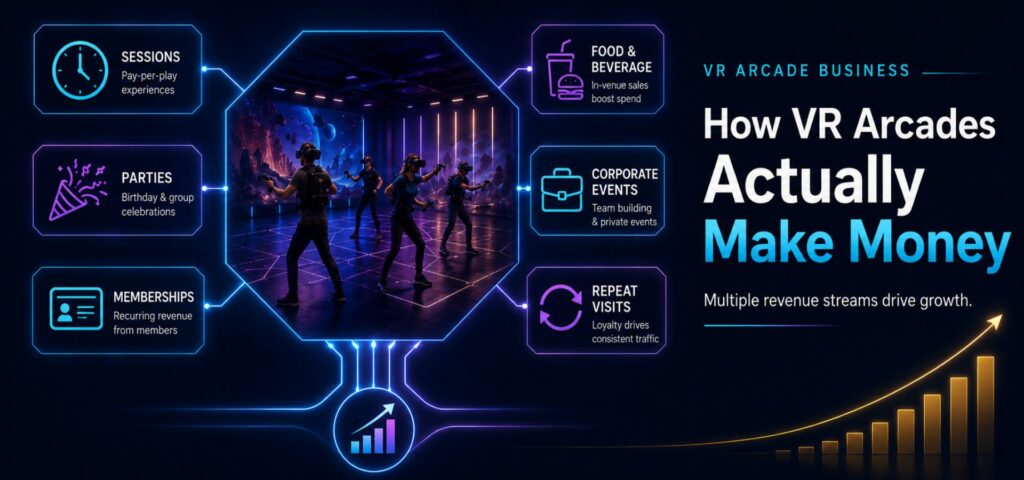
Ask five VR arcade owners how they make money and four will say the same thing: charge per session, then add parties and merch when margins get tight. That answer describes a booth arcade. It doesn’t describe a free-roam arena, and treating the two as one business is why so much advice on this topic falls apart the moment an operator tries to apply it. Room-scale sells time. Free-roam sells an experience A room-scale booth needs roughly 2 x 2 m to 3 x 3 m per player (about 6.5 x 6.5 ft to 10 x 10 ft), low staffing, and a 30 to 60 minute sessions. It’s a throughput business: revenue is seats per hour times price. A free-roam arena needs a shared floor of 20 x 20 ft (6 x 6 m) or more. Eight players push that past 33 x 33 ft (10 x 10 m). Figure roughly 200 sq ft (about 18 m²) of tracked space per person. It sells a group a full narrative arc rather than a slot, so it charges by the head and by the story, not by the minute. A six-person free-roam booking at around $50 a head is a $300 transaction in one time slot. Large free-roam arenas average close to $50 per person for a 45 to 60-minute mission and lean on corporate and private bookings for up to 40% of revenue at some locations. These aren’t competing formats. The industry has quietly demoted the isolated booth from headline product to supporting player. It’s a demo station now, a party filler, a way to occupy a group before or after their arena slot. We’ve written about how to weigh room-scale against free-roam and what free-roam actually requires to run in 2026. The short version for revenue: booth for frequency and low-commitment walk-ins, arena for the higher ticket and longer dwell time, both feeding each other in one venue instead of splitting your marketing budget. The shared-headset moment is a funnel, not a revenue line Every operator has watched this happen: a group walks in, two of them try a headset while the rest watch on a monitor, laugh, heckle, and wait their turn. That mixing and mingling rarely shows up as a line on the receipt. What it does is convert a skeptical non-gamer into a customer without asking them to commit to a 45-minute arena booking on their first visit. The better-run venues build this into the layout on purpose, with lounge seating where groups watch an instant replay of their session together after playing. The waiting and watching becomes part of what they paid for, not dead time between transactions. Treat the shared-headset moment as a nuisance to clear out fast and you remove the exact mechanic that turns a walk-in into a booking for the bigger-ticket experience next door. Customers often interpret changing prices as unfair Plenty of pricing advice lists surge pricing as a growth lever. The evidence from adjacent industries now runs the other way. Disney has spent the past year fielding backlash over what commentators call “dynamic ratcheting,” pricing that moves with demand until guests pay more for a worse day at the park. WWE raised standard show pricing from around $75 to $118 in a single year after its TKO merger and drew public criticism from its own fanbase for it. Across ticketed entertainment, about half of consumers call dynamic pricing unfair, and in markets like the UK and Canada that runs past 60%. Artists who publicly opt out of surge pricing for tours are getting credit for it. A VR venue depends on repeat visits from the same neighborhood far more than a theme park depends on any single guest coming back. Trading a short-term revenue bump for the reputation of “the arcade that charges more when you’re busiest” is a bad trade for a business built on locals returning six or more times a year. One distinction is worth making precisely: fixed, published tiers (weekday versus weekend pricing, group rates, advance-purchase discounts) aren’t the problem. A posted weekday/weekend split, set ahead of time rather than by a real-time algorithm, is a legitimate pricing tool. What backfires is pricing that moves based on how full you are right now or who’s asking. Customers notice, and they stop trusting the number on your website. Marketing in the right order: content, then search, then ads The content that travels for a VR venue is almost never the polished trailer. A 12-second clip of four friends failing a co-op mission does more, and so does the reaction shot from the person who just ripped off a headset laughing. Spectator screens showing the headset view double as a content pipeline: bystanders record what’s already on the screen for you. Nano and micro-influencers with 5,000 to 50,000 local followers convert better than a big name with no connection to your neighborhood. Underneath that, local SEO fundamentals still decide whether anyone finds you: a complete, actively-managed Google Business Profile carries a large share of local map-pack ranking, and review recency matters more than review count. The piece almost nobody in this niche is writing about yet is generative engine optimization: whether ChatGPT, Perplexity, or Google’s AI Overviews cite your venue when someone asks “VR arcade near me for a birthday party.” The longer, question-style searches people use to find a venue return an AI summary more than half the time. AI Overviews already show on roughly a quarter of Google searches, and that share keeps climbing. Content built with clear statistics, direct answers, and specific details gets pulled into those AI answers at meaningfully higher rates than vague marketing copy. Your game pages, party package pages, and pricing FAQ need to read like a direct answer to a question, not a sales pitch, because an AI answer engine is now a real referral source. The one number to check before you buy ads Paid ads come last, once organic and search are working, and before you