
VR Arcade Pricing: How to Set Session Prices, Packages, and Promotions
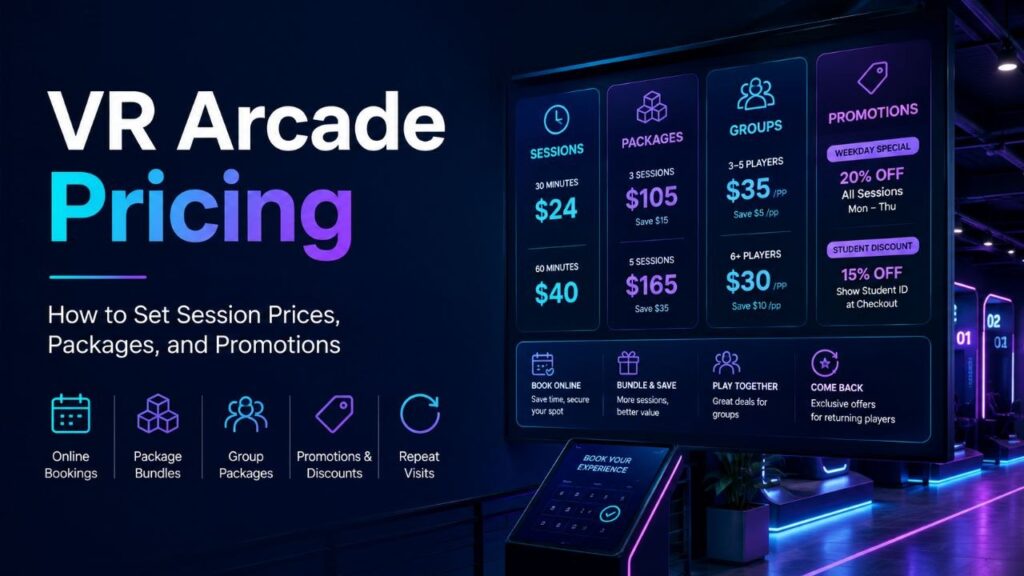
There is no universal number for VR arcade pricing. Two venues can run similar hardware and content, yet need different prices because they serve different customers, compete with different attractions, carry different costs, and sell different types of outings. A tourist-center arena, a suburban family entertainment center, and a university-town VR venue should not inherit the same rate card by default. A useful pricing process starts before the price itself. Define the local market, map the alternatives customers already buy, calculate the economic floor, decide what each package promises, and then test the result against real booking behavior. That approach draws on decades of retail, service, and pricing research rather than one current pricing formula. A practical VR arcade pricing framework The three questions work together. Cost-based pricing alone can ignore demand. Competitor matching can copy somebody else’s economics. Value language without a financial floor can create a popular offer that does not contribute enough to the venue. VR arcade pricing starts with the local market Wendell Smith’s 1956 work on market segmentation treated heterogeneous demand as a basic marketing reality: different groups can respond to different offers instead of behaving like one uniform market. For a physical venue, geography narrows that idea further. David Huff’s trade-area work defined the market around a geographically bounded pool of potential customers and the probability that they will choose a location. The U.S. Small Business Administration still advises small businesses to examine demand, market size, income, location, saturation, demographics, and what customers pay for alternatives. For a VR arcade, that means defining the realistic catchment area before copying a national or industry average. A venue near a tourist district may rely on one-time visitors with short decision windows. A suburban FEC may depend more on families, parties, schools, and repeat local groups. A university town can have strong evening demand but a lower willingness to pay for a premium single-player session. Research the customer’s real alternatives A venue that checks only other VR arcades sees too little of the market. Michael Porter’s competitive strategy work warned against viewing competition too narrowly. For an entertainment business, substitutes matter because customers usually begin with an occasion, budget, and group rather than a fixed commitment to VR. A family choosing a Saturday activity may compare VR with bowling, laser tag, a trampoline park, an escape room, karting, cinema, or another FEC. A company planning team building can compare the same VR venue with dinner, an escape room, a workshop, or a private event space. Research set Record Avoid Direct VR competitors Per-person price, duration, group size, private/shared format, packages, cancellation terms, memberships. Copying the headline price without understanding what the customer receives. Substitute entertainment Total group spend, time commitment, private access, food/party space, social proof, booking friction. Assuming VR competes only with VR. Local premium options What customers already pay for higher-end social experiences and events. Using household income alone as a willingness-to-pay measure. Low-cost alternatives Free or inexpensive activities that compete for the same time slot. Treating every lost booking as a pricing problem. Calculate the economic floor before testing value Pricing research has long treated price as a managerial decision with several inputs rather than a simple markup. Monroe and Della Bitta’s 1978 review examined the major pricing decisions managers face and the models used to support them. For a venue, the first financial check is straightforward: understand what each booking contributes after the costs that move with that sale, then test whether expected sales can cover fixed costs. SBA break-even guidance uses fixed costs, selling price, variable cost, and contribution margin for exactly this reason. A VR operator should include the costs that genuinely change with a session or package, then keep rent, salaried labor, insurance, depreciation, financing, and similar fixed costs visible in the wider model. Mixed attractions and packages often need separate calculations because a private arena booking does not behave like a single booth session. Related SynthesisVR reading: Free-Roam VR Arena Cost Analysis and How VR Arcades Actually Make Money Price the use case, not only the headset minutes B. Joseph Pine II and James H. Gilmore’s 1998 work on the experience economy argued that businesses can create economic value by staging an experience rather than competing only on the underlying good or service. Location-based entertainment fits that logic unusually well. A customer rarely wakes up wanting to buy 30 headset minutes. They may want a private activity for four friends, a birthday that is easy to host, a date-night plan, a school visit, or a team event that does not require the organizer to manage the details. Use case What the buyer may value Pricing structure to test Walk-in / first visit Low commitment, clarity, fast start. Per-person session or short introductory format. Friends / social group Playing together, simple group total, private access. Group bundle or private arena rate. Birthday Predictable total cost, host support, room time, smooth rotations. Named party package with clear inclusions. Corporate event Privacy, timing, invoicing, coordination, group confidence. Event package or private-hire rate. School / camp Per-head clarity, age fit, supervision, schedule control. Per-student or fixed group package. Related SynthesisVR reading: How to Market VR Arcade Birthday Parties for Summer Bookings Build packages when the customer is buying a bundle William Adams and Janet Yellen’s 1976 work formalized the economics of bundling. The research is technical, but the operator lesson is practical: a bundle can carry its own value and pricing logic instead of equaling the sum of every component sold separately. Four individual tickets and a private four-player arena package may use the same equipment, yet the second offer can include exclusivity, easier coordination, reserved time, a content choice, staff assistance, a score challenge, or another element that matters to the group. Birthday, school, and corporate packages deserve the same treatment. This also prevents a common pricing trap. If every package reduces to a minute-by-minute calculation, the operator invites customers to compare only time and price. Clear bundles create room to