
How Much Does It Cost to Start a VR Arcade? Build Your Own Startup Budget
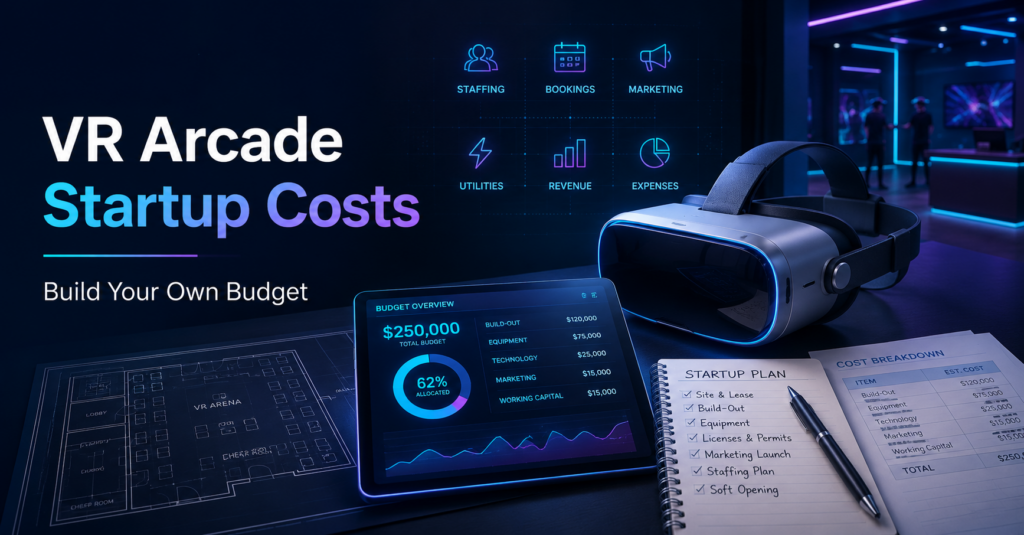
VR arcade startup costs can look completely different from one location to the next. Rent changes by city. Labor costs change by country. A four-headset standalone setup has a different cost structure from a PCVR arcade, a free-roam arena, or a family entertainment center adding VR to an existing attraction mix. That makes a single “average cost to open a VR arcade” difficult to use for serious planning. A better approach is to build the budget from your own market, venue, hardware, staffing, software, content, and revenue assumptions. We created a VR Arcade Startup Budget & Revenue Calculator to help you do exactly that. Use it alongside this guide to estimate your startup requirements, monthly operating costs, revenue potential, and break-even point. Start With the Local Market Before You Buy a Headset Hardware is one of the easier costs to identify. The local business case takes more work. Before choosing a venue or deciding how many stations to install, research what customers already pay for entertainment in your area. Look beyond other VR arcades. Your customers may also compare you with: Record the price, session length, group size, package structure, reviews, and target audience for each relevant attraction. Then ask a more useful question: What can your VR venue offer that the local market currently handles poorly? A university area may have demand for affordable multiplayer activities during weekday evenings. A family market may create more opportunity around birthdays and school breaks. An entertainment district may support longer social bookings, corporate groups, or competitive experiences. Your local demand should influence the venue before the equipment list does. Our guide to [VR arcade pricing, session prices, packages, and promotions] explains this process in more detail. 1. Calculate the Cost of the Venue For a new VR arcade, the premises usually create several expenses before the first customer arrives. Add the costs that apply to your location: An existing family entertainment center may already carry many of these costs. In that case, calculate the additional cost of adding VR rather than assigning the entire building expense to the attraction. A new standalone VR arcade needs to account for the full venue overhead. Keep the fit-out connected to the customer experience It is easy to spend heavily on futuristic décor before proving the business model. Customers still notice the basics first. Is the venue clean? Are staff helpful? Does the session start on time? Is the booking process clear? Does the group understand what to do? A simpler venue with excellent service, reliable operations, and the right experiences for its audience can build a stronger reputation than a more expensive space that struggles with those fundamentals. 2. Decide How Many Players You Actually Need to Serve Start with the booking model. A venue that expects groups of four has different hardware needs from an arena designed around eight-player birthday parties. A mixed venue may combine smaller room-scale stations with one larger multiplayer attraction. Work through this sequence: Space → audience → content → player capacity → hardware → booking model Our guide to [how many players a VR attraction should support] goes deeper into this decision. Once you know the sellable capacity, you can build the hardware budget. 3. Budget for More Hardware Than Your Sellable Capacity If you plan to sell six-player sessions, owning exactly six headsets creates a fragile operation. A damaged controller, charging issue, failed headset, or maintenance problem can immediately reduce the number of customers you can serve. Build spare capacity into the budget. For a standalone commercial setup, operators can evaluate devices such as the PICO 4 Ultra Enterprise. PICO positions the headset for enterprise use and supports tools designed for business and location-based entertainment deployments. Your hardware worksheet may include: Accessories can also support operational comfort. For example, BOBOVR offers optional battery straps compatible with the PICO 4 Ultra Enterprise. These add an external battery system that operators can swap while another battery charges. BOBOVR P4U Battery Strap They are optional. Include them only if they solve a real operating need in your setup. The same rule applies to every accessory: buy it because the venue needs it, rather than because it exists. 4. Include VR Management Software in the Monthly Model Running several headsets manually may appear manageable during a quiet test session. The workload changes when customers arrive together. Staff need to manage bookings, customers, sessions, content, station status, waivers, memberships, and different attraction formats while also taking care of the people standing in front of them. That is where a VR arcade management system becomes part of the operating model. SynthesisVR’s Ultimate plan currently combines tools including booking, online waivers, customer management, content control, memberships, discounts, gift vouchers, integrations, and station management. Rather than placing a fixed software price in a business plan that may become outdated, use the current SynthesisVR pricing page and calculate the cost for the number of stations you intend to operate. The important calculation is: Management platform cost per station × number of stations Software also affects the staffing model. Centralized station and session management can reduce repetitive manual work, giving staff more time to help customers. 5. Build Staffing Around the Work That Actually Happens Labor deserves more thought than simply entering an hourly wage. Calculate the fully loaded employment cost where possible, including employer costs that apply in your location. Then estimate: Opening hours per week × average staff required on shift × loaded hourly cost A small venue might test a model with one person during quieter periods and additional staff during evenings, weekends, or parties. A larger FEC, food-and-beverage operation, or high-throughput attraction may need considerably more. Ask what staff need to handle during the busiest hour: Automation can reduce repetitive work. It cannot replace hospitality. A technically impressive attraction with poor customer service creates a weak reason to return. 6. Plan for Commercial VR Content Licensing Commercial VR content also belongs in the operating budget. Consumer game purchases generally do not provide the