
3 Cooperative PCVR Free-Roam Games for VR Arcades

PCVR free-roam games do not have to follow the same formula. For VR arcades, free-roam can support fast group puzzles, longer communication-heavy challenges, or story-driven adventures where players depend on each other to progress. That range becomes useful when an operator wants to add variety without changing the underlying PCVR free-roam setup. For this week’s content spotlight, we picked three cooperative experiences from the SynthesisVR marketplace: Paranormal Pest Patrol, Prismatic Tower, and Yucatan. All three put teamwork at the center of the session, but they do it in very different ways. Three PCVR free-roam games at a glance Game Players Gameplay Starting play area Network status Paranormal Pest Patrol 2–8 7–15 min 5.2 × 5.2 m / 17 × 17 ft Network Veteran Prismatic Tower 2–4 45–55 min 4.6 × 4.6 m / 15.1 × 15.1 ft Network Debut Yucatan 1–8 40 min 4 × 5 m / 13.1 × 16.4 ft Network Veteran The specifications already hint at three different uses. Paranormal Pest Patrol can fit shorter group sessions and scale to eight players. Prismatic Tower gives smaller teams a longer puzzle experience. Yucatan combines a longer adventure with configurations that scale from one or two players to groups of eight. Paranormal Pest Patrol: short, social puzzle play for up to eight players Paranormal Pest Patrol sends players into a possessed home as a team of paranormal exterminators. The premise is deliberately light. Flying books, strange appliances, hidden demons and a loud self-proclaimed hero named Bill Bashley turn the experience into a comedy rather than a horror game. Underneath that humor sits an escape-room-style structure. Players need to observe the environment, find the paranormal pests and work through puzzles together. For a VR arcade, the session format is one of the more interesting parts. The marketplace lists gameplay at 7 to 15 minutes and supports several PCVR free-roam configurations: That creates options for venues running different arena sizes and booking formats. Paranormal Pest Patrol also includes a final score, so solving the experience does not have to end the replay conversation. A group can return and try to improve its previous result. The marketplace currently shows another useful signal: a five-star rating from 10 votes. The title also carries the Network Veteran designation, which identifies content from a studio with an established performance history across the DeployReality network. Operators can also find a Game Community directly from the listing. Technical support includes SynthesisVR Optimized multiplayer, Offline Multiplayer and a Standalone Game Server. Where it may fit: shorter family and friend-group sessions, larger bookings, puzzle fans, and venues looking for cooperative content outside the shooter category. Prismatic Tower: communication is the puzzle Prismatic Tower takes cooperation in a different direction. Two to four players enter a magical tower and move through a series of environmental puzzles. The important twist is that the group does not always have access to the same information. Players split between two rooms. One side may see the order of a sequence while the other side controls the objects. A clue discovered by one team may only become useful after they explain it to the players elsewhere. The game uses that idea throughout its puzzles. Players exchange items, decipher symbols, direct beams through prisms, mix ingredients and synchronize actions to move between floors. In other words, communication is not simply helpful. It is part of the game mechanic. Prismatic Tower supports 2–4 players in a 4.6 × 4.6 m / 15.1 × 15.1 ft PCVR free-roam area, with gameplay listed at 45 to 55 minutes. That puts it in a very different booking slot from Paranormal Pest Patrol. Rather than a short group challenge, Prismatic Tower can support a longer cooperative session for a smaller team. The title currently carries the Network Debut designation. This indicates that the publisher is still building its performance history across the DeployReality network. Its marketplace page also includes a Game Community, along with SynthesisVR Optimized multiplayer, Offline Multiplayer, a Standalone Game Server and an operator walkthrough. Where it may fit: smaller groups looking for a longer experience, escape-room audiences, corporate groups, and players who enjoy communication-heavy puzzles. Yucatan: cooperation on a larger adventure Yucatan moves further away from the traditional escape-room format. The experience sends players into a Mayan world built around an ancient prophecy, hidden gems and a final encounter with Quetzalcoatl. Instead of giving everyone one puzzle to solve at the same time, Yucatan can split a larger group into pairs. Each pair tackles challenges that use movement, dexterity, critical thinking and cooperation. The full group eventually comes back together for the final battle. That structure gives Yucatan an unusual way to handle larger bookings. The game supports: Gameplay runs for approximately 40 minutes. The pair-based format also means the experience can ask different things of different players. Quick reflexes may help in one challenge, while another rewards observation or problem-solving. That can work well for mixed groups where not everyone arrives with the same gaming or VR experience. Yucatan carries the Network Veteran designation and has a Game Community linked from its marketplace page. The listing also includes SynthesisVR Optimized multiplayer, Offline Multiplayer, a Standalone Game Server and an operator manual/walkthrough. Where it may fit: families, friend groups, larger bookings and guests looking for a story-driven cooperative adventure rather than a traditional shooter. The same free-roam format can serve very different bookings These three games share PCVR free-roam and cooperative multiplayer, but an operator would not necessarily sell them to the same customer in the same way. Paranormal Pest Patrol gives a group a quick challenge with comedy, puzzles and a score to chase. Prismatic Tower asks a smaller team to spend considerably longer communicating and working through connected puzzles. Yucatan stretches the cooperative format into a larger adventure that can accommodate up to eight players. That distinction becomes important when building a commercial VR content library. Player count alone does not tell you what role a game will play. Session length, arena size, audience, difficulty,
Cooperative VR Adventures Worth Exploring in 2026
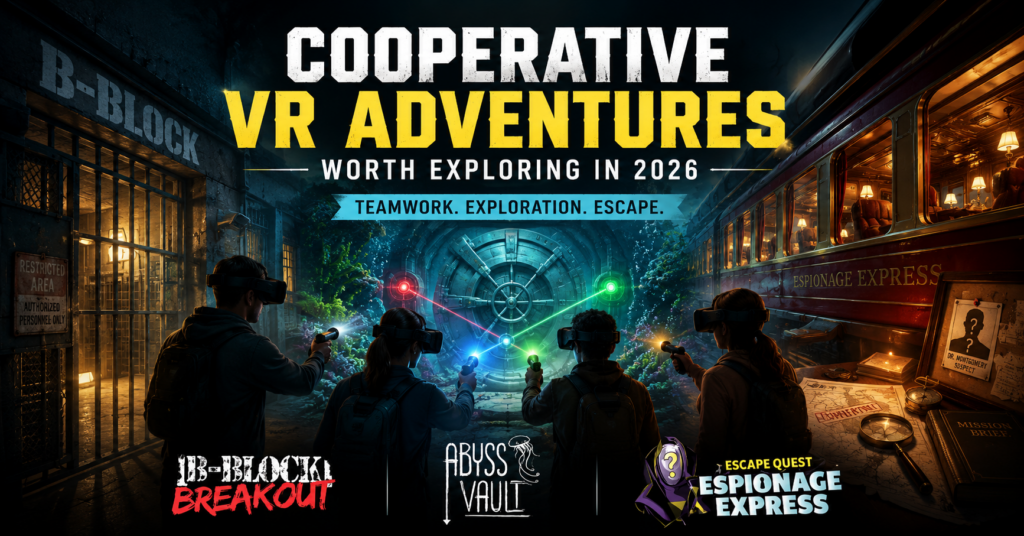
Competitive shooters and wave-based action games still dominate a lot of conversation around location-based VR content, but cooperative adventures hold a steady, important place in most successful attraction libraries. Operators running a single-genre lineup often miss a segment of guests who are not looking to compete at all. For families, corporate teams, birthday parties, and mixed-experience groups, a shared objective creates an easier entry point than direct competition. Instead of measuring individual performance, players solve problems together, explore an environment as a unit, and move through challenges as a team. Nobody has to “win.” The group either escapes, or it does not. Three current titles on the SynthesisVR marketplace show just how differently cooperative multiplayer can approach that same basic goal. Abyss: Vault: Exploration Through Teamwork Abyss: Vault drops a rebel squad into an underwater vault to recover what its owners hoarded. The vault fights back. Players carry different coloured light weapons (red, blue, or green) and have to combine beams to open doors and power systems as they push deeper. A mechanical crab guards the final stretch, and the game makes a point that lone players do not make it out. Coordinated squads do. This is a free roam title built for Pico, Quest, and Focus 3 headsets, with a footprint of roughly 19.7 x 19.7 ft (6.0 x 6.0 m) for 2 to 6 players. Operator angle: Groups looking for a longer-form adventure, rather than a high-intensity action session, tend to gravitate toward this kind of pacing. The colour-coded mechanic also gives operators an easy way to explain the experience to first-time players in under a minute. Escape Quest: Espionage Express: Solving Problems Together Escape Quest: Espionage Express puts players on a hacked train, chasing a saboteur named Dr. Montgomery through physics-based puzzles and a ticking clock. It leans on logic and observation rather than combat, and the studio built it specifically for players who are new to VR and still getting comfortable with the medium. The title runs on PCVR and standalone room-scale setups (Pico, Quest, Focus 3). A June 2026 update moved the game to a fully offline, LAN-based multiplayer system, removed the separate spectator subscription requirement, and added native support for standalone Pico headsets, so server and spectator-screen setup is simpler than it used to be. Operator angle: Escape-room style experiences often appeal to guests who do not think of themselves as gamers at all. It is a useful bridge title for venues trying to convert non-gaming groups, like a birthday party booked by a parent who has never picked up a controller. B Block Breakout: Collaboration Under Pressure B Block Breakout sends a group of scoundrels through a high-security prison they need to escape together. The game leans into atmosphere first: detailed prison interiors, a tense pace, and puzzles that depend on logic, deduction, and the occasional bit of luck. An auto-hint system can run on its own or be controlled by a Game Master watching the session, which gives operators flexibility on how hands-on they want staff to be during a playthrough. B Block Breakout supports both free roam (16.4 x 18.0 ft / 5.0 x 5.5 m, 2 to 6 players) and standalone or PCVR room-scale play across Pico, Quest, and Focus 3 headsets, giving operators flexibility depending on arena size. Operator angle: The strongest cooperative experiences tend to create their memorable moments through group problem-solving rather than combat, and this title is a clean example. The flexibility between free roam and room-scale setups also means it can fit venues that have not built out a larger free roam arena yet. Why Cooperative Experiences Matter for Commercial Venues This is the part that actually moves the needle for a venue’s calendar. Families do not always want to compete against each other, especially with a wide age range in the group. Birthday parties tend to book better when the activity does not single out a “winner” and a string of “losers” among ten-year-olds. Corporate groups often specifically request team-building framing, and a cooperative VR session delivers that without anyone needing to plan a contrived exercise. Mixed-age and mixed-experience groups, where a grandparent and a teenager are playing side by side, benefit when the format rewards communication over speed or precision. Cooperative titles also carry strong spectator appeal. A family member watching the action on a monitor screen is more engaged with a heist or escape unfolding than with a leaderboard updating. That spectator moment often turns into the next booking, since the person watching today is frequently the one calling to book a session next month. For VR arcade and FEC operators building a content rotation, the mix matters more than any single title. A LBE VR platform like SynthesisVR makes it straightforward to license titles like Abyss: Vault, Escape Quest: Espionage Express, and B Block Breakout alongside the rest of a venue’s catalogue, so operators can balance cooperative and competitive content without managing several separate vendor relationships. Final Takeaway Successful multiplayer attractions do not all rely on competition. Cooperative adventures offer a different kind of social experience, one built on communication, teamwork, and shared achievement rather than individual scorekeeping. For most venues, keeping a mix of competitive and cooperative content on the schedule means there is something that fits every group that walks through the door, whether that is a stag party looking for a shootout or a family of five who just want to escape a train together. Related Reading What Is the Difference Between Room-Scale and Free-Roam VR?How VR Arcades Fill Empty Weekday Sessions Without Discounting VR Room-Scale Classics Every VR Arcade Operator Should Know About
MetaExperiences Bundle on SynthesisVR: Free Roam Escape Adventures Designed for Modern LBVR Venues
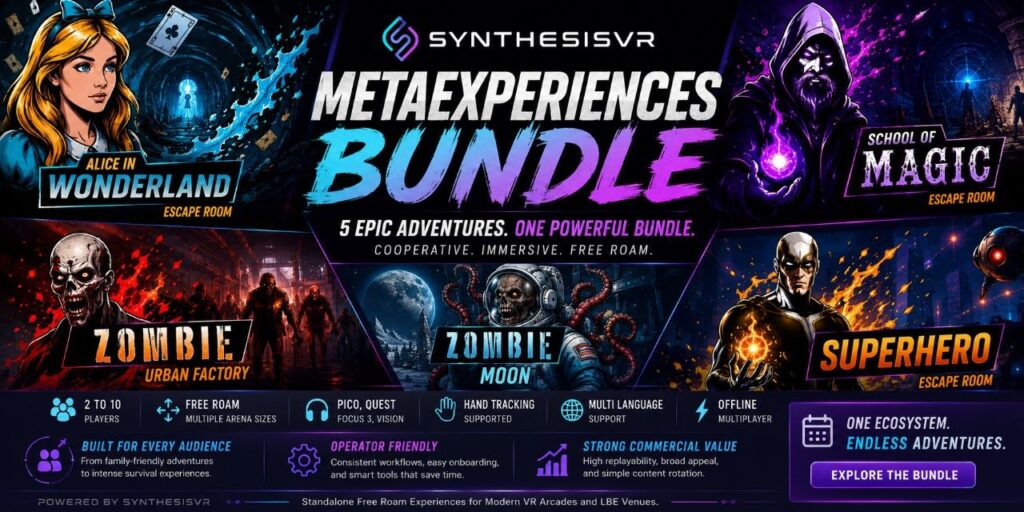
Free roam VR continues to evolve beyond simple tech demonstrations. The venues seeing the strongest repeat engagement are usually the ones offering experiences that groups can understand quickly, enjoy together, and talk about afterward. That is one of the reasons guided escape-room-style adventures continue to perform strongly in location-based VR. Families, birthday groups, corporate teams, first-time VR visitors, and casual audiences often respond better to cooperative progression than highly competitive gameplay. Instead of focusing purely on score chasing, guided adventures create shared objectives, group communication, puzzle solving, exploration, and narrative progression that naturally fit social entertainment environments. The MetaExperiences Bundle on SynthesisVR was built around that model. The collection combines multiple standalone free roam adventures into a single operational ecosystem, allowing venues to rotate between fantasy adventures, puzzle escape rooms, superhero experiences, and zombie survival gameplay while maintaining consistent onboarding flow and deployment structure across all titles. Supported Hardware and Free Roam Arena Sizes The MetaExperiences Bundle supports: Several experiences also support both Quest Hand Tracking and Pico Hand Tracking, allowing operators to choose between controller-based gameplay and more immersive gesture-driven interaction depending on the audience and headset deployment. The experiences support multiple free roam arena sizes ranging from compact 4x4m deployments for smaller groups up to 10x10m arenas supporting as many as 10 simultaneous players depending on the title. This flexibility allows the same content ecosystem to scale across: Operationally, all titles follow similar multiplayer flow and onboarding logic, reducing staff retraining and helping operators rotate themes without rebuilding workflows for each game. Why Escape-Room-Style VR Experiences Continue to Perform in LBVR Escape-room-style VR experiences solve several important commercial challenges for operators. First, they are easy to explain. Most players already understand the concept of exploring environments, solving puzzles, surviving encounters, or progressing through a shared story. Second, cooperative gameplay works particularly well for mixed-skill groups. Experienced players stay engaged while first-time VR users still feel included instead of overwhelmed. Third, guided progression creates stronger group memories. Players leave discussing moments from the adventure itself rather than simply comparing scores after a competitive round. That dynamic is particularly valuable for: For many LBVR venues, those audiences represent a large percentage of long-term repeat business. The Experiences Included in the Bundle Zombie Moon Zombie Moon is the newest addition to the MetaExperiences Bundle and introduces a large-scale cooperative zombie survival experience set inside a lunar research colony. Players are kidnapped, transported to Moon Base Alpha-13, and forced into survival experiments by a mad scientist who unleashes waves of infected creatures while observing the group’s behavior. The reduced-gravity setting changes movement pacing and gives the experience a distinct atmosphere compared to traditional zombie shooters. Gameplay focuses on cooperative survival, scalable combat difficulty, weapon progression, and wave-based action that works well for repeat group sessions. Internal DeployReality testing highlighted strong weapon balancing and smooth gameplay flow across different difficulty levels. Because the gameplay objective is immediately recognizable, onboarding remains relatively simple while still delivering enough progression to keep groups engaged throughout the session. The experience supports 2–10 players across multiple free roam arena sizes and includes broad language support including English, French, German, Italian, Polish, and Spanish. The latest update also integrated additional SynthesisVR controls and operational improvements requested through operator feedback. Urban Factory Urban Factory takes a more direct arcade-survival approach focused on immediate cooperative combat. Players are trapped inside an abandoned industrial facility while fighting through relentless zombie waves created by the same scientist behind the lunar experiments. Unlike puzzle-heavy escape adventures, Urban Factory focuses almost entirely on action pacing and survival pressure. The game’s positioning is commercially useful because it serves audiences looking for: The description itself summarizes the experience clearly:“No puzzles. Just pure survival.” For operators, that simplicity matters. Sessions are easier to explain at the front desk, throughput remains predictable, and casual visitors understand the gameplay objective almost immediately. Urban Factory also supports smaller free roam footprints starting at 4x4m deployments, making it accessible for venues that want free roam zombie content without requiring warehouse-scale arenas. The experience supports Pico, Quest, Focus 3, and Vision headsets along with offline multiplayer for groups of up to 10 players depending on arena configuration. Superhero Superhero shifts the bundle toward cinematic free roam adventure gameplay with stronger narrative pacing and guided progression. Players step into a cooperative superhero-themed experience that combines exploration, puzzle interaction, environmental storytelling, and action-driven sequences across a 45–55 minute session structure. The superhero theme gives the experience broad commercial appeal because it is easy for mixed-age audiences to understand and market around. One of the strongest operational features is support for both traditional controllers and hand tracking on Quest and Pico devices. Hand tracking helps create a more immersive experience for first-time users while reducing the intimidation factor that some casual visitors feel when learning controller layouts. The guided structure also helps reduce confusion during gameplay, making sessions easier for staff to manage even when hosting players with limited VR experience. Recent updates improved overall stability and resolved issues related to room markers and progression flow, helping operators maintain smoother session reliability. School of Magic School of Magic expands the fantasy-adventure side of the bundle with a cooperative wizard-themed escape experience focused on magical interaction, exploration, and guided progression. Players move through mystical environments, uncover secrets, solve puzzles, and interact with magical elements while progressing through a story-driven adventure designed around cooperative participation rather than competitive gameplay. The Quest and Pico hand tracking support aligns particularly well with the magic-casting mechanics, creating a more intuitive interaction system for players unfamiliar with VR controllers. Operationally, School of Magic benefits from the same deployment consistency as the rest of the MetaExperiences ecosystem. Venues can rotate between action, fantasy, puzzle, and survival themes while maintaining similar onboarding flow and free roam management structure. The experience runs across multiple arena sizes and supports groups ranging from small family sessions up to larger multiplayer deployments with 10 simultaneous players. Alice in Wonderland Alice in Wonderland is one of the strongest
AVO Escape Space – An Unsettling Dystopian Escape Room

Synthesis VR is Introducing a New Escape Room – AVO Escape Space Synthesis VR is proud to announce a new escape room title, bolstering our vast game library. Introducing AVO Escape Space, a dystopian, story-driven escape room VR game that catapults players into the vast expanse of outer space. AVO Escape Space is a single-player 1-hour long adventure, for the PCVR platform Your Doom is Imminent You are PatientZ, the last surviving passenger hurtling through a meteor storm, players must navigate a web of intricate puzzles to escape the clutches of a doomed spaceship. Assisted by the enigmatic AVO AI system, the game weaves a captivating narrative that transcends the conventional boundaries of escape games. Get Ready for a New Challenge AVO Escape Space offers a new challenge to enthusiasts of the escape room genre. The game immerses players with a gripping story that unfolds as they progress through a series of mind-bending puzzles. The intricate design of these challenges ensures that even the most seasoned escape room veterans will find themselves pulling their hair out, making every victory all the more rewarding. Complex AI Assistant Players are sure to enjoy AVO, the AI system that serves as both guide and advocate throughout the game. The integration of AI into the gameplay adds complexity, blurring the lines between VR and the real world. As players grapple with the puzzles, AVO is your ally, providing hints and guidance that are essential to the success of the mission. This dynamic interaction elevates the gaming experience, creating a sense of friendship with a “robot” that is both fascinating and unsettling. Immersive, Dystopian Environment The game’s setting is in outer space, inside a deadly meteor storm, which adds a layer of urgency and intensity, further immersing players in the dystopian narrative. The gorgeous graphics and attention to detail contribute to a sense of awe and wonder. As players navigate the spaceship’s confined quarters, the looming threat of your impending death serves as a constant reminder that time is of the essence, intensifying the escape room experience. AVO Escape Space provides quite the challenge. The game’s estimated completion time of one hour ensures that you will be immersed in a substantial gaming session. Whether you are a VR newbie or a seasoned veteran of escape-the-room challenges, AVO Escape Space has something to offer. License AVO Escape Space on Synthesis VR AVO Escape Space is one of over 300+ games available to license in the Synthesis VR Library! Synthesis VR stands as the most powerful tool for your VR Arcade. With its comprehensive suite of features, it empowers you to take complete control of your business operations. Whether it’s managing VR devices, offering an extensive game library, enhancing customer experiences, simplifying billing, streamlining reservations, or providing insightful analytics, Synthesis VR is your key to VR arcade success. Harness its capabilities and watch your VR arcade thrive like never before.