
How Can VR Arcades Sell More Gift Cards During the Holiday Season?
What you sell in December could help fill your VR arcade in January. During our November 24 Arcades of the Roundtable community call, VR arcade operators from North America and Europe shared their approaches to holiday gift card sales. Some run month-long promotions, others offer tiered rewards, and several see gift cards as a way to maintain customer traffic after Christmas. However, operators also raised an important concern: how can venues compete for holiday spending when their profit margins leave little room for discounts? VR arcades can increase holiday gift card sales by promoting experiences for specific audiences, offering carefully structured incentives, reaching local communities and making purchasing convenient. The opportunity extends beyond December, as gift card recipients become potential new and returning customers. Why Holiday Gift Card Sales Matter in 2026 According to the National Retail Federation’s 2026 holiday research, 47% of US holiday shoppers would like to receive gift cards, making them the most requested gift category. However, its November 19 consumer survey revealed that 39% of holiday shoppers plan to give gift cards this year, compared with 43% in 2025. At the same time, Deloitte’s 2026 Holiday Retail Survey found that half of surveyed US shoppers plan to give experiences, an increase of 11 percentage points since 2024. These findings cover the broader consumer market, but they highlight a relevant opportunity for VR arcades and family entertainment centers (FECs). Consumers want experiences and gift cards, yet they are becoming more selective about their spending. VR venues need to demonstrate what makes their experience worth giving. 1. Help Customers Visualize the Gift They Are Buying Someone purchasing a VR arcade gift card may have never played virtual reality themselves. A grandparent buying a Christmas present for a teenager may know very little about VR. A parent may wonder whether the entire family can participate. An employer might want an experience that appeals to employees with different interests. Instead of displaying monetary values alone, help customers understand what each gift card can offer. Build your holiday messaging around recognizable occasions: For example, if your multiplayer VR experience costs $30 per person, promote a $60 gift card as an adventure for two. Use short gameplay videos, customer reactions and photographs of groups enjoying your venue. These materials help purchasers understand the experience without needing to know anything about VR hardware or gaming. Our guide to using VR arcade game marketing materials explains how operators can create campaigns using existing promotional assets. 2. Choose Gift Card Promotions That Protect Profit Margins One of the most interesting findings from our November Roundtable was how differently operators approach holiday discounts. A Canadian VR entertainment center offers a 10% gift card promotion from November 20 to December 20, advertising it directly in the venue’s windows. A US family entertainment center runs an annual tiered gift card promotion, offering larger bonuses when customers spend more. Another operator explained that commercial licensing costs and local pricing pressures leave very little room for discounts. Each venue needs a promotional structure that reflects its operating costs, customer base and available capacity. Promotion type Example offer Objective Direct discount Pay $90 for a $100 gift card Encourage immediate purchases Bonus voucher Buy a $100 gift card and receive a separate $15 bonus Encourage future visits Tiered rewards Receive larger bonuses at higher purchase amounts Increase average purchase value Added experience Receive an additional arcade activity with a gift card purchase Increase perceived value Full-price gifting Offer personalized, instantly delivered gift cards Protect margins These are illustrative promotional structures. Operators should calculate their own costs before selecting an offer. Reward the person buying the gift SynthesisVR customer HEROES VR Adventures in Roseville, California, provides an example through its 2026 holiday campaign. The venue promotes gift cards alongside a reward for the purchaser, giving customers an additional reason to buy a VR experience for someone else. This approach creates an opportunity to attract both the gift recipient and the original purchaser to the venue. Operators could adapt the concept by offering a separate return-visit voucher, an affordable attraction add-on or another benefit that fits their business model. Calculate the real cost of your promotion Consider a VR arcade that charges $100 for a group experience and incurs $40 in direct delivery costs. Regular price 20% discount Amount collected $100 $80 Direct delivery costs $40 $40 Contribution toward overhead and profit $60 $40 In this example, a 20% discount reduces the booking’s contribution by approximately 33%. The venue would need 50% more comparable bookings to generate the same total contribution, assuming delivery costs remain constant. Before launching a promotion, consider commercial VR game licensing, staffing, payment processing and other variable expenses. Where margins are tight, an inexpensive add-on or a separate promotional voucher for quieter periods may be a better option than discounting the entire experience. 3. Plan Holiday Gift Card Campaigns Beyond Black Friday Black Friday provides a natural opportunity to launch holiday promotions, but gift card marketing should continue throughout December. Different purchasing periods call for different messages. Campaign period Marketing focus November 27–30 Black Friday and Cyber Monday offers December 1–13 Experience-based gifts for families, friends and employees December 14–20 Convenient gifting and group experiences December 21–24 Instantly delivered digital gift cards December 26–31 Holiday activities and planning the next group outing January and February Gift card redemption and repeat visits A venue can continue selling the same gift cards throughout this period while adapting its advertising. Early shoppers may respond to a time-limited bonus. Last-minute shoppers may care more about finding a thoughtful present that arrives immediately. Prepare your website updates, emails and social media posts in advance so staff can concentrate on delivering experiences during the holiday rush. 4. Make Gift Cards Visible Wherever Customers Find Your Venue During our Roundtable, a multi-location arcade operator highlighted the importance of both physical and electronic gift card sales from November through the end of the year. Another operator uses window displays to promote holiday gift card offers. These
How VR Arcades and FECs Can Plan Their Seasonal Marketing Calendar
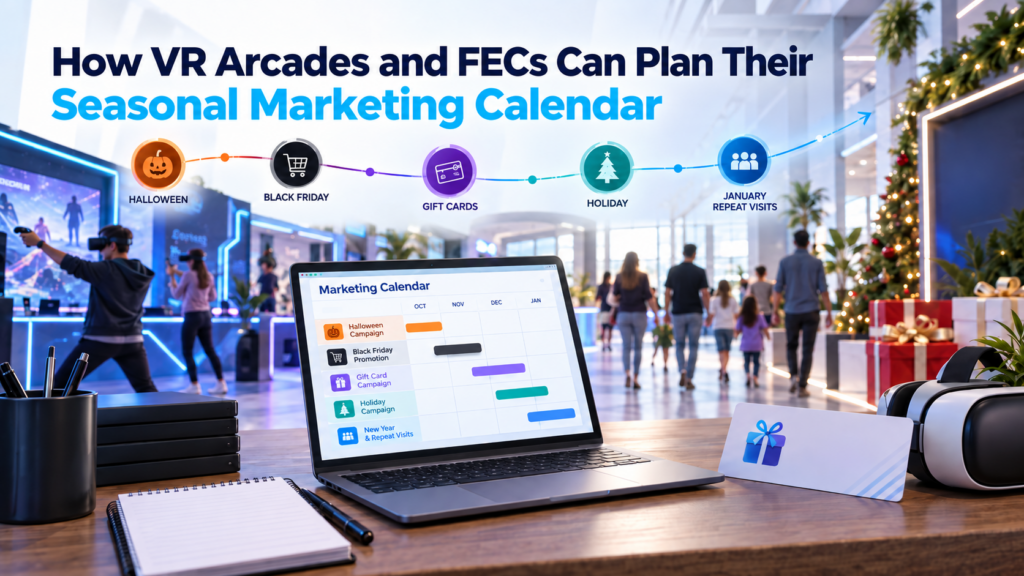
Seasonal marketing for VR arcades works best when the calendar tells the team more than what to post next. A useful seasonal marketing calendar should show who the venue wants to reach, what behavior the campaign should create, which offer fits that audience, how operations will deliver it, and what should happen after the visit. That matters because Halloween, Black Friday, Christmas, school breaks, corporate party season, and January do not create the same type of demand. A campaign that works for families during a school holiday may have little relevance to a corporate organizer planning a December event or somebody buying a VR experience as a Christmas gift. For VR arcades and family entertainment centers, there is another layer. The experience itself can change. Operators can rotate content, feature different multiplayer experiences, build seasonal packages, run competitions, and adapt the attraction mix without rebuilding the venue around every campaign. The result is a marketing calendar that connects customer demand with what the venue can actually deliver. Start with the moments that change customer behavior A seasonal calendar does not have to begin with a list of holidays. Start with the periods when the behavior of your customers changes. School breaks create family availability. Halloween creates demand for themed entertainment. November introduces holiday shopping and Black Friday. December can bring corporate parties, gift buying, visiting families, and school vacations. January may bring quieter general traffic alongside customers redeeming gifts they received during the holidays. Even the customer’s planning window can begin surprisingly early. The National Retail Federation reported that by early August 2026, one-quarter of consumers surveyed had already purchased at least one Halloween item. (National Retail Federation) For a physical entertainment venue, the relevant calendar also depends on its local market. A tourist destination, suburban family entertainment center, university-town arcade, and city-center VR venue can experience very different demand patterns. Bob Phibbs, The Retail Doctor, makes a related point in his guidance for seasonal brick-and-mortar businesses: seasonal demand is often connected to the occasion behind the purchase, including gifting and travel, rather than simply the date printed on the calendar. (Retail Doc) Before filling the calendar with promotions, operators should therefore ask: What changes in our customers’ lives during this period that gives them a reason to visit us? That question usually produces a better campaign than beginning with, “What should we post for Halloween?” Give every seasonal campaign one commercial job Seasonality creates attention. The venue still needs to decide what it wants that attention to accomplish. A Halloween campaign might exist to increase evening bookings among teens and young adults. A corporate Christmas campaign could target higher-value group reservations. A Black Friday offer might generate advance revenue through gift cards. A January campaign could encourage people who visited or received a gift during December to come back. This connects with the pricing framework we explored in our guide to VR arcade session prices, packages, and promotions. A promotion works better when the operator defines the behavior it should create before choosing the discount or package. A simple seasonal campaign might therefore have a goal such as: This also makes measurement easier. The operator already knows what success should look like before the campaign launches. Build each promotion around four connected layers A practical way to plan each seasonal campaign is what we can call the Seasonal Campaign Stack. Every campaign needs four layers: Demand: Who has a reason to visit during this period? Offer: What gives that customer a clear reason to book? Delivery: Can the venue reliably provide the experience being promoted? Follow-up: What should happen after that visit? Consider Halloween. Demand might come from friend groups, families, teenagers, or adults looking for something different to do around October 31. The offer could be a horror VR package, competitive Halloween night, family-friendly spooky session, or themed free-roam experience. Delivery means checking the content, licensing, player capacity, session length, staff briefing, booking flow, and hardware before the promotion goes live. Follow-up could move those customers toward a November event, Christmas gift card, new multiplayer experience, or another reason to return. We covered the package-building side in more depth in How to Build Halloween VR Arcade Packages for Different Audiences. The same four questions can then be reused for Black Friday, Christmas, Valentine’s Day, spring break, summer, back-to-school season, and local events. Choose the audience before choosing the message A venue may have several very different audiences inside the same customer database. A birthday parent, local teenager, tourist, corporate organizer, repeat player, and someone who bought a gift card are all customers. Their reasons for booking are completely different. This is especially important for email marketing. Neil Patel’s current guidance on email personalization emphasizes behavioral and transaction data rather than relying only on basic personalization such as a customer’s name. Segmentation can use previous purchases, engagement, location, behavior, and customer lifecycle stage to make the message more relevant. (Neil Patel) For an entertainment venue, that might mean: We explored this segmentation further in How VR Entertainment Venues Turn First-Time Visitors Into Repeat Customers. This is also why the seasonal calendar and the email calendar should eventually connect. Wednesday’s deeper email-marketing article can build on this part without repeating the whole seasonal strategy. Plan the content calendar with the marketing calendar This is where VR venues have an advantage over many traditional brick-and-mortar businesses. The building may stay exactly the same while the experience customers come to play changes. A horror title can move into the spotlight for Halloween. Competitive multiplayer can support a tournament or social event. Family-friendly experiences can lead during school breaks. Cooperative content may fit corporate or group campaigns. That means operators can plan what they promote and what customers will play at the same time. Our guide to VR arcade content rotation looks at this in more detail. Rotation does not always require licensing something new. Operators can feature an existing title, introduce a leaderboard, run a challenge, change staff recommendations, or bring