
How to Build an Educational VR Program for Schools and Groups
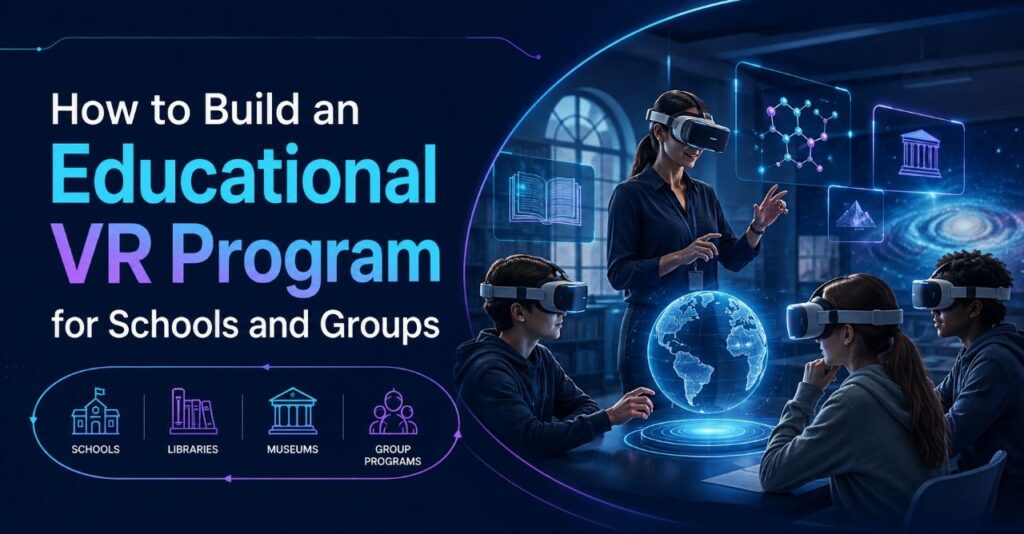
Building an educational VR program for schools takes more than adding educational content to a headset fleet. Teachers need to understand what students will learn, which ages the activity suits, how a full class will move through the experience, how long the visit will take, and what the school will pay. Libraries, museums, science centers, and other institutions face many of the same questions when adding VR to their educational programming. For VR arcades and location-based entertainment venues, school groups can also create a new use for weekday capacity. Operators already have much of the infrastructure in place: headsets, staff, commercial VR content, and experience managing groups. The next step is turning those resources into a program that a teacher or institution can confidently book. Building a program a teacher can approve Established field trip providers make practical information easy to find. Teachers usually need the age or grade range, learning focus, program duration, group capacity, supervision requirements, accessibility information, arrival instructions, and price before they can move a trip forward. An educational VR offer needs the same clarity. A page that simply says “Educational VR available for school groups” still leaves most of the planning with the teacher. A stronger offer explains what students will explore, how the experience connects to a subject, how many students can attend, how the class moves through the available headsets, and what happens during the rest of the visit. A simple way to plan the offer is to work backward from the questions the school needs answered: This also changes how an operator chooses educational VR content. Instead of starting with a list of available experiences, start with the school use case. A biology experience might support a science visit. A virtual field trip could connect with geography or history. Engineering content may fit a STEM program. The content has a clearer role once there is a program around it. A short VR experience can support a full school visit The VR portion does not need to fill the entire booking. During our recent Step Into Webb education webinar, Adventure Portal demonstrated how a relatively short immersive experience can sit inside a longer structured lesson. Step Into Webb itself runs for around 15 minutes and targets students in grades 6 through 10. The wider program can combine that VR session with supporting tasks and teacher-led activities. For a venue, that creates the possibility of a 45- or 60-minute school visit without keeping every student inside VR for the full hour. A class might begin together with an introduction to the subject. Smaller groups then move through the VR experience while other students work on related activities. The groups rotate until everyone has completed the immersive portion, then come together again for a discussion or recap. Supporting activities give the visit more structure and help connect what students see inside VR with the wider learning objective. This becomes especially useful when the immersive experience itself lasts 10 or 15 minutes. The venue can build a much richer educational program around that time rather than stretching the VR session simply to fill an hour. Class capacity is bigger than headset count One of the first questions operators often ask is how a venue with six or eight headsets can host a full class. The answer is in the program design. During the Step Into Webb webinar, one example used a class of 30 students and eight available headsets. The class could split into smaller groups. One group enters VR while the other students complete related activities, then the groups rotate. The exact numbers will differ from one location to another. Available space, staff, student age, experience length, and headset capacity all influence the final setup. Still, the example highlights an important distinction: Educational capacity does not have to equal headset capacity. An operator should calculate how many students can complete the entire program during the available booking window, rather than using the number of headsets as the maximum class size. This can make educational VR practical for venues that would never consider buying enough hardware for an entire school class to enter VR simultaneously. Using existing weekday capacity For an established VR arcade, school visits can fit into a very different part of the weekly schedule from regular entertainment bookings. A class arriving on Tuesday morning does not compete directly with the birthday parties, friend groups, or free-roam sessions that drive weekend and evening demand. The venue also already has much of the infrastructure required to deliver the program. Staff understand headset setup and cleaning. The venue has group onboarding procedures, commercial VR hardware, content, physical space, and a VR management system supporting the headset fleet. Education gives those existing resources another commercial use. During our education webinar, one operator described running regular field trips and having hosted several school groups within a single day. Their existing program combines educational activities with VR and uses different areas of the venue to move students through the visit. That example shows why the operational design matters as much as the content. Staff need to know when each rotation starts, where students wait, which headsets are ready, how long each activity lasts, and who supervises each part of the group. Once the venue establishes that workflow, the next school visit becomes much easier to run. Educational VR inside schools Schools and universities can also operate VR directly. A school with its own headset fleet has a different set of priorities from an entertainment venue. The institution may want one set of hardware to serve several classes, teachers, and subjects throughout the academic year. A biology class might use the headsets for anatomy or natural science. Another teacher could use the same fleet for engineering, Earth science, history, or a virtual field trip later in the term. The educational value of the hardware grows when the institution can reuse it across different subjects and age groups. Content breadth therefore becomes an important planning question. A school investing in
3 VR Education Experiences Worth Adding to Your Arcade Lineup in 2026
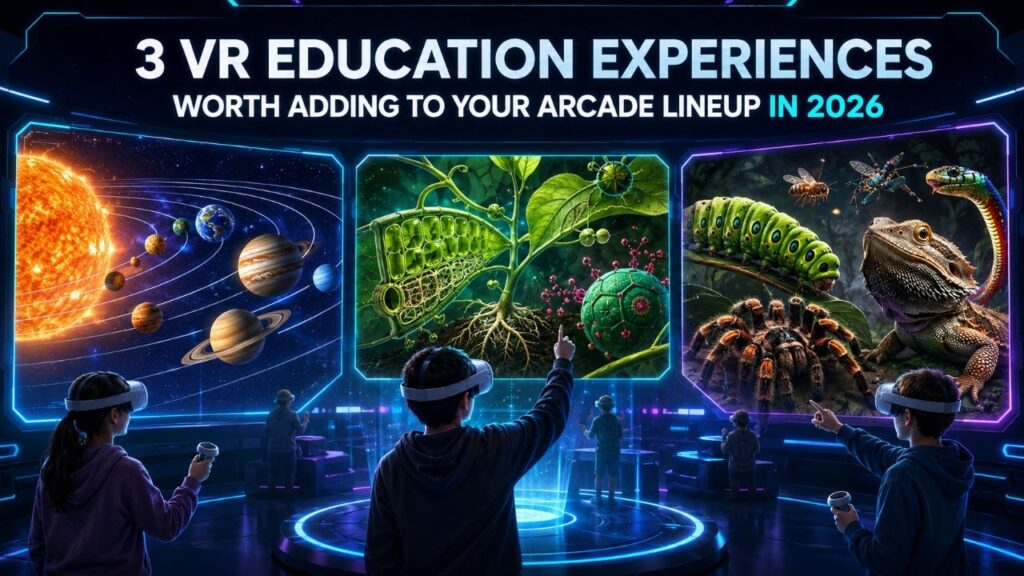
A VR attraction venue already owns the hard part. The fleet is bought, the booking system runs, and staff can start a session on their own. Maybe your weekday hours run lighter than your weekends. VR education content is one way to fill them, and it uses the setup you already have. The demand is there to meet. Curriculum VR runs in well over 200,000 schools now, and a 2025 Museums Association survey found 79 percent of the public interested in using digital tools to reach things they cannot otherwise see. The results back the interest up: Stanford research found students who learned in VR retained about 30 percent more than students taught the same material the usual way. What most schools, camps, and small museums do not want is to buy the gear, manage it, and train staff to run it. That is the exact part an operator has already solved. So the opportunity runs two ways. Package a school outing at your venue, or load a few headsets into a case and run a session in a classroom. Camp organizers and event planners will pay for a rainy-day activity with real substance. A museum or library can offer a pop-up VR station without owning the hardware. All three titles below run on the Pico, Quest, or Focus 3 headsets most fleets already carry. Each one anchors a different kind of booking. VictoryXR Science Curricula: Anatomy & Physiology – Body Awesome VictoryXR built the first VR science curriculum aligned to the Next Generation Science Standards. Body Awesome maps to NGSS standards HS-LS2-3 and HS-LS4-1, plus the matching Texas (TEKS) and Florida (CPALMS) standards. That alignment does the selling for you before a buyer asks. Inside the lesson, students pull organs out to full size and rotate them. Open the heart, kidney, or brain and you see how each structure drives its system. A nationally recognized science teacher narrates each organ as students double-tap to trigger it. Every organ carries two activity prompts that push past looking: predicting, sketching, comparing, answering. The lab manual ships with a glossary and pronunciation guide. The Teacher’s Edition includes 60 assessment questions with answers, so a teacher can run it graded rather than as a demo. Where it fits: Body Awesome is one lesson inside a catalog of 48 units and 240 VR experiences. Those span Earth and space science, engineering, life science, and physical science. That scale turns a one-off school visit into a repeat booking across subjects and terms. It runs on PCVR room-scale and standalone Quest. That suits a high school biology block, a homeschool co-op, or a university department testing a shared lab. Sell it with a standards checklist, and the catalog answers “what’s next” for you. View VictoryXR Science Curricula on SynthesisVR VR Plant Journey VR Plant Journey turns a biology lesson into a throwing and archery game. Players shrink inside a canola plant and move through three chapters: root, leaf, and seed. Each one is built on a real process. The leaf level has you throwing carbon dioxide and water to run photosynthesis. Down in the root, you assemble ammonium and nitrate, the nutrients the plant feeds on. The seed level asks you to hit oil bodies with a bow and arrow so they grow. Get the balance right and the plant develops. Get it wrong and it stalls. The content came out of a collaboration with plant researchers at the Leibniz Institute of Plant Genetics and Crop Plant Research, and the design has picked up nominations at the VR Awards, the Auggie Awards, Laval Virtual, and the VRnow Awards for education and training. Where it fits: the throwing and archery mechanics give this one more energy than a lab-style title. That matters with younger visitors, who lose interest fast in passive content. Its three short levels fit a walk-in group’s attention span. It slots into a summer camp afternoon, a library’s family hour, or a museum’s school-group rotation as easily as a classroom. It runs on PCVR room-scale and standalone Quest. Lead with this one when the group is mixed ages or the booking is more field-day than field trip. View VR Plant Journey on SynthesisVR Creepy Crawly Zoo 2.0 Creepy Crawly Zoo 2.0 shrinks players to about two inches tall and drops them inside a macro-scale insect and reptile exhibit. It is built on a real collection: creator Antonio Gustin shot it with an 8K macro VR camera alongside Dan Capps, whose private insect collection was once the largest in the world and appeared at Disney’s Epcot. The experience carries 100 display cases and more than 30 macro encounters, including scorpions, tarantulas, lizards, snakes, and a freshwater pond, with Capps appearing on video to guide guests through the specimens himself. Where it fits: this is the least game-like of the three, closer to a walkable exhibit than a title with a win state. Gustin describes it as a place to explore rather than a game, made to raise questions and hold attention. That reads as a natural fit for a science center, a nature center, or a school running a biology or ecology unit, and it gives a VR arcade something visually distinct to round out an education slot. It is standalone Quest only, so it drops straight into any venue already running a Quest fleet with nothing extra to buy. View Creepy Crawly Zoo 2.0 on SynthesisVR How Operators Turn This Into Bookings Adding the content is the easy half. The revenue comes from who you put in front of it. Package a school outing at your venue and sell it on the schedule that already suits you: a class-length 45 to 60 minute session, students rotating through the arena in small teams while the rest work with a teacher. Full-venue exclusivity is far easier to promise on a Wednesday afternoon than a Saturday night, and that midweek slot is the one you are trying to fill anyway. If the school cannot travel, bring