
How VR Arcades and FECs Can Plan Their Seasonal Marketing Calendar
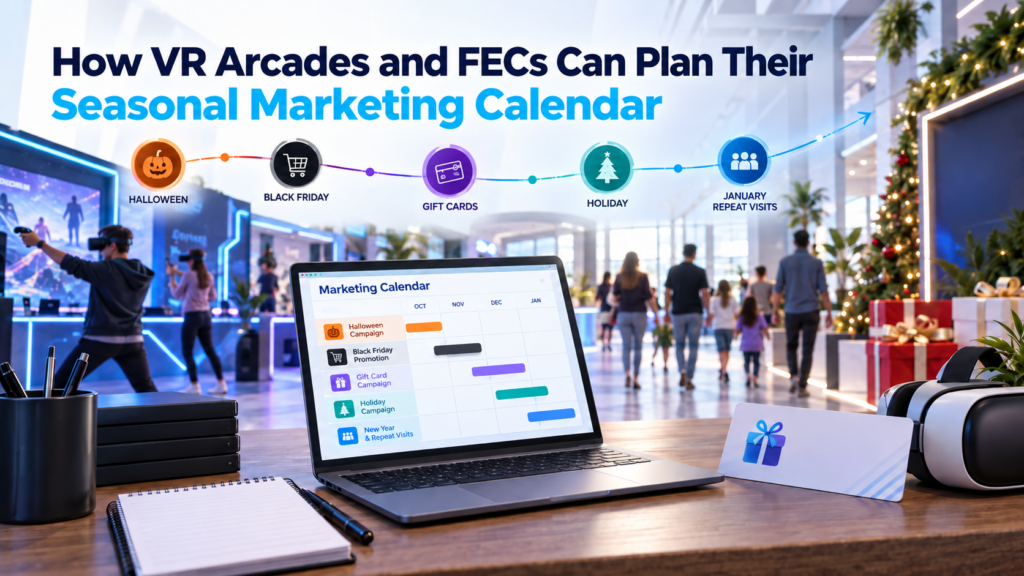
Seasonal marketing for VR arcades works best when the calendar tells the team more than what to post next. A useful seasonal marketing calendar should show who the venue wants to reach, what behavior the campaign should create, which offer fits that audience, how operations will deliver it, and what should happen after the visit. That matters because Halloween, Black Friday, Christmas, school breaks, corporate party season, and January do not create the same type of demand. A campaign that works for families during a school holiday may have little relevance to a corporate organizer planning a December event or somebody buying a VR experience as a Christmas gift. For VR arcades and family entertainment centers, there is another layer. The experience itself can change. Operators can rotate content, feature different multiplayer experiences, build seasonal packages, run competitions, and adapt the attraction mix without rebuilding the venue around every campaign. The result is a marketing calendar that connects customer demand with what the venue can actually deliver. Start with the moments that change customer behavior A seasonal calendar does not have to begin with a list of holidays. Start with the periods when the behavior of your customers changes. School breaks create family availability. Halloween creates demand for themed entertainment. November introduces holiday shopping and Black Friday. December can bring corporate parties, gift buying, visiting families, and school vacations. January may bring quieter general traffic alongside customers redeeming gifts they received during the holidays. Even the customer’s planning window can begin surprisingly early. The National Retail Federation reported that by early August 2026, one-quarter of consumers surveyed had already purchased at least one Halloween item. (National Retail Federation) For a physical entertainment venue, the relevant calendar also depends on its local market. A tourist destination, suburban family entertainment center, university-town arcade, and city-center VR venue can experience very different demand patterns. Bob Phibbs, The Retail Doctor, makes a related point in his guidance for seasonal brick-and-mortar businesses: seasonal demand is often connected to the occasion behind the purchase, including gifting and travel, rather than simply the date printed on the calendar. (Retail Doc) Before filling the calendar with promotions, operators should therefore ask: What changes in our customers’ lives during this period that gives them a reason to visit us? That question usually produces a better campaign than beginning with, “What should we post for Halloween?” Give every seasonal campaign one commercial job Seasonality creates attention. The venue still needs to decide what it wants that attention to accomplish. A Halloween campaign might exist to increase evening bookings among teens and young adults. A corporate Christmas campaign could target higher-value group reservations. A Black Friday offer might generate advance revenue through gift cards. A January campaign could encourage people who visited or received a gift during December to come back. This connects with the pricing framework we explored in our guide to VR arcade session prices, packages, and promotions. A promotion works better when the operator defines the behavior it should create before choosing the discount or package. A simple seasonal campaign might therefore have a goal such as: This also makes measurement easier. The operator already knows what success should look like before the campaign launches. Build each promotion around four connected layers A practical way to plan each seasonal campaign is what we can call the Seasonal Campaign Stack. Every campaign needs four layers: Demand: Who has a reason to visit during this period? Offer: What gives that customer a clear reason to book? Delivery: Can the venue reliably provide the experience being promoted? Follow-up: What should happen after that visit? Consider Halloween. Demand might come from friend groups, families, teenagers, or adults looking for something different to do around October 31. The offer could be a horror VR package, competitive Halloween night, family-friendly spooky session, or themed free-roam experience. Delivery means checking the content, licensing, player capacity, session length, staff briefing, booking flow, and hardware before the promotion goes live. Follow-up could move those customers toward a November event, Christmas gift card, new multiplayer experience, or another reason to return. We covered the package-building side in more depth in How to Build Halloween VR Arcade Packages for Different Audiences. The same four questions can then be reused for Black Friday, Christmas, Valentine’s Day, spring break, summer, back-to-school season, and local events. Choose the audience before choosing the message A venue may have several very different audiences inside the same customer database. A birthday parent, local teenager, tourist, corporate organizer, repeat player, and someone who bought a gift card are all customers. Their reasons for booking are completely different. This is especially important for email marketing. Neil Patel’s current guidance on email personalization emphasizes behavioral and transaction data rather than relying only on basic personalization such as a customer’s name. Segmentation can use previous purchases, engagement, location, behavior, and customer lifecycle stage to make the message more relevant. (Neil Patel) For an entertainment venue, that might mean: We explored this segmentation further in How VR Entertainment Venues Turn First-Time Visitors Into Repeat Customers. This is also why the seasonal calendar and the email calendar should eventually connect. Wednesday’s deeper email-marketing article can build on this part without repeating the whole seasonal strategy. Plan the content calendar with the marketing calendar This is where VR venues have an advantage over many traditional brick-and-mortar businesses. The building may stay exactly the same while the experience customers come to play changes. A horror title can move into the spotlight for Halloween. Competitive multiplayer can support a tournament or social event. Family-friendly experiences can lead during school breaks. Cooperative content may fit corporate or group campaigns. That means operators can plan what they promote and what customers will play at the same time. Our guide to VR arcade content rotation looks at this in more detail. Rotation does not always require licensing something new. Operators can feature an existing title, introduce a leaderboard, run a challenge, change staff recommendations, or bring
How to Build Halloween VR Arcade Packages for Different Audiences
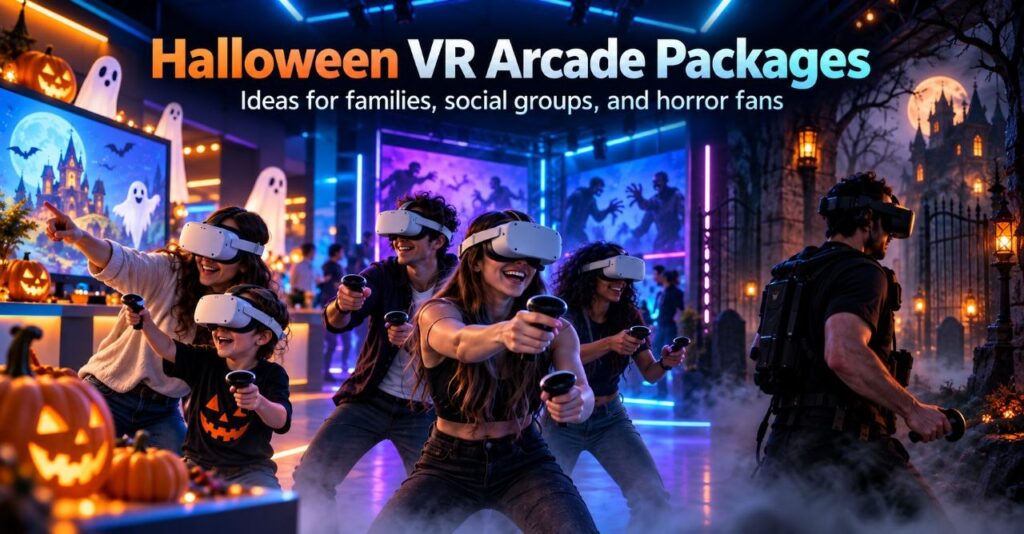
Halloween gives VR arcades an easy reason to change what customers see, promote experiences that may spend less time in the spotlight during the rest of the year, and create a seasonal offer around content they already have access to. The timing matters. Halloween VR arcade packages should be ready before customers start deciding what to do in late October. In our recent guide to planning VR arcade seasonal promotions before demand peaks, we suggested starting internal planning around six to eight weeks before a major event, followed by the main customer-facing campaign roughly four to six weeks ahead. For Halloween 2026, that window is already open. Operators starting now still have time to choose content, define the offer, test the experience, prepare the booking page, and begin promotion well before October 31. The offer itself can stay simple. A venue might sell a themed block of VR time with several Halloween game choices. Another might add snacks, drinks, a group photo, or a small Halloween treat. A free-roam venue can reserve the arena for a dedicated spooky session. The right format depends on who the venue wants to bring in. Start With the Audience Before Choosing the Scare Halloween content covers a much wider range than traditional horror. A family with younger players may want pumpkins, ghosts, candy, and supernatural themes without intense scares. A group of teenagers or young adults may want something more suspenseful, social, or competitive. Adult groups can move into darker escape experiences, psychological horror, zombies, and stronger jump scares. That is why the content decision should start with the customer rather than the genre. The same principle applies throughout the year. Our guide to choosing VR arcade games for different customer groups looks at audience fit alongside hardware, available space, player capacity, session length, and staff workflow. A Halloween campaign simply gives operators a seasonal reason to apply the same process. A useful starting point is to define the intensity of each Halloween offer clearly. Labels such as Family Spooky, Scary, and Full Horror can help customers understand what they are booking before they arrive. Turn Halloween Content Into a Bookable Package A seasonal offer works better when customers can understand it in a few seconds. The venue can keep the entry-level package focused entirely on VR. Food, drinks, party space, or other extras can sit in higher tiers if the operation supports them. The packaging principles are similar to those we covered in our guide to VR arcade birthday party packages. Customers respond better when the total visit length, group size, price, session format, and included extras are clear before checkout. For Halloween, the additional question is simple: How scary is this going to be? Answer that on the booking page. Where to Find Halloween VR Content Operators running PCVR and room-scale stations can start with the dedicated Halloween VR content category. It currently brings together titles such as Halloween Candy Reclaim, The Obsessive Shadow, Fear of the Dark, Cosmodread, Dreadhalls, Escape Bloody Mary, and AFFECTED: The Manor, among others. Free-roam operators should also browse the dedicated SynthesisVR free-roam library. The free-roam section separates content by setups including PCVR, PICO, HTC Focus, and Quest, which matters when an operator needs Halloween content that fits an existing arena rather than a room-scale station. That distinction also helps operators avoid choosing a Halloween title based on theme alone and discovering later that the platform, player count, or physical footprint does not fit the venue. Family-Friendly Halloween VR Family Halloween content can use the season without turning the visit into a horror experience. Halloween Candy Reclaim is a PCVR room-scale example built specifically around that idea. Players use pickle guns while recovering stolen candy from Halloween creatures. The experience describes itself as family-friendly and intentionally non-scary, with pumpkins, ghosts, skeletons, candy, seven levels, multiple difficulty settings, and local multiplayer. For a free-roam setup, Paranormal Pest Patrol offers another direction. Groups become paranormal exterminators dealing with mischievous demons inside a possessed house. Its comedic tone, simple controls, puzzle structure, E10+ rating, and support for groups of two to eight players make it easier to position as a spooky group adventure rather than full horror. Either could sit inside a family package with a fixed session length, Halloween snack, photo spot, or small treat at the end. The commercial value comes from the packaging. Parents do not need to understand the difference between every title in the library. They need to know that the experience fits their group and that nobody is walking into something far scarier than expected. Give Social Groups Something Spookier Older groups give operators room to increase the intensity. Fear of the Dark runs on PCVR room-scale and supports multiplayer for up to five people. Players protect the torch carrier while moving through a village filled with zombies, werewolves, monsters, bats, and other threats. Multiple difficulty settings give operators some flexibility around the group they are serving. Free-roam venues can look at experiences such as The Hallow, a PCVR free-roam title for two to eight players. Its supernatural 19th-century premise sends the group searching for abnormal activity under the guidance of a mysterious magician. This type of content can support a Halloween social offer aimed at friend groups, students, and young adults. The marketing can focus on bringing the group together, choosing how brave they want to be, and booking a fixed evening slot. We covered the wider booking behavior of this audience in How VR Entertainment Centers Attract Student Groups and Young Adult Audiences. Social-first promotion, clear pricing, multiplayer content, and a quick mobile booking path become especially relevant when the customer may decide on the activity with friends only a few days before the visit. Build a Stronger Horror Option for Adults Some customers will actively search for the most intense experience the venue can offer. For PCVR room-scale stations, AFFECTED: The Manor focuses heavily on atmosphere, lighting, audio, and a guided route through a haunted environment. Its design also makes
How VR Arcades Can Plan Seasonal Campaigns Before Demand Peaks
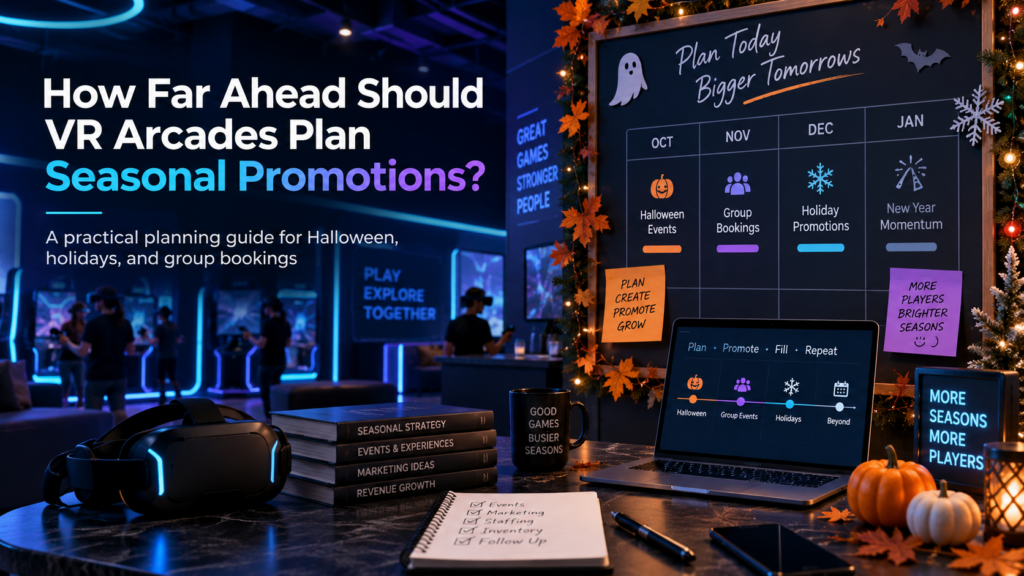
VR arcade seasonal promotions usually need more preparation time than customers ever see. For a major occasion such as Halloween or the winter holidays, a practical starting point is six to eight weeks before the event for internal planning, followed by the main customer-facing campaign about four to six weeks ahead. Promotions aimed at schools, corporate groups, or other organized bookings may need an even longer runway. The timing matters because a seasonal campaign involves more than preparing a few social posts. Operators may need to select content, check commercial licensing, build a package, set pricing, test the session, update the booking page, brief staff, and prepare marketing assets before the first customer sees the offer. Consumer behavior also starts earlier than the date on the calendar suggests. In September 2026, the National Retail Federation reported that one-quarter of Halloween consumers had already purchased at least one Halloween item by early August. In 2025, 49% started Halloween shopping before October. That retail data does not tell us exactly when someone will book a VR session, but it does show how early seasonal attention can begin. How Far Ahead Should VR Arcade Seasonal Promotions Start? There is no universal lead time that fits every venue or customer group. A local group of friends deciding what to do on Friday night behaves very differently from a school coordinator arranging a visit for 30 students. A company booking an end-of-year event may need approval several weeks before the date. A family looking for Halloween entertainment may decide within days. For planning purposes, operators can use the following ranges as a working model: These are planning ranges, not fixed industry rules. A venue should adjust them as its own booking data becomes available. The useful distinction is between when the venue starts preparing and when the customer starts seeing the campaign. Plan From the Customer’s Decision Date Start with the audience. A school may need approval, transportation arrangements, parental information, and a confirmed cost per student. That creates a longer booking cycle. Corporate groups may need several quotes before someone approves the event. December team activities can enter the planning stage while customers are still thinking about Halloween. Birthday bookings fall somewhere in the middle. Parents often compare several local entertainment options, check availability with other families, and choose a date before committing to a venue. Student and young-adult groups can move much faster. A multiplayer offer promoted on a Monday may generate bookings later that same week if the price, availability, and booking path are clear. The holiday date alone therefore tells the operator very little. The customer planning the visit determines how early the campaign needs to appear. Give the Venue Time to Prepare Before Promotion Begins The first part of the campaign happens behind the scenes. Before publishing the first seasonal post, an operator should know: This prevents an awkward situation where marketing creates interest before the actual offer is ready to book. It also gives staff time to test the experience under the conditions the campaign promises. If an offer advertises an eight-person Halloween session every 45 minutes, the venue needs to know that the content, headset preparation, onboarding, reset time, and staffing can support that schedule. The same logic applies to pricing. Seasonal demand may justify a package, extended session, group rate, competition, or themed event. Operators need enough time to check whether that offer still works after content licensing, staffing, and operating costs are included. Match Seasonal Content to a Clear Reason to Visit Seasonal marketing does not require an entirely new content library every few months. A venue may already have experiences that fit the occasion but receive little attention during the rest of the year. Horror titles can move forward before Halloween. Family experiences can support school-break campaigns. Competitive multiplayer can become the basis of a holiday challenge or student event. Our guide to VR arcade content rotation explains this in more detail. Operators can rotate which experiences receive attention without continually replacing the entire library. That distinction is useful when planning seasonal promotions. The operator can first decide what customer occasion the campaign needs to serve, then review the existing library for content that fits. A new commercial license becomes necessary only when the current attraction mix has a genuine gap. A Halloween 2026 Planning Example Halloween falls on Saturday, October 31 this year. An operator beginning the campaign in the week of September 7 still has enough time to build a structured promotion. September 7–13: Decide what the Halloween offer actually is. Choose the audience, featured content, price, eligible dates, player capacity, and session structure. Test the experiences staff will recommend. September 14–20: Prepare the booking page, visuals, email copy, social assets, staff instructions, and any local partner outreach. Confirm that the offer can be booked without customers having to contact the venue for basic information. September 21–October 4: Start the main customer campaign. Introduce the Halloween offer while people are already making seasonal plans. Give organized groups enough time to coordinate participants. October 5–18: Show the experience in more detail. Gameplay clips, venue footage, customer reactions, available dates, group size information, and clear pricing can answer the questions that appear after initial interest. October 19–31: Shift toward immediate booking decisions. Availability, remaining dates, same-week plans, and last-minute group opportunities become more relevant than explaining the campaign from the beginning. This timeline also avoids placing the full marketing burden on the final week of October. Start Thinking About the Next Season Before the Current One Ends Halloween provides a useful example of how seasonal calendars overlap. The National Retail Federation reports that around two in five winter-holiday shoppers typically start browsing and buying before November, and retailers have responded with holiday campaigns beginning in October. Again, retail shopping behavior and entertainment booking behavior are different, but the data shows that customer attention can move to the next occasion early. For a VR venue, that means winter planning can begin while the Halloween campaign