
How VR Arcades Fill Empty Weekday Sessions Without Discounting
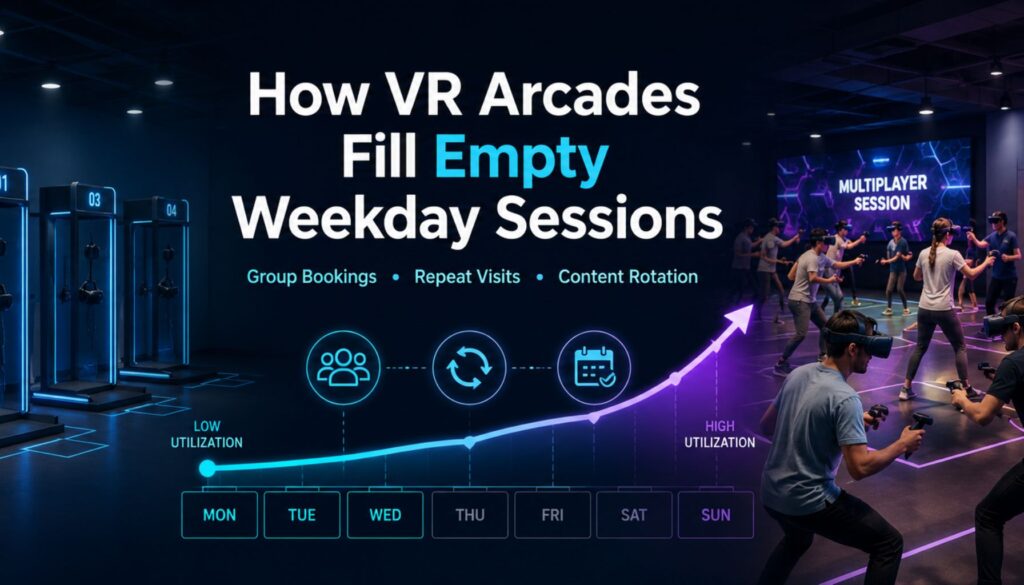
For most VR arcades, family entertainment centers (FECs), and location-based entertainment (LBE) venues, Friday evenings and weekends take care of themselves. The real operational challenge begins on Monday morning. Every empty VR session between Monday and Thursday represents revenue that can never be recovered. Unlike retail inventory, unused attraction capacity expires forever. Once a 3:00 PM session passes without players, that opportunity is gone. Many operators respond by introducing weekday discounts. While discounts may increase short-term bookings, they rarely solve the underlying problem. Over time, they can even reduce profitability by training customers to wait for lower prices. The strongest operators take a different approach. Rather than lowering prices, they redesign how weekday demand is created, packaged, and managed. They treat weekday utilization as an operational challenge—not simply a marketing one. Why Weekday Utilization Matters More Than It Looks A single underperforming weekday can offset gains from a strong Saturday. Across an entire year, consistent weekday gaps compound into a meaningful revenue shortfall, particularly for venues carrying fixed overhead on VR hardware and dedicated attraction space. Analysts estimate the location-based VR market will reach approximately $2.76 billion in 2026 and continue growing rapidly through the end of the decade. As more operators enter the market, long-term performance increasingly depends on operational consistency rather than novelty alone. Utilization influences several areas that operators often underestimate: A quieter Tuesday session often provides a better guest experience than a fully booked Saturday. That difference can influence reviews, referrals, and future bookings long after the session ends. Why Many VR Venues Struggle to Fill Weekday Sessions Empty weekdays rarely reflect a lack of interest in VR. More often, they reflect a mismatch between how the attraction is offered and how people organize their time during the week. Weekday audiences behave differently from weekend visitors. Families work around school schedules. Friend groups need low-friction planning and simple booking. Students coordinate around evening availability. Corporate groups require a clear reason to justify an outing during business hours. Tourists operate on unpredictable schedules and shorter decision windows. Many venues build their booking structure around peak weekend behavior and then expect those same systems to perform throughout the week. Across commercial VR venues, free-roam and room-scale attractions often attract different audiences and booking behaviors. Operators who understand those patterns tend to build more balanced attraction portfolios and create offers that fit specific weekday audiences rather than treating all bookings the same. Common friction points include: Operators regularly use group pricing for schools, sports teams, corporate outings, and social groups because those audiences can help fill capacity that would otherwise remain unused during off-peak periods. How Can VR Arcades Increase Weekday Bookings? Discounting can increase attention, but it does not always address the reasons people delay or avoid booking. Operators often discover that price is only one part of the equation. Weekday attendance depends just as heavily on how easily groups can organize, book, and commit to an experience. Across the broader FEC industry, structured group experiences consistently outperform discount-heavy approaches. Birthday packages, corporate events, school programs, and group offers simplify decision-making for organizers and reduce booking friction. The same principle applies directly to VR. A group of six friends can easily postpone a VR outing if one person must coordinate payments, explain the experience, and organize schedules. That same group is more likely to commit when presented with a simple package: “Six-player session. One booking. Clear pricing. Clear experience.” Tying package benefits to off-peak windows, school calendars, or local community schedules can help smooth demand throughout the week without reducing prices across the board. Operators in bowling centers, laser tag venues, and escape rooms have applied this approach for years. VR arcades that design around group booking behavior often see stronger weekday utilization because they make participation easier to organize. Why Repeat Visits Create More Stable Revenue Than Acquisition Spikes One-time visitors are difficult to predict. Repeat visitors create more consistent demand patterns and often generate greater value over time. Operators frequently focus on acquiring new players while underestimating how much weekday utilization depends on giving existing customers a reason to return. A local customer who visits twice per month often contributes more revenue across a year than a tourist who visits once during a holiday. One recurring pattern across commercial VR venues is that players rarely ask how many titles are available. They ask whether there is something new to try since their last visit. The challenge for many VR venues is content fatigue. VR experiences are highly immersive, but they are also finite. Once visitors feel they have experienced everything available, motivation to return declines. Content rotation helps address this challenge. Venues that regularly introduce new experiences, seasonal content, multiplayer options, or fresh attraction formats create natural opportunities for return visits. Over time, this helps shift the venue from being perceived as a one-time activity into a recurring social destination. Promoting new experiences through social media, email campaigns, loyalty programs, and in-venue signage gives operators a practical way to convert content updates into measurable return traffic. The Role of Attraction Variety and Social Session Design The strongest operators rarely depend on a single experience type to support weekday traffic. An attraction mix that includes competitive multiplayer experiences, shorter repeatable sessions, free-roam attractions, and room-scale content provides flexibility when serving different audience segments. Weekday utilization rates for entertainment venues often fall between 40% and 50%, compared to 75% to 85% during weekends. Successful operators plan around that reality rather than treating it as a temporary problem. Multiplayer VR experiences naturally align with how social groups plan activities. A group of friends, a student organization, a sports team, or a corporate department all require a reason to commit and a simple booking process. Clearly packaged multiplayer experiences remove barriers that often prevent those groups from converting. Operator Reality Check Several operators invested heavily in new hardware while weekday utilization remained inconsistent. Attendance often improved temporarily before returning to previous patterns. Many operators expect new equipment or newly
3 PCVR Games That Keep Competitive Groups Coming Back This Summer
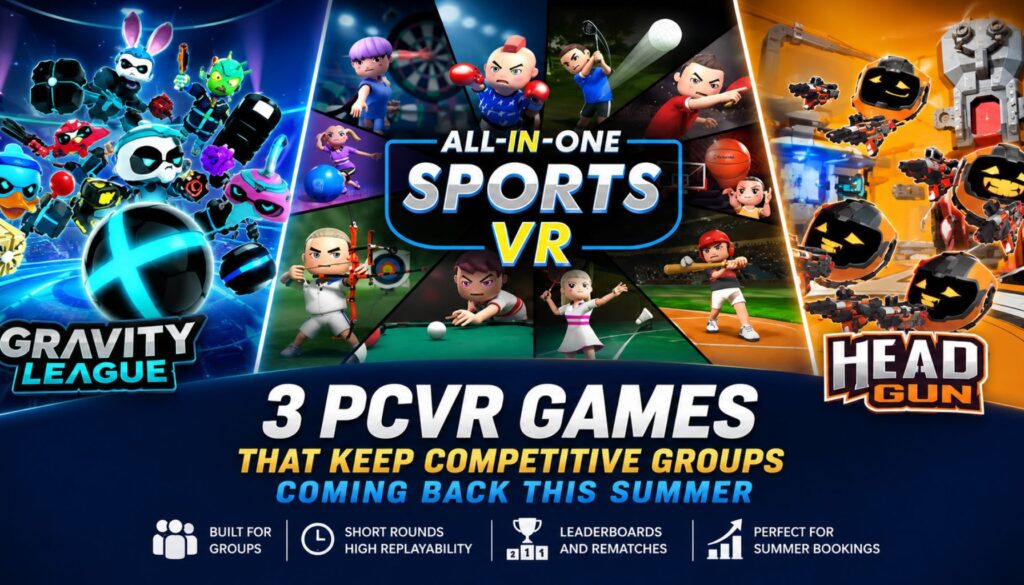
Competitive PCVR games often appeal to a different type of guest than narrative-driven experiences. Some groups walk into a VR session ready to explore. Others walk in ready to compete, compare scores, and ask for a rematch. For those groups, the best games are the ones that create momentum fast. Clear rules, short rounds, and visible progress keep players engaged because the goal feels close, the outcome feels fair, and every round gives them a new chance to do better. That pattern lines up with what motivation research has shown for decades: people tend to increase effort as they get closer to a goal, and the presence of a rival raises that effort further. Clark Hull first documented the goal-gradient effect in 1932, finding that effort accelerates as a goal comes within reach. Gavin J. Kilduff at New York University later confirmed that competing directly against someone raises both motivation and measurable performance, even when no prize is involved. In a venue setting, that combination translates into rematches, leaderboard chases, and groups that book again because the last match did not go the way they wanted. A birthday group with mixed experience levels, a summer camp operating on a schedule, or a corporate booking looking for team-based competition often responds well to the same formula: short rounds, simple rules, and enough variety to make the next match feel worth taking. When players can see their progress and immediately try again, the session becomes more than a one-time playthrough. These three PCVR room-scale titles are built around that logic. Why Competitive PCVR Games Perform Differently in Commercial Venues Not every multiplayer VR experience creates the same booking behavior. Multiplayer score-driven formats introduce a different dynamic because players leave with a clear outcome. Someone wins, someone loses, and someone usually wants another chance. For VR arcade operators, that often translates into longer engagement within a booking, stronger replayability, and easier tournament-style programming for birthdays, camps, corporate events, and group outings. A three-minute match can generate multiple rounds within a single session, allowing venues to keep groups engaged without extending booking times. Competitive experiences also simplify onboarding. Players typically understand the objective immediately, which reduces explanation time and allows staff to focus on session management rather than lengthy game briefings. For venues managing multiple groups throughout the day, those small time savings can compound across dozens of sessions. The result is often a content category that supports throughput, repeat visits, and social competition without requiring complex setup or extensive staff intervention. Gravity League PCVR room-scale | Pico | Quest | Focus 3 | 1-4 players | 3 minutes per match | No age limit | Network Veteran Zero-gravity sports where players use Gravity Gloves to drive a ball into the opposing goal. The mechanics read like full-body air hockey: the objective is visible immediately, the physics respond the way guests expect, and nobody needs to ask what they are supposed to do. A group of four understands the game within thirty seconds of putting on a headset, which means staff spend that time watching rather than explaining. Matches run three minutes. A birthday group can run a full round-robin bracket inside a single booking slot and still have time for a rematch. Standalone support across Pico 4 Enterprise, Quest, and Focus 3 alongside PCVR room-sacle version gives operators flexibility across different station configurations without a separate licensing decision. Wacky Party Mode widens the appeal for mixed-skill groups where guests range from experienced players to first-timers. For operators, the three-minute match structure creates flexibility throughout the day. A venue can run quick rematches, mini-tournaments, or round-robin formats without affecting booking schedules. That makes Gravity League particularly useful for birthday parties, youth groups, and competitive corporate sessions where participants want multiple opportunities to improve their score. Players describe it as competitive, customization-friendly, and easy to replay. The Network Veteran badge on the SynthesisVR marketplace reflects an established performance track record across the network. Game page: deployreality.com/synthesisvr/games/gravity-league HeadGun PCVR Room Scale | 2-10 players | No age limit | No blood | SynthesisVR CDN Optimized Ten players competing simultaneously is an unusual spec for a room scale title. HeadGun supports it through transformable maps that reconfigure based on player count, so a group of four and a group of ten are each playing a version sized for their session rather than the same map at different densities.Three modes give staff a natural structure for longer group sessions: Deathmatch to warm up, Team Deathmatch once the group has found its footing, then Capture the Flag for guests who want a shared team objective over a personal kill count. The ability to support between two and ten players also gives operators flexibility when group sizes vary. Rather than building separate programming around different attendance levels, venues can accommodate smaller and larger groups within the same attraction, helping maintain attraction utilization throughout the day without requiring different content setups. Single-button controls and an integrated tutorial back the zero-learning-curve claim with something concrete: players do not need a staff briefing to start. The September 2024 update added operator-configurable motion sickness controls and French and Chinese Simplified localization, relevant for venues with multilingual guests or international group bookings. Rated 0+ with no blood and no aggression, which removes the age conversation at the front desk entirely. Reviewer coverage frames it as a smooth-running arcade shooter with accessible controls. For operators, that translates to a title that works across birthday groups, camp sessions, and corporate bookings without requiring a different setup or briefing for each audience. Game page: deployreality.com/synthesisvr/games/headgun All-In-One Sports VR PCVR Room Scale | Pico | Quest | 1-2 players per station | No age limit | SynthesisVR CDN Optimized Ten sports disciplines under a single license: Baseball, Archery, Ping Pong, Basketball, Bowling, Badminton, Golf, Darts, Billiards, Boxing. Real-time PvP across most disciplines. The mechanics transfer because guests already know the movement vocabulary: a darts throw, a basketball arc, a tennis return. That prior knowledge compresses the learning curve