
How VR Arcades and FECs Can Plan Their Seasonal Marketing Calendar
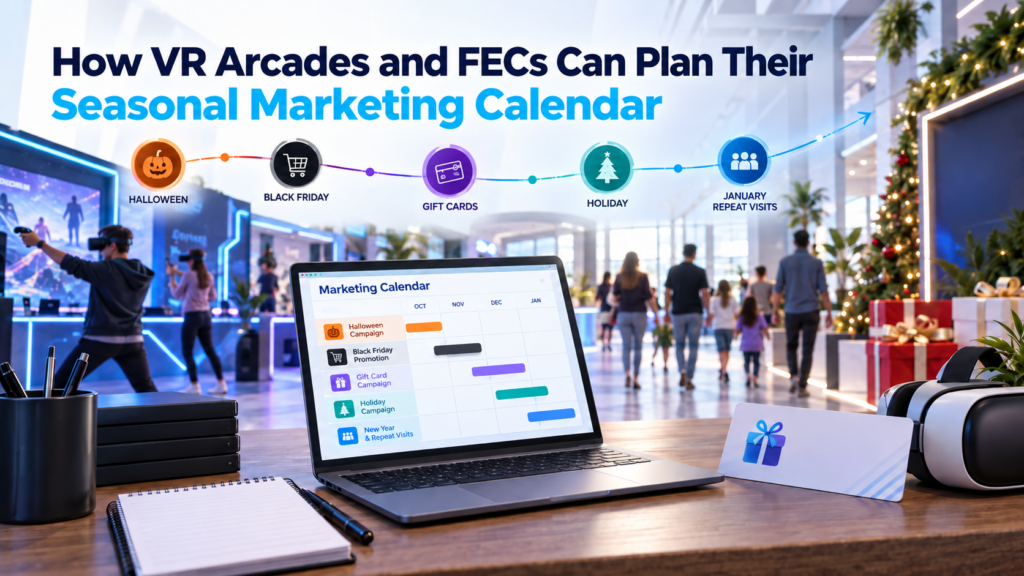
Seasonal marketing for VR arcades works best when the calendar tells the team more than what to post next. A useful seasonal marketing calendar should show who the venue wants to reach, what behavior the campaign should create, which offer fits that audience, how operations will deliver it, and what should happen after the visit. That matters because Halloween, Black Friday, Christmas, school breaks, corporate party season, and January do not create the same type of demand. A campaign that works for families during a school holiday may have little relevance to a corporate organizer planning a December event or somebody buying a VR experience as a Christmas gift. For VR arcades and family entertainment centers, there is another layer. The experience itself can change. Operators can rotate content, feature different multiplayer experiences, build seasonal packages, run competitions, and adapt the attraction mix without rebuilding the venue around every campaign. The result is a marketing calendar that connects customer demand with what the venue can actually deliver. Start with the moments that change customer behavior A seasonal calendar does not have to begin with a list of holidays. Start with the periods when the behavior of your customers changes. School breaks create family availability. Halloween creates demand for themed entertainment. November introduces holiday shopping and Black Friday. December can bring corporate parties, gift buying, visiting families, and school vacations. January may bring quieter general traffic alongside customers redeeming gifts they received during the holidays. Even the customer’s planning window can begin surprisingly early. The National Retail Federation reported that by early August 2026, one-quarter of consumers surveyed had already purchased at least one Halloween item. (National Retail Federation) For a physical entertainment venue, the relevant calendar also depends on its local market. A tourist destination, suburban family entertainment center, university-town arcade, and city-center VR venue can experience very different demand patterns. Bob Phibbs, The Retail Doctor, makes a related point in his guidance for seasonal brick-and-mortar businesses: seasonal demand is often connected to the occasion behind the purchase, including gifting and travel, rather than simply the date printed on the calendar. (Retail Doc) Before filling the calendar with promotions, operators should therefore ask: What changes in our customers’ lives during this period that gives them a reason to visit us? That question usually produces a better campaign than beginning with, “What should we post for Halloween?” Give every seasonal campaign one commercial job Seasonality creates attention. The venue still needs to decide what it wants that attention to accomplish. A Halloween campaign might exist to increase evening bookings among teens and young adults. A corporate Christmas campaign could target higher-value group reservations. A Black Friday offer might generate advance revenue through gift cards. A January campaign could encourage people who visited or received a gift during December to come back. This connects with the pricing framework we explored in our guide to VR arcade session prices, packages, and promotions. A promotion works better when the operator defines the behavior it should create before choosing the discount or package. A simple seasonal campaign might therefore have a goal such as: This also makes measurement easier. The operator already knows what success should look like before the campaign launches. Build each promotion around four connected layers A practical way to plan each seasonal campaign is what we can call the Seasonal Campaign Stack. Every campaign needs four layers: Demand: Who has a reason to visit during this period? Offer: What gives that customer a clear reason to book? Delivery: Can the venue reliably provide the experience being promoted? Follow-up: What should happen after that visit? Consider Halloween. Demand might come from friend groups, families, teenagers, or adults looking for something different to do around October 31. The offer could be a horror VR package, competitive Halloween night, family-friendly spooky session, or themed free-roam experience. Delivery means checking the content, licensing, player capacity, session length, staff briefing, booking flow, and hardware before the promotion goes live. Follow-up could move those customers toward a November event, Christmas gift card, new multiplayer experience, or another reason to return. We covered the package-building side in more depth in How to Build Halloween VR Arcade Packages for Different Audiences. The same four questions can then be reused for Black Friday, Christmas, Valentine’s Day, spring break, summer, back-to-school season, and local events. Choose the audience before choosing the message A venue may have several very different audiences inside the same customer database. A birthday parent, local teenager, tourist, corporate organizer, repeat player, and someone who bought a gift card are all customers. Their reasons for booking are completely different. This is especially important for email marketing. Neil Patel’s current guidance on email personalization emphasizes behavioral and transaction data rather than relying only on basic personalization such as a customer’s name. Segmentation can use previous purchases, engagement, location, behavior, and customer lifecycle stage to make the message more relevant. (Neil Patel) For an entertainment venue, that might mean: We explored this segmentation further in How VR Entertainment Venues Turn First-Time Visitors Into Repeat Customers. This is also why the seasonal calendar and the email calendar should eventually connect. Wednesday’s deeper email-marketing article can build on this part without repeating the whole seasonal strategy. Plan the content calendar with the marketing calendar This is where VR venues have an advantage over many traditional brick-and-mortar businesses. The building may stay exactly the same while the experience customers come to play changes. A horror title can move into the spotlight for Halloween. Competitive multiplayer can support a tournament or social event. Family-friendly experiences can lead during school breaks. Cooperative content may fit corporate or group campaigns. That means operators can plan what they promote and what customers will play at the same time. Our guide to VR arcade content rotation looks at this in more detail. Rotation does not always require licensing something new. Operators can feature an existing title, introduce a leaderboard, run a challenge, change staff recommendations, or bring
How VR Arcades Can Adapt to Summer Demand Shifts and Capture More Indoor Entertainment Traffic
Most VR arcade operators expect summer to bring more visitors. What many find instead is that summer changes booking behavior more than it changes overall demand. Seasonal patterns vary considerably across commercial VR venues. Tourist destinations often welcome an influx of first-time visitors. Local family entertainment centers may see regulars disappear for holidays. A rainy afternoon can transform a quiet Wednesday into one of the busiest periods of the week with only a few hours’ notice. For VR arcades, FECs, and location-based entertainment venues, marketing your VR arcade effectively in summer comes down to understanding who is likely to visit, how they make booking decisions, and whether the venue is ready to respond when demand shifts without warning. How Summer Actually Changes VR Arcade Marketing and Traffic Summer rarely increases demand evenly. The more common pattern across commercial LBE venues is a reshaping of when and how bookings arrive. Weekend sessions often stay healthy. Weekday utilization becomes harder to predict. Tourist-heavy markets see more first-time visitors, while local venues lose regulars to travel and outdoor activities. These patterns tend to run in parallel rather than canceling each other out, which means operators serving both local and tourist audiences may see strong overall numbers while still struggling with utilization on specific days and sessions. One weekend should not be read as a trend. Summer demand tends to arrive in waves driven by weather, local events, school schedules, and travel patterns, so a strong Saturday tells you less than you might expect about the following week. Operators who plan around consistent utilization rather than occasional spikes tend to manage the season more effectively. Why Heatwaves and Rainy Days Are Your Best Walk-In Opportunities Weather is one of the most reliable same-day demand drivers for indoor entertainment venues, and summer is when that effect is most pronounced. When outdoor plans fall apart, consumers search for alternatives the same day. Operators in family entertainment and attraction sectors have consistently noted that rainy weekends drive stronger attendance than clear-sky holiday weekends in some markets, with outdoor competitors like mini golf and go-karts seeing slower traffic while indoor venues pick up the difference. The mechanism is straightforward: a family with an afternoon free and a change in weather needs an answer quickly. What they search for reflects that urgency. Queries like “indoor activities near me,” “things to do with kids,” “VR arcade near me,” and “rainy day activities” are high-intent searches from people ready to book that day. Venues that answer those searches with clear, practical information, session length, pricing, group size, age suitability, what to expect on arrival, convert that traffic at a higher rate than venues that bury the details. Local SEO visibility and a clean booking page matter more in this moment than any promotional campaign. Summer Visitors Are Not One Audience A family booking a birthday party, a camp coordinator managing forty kids, a tourist couple with two free hours, and a group of friends deciding last-minute what to do on a Friday night all land in the same venue. They found it differently, they need different things, and they make decisions on very different timelines. Operators who recognize these differences can build offers, messaging, and scheduling structures that match the actual booking journey rather than defaulting to one-size promotional language. The booking pattern column in the graphic above is particularly useful for session planning: families plan ahead, camps book in advance to manage logistics, tourists decide same-day, and social groups move on short notice. A venue that can accommodate all four simultaneously, without staff coordination becoming the limiting factor, is in a structurally stronger position than one that handles them well in sequence but struggles when they overlap. Why Local Search Visibility Matters More in Summer Many summer visitors have never heard of your venue before. They find it through Google Search, Google Maps, tourism sites, local directories, and increasingly through AI-powered search results that surface venue recommendations directly in the answer rather than a list of links. Discoverability at that moment depends on two things: whether the venue appears in the results, and whether the listing answers the practical questions quickly enough to convert. Visitors searching for last-minute indoor activities are not browsing. They want session length, pricing, group size limits, and age recommendations without having to dig. Venues that surface that information clearly, in their Google Business Profile, on their booking page, and in their site copy, tend to win that traffic over venues with better attractions but harder-to-navigate information. This is also where structured data and locally relevant page content start to matter for venues that want to compete in AI-assisted search, where the answer shown to a user is often pulled from a single well-organized source rather than ranked links. Platforms like ROLLER, which works with thousands of FEC and attraction operators globally, note that seasonal promotions and clear online booking flows are among the highest-impact changes venues can make before peak periods. What to Review Before Peak Summer Traffic Arrives The checklist below covers three areas operators should audit before the season peaks: booking experience, local visibility, and operational readiness. Small improvements in clarity often create more bookings than additional advertising spend. A pricing page that answers questions without extra clicks, a Google Business Profile updated with current hours and photos, and staff briefed on same-day demand spikes are each lower-cost interventions than a paid campaign, and each one compounds across every visitor who arrives from organic search over the course of a season. Managing the Operational Complexity That Comes With Seasonal Variety On a busy summer day, a VR arcade might run a birthday party in the morning, a summer camp group at midday, tourist walk-ins through the afternoon, and a social multiplayer session in the evening. Each of those groups needs different content, different session structures, and different levels of staff involvement. That variety is manageable when volume is moderate. During weather-driven spikes, when two or three groups arrive within a short window