
How Much Space Do You Need for a Free-Roam VR Arena? A Practical Guide for Operators
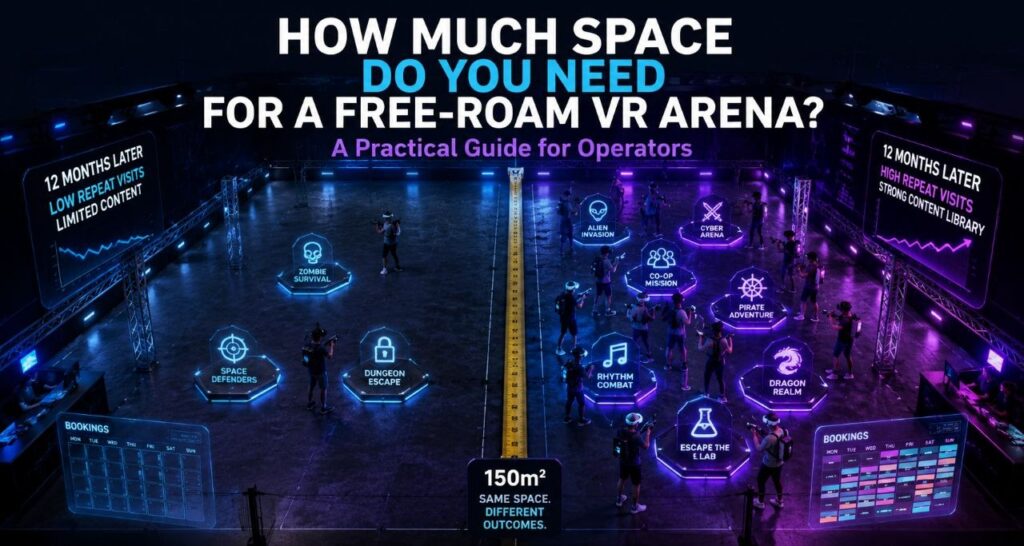
Two operators can open with the same floor plan and end up running completely different businesses. One launches with a handful of compatible experiences, burns through them within a few months, and watches repeat visit rates fall. The other builds a content rotation that supports birthday parties, corporate bookings, and returning regulars well into the second year. The space did not determine that outcome. The relationship between space, hardware, and content compatibility did. Most operators approaching this question want a number: minimum dimensions, something concrete for a lease negotiation or venue layout conversation. That number exists, and this article covers it. But the more important question is whether the footprint you choose gives you enough content range to run a profitable attraction twelve months after opening. What free-roam VR actually requires from a space Free-roam VR differs from room-scale in one practical way: players move independently through a shared physical space rather than standing in fixed positions. That movement creates simultaneous requirements for safety clearance, tracking reliability, and enough floor area that players are not colliding with each other or the play zone boundaries mid-session. Tracking systems, whether PCVR with external base stations or standalone inside-out on headsets like the PICO 4 Enterprise or HTC Vive Focus 3, need consistent line of sight across the full arena floor, low surface reflectivity, and adequate ceiling height. These requirements do not change with arena size, but they become harder to satisfy as the space grows and tracking zones multiply. The practical floor area question comes down to what the content itself requires. Across the commercial free-roam catalogue, 6x6m (20x20ft) is the standard minimum that the majority of titles are built around. Some compact titles run at 5x5m (16x16ft) or even 4x4m (13x13ft), but those represent a narrower selection. The 6x6m (20x20ft) threshold is where the bulk of available experiences become accessible. Arena size tiers and what each unlocks Commercial free-roam setups generally fall into four size bands. Each one changes not just capacity but content access. Entry: 5x5m / 16x16ft (25 sqm / 270 sq ft) A small number of titles are purpose-built for this footprint, typically compact shooters, escape room formats, and experiences designed for 2 to 4 players in tighter spaces. Great Train Outlaws, for example, runs at 5x5m for up to 4 players on PCVR. These setups can work as introductory or add-on attractions inside larger venues, but the content catalogue at this size is limited and operators tend to exhaust it faster than expected. Standard: 6x6m / 20x20ft (36 sqm / 390 sq ft) This is the most common minimum specification across the commercial free-roam catalogue, on both PCVR and standalone platforms. At 6x6m (20x20ft), the majority of available titles become accessible. Arizona Sunshine Remake: Free-Roam starts at 6x6m (20x20ft) for up to 4 players, available on both PCVR and standalone, and scales to 10x10m (33x33ft) for 8. Most operators opening a dedicated free-roam attraction should treat 6x6m as the baseline, not the floor. Mid: 8x8m / 26x26ft (64 sqm / 690 sq ft) Moving to 8x8m opens a meaningful jump in both player count and title variety. A significant portion of the catalogue lists 8x8m as the threshold for 6 to 8 player configurations. This is where team-based formats, competitive gameplay, and larger group bookings become viable without requiring a full large-arena footprint. Large: 10x10m / 33x33ft (100 sqm / 1,075 sq ft) The 10x10m tier unlocks the widest content library and the strongest commercial formats. After The Fall: Free-Roam illustrates the pattern clearly: at 6x6m (20x20ft) it supports 4 players, but the 8-player configuration requires 10x10m (33x33ft). Titles requiring this footprint tend to be the premium, high-capacity experiences, competitive league formats, large co-op missions, longer session durations, that justify higher ticket prices and drive stronger group booking performance. Why content compatibility matters as much as floor area When an operator locks in a footprint, they are also locking in a content ecosystem. Free-roam titles are built for specific arena dimensions, player counts, and hardware configurations. A game designed for 10x10m (33x33ft) with 8 players does not scale down to 6x6m (20x20ft) with 4. Content requiring PCVR tracking with external base stations cannot run on a standalone-only deployment. In practice, the titles available to a compact standalone arena are a genuine subset of what is available to a larger PCVR setup, and that subset narrows further at the entry tier. The question operators tend to underestimate is not “How many experiences do I have at launch?” It is “How long before my regular customers have played all of them?” A broader content library, and the ability to rotate in new titles regularly, is what extends the commercial life of the attraction past the initial novelty period. Operators who plan content strategy and footprint together tend to build more durable attractions than those who treat the two decisions separately. How space affects the commercial variables Session throughput is the first number most operators calculate: a 4-player session at 30 minutes plus 10 minutes of onboarding and reset gives roughly four sessions per hour per arena. Moving to 6 or 8 players changes the math, but it also changes which titles are accessible and which audience segments can be booked. Corporate groups, school trips, and birthday parties all have different minimum viable player counts, and a 4-player cap excludes a meaningful share of group booking demand. Audience flexibility follows from content range. A larger arena with diverse title options lets operators serve casual first-timers and returning experienced players on the same day by rotating experience types. A smaller arena with a narrower library tends to converge toward one primary audience, which limits growth when that segment is saturated. Infrastructure scalability is worth considering earlier than most operators do. A 6x6m arena built on an expandable PCVR backbone is relatively straightforward to grow. An arena built on standalone-only hardware may require a full equipment change to access the content catalogue that larger formats unlock. The setup decision often determines