
How VR Arcades Can Bring Customers Back With Simple Email Campaigns
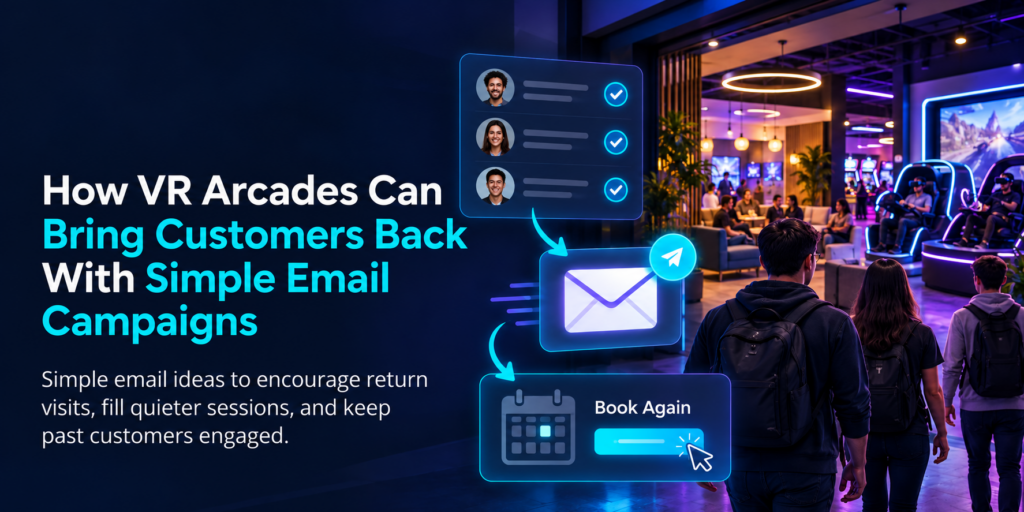
Your next booking could come from someone who has already visited your arcade. When did you last email them? During a recent conversation with VR arcade operators, one venue owner raised a familiar issue. They had collected customer contact details over time but hadn’t done anything with that information. They knew they should be emailing their customers. They simply hadn’t started. This is an opportunity worth exploring. Every customer who has visited your VR arcade already knows where you are, what you offer, and what playing VR feels like. Yet without regular communication, they might never hear about your new games, weekday specials, birthday packages, or seasonal events. A simple email can give previous visitors a reason to return. And you don’t need a marketing department, expensive software, or a complicated campaign to get started. Why Email Marketing Still Matters for VR Arcades in 2026 Email remains a useful way for businesses to maintain relationships with existing customers. According to the Data & Marketing Association’s Email Benchmarking Report 2026, email performance remains strong, with improving deliverability, declining unsubscribe rates, and record click-through rates across the UK market. For VR arcade operators, the practical advantage is straightforward. Your customers don’t necessarily follow your social media accounts. They might miss an announcement about a new multiplayer game or a weekday promotion. But if they’ve agreed to receive your emails, you have a way to communicate directly with them. You can remind them about an experience they enjoyed, introduce something new, or invite them back with a specific offer. The most useful messages answer one question: Why should this customer visit again? 6 Simple Emails Every VR Arcade Can Send You don’t need to create a new promotion every week. Start with the experiences, offers, and events your venue already has. Here are six practical email campaigns worth trying. The goal is to make each email useful and easy to act on. A customer who visited for a multiplayer session might be interested in a new cooperative game. A parent who previously booked a birthday party may appreciate information about your current group packages. Even a short message can be effective when the offer matches the audience. 3 Ready-to-Use Email Templates for Your VR Arcade You can adapt these examples for your venue, replace the placeholders, and include a direct link to your booking page. Template 1: Thank Customers and Invite Them Back Template 2: Announce New Games Template 3: Fill Quieter Weekday Sessions What About Birthdays, Holidays, and Customers Who Haven’t Returned? Once you’ve sent your first few emails, you can expand into other occasions. Birthday invitations: If you’ve collected birthday information appropriately, remind eligible customers about group celebrations. Focus on what your package includes, the number of players, and how to book. Seasonal emails: Promote family entertainment during school breaks, Halloween experiences in October, or group activities during holiday periods. Returning customer emails: Reach out to customers who haven’t visited recently with a relevant game recommendation or invitation. If your records support it, start with customers whose last visit was approximately 60–90 days ago. You can also tailor messages to the type of experience customers previously enjoyed, provided you have reliable preference information and the appropriate permission to use it. These emails don’t need to be long. One clear offer and one booking link are often enough. How to Start Email Marketing for Your VR Arcade in 30 Minutes If you’ve never sent a marketing email to your customers, start small. Step 1: Check your existing customer contacts (5 minutes) Look at the contact information your venue already collects through bookings, customer registrations, or other systems. Identify which customers can legally receive marketing communications. Having an email address on file does not automatically mean you can use it for promotions. Step 2: Choose one reason to email (5 minutes) Perhaps you’ve added a game, have availability on Tuesday afternoons, or want to encourage first-time visitors to book again. Start with one clear message for one relevant audience. Step 3: Pick a simple email tool (10 minutes) If you’re contacting a small number of customers individually, your existing business email may be sufficient. For regular campaigns, a dedicated email marketing platform makes it easier to manage audiences, templates, unsubscribes, and performance. Tool Suitable for Gmail or Outlook Occasional individual communication Mailchimp Newsletters, promotions, and customer lists Brevo Email campaigns and automated workflows MailerLite Simple newsletters and email sequences ActiveCampaign Advanced customer segmentation and automation Use a dedicated marketing platform for bulk promotional emails rather than sending mass messages through an ordinary personal inbox. Step 4: Write and send your first campaign (10 minutes) Choose one of the templates above. Replace the placeholders, check that your booking link works, and send a test email to yourself. Make sure the message clearly identifies your business and includes the required unsubscribe option. You now have your first campaign ready. The next step is to check whether anyone booked because of it. How SynthesisVR Can Support Customer Email Marketing If your VR arcade uses SynthesisVR, you may already have access to useful customer information and integration options. Within the SynthesisVR Web Console, the Customers page allows operators to view registered customer accounts, including names, email addresses where supplied, registration dates, and membership information. Customer details may be collected through SynthesisVR online bookings or waiver forms, depending on your venue setup. This provides a starting point for reviewing your existing customer records and identifying where you may need to improve marketing consent collection. For venues ready to automate more of their communication, SynthesisVR also provides integrations with email marketing platforms. Mailchimp integration SynthesisVR’s Mailchimp integration can synchronize customer information, including new registrations and booking-related data, with Mailchimp audiences. This can reduce manual data entry and help operators maintain their email lists. Marketing permissions and audience settings still need to be configured correctly. ActiveCampaign integration For operators who want more advanced workflows, the ActiveCampaign integration supports customer data synchronization and personalized marketing automation. Depending on the information
How VR Arcades and FECs Can Plan Their Seasonal Marketing Calendar
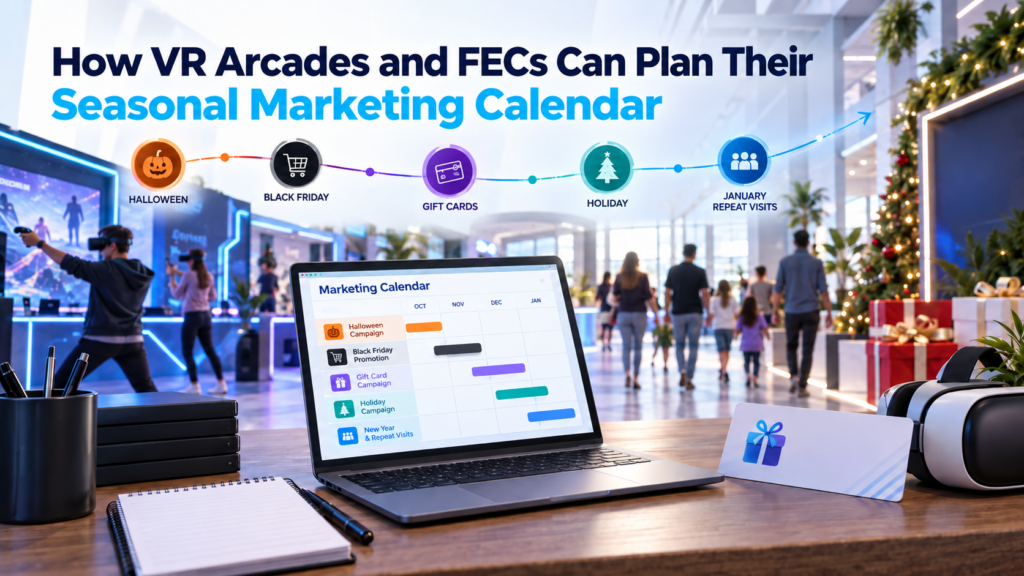
Seasonal marketing for VR arcades works best when the calendar tells the team more than what to post next. A useful seasonal marketing calendar should show who the venue wants to reach, what behavior the campaign should create, which offer fits that audience, how operations will deliver it, and what should happen after the visit. That matters because Halloween, Black Friday, Christmas, school breaks, corporate party season, and January do not create the same type of demand. A campaign that works for families during a school holiday may have little relevance to a corporate organizer planning a December event or somebody buying a VR experience as a Christmas gift. For VR arcades and family entertainment centers, there is another layer. The experience itself can change. Operators can rotate content, feature different multiplayer experiences, build seasonal packages, run competitions, and adapt the attraction mix without rebuilding the venue around every campaign. The result is a marketing calendar that connects customer demand with what the venue can actually deliver. Start with the moments that change customer behavior A seasonal calendar does not have to begin with a list of holidays. Start with the periods when the behavior of your customers changes. School breaks create family availability. Halloween creates demand for themed entertainment. November introduces holiday shopping and Black Friday. December can bring corporate parties, gift buying, visiting families, and school vacations. January may bring quieter general traffic alongside customers redeeming gifts they received during the holidays. Even the customer’s planning window can begin surprisingly early. The National Retail Federation reported that by early August 2026, one-quarter of consumers surveyed had already purchased at least one Halloween item. (National Retail Federation) For a physical entertainment venue, the relevant calendar also depends on its local market. A tourist destination, suburban family entertainment center, university-town arcade, and city-center VR venue can experience very different demand patterns. Bob Phibbs, The Retail Doctor, makes a related point in his guidance for seasonal brick-and-mortar businesses: seasonal demand is often connected to the occasion behind the purchase, including gifting and travel, rather than simply the date printed on the calendar. (Retail Doc) Before filling the calendar with promotions, operators should therefore ask: What changes in our customers’ lives during this period that gives them a reason to visit us? That question usually produces a better campaign than beginning with, “What should we post for Halloween?” Give every seasonal campaign one commercial job Seasonality creates attention. The venue still needs to decide what it wants that attention to accomplish. A Halloween campaign might exist to increase evening bookings among teens and young adults. A corporate Christmas campaign could target higher-value group reservations. A Black Friday offer might generate advance revenue through gift cards. A January campaign could encourage people who visited or received a gift during December to come back. This connects with the pricing framework we explored in our guide to VR arcade session prices, packages, and promotions. A promotion works better when the operator defines the behavior it should create before choosing the discount or package. A simple seasonal campaign might therefore have a goal such as: This also makes measurement easier. The operator already knows what success should look like before the campaign launches. Build each promotion around four connected layers A practical way to plan each seasonal campaign is what we can call the Seasonal Campaign Stack. Every campaign needs four layers: Demand: Who has a reason to visit during this period? Offer: What gives that customer a clear reason to book? Delivery: Can the venue reliably provide the experience being promoted? Follow-up: What should happen after that visit? Consider Halloween. Demand might come from friend groups, families, teenagers, or adults looking for something different to do around October 31. The offer could be a horror VR package, competitive Halloween night, family-friendly spooky session, or themed free-roam experience. Delivery means checking the content, licensing, player capacity, session length, staff briefing, booking flow, and hardware before the promotion goes live. Follow-up could move those customers toward a November event, Christmas gift card, new multiplayer experience, or another reason to return. We covered the package-building side in more depth in How to Build Halloween VR Arcade Packages for Different Audiences. The same four questions can then be reused for Black Friday, Christmas, Valentine’s Day, spring break, summer, back-to-school season, and local events. Choose the audience before choosing the message A venue may have several very different audiences inside the same customer database. A birthday parent, local teenager, tourist, corporate organizer, repeat player, and someone who bought a gift card are all customers. Their reasons for booking are completely different. This is especially important for email marketing. Neil Patel’s current guidance on email personalization emphasizes behavioral and transaction data rather than relying only on basic personalization such as a customer’s name. Segmentation can use previous purchases, engagement, location, behavior, and customer lifecycle stage to make the message more relevant. (Neil Patel) For an entertainment venue, that might mean: We explored this segmentation further in How VR Entertainment Venues Turn First-Time Visitors Into Repeat Customers. This is also why the seasonal calendar and the email calendar should eventually connect. Wednesday’s deeper email-marketing article can build on this part without repeating the whole seasonal strategy. Plan the content calendar with the marketing calendar This is where VR venues have an advantage over many traditional brick-and-mortar businesses. The building may stay exactly the same while the experience customers come to play changes. A horror title can move into the spotlight for Halloween. Competitive multiplayer can support a tournament or social event. Family-friendly experiences can lead during school breaks. Cooperative content may fit corporate or group campaigns. That means operators can plan what they promote and what customers will play at the same time. Our guide to VR arcade content rotation looks at this in more detail. Rotation does not always require licensing something new. Operators can feature an existing title, introduce a leaderboard, run a challenge, change staff recommendations, or bring
How to Build Halloween VR Arcade Packages for Different Audiences
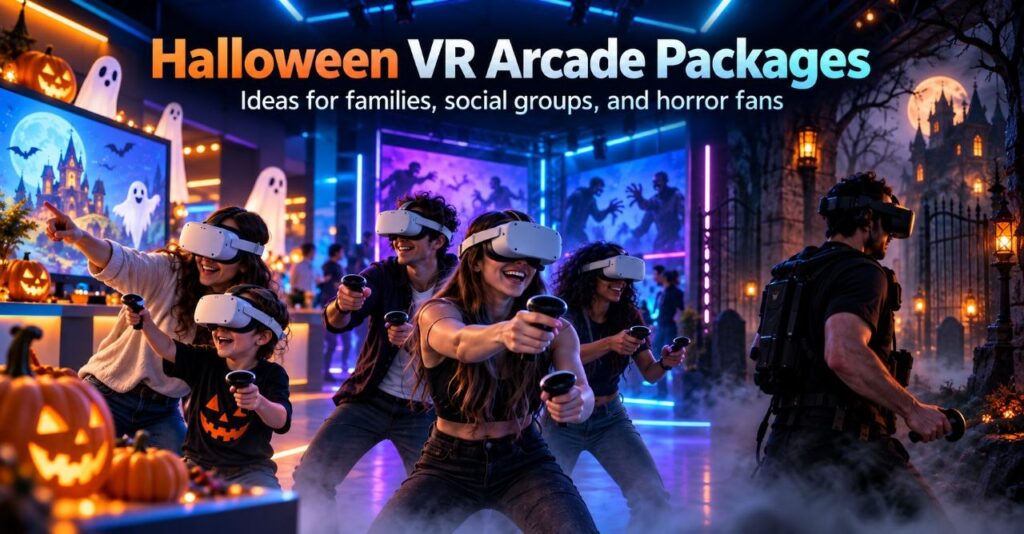
Halloween gives VR arcades an easy reason to change what customers see, promote experiences that may spend less time in the spotlight during the rest of the year, and create a seasonal offer around content they already have access to. The timing matters. Halloween VR arcade packages should be ready before customers start deciding what to do in late October. In our recent guide to planning VR arcade seasonal promotions before demand peaks, we suggested starting internal planning around six to eight weeks before a major event, followed by the main customer-facing campaign roughly four to six weeks ahead. For Halloween 2026, that window is already open. Operators starting now still have time to choose content, define the offer, test the experience, prepare the booking page, and begin promotion well before October 31. The offer itself can stay simple. A venue might sell a themed block of VR time with several Halloween game choices. Another might add snacks, drinks, a group photo, or a small Halloween treat. A free-roam venue can reserve the arena for a dedicated spooky session. The right format depends on who the venue wants to bring in. Start With the Audience Before Choosing the Scare Halloween content covers a much wider range than traditional horror. A family with younger players may want pumpkins, ghosts, candy, and supernatural themes without intense scares. A group of teenagers or young adults may want something more suspenseful, social, or competitive. Adult groups can move into darker escape experiences, psychological horror, zombies, and stronger jump scares. That is why the content decision should start with the customer rather than the genre. The same principle applies throughout the year. Our guide to choosing VR arcade games for different customer groups looks at audience fit alongside hardware, available space, player capacity, session length, and staff workflow. A Halloween campaign simply gives operators a seasonal reason to apply the same process. A useful starting point is to define the intensity of each Halloween offer clearly. Labels such as Family Spooky, Scary, and Full Horror can help customers understand what they are booking before they arrive. Turn Halloween Content Into a Bookable Package A seasonal offer works better when customers can understand it in a few seconds. The venue can keep the entry-level package focused entirely on VR. Food, drinks, party space, or other extras can sit in higher tiers if the operation supports them. The packaging principles are similar to those we covered in our guide to VR arcade birthday party packages. Customers respond better when the total visit length, group size, price, session format, and included extras are clear before checkout. For Halloween, the additional question is simple: How scary is this going to be? Answer that on the booking page. Where to Find Halloween VR Content Operators running PCVR and room-scale stations can start with the dedicated Halloween VR content category. It currently brings together titles such as Halloween Candy Reclaim, The Obsessive Shadow, Fear of the Dark, Cosmodread, Dreadhalls, Escape Bloody Mary, and AFFECTED: The Manor, among others. Free-roam operators should also browse the dedicated SynthesisVR free-roam library. The free-roam section separates content by setups including PCVR, PICO, HTC Focus, and Quest, which matters when an operator needs Halloween content that fits an existing arena rather than a room-scale station. That distinction also helps operators avoid choosing a Halloween title based on theme alone and discovering later that the platform, player count, or physical footprint does not fit the venue. Family-Friendly Halloween VR Family Halloween content can use the season without turning the visit into a horror experience. Halloween Candy Reclaim is a PCVR room-scale example built specifically around that idea. Players use pickle guns while recovering stolen candy from Halloween creatures. The experience describes itself as family-friendly and intentionally non-scary, with pumpkins, ghosts, skeletons, candy, seven levels, multiple difficulty settings, and local multiplayer. For a free-roam setup, Paranormal Pest Patrol offers another direction. Groups become paranormal exterminators dealing with mischievous demons inside a possessed house. Its comedic tone, simple controls, puzzle structure, E10+ rating, and support for groups of two to eight players make it easier to position as a spooky group adventure rather than full horror. Either could sit inside a family package with a fixed session length, Halloween snack, photo spot, or small treat at the end. The commercial value comes from the packaging. Parents do not need to understand the difference between every title in the library. They need to know that the experience fits their group and that nobody is walking into something far scarier than expected. Give Social Groups Something Spookier Older groups give operators room to increase the intensity. Fear of the Dark runs on PCVR room-scale and supports multiplayer for up to five people. Players protect the torch carrier while moving through a village filled with zombies, werewolves, monsters, bats, and other threats. Multiple difficulty settings give operators some flexibility around the group they are serving. Free-roam venues can look at experiences such as The Hallow, a PCVR free-roam title for two to eight players. Its supernatural 19th-century premise sends the group searching for abnormal activity under the guidance of a mysterious magician. This type of content can support a Halloween social offer aimed at friend groups, students, and young adults. The marketing can focus on bringing the group together, choosing how brave they want to be, and booking a fixed evening slot. We covered the wider booking behavior of this audience in How VR Entertainment Centers Attract Student Groups and Young Adult Audiences. Social-first promotion, clear pricing, multiplayer content, and a quick mobile booking path become especially relevant when the customer may decide on the activity with friends only a few days before the visit. Build a Stronger Horror Option for Adults Some customers will actively search for the most intense experience the venue can offer. For PCVR room-scale stations, AFFECTED: The Manor focuses heavily on atmosphere, lighting, audio, and a guided route through a haunted environment. Its design also makes
How VR Arcades Can Plan Seasonal Campaigns Before Demand Peaks
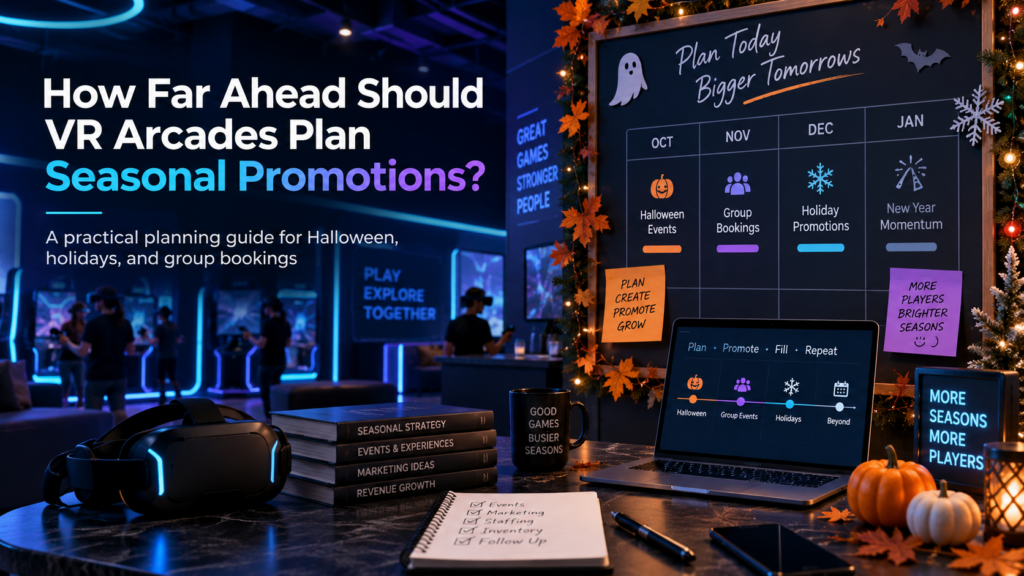
VR arcade seasonal promotions usually need more preparation time than customers ever see. For a major occasion such as Halloween or the winter holidays, a practical starting point is six to eight weeks before the event for internal planning, followed by the main customer-facing campaign about four to six weeks ahead. Promotions aimed at schools, corporate groups, or other organized bookings may need an even longer runway. The timing matters because a seasonal campaign involves more than preparing a few social posts. Operators may need to select content, check commercial licensing, build a package, set pricing, test the session, update the booking page, brief staff, and prepare marketing assets before the first customer sees the offer. Consumer behavior also starts earlier than the date on the calendar suggests. In September 2026, the National Retail Federation reported that one-quarter of Halloween consumers had already purchased at least one Halloween item by early August. In 2025, 49% started Halloween shopping before October. That retail data does not tell us exactly when someone will book a VR session, but it does show how early seasonal attention can begin. How Far Ahead Should VR Arcade Seasonal Promotions Start? There is no universal lead time that fits every venue or customer group. A local group of friends deciding what to do on Friday night behaves very differently from a school coordinator arranging a visit for 30 students. A company booking an end-of-year event may need approval several weeks before the date. A family looking for Halloween entertainment may decide within days. For planning purposes, operators can use the following ranges as a working model: These are planning ranges, not fixed industry rules. A venue should adjust them as its own booking data becomes available. The useful distinction is between when the venue starts preparing and when the customer starts seeing the campaign. Plan From the Customer’s Decision Date Start with the audience. A school may need approval, transportation arrangements, parental information, and a confirmed cost per student. That creates a longer booking cycle. Corporate groups may need several quotes before someone approves the event. December team activities can enter the planning stage while customers are still thinking about Halloween. Birthday bookings fall somewhere in the middle. Parents often compare several local entertainment options, check availability with other families, and choose a date before committing to a venue. Student and young-adult groups can move much faster. A multiplayer offer promoted on a Monday may generate bookings later that same week if the price, availability, and booking path are clear. The holiday date alone therefore tells the operator very little. The customer planning the visit determines how early the campaign needs to appear. Give the Venue Time to Prepare Before Promotion Begins The first part of the campaign happens behind the scenes. Before publishing the first seasonal post, an operator should know: This prevents an awkward situation where marketing creates interest before the actual offer is ready to book. It also gives staff time to test the experience under the conditions the campaign promises. If an offer advertises an eight-person Halloween session every 45 minutes, the venue needs to know that the content, headset preparation, onboarding, reset time, and staffing can support that schedule. The same logic applies to pricing. Seasonal demand may justify a package, extended session, group rate, competition, or themed event. Operators need enough time to check whether that offer still works after content licensing, staffing, and operating costs are included. Match Seasonal Content to a Clear Reason to Visit Seasonal marketing does not require an entirely new content library every few months. A venue may already have experiences that fit the occasion but receive little attention during the rest of the year. Horror titles can move forward before Halloween. Family experiences can support school-break campaigns. Competitive multiplayer can become the basis of a holiday challenge or student event. Our guide to VR arcade content rotation explains this in more detail. Operators can rotate which experiences receive attention without continually replacing the entire library. That distinction is useful when planning seasonal promotions. The operator can first decide what customer occasion the campaign needs to serve, then review the existing library for content that fits. A new commercial license becomes necessary only when the current attraction mix has a genuine gap. A Halloween 2026 Planning Example Halloween falls on Saturday, October 31 this year. An operator beginning the campaign in the week of September 7 still has enough time to build a structured promotion. September 7–13: Decide what the Halloween offer actually is. Choose the audience, featured content, price, eligible dates, player capacity, and session structure. Test the experiences staff will recommend. September 14–20: Prepare the booking page, visuals, email copy, social assets, staff instructions, and any local partner outreach. Confirm that the offer can be booked without customers having to contact the venue for basic information. September 21–October 4: Start the main customer campaign. Introduce the Halloween offer while people are already making seasonal plans. Give organized groups enough time to coordinate participants. October 5–18: Show the experience in more detail. Gameplay clips, venue footage, customer reactions, available dates, group size information, and clear pricing can answer the questions that appear after initial interest. October 19–31: Shift toward immediate booking decisions. Availability, remaining dates, same-week plans, and last-minute group opportunities become more relevant than explaining the campaign from the beginning. This timeline also avoids placing the full marketing burden on the final week of October. Start Thinking About the Next Season Before the Current One Ends Halloween provides a useful example of how seasonal calendars overlap. The National Retail Federation reports that around two in five winter-holiday shoppers typically start browsing and buying before November, and retailers have responded with holiday campaigns beginning in October. Again, retail shopping behavior and entertainment booking behavior are different, but the data shows that customer attention can move to the next occasion early. For a VR venue, that means winter planning can begin while the Halloween campaign
How VR Entertainment Venues Turn First-Time Visitors Into Repeat Customers
By the end of August, a VR venue’s guest list is usually the longest it will be all year. First-time bookings come in from tourists and from families killing a rainy afternoon. Some walk in on a whim after seeing a friend’s video. A single follow-up email or a discount code in September won’t turn that list into a customer base. Most of it has already forgotten the visit by then. A first-time guest hasn’t paid for themselves yet, not in any real sense. Getting them through the door costs something: an ad, a discount, a slow afternoon spent chatting them up at the front desk. That cost lands whether they ever come back or not. A guest who visits four times splits it four ways. One who visits once never splits it at all. Repeat behavior isn’t a nice outcome sitting on top of a good season. It’s where a first visit actually turns into a return on what it took to earn it. How VR Arcades Transition From Summer Traffic to Local Repeat Visitors covered the first half of this problem. Sort visitors at booking. Sell the second visit before the guest leaves the building. Build a monthly reason to come back. That gets a first-timer to book again once. It doesn’t explain what happens next, and next is where most venues quietly stop. Sort guests before you decide what to tell any of them A tourist, a birthday parent, and a local teenager who came in with friends are not the same guest wearing different clothes. Send all three the same “come back soon” message, and you waste it on at least two of them. None of this needs a marketing department. It needs a booking system that tags visit history, booking source, and what a guest actually played. Then the next message can speak to who they are, instead of the same one going out to everyone. The third visit decides whether it’s a habit or a coincidence What separates visit one from visit two is usually the offer: a discount, an invitation, a reason stated clearly enough to act on. What separates visit two from visit three is whether anything actually changed. Picture a guest’s second visit looking identical to their first: same headset, same game, same layout. They quietly file the venue under “done that.” They stop opening the next email. Content rotation is what decides whether a second visit turns into a third. A returning guest needs the second experience to feel different from the first. A rotating multiplayer lineup is the cheapest way to create that difference. It doesn’t require buying anything new. Content is what makes the second and third visit feel different Every operator agrees content should rotate. Fewer actually run it as a schedule with a name attached. A cadence that holds up in practice looks simple. One featured multiplayer title changes every month. Staff get a briefing and a new promo photo goes up before the swap. Every quarter, someone reviews the full catalog and checks what guests are actually replaying against what’s gathering dust. Seasonal and holiday-tied content, a Halloween tournament, a school-break event, a leaderboard reset, gives locals a reason to plan a visit around a date. That beats waiting for one more generic reminder. Without someone responsible for making the swap happen on a fixed date, “we rotate content” stays a good intention. It quietly reverts to whatever has been running since June. Follow-up has to match where each guest actually is Selling the second visit at checkout gets the first repeat booking. Keeping that guest past visit two takes follow-up timed to the individual, not to a shared send date. A guest who hasn’t rebooked thirty days after their last visit needs a different message than one who hasn’t rebooked in ninety. At thirty days, a simple nudge tied to whatever’s new that month usually works, because the visit is still fresh in their mind. At sixty, that guest needs a stronger reason: a themed event, a new season, something worth the trip back. By ninety days without a return visit, most guests have effectively lapsed. They belong on a separate, less frequent list, not the regular monthly send. Send a single “come back soon” campaign to the whole list, and it’s just a broadcast. A system responds to each guest’s own clock instead. Status and perks work harder than another discount code Regulars stop responding to the offer that got them in the door the first time. What still moves them is proof that you remember they’ve been in before. That can mean early access to a new multiplayer title before it goes live for everyone else. It can mean priority booking during a busy weekend slot. It can mean a leaderboard rank that carries over between visits. None of this requires a formal membership program. It requires remembering, visibly, that a guest has been in before, and giving them something a first-timer doesn’t get. That’s what keeps a third or fourth visit from feeling like the same transaction on repeat. A guest’s own clip sells the next visit better than your marketing does VR is one of the few attractions where the experience is genuinely worth filming. Picture a group failing a co-op mission, or a losing team taking heckles from whoever’s watching the spectator screen. That footage brings a friend group back with new people faster than any paid ad. Prompting it costs nothing. Position the spectator screen where it’s easy to film. Have a staff member offer to record the last thirty seconds of a session. Add a simple “bring a friend” offer for whoever books off someone else’s visit. Referrals and shared clips grow the guest list without adding to the acquisition cost this whole piece is trying to avoid. Local repeat guests carry the entire calendar once summer ends A repeat rate that feels like a bonus on top of steady July tourist traffic becomes something else
How VR Entertainment Centers Market After-School and Autumn Group Activities
Summer traffic finds you, but autumn traffic has to be booked. The families and walk-ins that filled a Tuesday afternoon in July are back in classrooms and offices by late September, and the weekday hours that once ran near capacity turn into the quietest, least profitable stretch of your week. Advertising harder rarely moves them, because the people worth reaching now don’t buy on impulse. They buy against a calendar and a budget. Autumn belongs to organized groups. After-school clubs, youth organizations, sports teams, student societies, and parents planning something for a dozen kids usually book ahead, and they are the demand that can carry weekday utilization from October through the holidays. Winning that demand takes a different playbook than a summer promotion aimed at whoever happens to be nearby. Sell to the buyer, not the crowd Every group booking has one person who approves it, and that person has a single question standing between you and a confirmed slot. A teacher needs to know your venue is safe and supervised before she brings thirty students across town. A five-a-side coach wants to hear that all eighteen players get a real turn inside the hour he’s paying for. A student society organizer cares whether the night is competitive enough to be worth posting about. Send all three the same “group discount” email and you have answered none of them. Sort your prospects by who signs off on the booking, then lead with the thing that unblocks them: The session behind all four offers can be identical. What converts is opening with the buyer’s real concern instead of your price list. Weekday afternoons are inventory, not leftovers The reflex is to discount quiet weekday hours until something fills them. Fencing them off as group-only inventory works better. Attach rules: a fixed block, a minimum head count that makes staffing the room worthwhile, a deposit to hold the date, and a release deadline so an unconfirmed group frees the slot in time to resell it. That changes the conversation with an organizer completely. You stop asking whether you can squeeze thirty kids in somewhere on a busy floor. You start offering a defined product with a capacity, a price, and a booking window, which is exactly what an organization planning three weeks out needs before it can commit. Groups book an outcome, never a headset No coordinator wants to rent VR headsets. They want a result they can defend to whoever signed the check. Enrichment coordinators book structured learning and teamwork. A coach books a session that carries back to the pitch. A society books a competitive night with a leaderboard and a clear winner. Package around what the group walks out with, and price that outcome rather than the hardware. Present these as sample formats, not house standards. A forty-minute cooperative session for a youth club and a ninety-minute competitive bracket for a society give an organizer something concrete to picture, without you pretending there’s an industry rulebook behind it. Six stations can host eighteen people The objection that quietly kills group bookings is capacity. An organizer counts your six stations, divides eighteen players by six, and decides you’re too small for the group. You aren’t, and walking them through why is the most persuasive thing you can put on a booking page, because almost no venue bothers to explain it. Here is the math on six stations and eighteen players. Split them into three teams of six. One team plays while the other two track the leaderboard, plan their runs, and coach from the sideline. Run three rounds of twelve to fifteen minutes and rotate a fresh team in between each one, and every player gets a full turn inside the hour. The waiting teams are not dead weight; the heckling and the rivalry between rounds are where a group session gets its energy, and free-roam multiplayer and arena titles are built for exactly this team-versus-team format. That rotation is what lets a modest room sell to a party of eighteen with a straight face, and it hands your staff one structure they can run identically every time. When an organizer is deciding whether to trust you with a class of thirty, a clear plan beats raw station count every time. Group bookings come from a list, not a landing page Waiting for a coordinator to stumble onto your booking page is not a plan. Group business comes from a short, worked list of nearby schools, youth clubs, sports leagues, and student societies, and from getting their organizer through your door before they commit anyone. Invite coordinators in for a fifteen-minute preview so they see the space and the supervision for themselves. Send them off with a one-page pack covering capacity, timing, pricing, and suitability, plus a parent email they can forward without rewriting a line. Then follow up, because this cycle is slow by design. A coordinator who previews in September and books a Halloween tournament in October is a normal sale, not a lost lead. Add a ten-second clip of a live session to everything you hand over. A real group mid-game closes the booking better than any paragraph describing it. One format, a whole season of names You do not need a new offer every month. One group format, re-skinned, covers the entire autumn calendar. The same cooperative-or-competitive session becomes a back-to-school challenge in September, a Halloween tournament in October, a student league that runs through term, a sports-team social whenever a coach asks, and an early holiday team event in December. The operating process underneath never changes. Only the theme on the flyer does, which is what keeps the season profitable instead of exhausting. The booking only repeats if the delivery holds A group format earns its place only if any staff member can run it the same way on a full Saturday. That means the unglamorous layer most venues skip: saved content playlists, a fixed briefing script, clear age and intensity labels, a spectator
How VR Arcades Fill Empty Weekday Sessions Without Discounting
For most VR arcades, family entertainment centers (FECs), and location-based entertainment (LBE) venues, Friday evenings and weekends take care of themselves. The real operational challenge begins on Monday morning. Every empty VR session between Monday and Thursday represents revenue that can never be recovered. Unlike retail inventory, unused attraction capacity expires forever. Once a 3:00 PM session passes without players, that opportunity is gone. Many operators respond by introducing weekday discounts. While discounts may increase short-term bookings, they rarely solve the underlying problem. Over time, they can even reduce profitability by training customers to wait for lower prices. The strongest operators take a different approach. Rather than lowering prices, they redesign how weekday demand is created, packaged, and managed. They treat weekday utilization as an operational challenge—not simply a marketing one. Why Weekday Utilization Matters More Than It Looks A single underperforming weekday can offset gains from a strong Saturday. Across an entire year, consistent weekday gaps compound into a meaningful revenue shortfall, particularly for venues carrying fixed overhead on VR hardware and dedicated attraction space. Analysts estimate the location-based VR market will reach approximately $2.76 billion in 2026 and continue growing rapidly through the end of the decade. As more operators enter the market, long-term performance increasingly depends on operational consistency rather than novelty alone. Utilization influences several areas that operators often underestimate: A quieter Tuesday session often provides a better guest experience than a fully booked Saturday. That difference can influence reviews, referrals, and future bookings long after the session ends. Why Many VR Venues Struggle to Fill Weekday Sessions Empty weekdays rarely reflect a lack of interest in VR. More often, they reflect a mismatch between how the attraction is offered and how people organize their time during the week. Weekday audiences behave differently from weekend visitors. Families work around school schedules. Friend groups need low-friction planning and simple booking. Students coordinate around evening availability. Corporate groups require a clear reason to justify an outing during business hours. Tourists operate on unpredictable schedules and shorter decision windows. Many venues build their booking structure around peak weekend behavior and then expect those same systems to perform throughout the week. Across commercial VR venues, free-roam and room-scale attractions often attract different audiences and booking behaviors. Operators who understand those patterns tend to build more balanced attraction portfolios and create offers that fit specific weekday audiences rather than treating all bookings the same. Common friction points include: Operators regularly use group pricing for schools, sports teams, corporate outings, and social groups because those audiences can help fill capacity that would otherwise remain unused during off-peak periods. How Can VR Arcades Increase Weekday Bookings? Discounting can increase attention, but it does not always address the reasons people delay or avoid booking. Operators often discover that price is only one part of the equation. Weekday attendance depends just as heavily on how easily groups can organize, book, and commit to an experience. Across the broader FEC industry, structured group experiences consistently outperform discount-heavy approaches. Birthday packages, corporate events, school programs, and group offers simplify decision-making for organizers and reduce booking friction. The same principle applies directly to VR. A group of six friends can easily postpone a VR outing if one person must coordinate payments, explain the experience, and organize schedules. That same group is more likely to commit when presented with a simple package: “Six-player session. One booking. Clear pricing. Clear experience.” Tying package benefits to off-peak windows, school calendars, or local community schedules can help smooth demand throughout the week without reducing prices across the board. Operators in bowling centers, laser tag venues, and escape rooms have applied this approach for years. VR arcades that design around group booking behavior often see stronger weekday utilization because they make participation easier to organize. Why Repeat Visits Create More Stable Revenue Than Acquisition Spikes One-time visitors are difficult to predict. Repeat visitors create more consistent demand patterns and often generate greater value over time. Operators frequently focus on acquiring new players while underestimating how much weekday utilization depends on giving existing customers a reason to return. A local customer who visits twice per month often contributes more revenue across a year than a tourist who visits once during a holiday. One recurring pattern across commercial VR venues is that players rarely ask how many titles are available. They ask whether there is something new to try since their last visit. The challenge for many VR venues is content fatigue. VR experiences are highly immersive, but they are also finite. Once visitors feel they have experienced everything available, motivation to return declines. Content rotation helps address this challenge. Venues that regularly introduce new experiences, seasonal content, multiplayer options, or fresh attraction formats create natural opportunities for return visits. Over time, this helps shift the venue from being perceived as a one-time activity into a recurring social destination. Promoting new experiences through social media, email campaigns, loyalty programs, and in-venue signage gives operators a practical way to convert content updates into measurable return traffic. The Role of Attraction Variety and Social Session Design The strongest operators rarely depend on a single experience type to support weekday traffic. An attraction mix that includes competitive multiplayer experiences, shorter repeatable sessions, free-roam attractions, and room-scale content provides flexibility when serving different audience segments. Weekday utilization rates for entertainment venues often fall between 40% and 50%, compared to 75% to 85% during weekends. Successful operators plan around that reality rather than treating it as a temporary problem. Multiplayer VR experiences naturally align with how social groups plan activities. A group of friends, a student organization, a sports team, or a corporate department all require a reason to commit and a simple booking process. Clearly packaged multiplayer experiences remove barriers that often prevent those groups from converting. Operator Reality Check Several operators invested heavily in new hardware while weekday utilization remained inconsistent. Attendance often improved temporarily before returning to previous patterns. Many operators expect new equipment or newly
How VR Arcades Can Adapt to Summer Demand Shifts and Capture More Indoor Entertainment Traffic
Most VR arcade operators expect summer to bring more visitors. What many find instead is that summer changes booking behavior more than it changes overall demand. Seasonal patterns vary considerably across commercial VR venues. Tourist destinations often welcome an influx of first-time visitors. Local family entertainment centers may see regulars disappear for holidays. A rainy afternoon can transform a quiet Wednesday into one of the busiest periods of the week with only a few hours’ notice. For VR arcades, FECs, and location-based entertainment venues, marketing your VR arcade effectively in summer comes down to understanding who is likely to visit, how they make booking decisions, and whether the venue is ready to respond when demand shifts without warning. How Summer Actually Changes VR Arcade Marketing and Traffic Summer rarely increases demand evenly. The more common pattern across commercial LBE venues is a reshaping of when and how bookings arrive. Weekend sessions often stay healthy. Weekday utilization becomes harder to predict. Tourist-heavy markets see more first-time visitors, while local venues lose regulars to travel and outdoor activities. These patterns tend to run in parallel rather than canceling each other out, which means operators serving both local and tourist audiences may see strong overall numbers while still struggling with utilization on specific days and sessions. One weekend should not be read as a trend. Summer demand tends to arrive in waves driven by weather, local events, school schedules, and travel patterns, so a strong Saturday tells you less than you might expect about the following week. Operators who plan around consistent utilization rather than occasional spikes tend to manage the season more effectively. Why Heatwaves and Rainy Days Are Your Best Walk-In Opportunities Weather is one of the most reliable same-day demand drivers for indoor entertainment venues, and summer is when that effect is most pronounced. When outdoor plans fall apart, consumers search for alternatives the same day. Operators in family entertainment and attraction sectors have consistently noted that rainy weekends drive stronger attendance than clear-sky holiday weekends in some markets, with outdoor competitors like mini golf and go-karts seeing slower traffic while indoor venues pick up the difference. The mechanism is straightforward: a family with an afternoon free and a change in weather needs an answer quickly. What they search for reflects that urgency. Queries like “indoor activities near me,” “things to do with kids,” “VR arcade near me,” and “rainy day activities” are high-intent searches from people ready to book that day. Venues that answer those searches with clear, practical information, session length, pricing, group size, age suitability, what to expect on arrival, convert that traffic at a higher rate than venues that bury the details. Local SEO visibility and a clean booking page matter more in this moment than any promotional campaign. Summer Visitors Are Not One Audience A family booking a birthday party, a camp coordinator managing forty kids, a tourist couple with two free hours, and a group of friends deciding last-minute what to do on a Friday night all land in the same venue. They found it differently, they need different things, and they make decisions on very different timelines. Operators who recognize these differences can build offers, messaging, and scheduling structures that match the actual booking journey rather than defaulting to one-size promotional language. The booking pattern column in the graphic above is particularly useful for session planning: families plan ahead, camps book in advance to manage logistics, tourists decide same-day, and social groups move on short notice. A venue that can accommodate all four simultaneously, without staff coordination becoming the limiting factor, is in a structurally stronger position than one that handles them well in sequence but struggles when they overlap. Why Local Search Visibility Matters More in Summer Many summer visitors have never heard of your venue before. They find it through Google Search, Google Maps, tourism sites, local directories, and increasingly through AI-powered search results that surface venue recommendations directly in the answer rather than a list of links. Discoverability at that moment depends on two things: whether the venue appears in the results, and whether the listing answers the practical questions quickly enough to convert. Visitors searching for last-minute indoor activities are not browsing. They want session length, pricing, group size limits, and age recommendations without having to dig. Venues that surface that information clearly, in their Google Business Profile, on their booking page, and in their site copy, tend to win that traffic over venues with better attractions but harder-to-navigate information. This is also where structured data and locally relevant page content start to matter for venues that want to compete in AI-assisted search, where the answer shown to a user is often pulled from a single well-organized source rather than ranked links. Platforms like ROLLER, which works with thousands of FEC and attraction operators globally, note that seasonal promotions and clear online booking flows are among the highest-impact changes venues can make before peak periods. What to Review Before Peak Summer Traffic Arrives The checklist below covers three areas operators should audit before the season peaks: booking experience, local visibility, and operational readiness. Small improvements in clarity often create more bookings than additional advertising spend. A pricing page that answers questions without extra clicks, a Google Business Profile updated with current hours and photos, and staff briefed on same-day demand spikes are each lower-cost interventions than a paid campaign, and each one compounds across every visitor who arrives from organic search over the course of a season. Managing the Operational Complexity That Comes With Seasonal Variety On a busy summer day, a VR arcade might run a birthday party in the morning, a summer camp group at midday, tourist walk-ins through the afternoon, and a social multiplayer session in the evening. Each of those groups needs different content, different session structures, and different levels of staff involvement. That variety is manageable when volume is moderate. During weather-driven spikes, when two or three groups arrive within a short window