
How Much Guidance Should VR Arcade Staff Give Players?
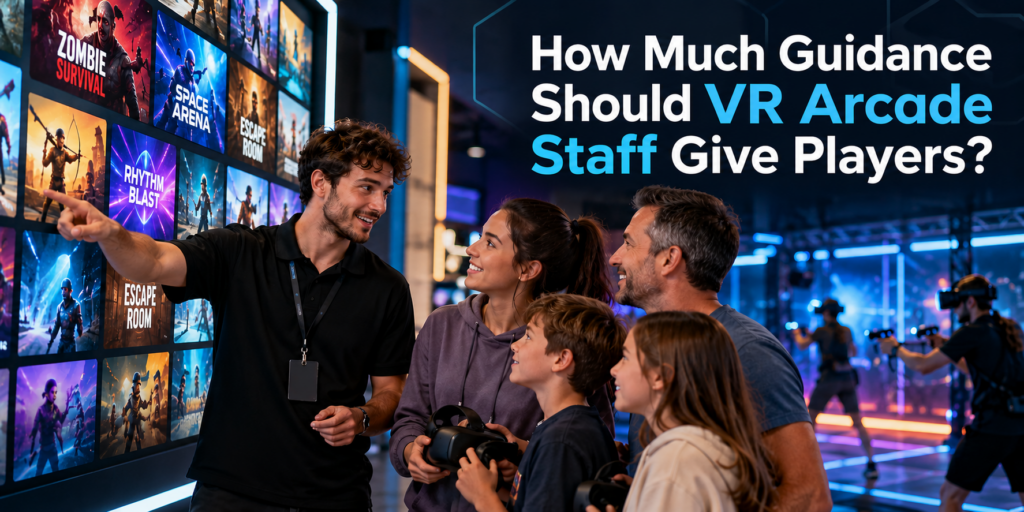
A strong VR content library gives customers choice, but choice alone does not guarantee a good experience. Staff still need to understand who an experience is for, how it starts, what players need to know before putting on the headset, and when they may need help. That makes staff guidance an important part of running a VR arcade, particularly for first-time visitors who have little idea what to choose or what to expect. Why VR Players Need More Guidance Than They May Realize Experienced VR players may arrive knowing exactly what they want. Many customers do not. A family with children, a birthday group, two adults trying VR for the first time and a group of experienced gamers can all walk into the same venue with very different expectations. Asking them to browse a large game library without guidance puts much of the decision on the customer. The goal is not to make the decision for the customer. It is to turn a potentially overwhelming library into a manageable set of experiences that fit the group. Staff Should Know the Content They Are Offering This was one of the interesting issues raised in our recent conversations with VR arcade operators. Adding an experience to the library and waiting to see whether customers play it provides limited information about whether the content itself is working. A game may receive little play because customers cannot tell what it is from the title or thumbnail. Staff may rarely recommend it. Players may start it without understanding the objective. A group may choose something poorly suited to its size or experience level. The operator can then conclude that customers simply do not like the game. That conclusion may be wrong. Before staff recommend an experience, they should ideally know: What is the experience about?Staff should be able to explain the basic premise in one or two sentences. Who is it suitable for?Consider age, VR experience, group size, physical intensity and genre. How does the experience begin?Some games are immediately intuitive. Others require players to understand controls, roles or objectives before the session starts. What commonly causes players difficulty?Knowing where people tend to get stuck allows staff to intervene quickly instead of leaving players frustrated. What hardware and play space does it require?A recommendation still has to work with the venue’s available setup. This is one reason properly testing VR arcade games before adding them to the active library matters. Staff who have actually played an experience can explain it much more naturally than staff working from a title and description alone. Guidance Starts Before the Headset Goes On Some of the most useful guidance happens before gameplay begins. A good introduction does not need to become a five-minute tutorial. In many cases, players only need a few pieces of information: What am I trying to do?Give the player the objective. What do I need to know to get started?Explain the essential controls or interaction. What should I expect?If players will move between stages, communicate with teammates, physically turn around or encounter something intense, tell them beforehand. This is especially important with first-time VR users. They are learning the game and learning how to interact in VR at the same time. Giving them the right information before the session can reduce confusion once the headset is on. During the Game, Help Without Taking Over There is another extreme operators should avoid: over-guiding. A puzzle is less satisfying if a staff member immediately gives away the solution. Exploration loses its appeal if someone constantly tells players where to go. Experienced players may want very little assistance. The best level of support therefore changes with the player and the experience. Staff should know when a player is discovering and when a player is simply stuck. Someone experimenting with different solutions may be enjoying the game exactly as intended. Someone repeating the same failed interaction for several minutes may need a small prompt. Start with the least intrusive intervention: Prompt → hint → explanation → direct assistance That preserves player agency while preventing frustration from consuming a large part of a paid session. Technical Problems Need Fast Intervention Gameplay guidance and technical support are different. If tracking fails, a controller disconnects, a headset loses connection or the game does not progress correctly, waiting for the player to solve the problem wastes session time. Staff need enough familiarity with both the content and the venue setup to recognize when the problem is technical. This becomes particularly important during busy periods. A problem that takes an experienced staff member 30 seconds to identify can consume several minutes when the person supervising the session does not know what normal gameplay should look like. Knowing the game is therefore part of troubleshooting it. Better Recommendations Can Improve Content Utilization Staff knowledge also affects which games get played. Imagine a venue has 40 experiences available, but employees confidently recommend only five because those are the games they know best. From the customer’s perspective, the venue effectively has a five-game library. The remaining content may be technically available, but it is doing little work for the business. Training staff across a carefully selected range of experiences can help venues make better use of the content they already license. It also gives operators better information when deciding what to keep, rotate or replace. Instead of asking only: “How often was this game launched?” operators can also ask: “Did we recommend it to the right customers?” That is a much more useful question when evaluating content performance. Build a Simple Content Knowledge System for Staff Staff do not need to memorize every detail of every game. A simple internal reference can make recommendations much easier. For each active experience, record: This also makes onboarding new employees easier. Rather than expecting them to learn an entire commercial VR library at once, operators can establish a core group of experiences every staff member should know well and expand from there. Let Your VR Management System Handle the
VR Arcade Pricing: How to Set Session Prices, Packages, and Promotions
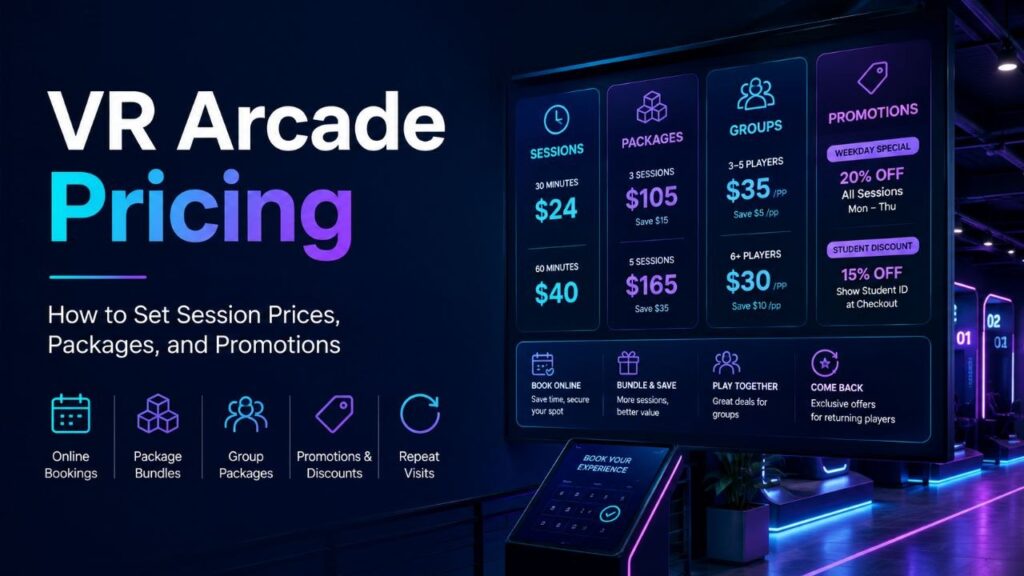
There is no universal number for VR arcade pricing. Two venues can run similar hardware and content, yet need different prices because they serve different customers, compete with different attractions, carry different costs, and sell different types of outings. A tourist-center arena, a suburban family entertainment center, and a university-town VR venue should not inherit the same rate card by default. A useful pricing process starts before the price itself. Define the local market, map the alternatives customers already buy, calculate the economic floor, decide what each package promises, and then test the result against real booking behavior. That approach draws on decades of retail, service, and pricing research rather than one current pricing formula. A practical VR arcade pricing framework The three questions work together. Cost-based pricing alone can ignore demand. Competitor matching can copy somebody else’s economics. Value language without a financial floor can create a popular offer that does not contribute enough to the venue. VR arcade pricing starts with the local market Wendell Smith’s 1956 work on market segmentation treated heterogeneous demand as a basic marketing reality: different groups can respond to different offers instead of behaving like one uniform market. For a physical venue, geography narrows that idea further. David Huff’s trade-area work defined the market around a geographically bounded pool of potential customers and the probability that they will choose a location. The U.S. Small Business Administration still advises small businesses to examine demand, market size, income, location, saturation, demographics, and what customers pay for alternatives. For a VR arcade, that means defining the realistic catchment area before copying a national or industry average. A venue near a tourist district may rely on one-time visitors with short decision windows. A suburban FEC may depend more on families, parties, schools, and repeat local groups. A university town can have strong evening demand but a lower willingness to pay for a premium single-player session. Research the customer’s real alternatives A venue that checks only other VR arcades sees too little of the market. Michael Porter’s competitive strategy work warned against viewing competition too narrowly. For an entertainment business, substitutes matter because customers usually begin with an occasion, budget, and group rather than a fixed commitment to VR. A family choosing a Saturday activity may compare VR with bowling, laser tag, a trampoline park, an escape room, karting, cinema, or another FEC. A company planning team building can compare the same VR venue with dinner, an escape room, a workshop, or a private event space. Research set Record Avoid Direct VR competitors Per-person price, duration, group size, private/shared format, packages, cancellation terms, memberships. Copying the headline price without understanding what the customer receives. Substitute entertainment Total group spend, time commitment, private access, food/party space, social proof, booking friction. Assuming VR competes only with VR. Local premium options What customers already pay for higher-end social experiences and events. Using household income alone as a willingness-to-pay measure. Low-cost alternatives Free or inexpensive activities that compete for the same time slot. Treating every lost booking as a pricing problem. Calculate the economic floor before testing value Pricing research has long treated price as a managerial decision with several inputs rather than a simple markup. Monroe and Della Bitta’s 1978 review examined the major pricing decisions managers face and the models used to support them. For a venue, the first financial check is straightforward: understand what each booking contributes after the costs that move with that sale, then test whether expected sales can cover fixed costs. SBA break-even guidance uses fixed costs, selling price, variable cost, and contribution margin for exactly this reason. A VR operator should include the costs that genuinely change with a session or package, then keep rent, salaried labor, insurance, depreciation, financing, and similar fixed costs visible in the wider model. Mixed attractions and packages often need separate calculations because a private arena booking does not behave like a single booth session. Related SynthesisVR reading: Free-Roam VR Arena Cost Analysis and How VR Arcades Actually Make Money Price the use case, not only the headset minutes B. Joseph Pine II and James H. Gilmore’s 1998 work on the experience economy argued that businesses can create economic value by staging an experience rather than competing only on the underlying good or service. Location-based entertainment fits that logic unusually well. A customer rarely wakes up wanting to buy 30 headset minutes. They may want a private activity for four friends, a birthday that is easy to host, a date-night plan, a school visit, or a team event that does not require the organizer to manage the details. Use case What the buyer may value Pricing structure to test Walk-in / first visit Low commitment, clarity, fast start. Per-person session or short introductory format. Friends / social group Playing together, simple group total, private access. Group bundle or private arena rate. Birthday Predictable total cost, host support, room time, smooth rotations. Named party package with clear inclusions. Corporate event Privacy, timing, invoicing, coordination, group confidence. Event package or private-hire rate. School / camp Per-head clarity, age fit, supervision, schedule control. Per-student or fixed group package. Related SynthesisVR reading: How to Market VR Arcade Birthday Parties for Summer Bookings Build packages when the customer is buying a bundle William Adams and Janet Yellen’s 1976 work formalized the economics of bundling. The research is technical, but the operator lesson is practical: a bundle can carry its own value and pricing logic instead of equaling the sum of every component sold separately. Four individual tickets and a private four-player arena package may use the same equipment, yet the second offer can include exclusivity, easier coordination, reserved time, a content choice, staff assistance, a score challenge, or another element that matters to the group. Birthday, school, and corporate packages deserve the same treatment. This also prevents a common pricing trap. If every package reduces to a minute-by-minute calculation, the operator invites customers to compare only time and price. Clear bundles create room to
What Successful VR Venues Do Differently to Stay Profitable Year-Round
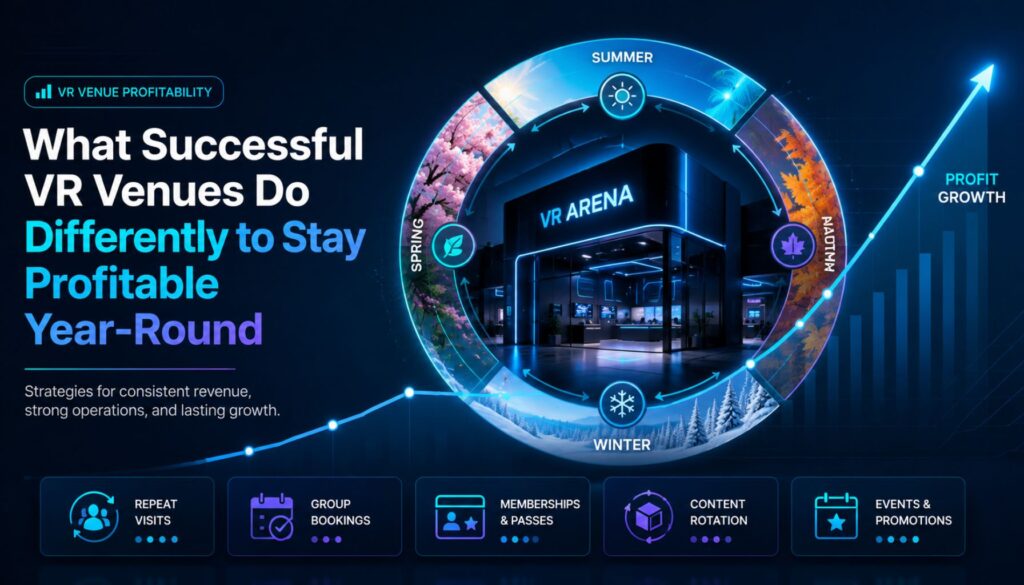
Most VR venues can attract attention when they first open. The harder test comes 12 to 24 months later, after launch coverage has faded and the first wave of local curiosity has passed. Industry guides place mature, well-run VR venues within a broad net margin range of 20 to 40 percent. Headset choice affects costs, but it rarely explains the full distance between the bottom and top of that range. The larger differences usually appear in demand generation, booking behavior, staff workflows, session throughput, repeat visits, and revenue outside paid headset time. That is where VR venue profitability becomes measurable. The 2026 attractions industry benchmark data, drawn from anonymized booking and transaction records across the sector, gives operators a useful way to compare their systems with wider market behavior. Advance bookings make demand more valuable and more visible Online bookings generate 45 percent of total revenue across attractions venues while accounting for only 33 percent of bookings. That means online bookings over-index on revenue by 12 percentage points. The benchmark does not isolate the reason. Larger groups, higher-value packages, advance upgrades, and add-on purchases could all contribute. The operational conclusion remains useful: advance bookings carry more revenue per booking and give the venue time to plan around them. A venue that reaches Wednesday with half its weekend sessions already committed can schedule staff against known demand, prepare for larger groups, and spot a soft weekend early enough to respond. A venue that relies mainly on walk-ins learns how the week performed while the week is already happening. The practical improvements are straightforward: Advance rates and group pricing can help, although the commitment matters more than the discount itself. Marketing keeps demand active throughout the year A short booking path helps convert interest, but the venue still needs to create that interest. Once opening coverage and local curiosity decline, year-round performance depends on a repeatable way to reach new customers and bring previous guests back. Attractions-industry guidance treats customer acquisition and retention as core revenue activities. Targeted campaigns, segmented guest communication, membership promotion, and post-visit follow-up can help venues generate bookings without depending entirely on walk-in traffic or seasonal demand. For a VR venue, the strongest campaigns usually begin with a specific audience and occasion: The marketing content should also make the experience easy to understand. Guests need to know how many people can play, how long the session lasts, whether players compete or cooperate, what age group it suits, and what makes the experience worth sharing. Generic headset footage creates awareness, but specific group scenarios give people a clearer reason to book. Guest data turns one-time promotion into a repeatable system. Venues can track where bookings originated, which packages generated revenue, how many guests returned, and which audiences filled normally quiet periods. A campaign that reliably fills four Tuesday sessions may contribute more to profitability than a post that reaches thousands of people without producing bookings. Marketing creates demand, the booking journey captures it, and venue operations determine how much of that revenue becomes margin and repeat business. Consistency is whatever survives a staff change Attractions venues often rely on seasonal and part-time staff, which limits how much operational quality can depend on one experienced employee. Every critical process that exists only in an experienced employee’s head creates a business risk. Guests experience that risk as waiting. Resets take longer. Briefings vary between staff members. Sessions start late because the person on shift is trying to remember which title launches in which way. A group that arrived on time spends part of its paid visit watching staff troubleshoot. Venues that hold steady through turnover standardize session launches, headset preparation, guest briefings, resets, and basic fault recovery. They maintain the same approved content library across the headset fleet and build reset steps into the workflow. By week ten, a new hire should be following the same operating pattern as an experienced team member. We covered the throughput side of this in Launching Games Without Breaking the Flow. Commercial VR content protects throughput A consumer title can be entertaining and still be awkward to run in a commercial venue. Venue-ready content needs clear onboarding, predictable session lengths, reliable multiplayer handling, simple reset behavior, and a commercial license. These elements determine how efficiently staff can move one group out and the next group in. When they are missing, the commercial cost appears as friction: The exact throughput target depends on session length, attraction format, and the number of stations in the venue. The principle stays consistent. When actual session capacity falls below the floor plan’s model, margin disappears into setup and reset time. Commercial licensing sits underneath the entire operation. Using a title in a paid venue requires more than access through a consumer storefront or commercial Steam account. We explain the distinction in VR Commercial Licensing Explained. The numbers that separate a steady venue from a seasonal one Guest-level metrics such as repeat visit rate and time to second visit are covered in How VR Entertainment Venues Turn First-Time Visitors Into Repeat Customers. The figures below answer a broader question: has the venue built enough recurring demand to hold through a quiet stretch? Members visit nearly four additional times per year Members visit 4.9 times per year, compared with 1.3 visits for non-members. That is an additional 3.6 visits per person annually. Membership revenue gives the venue a base of customers who already have a reason to return. It also gives the operator a group that can support weekday sessions, content rotation, member events, and quieter calendar periods. A membership still needs enough value to justify renewal. We cover the structure in How VR Arcades Actually Make Money. Party programs create future customers Guests return 41 percent of the time at venues that run parties, compared with 26 percent at venues that do not. That is a 15-point difference. Party packages already appeal to operators because they can combine group pricing, food and beverage, private space, and predictable scheduling. The benchmark
How VR Arcades Fill Empty Weekday Sessions Without Discounting
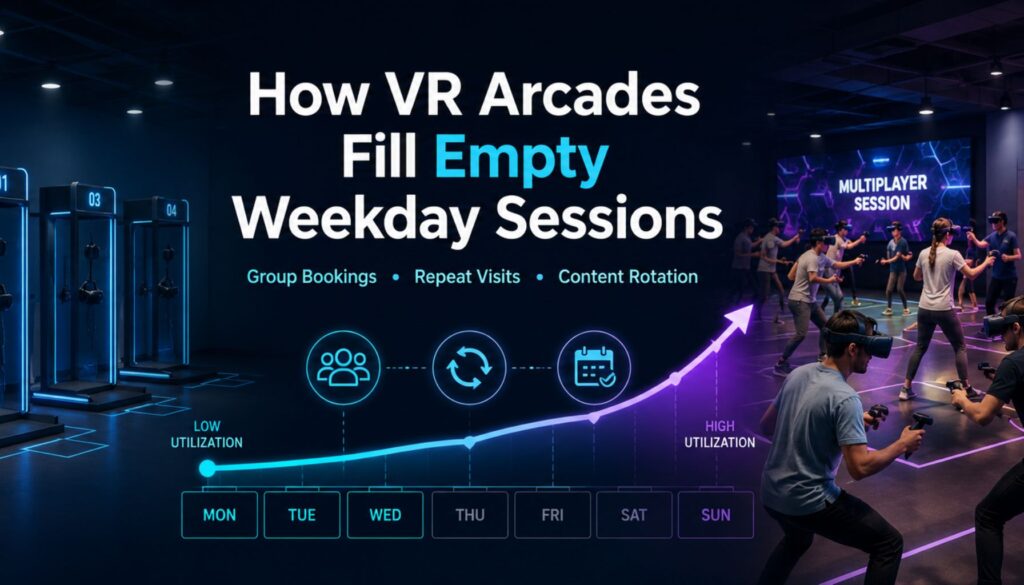
For most VR arcades, family entertainment centers (FECs), and location-based entertainment (LBE) venues, Friday evenings and weekends take care of themselves. The real operational challenge begins on Monday morning. Every empty VR session between Monday and Thursday represents revenue that can never be recovered. Unlike retail inventory, unused attraction capacity expires forever. Once a 3:00 PM session passes without players, that opportunity is gone. Many operators respond by introducing weekday discounts. While discounts may increase short-term bookings, they rarely solve the underlying problem. Over time, they can even reduce profitability by training customers to wait for lower prices. The strongest operators take a different approach. Rather than lowering prices, they redesign how weekday demand is created, packaged, and managed. They treat weekday utilization as an operational challenge—not simply a marketing one. Why Weekday Utilization Matters More Than It Looks A single underperforming weekday can offset gains from a strong Saturday. Across an entire year, consistent weekday gaps compound into a meaningful revenue shortfall, particularly for venues carrying fixed overhead on VR hardware and dedicated attraction space. Analysts estimate the location-based VR market will reach approximately $2.76 billion in 2026 and continue growing rapidly through the end of the decade. As more operators enter the market, long-term performance increasingly depends on operational consistency rather than novelty alone. Utilization influences several areas that operators often underestimate: A quieter Tuesday session often provides a better guest experience than a fully booked Saturday. That difference can influence reviews, referrals, and future bookings long after the session ends. Why Many VR Venues Struggle to Fill Weekday Sessions Empty weekdays rarely reflect a lack of interest in VR. More often, they reflect a mismatch between how the attraction is offered and how people organize their time during the week. Weekday audiences behave differently from weekend visitors. Families work around school schedules. Friend groups need low-friction planning and simple booking. Students coordinate around evening availability. Corporate groups require a clear reason to justify an outing during business hours. Tourists operate on unpredictable schedules and shorter decision windows. Many venues build their booking structure around peak weekend behavior and then expect those same systems to perform throughout the week. Across commercial VR venues, free-roam and room-scale attractions often attract different audiences and booking behaviors. Operators who understand those patterns tend to build more balanced attraction portfolios and create offers that fit specific weekday audiences rather than treating all bookings the same. Common friction points include: Operators regularly use group pricing for schools, sports teams, corporate outings, and social groups because those audiences can help fill capacity that would otherwise remain unused during off-peak periods. How Can VR Arcades Increase Weekday Bookings? Discounting can increase attention, but it does not always address the reasons people delay or avoid booking. Operators often discover that price is only one part of the equation. Weekday attendance depends just as heavily on how easily groups can organize, book, and commit to an experience. Across the broader FEC industry, structured group experiences consistently outperform discount-heavy approaches. Birthday packages, corporate events, school programs, and group offers simplify decision-making for organizers and reduce booking friction. The same principle applies directly to VR. A group of six friends can easily postpone a VR outing if one person must coordinate payments, explain the experience, and organize schedules. That same group is more likely to commit when presented with a simple package: “Six-player session. One booking. Clear pricing. Clear experience.” Tying package benefits to off-peak windows, school calendars, or local community schedules can help smooth demand throughout the week without reducing prices across the board. Operators in bowling centers, laser tag venues, and escape rooms have applied this approach for years. VR arcades that design around group booking behavior often see stronger weekday utilization because they make participation easier to organize. Why Repeat Visits Create More Stable Revenue Than Acquisition Spikes One-time visitors are difficult to predict. Repeat visitors create more consistent demand patterns and often generate greater value over time. Operators frequently focus on acquiring new players while underestimating how much weekday utilization depends on giving existing customers a reason to return. A local customer who visits twice per month often contributes more revenue across a year than a tourist who visits once during a holiday. One recurring pattern across commercial VR venues is that players rarely ask how many titles are available. They ask whether there is something new to try since their last visit. The challenge for many VR venues is content fatigue. VR experiences are highly immersive, but they are also finite. Once visitors feel they have experienced everything available, motivation to return declines. Content rotation helps address this challenge. Venues that regularly introduce new experiences, seasonal content, multiplayer options, or fresh attraction formats create natural opportunities for return visits. Over time, this helps shift the venue from being perceived as a one-time activity into a recurring social destination. Promoting new experiences through social media, email campaigns, loyalty programs, and in-venue signage gives operators a practical way to convert content updates into measurable return traffic. The Role of Attraction Variety and Social Session Design The strongest operators rarely depend on a single experience type to support weekday traffic. An attraction mix that includes competitive multiplayer experiences, shorter repeatable sessions, free-roam attractions, and room-scale content provides flexibility when serving different audience segments. Weekday utilization rates for entertainment venues often fall between 40% and 50%, compared to 75% to 85% during weekends. Successful operators plan around that reality rather than treating it as a temporary problem. Multiplayer VR experiences naturally align with how social groups plan activities. A group of friends, a student organization, a sports team, or a corporate department all require a reason to commit and a simple booking process. Clearly packaged multiplayer experiences remove barriers that often prevent those groups from converting. Operator Reality Check Several operators invested heavily in new hardware while weekday utilization remained inconsistent. Attendance often improved temporarily before returning to previous patterns. Many operators expect new equipment or newly