
Free-Roam VR vs Room-Scale VR: What Commercial Operators Actually Need to Know
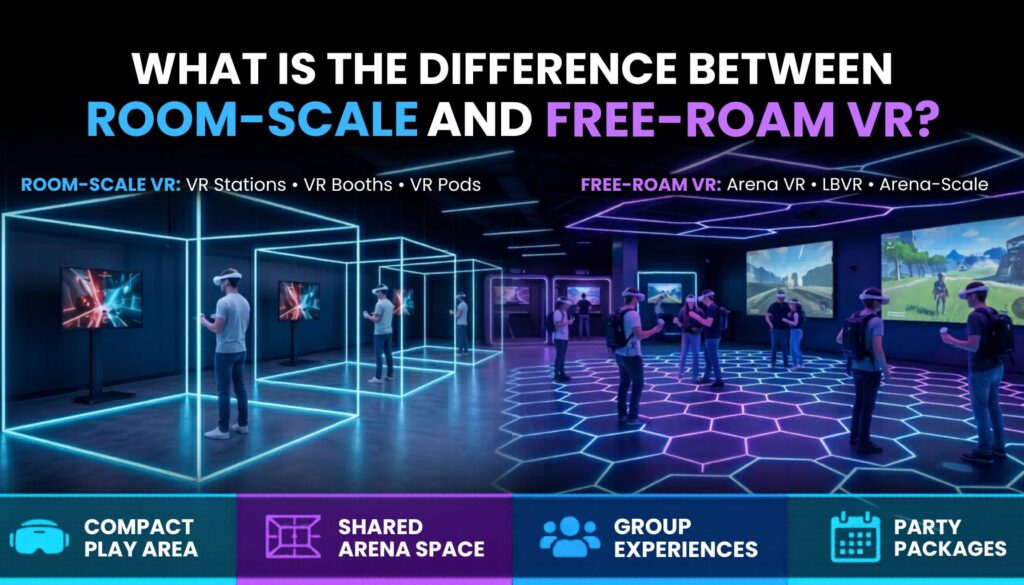
When people compare room-scale VR and free-roam VR, the discussion usually starts with space. Room-scale uses a smaller tracked area. Free-roam uses a larger physical arena where players walk naturally. That explanation is technically accurate. For commercial operators, it is also incomplete. Room-scale VR and free-roam VR are different attraction formats, each serving a different operational and commercial role inside a venue. They affect staffing requirements, player capacity, content strategy, floor plan decisions, and how a business generates revenue. Data from hundreds of commercial VR venues shows that operators rarely choose one format over the other: they build around free-roam as the primary investment, then layer room-scale around it to serve a different part of the guest experience. Understanding why that pattern works is more useful than debating which format is “better.” What Does Room-Scale VR Mean? The debate around free-roam VR vs room-scale VR usually starts with space. Room-scale VR refers to experiences that take place within a defined tracked play area, typically a minimum of 2×2 meters and ideally 2.5×2.5 meters per player or group. Within that space, players can walk, crouch, turn, and interact physically rather than sitting or standing in a fixed position. The setup can take several forms. Some operators build enclosed rooms with solid walls. Others use curtain dividers or open floor plans with clearly marked boundaries. A monitor facing outward so waiting guests can watch gameplay in progress is standard across all configurations. The experience may support a single player or a small multiplayer group, as long as all players share the same tracked area. Across the industry this format goes by several names: VR stations, VR booths, VR pods. These are not distinct attraction categories. They describe different ways of delivering the same format, whether that means an open play position on a venue floor, a partitioned booth for privacy and organization, or a branded enclosed unit with custom theming. The format is consistent: compact, defined play space with flexible deployment. Because room-scale setups require relatively little floor area and integrate into most existing layouts, operators use them to add attraction variety, increase density, or introduce new content without major venue redesigns. That flexibility matters most when a venue is already anchored by a larger attraction and needs to fill the surrounding floor plan productively. What Does Free-Roam VR Mean? Free-roam VR allows multiple players to walk through a shared virtual environment together, each wearing a wireless headset, navigating the same physical arena at the same time. Where room-scale defines a boundary for each player, free-roam removes that boundary. Everyone in the experience occupies one shared arena space, physically moving alongside each other while interacting inside the same virtual world. The format is commonly referred to as free-roam VR, arena VR, or arena-scale VR. Within the industry, location-based VR and LBVR are broader terms that often apply here as well. The technology behind free-roam has changed significantly over the past several years. Early commercial setups relied on backpack PCs: players wore full computing rigs on their backs through the experience, and tracking depended on external sensor arrays that required significant setup time between sessions. Modern free-roam operates differently. Standalone headsets with inside-out tracking have largely replaced backpack systems. Arenas are designed specifically to support stable tracking: floor markers, aruco patterns, and walls with non-repeating visual textures give headsets consistent reference points as players move. The result is more reliable tracking, faster resets, and simpler day-to-day operations. Arena size in free-roam is not fixed by a single standard. Most commercial free-roam titles are designed around a 6x6m (20x20ft) play space, which has become the practical baseline for operators because it unlocks the widest range of available content. Larger arenas, typically around 10x10m, support more simultaneous players or give players more physical room, though player counts do not always scale with the additional space. Some titles allow operators to adapt the experience to a different play space size, but that flexibility is less common across the catalog. The practical starting point for most operators is sizing the arena around the content library they want to run, not the other way around. Free-roam experiences are built around what the format does well: multiplayer cooperation and competition, physical exploration across a large shared space, and social play where every participant is present in the same environment at once. The Practical Difference: Movement and Play Area The most visible difference between the two formats is how players move. In room-scale VR, movement stays within a compact tracked area per player. In free-roam VR, walking is central to the experience: players navigate the arena physically and the virtual world responds to where they actually are. From an operator perspective, that produces meaningfully different venue requirements. The choice is rarely about which format is technically superior. It is about which format fits the venue being built and the audience it serves. Why Free-Roam Draws Stronger Commercial Interest Several factors have made free-roam VR the more discussed format among venue operators, and data from commercial deployments reflects that priority consistently. The clearest factor is replicability. A consumer at home can buy a headset, clear some furniture, and run a room-scale experience. The quality differs from a commercial setup, but the format is accessible. Free-roam arenas are not. No home environment accommodates a shared arena with multiple simultaneous players, calibrated tracking walls, and the session infrastructure a venue provides. Content reinforces that gap in a specific way. Titles like Arizona Sunshine Remake: Free-Roam and After the Fall: Free-Roam are built exclusively for commercial venue deployment. They have no consumer release. A guest who already owns a home headset still has a clear reason to book: the experience they want does not exist on any device they can buy. That content exclusivity also has a less obvious commercial benefit. VR content licensing structured through a commercial platform closes the route that consumer versions leave open. Room-scale content that exists in consumer ecosystems can be acquired and run by any venue regardless
How Family Entertainment Centers Use VR Attractions During Heatwaves and Rainy Days
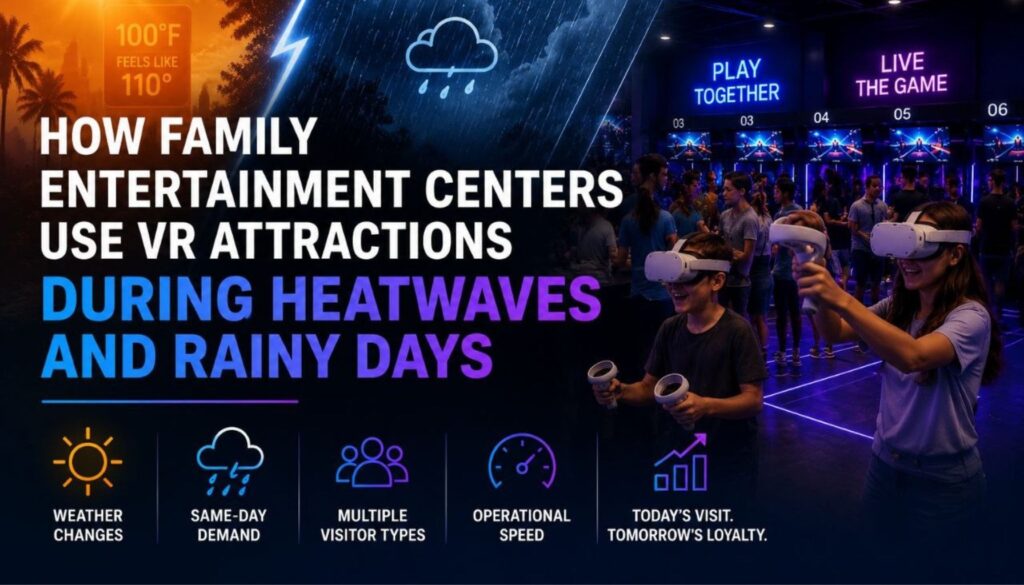
Why Indoor Attractions Benefit When Outdoor Plans Change A heatwave pushes temperatures past what most families will tolerate outdoors. A summer storm cancels afternoon plans. A tourist group abandons the beach and starts searching for something to do indoors. Within a few hours, a quiet weekday turns into one of the busiest periods of the week and the venues that capture that traffic are rarely the loudest marketers. They are the ones that were operationally ready before the weather changed. For VR arcades, family entertainment centers, and location-based entertainment venues, weather-driven demand is some of the highest-intent traffic the season produces. These visitors are actively looking for something to do today. Converting that interest into a booking depends on local visibility, a clear booking journey, and the operational capacity to deliver when multiple groups arrive in a short window. The foundations of local visibility and seasonal positioning are covered in the first article in this series: How VR Arcades Can Adapt to Summer Demand Shifts and Capture More Indoor Entertainment Traffic. Why VR Attractions Benefit When Outdoor Plans Change Extreme weather does not create leisure demand from nothing. It shifts existing demand from one category of venue to another. When heat, rain, or poor air quality makes outdoor activities less appealing, consumers look for indoor alternatives and the family entertainment center sector is one of the primary beneficiaries of that shift. Research on North American FEC market growth consistently shows strong demand for indoor, experience-driven attractions, particularly those that support group participation. This is why FECs frequently combine multiple attractions under one roof. Bowling, arcades, indoor mini golf, karting, laser tag, escape rooms, and VR experiences all compete for the same visitor at the same moment. When outdoor plans collapse, VR arcades sit inside that same consideration set, which makes how the venue presents itself online, and how quickly it can operate when guests arrive, commercially significant. The Same-Day Booking Moment Weather-driven visitors behave differently from planned visitors. A birthday party may be booked weeks in advance. A school group outing may be organized months ahead. A family escaping a heatwave often decides within hours, a tourist dealing with unexpected rain may search for local attractions that afternoon, and a friend group whose outdoor plans fell apart wants an immediate alternative. These visitors are not researching extensively. They want answers: Can we book today? How much does it cost? How many people can play, and for how long? Is it suitable for children? The venue that surfaces that information fastest, with accurate hours and a clear booking path, usually wins the session. Google has increasingly emphasized accurate, specific business information as a core factor in local discoverability, including within AI-powered search results, which raises the cost of having outdated or incomplete listings during demand spikes. Multiple Visitor Types, One Peak Period One of the more common operational mistakes during weather-driven surges is treating the incoming traffic as a single audience. In practice, a busy heatwave afternoon can bring families prioritizing supervision and simplicity, tourists who need an easy-to-understand experience within a tight schedule, teenagers and young adults focused on multiplayer social experiences, and pre-booked birthday parties already on the calendar, all arriving within the same two-hour window. Managing those groups simultaneously is where manual coordination breaks down. Staff who are troubleshooting headsets cannot simultaneously onboard walk-ins. A session running late for one group delays the next group booking. The multiplayer coordination that works smoothly during a planned birthday party can stall under unplanned volume if the workflow depends on individual staff judgment rather than repeatable process. Operational Readiness During Demand Spikes Several venue operators have described the same pattern: strong walk-in traffic during a heatwave, followed by the realization that session launch bottlenecks were limiting how much revenue they could actually capture. Weather creates the demand. Operations determine how much of it converts. A five-minute delay launching a session affects the next booking. A slow headset preparation process reduces throughput during peak hours. When a staff member troubleshoots a hardware issue, every walk-in waiting in the lobby is evaluating whether the venue is worth the wait. The venues that consistently capture weather-driven revenue tend to treat session launch speed, multiplayer coordination, and guest onboarding as operational disciplines rather than ad hoc decisions, the same disciplines that protect throughput and group booking quality throughout the rest of the season. Five Things to Review Before the Next Weather Spike 1. Audit your local listings. Verify operating hours, contact information, photos, and booking links across your Google Business Profile. Inaccurate or incomplete listings cost bookings on the highest-intent days of the season. 2. Simplify the booking journey. Pricing, session length, age recommendations, and group sizes should be visible without requiring visitors to search through multiple pages. Same-day traffic has low patience for friction. 3. Prepare for different visitor profiles. Build recommended experience paths for families, tourist groups, friend groups, and larger parties before demand arrives rather than improvising at the desk. 4. Audit session launch procedures. Map where staff lose time during onboarding, headset preparation, and multiplayer setup. A documented workflow that any team member can follow consistently is the difference between 20-minute and 35-minute session launch cycles. 5. Build a weather response plan. Have marketing assets, social posts, and operational procedures ready in advance. Reacting after a heatwave warning has already been issued leaves less time to capture the most valuable part of the traffic window. From Weather Traffic to Repeat Visits Weather-driven traffic is short-term in nature, but the relationships it creates can last through autumn and beyond. A family that discovers the venue during a rainy weekend can become a future birthday party booking. A tourist group that had a smooth session experience generates reviews and referrals that continue driving organic traffic after the weather changes. The venues that benefit most from these spikes tend to focus on converting the visit into a relationship: capturing contact information, offering a clear return incentive, and delivering a session experience consistent enough
3 PCVR Games That Keep Competitive Groups Coming Back This Summer
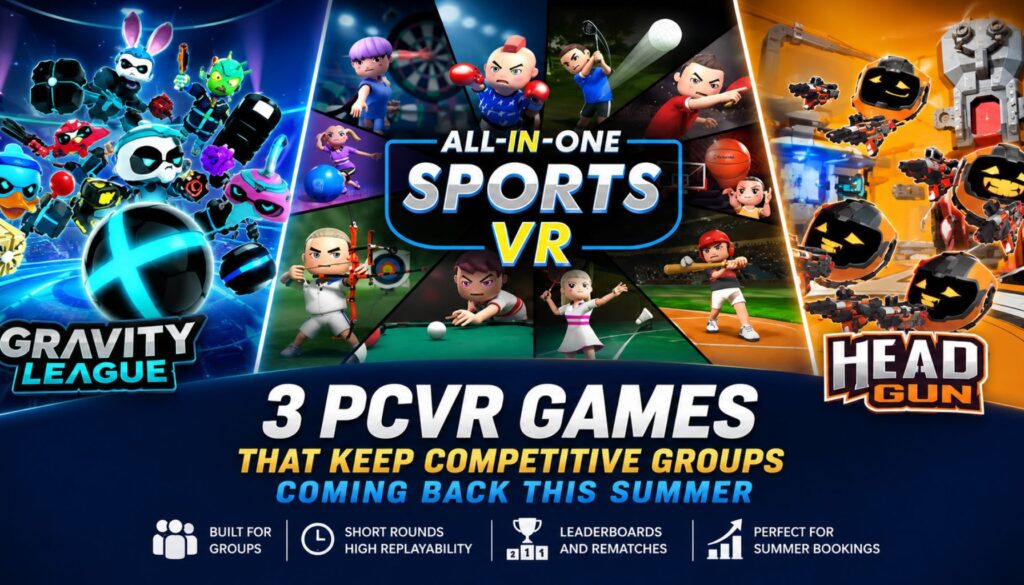
Competitive PCVR games often appeal to a different type of guest than narrative-driven experiences. Some groups walk into a VR session ready to explore. Others walk in ready to compete, compare scores, and ask for a rematch. For those groups, the best games are the ones that create momentum fast. Clear rules, short rounds, and visible progress keep players engaged because the goal feels close, the outcome feels fair, and every round gives them a new chance to do better. That pattern lines up with what motivation research has shown for decades: people tend to increase effort as they get closer to a goal, and the presence of a rival raises that effort further. Clark Hull first documented the goal-gradient effect in 1932, finding that effort accelerates as a goal comes within reach. Gavin J. Kilduff at New York University later confirmed that competing directly against someone raises both motivation and measurable performance, even when no prize is involved. In a venue setting, that combination translates into rematches, leaderboard chases, and groups that book again because the last match did not go the way they wanted. A birthday group with mixed experience levels, a summer camp operating on a schedule, or a corporate booking looking for team-based competition often responds well to the same formula: short rounds, simple rules, and enough variety to make the next match feel worth taking. When players can see their progress and immediately try again, the session becomes more than a one-time playthrough. These three PCVR room-scale titles are built around that logic. Why Competitive PCVR Games Perform Differently in Commercial Venues Not every multiplayer VR experience creates the same booking behavior. Multiplayer score-driven formats introduce a different dynamic because players leave with a clear outcome. Someone wins, someone loses, and someone usually wants another chance. For VR arcade operators, that often translates into longer engagement within a booking, stronger replayability, and easier tournament-style programming for birthdays, camps, corporate events, and group outings. A three-minute match can generate multiple rounds within a single session, allowing venues to keep groups engaged without extending booking times. Competitive experiences also simplify onboarding. Players typically understand the objective immediately, which reduces explanation time and allows staff to focus on session management rather than lengthy game briefings. For venues managing multiple groups throughout the day, those small time savings can compound across dozens of sessions. The result is often a content category that supports throughput, repeat visits, and social competition without requiring complex setup or extensive staff intervention. Gravity League PCVR room-scale | Pico | Quest | Focus 3 | 1-4 players | 3 minutes per match | No age limit | Network Veteran Zero-gravity sports where players use Gravity Gloves to drive a ball into the opposing goal. The mechanics read like full-body air hockey: the objective is visible immediately, the physics respond the way guests expect, and nobody needs to ask what they are supposed to do. A group of four understands the game within thirty seconds of putting on a headset, which means staff spend that time watching rather than explaining. Matches run three minutes. A birthday group can run a full round-robin bracket inside a single booking slot and still have time for a rematch. Standalone support across Pico 4 Enterprise, Quest, and Focus 3 alongside PCVR room-sacle version gives operators flexibility across different station configurations without a separate licensing decision. Wacky Party Mode widens the appeal for mixed-skill groups where guests range from experienced players to first-timers. For operators, the three-minute match structure creates flexibility throughout the day. A venue can run quick rematches, mini-tournaments, or round-robin formats without affecting booking schedules. That makes Gravity League particularly useful for birthday parties, youth groups, and competitive corporate sessions where participants want multiple opportunities to improve their score. Players describe it as competitive, customization-friendly, and easy to replay. The Network Veteran badge on the SynthesisVR marketplace reflects an established performance track record across the network. Game page: deployreality.com/synthesisvr/games/gravity-league HeadGun PCVR Room Scale | 2-10 players | No age limit | No blood | SynthesisVR CDN Optimized Ten players competing simultaneously is an unusual spec for a room scale title. HeadGun supports it through transformable maps that reconfigure based on player count, so a group of four and a group of ten are each playing a version sized for their session rather than the same map at different densities.Three modes give staff a natural structure for longer group sessions: Deathmatch to warm up, Team Deathmatch once the group has found its footing, then Capture the Flag for guests who want a shared team objective over a personal kill count. The ability to support between two and ten players also gives operators flexibility when group sizes vary. Rather than building separate programming around different attendance levels, venues can accommodate smaller and larger groups within the same attraction, helping maintain attraction utilization throughout the day without requiring different content setups. Single-button controls and an integrated tutorial back the zero-learning-curve claim with something concrete: players do not need a staff briefing to start. The September 2024 update added operator-configurable motion sickness controls and French and Chinese Simplified localization, relevant for venues with multilingual guests or international group bookings. Rated 0+ with no blood and no aggression, which removes the age conversation at the front desk entirely. Reviewer coverage frames it as a smooth-running arcade shooter with accessible controls. For operators, that translates to a title that works across birthday groups, camp sessions, and corporate bookings without requiring a different setup or briefing for each audience. Game page: deployreality.com/synthesisvr/games/headgun All-In-One Sports VR PCVR Room Scale | Pico | Quest | 1-2 players per station | No age limit | SynthesisVR CDN Optimized Ten sports disciplines under a single license: Baseball, Archery, Ping Pong, Basketball, Bowling, Badminton, Golf, Darts, Billiards, Boxing. Real-time PvP across most disciplines. The mechanics transfer because guests already know the movement vocabulary: a darts throw, a basketball arc, a tennis return. That prior knowledge compresses the learning curve