
How to Build an Educational VR Program for Schools and Groups
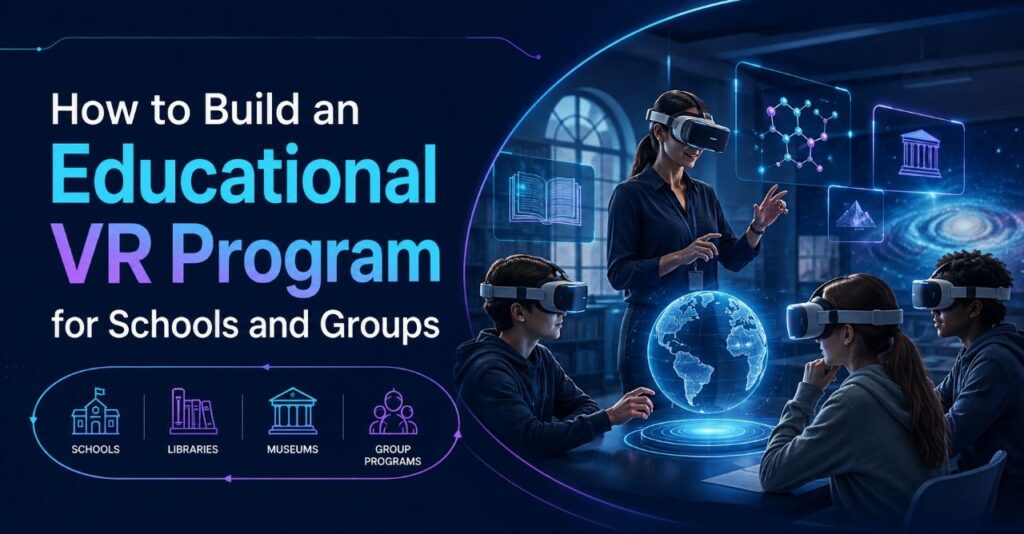
Building an educational VR program for schools takes more than adding educational content to a headset fleet. Teachers need to understand what students will learn, which ages the activity suits, how a full class will move through the experience, how long the visit will take, and what the school will pay. Libraries, museums, science centers, and other institutions face many of the same questions when adding VR to their educational programming. For VR arcades and location-based entertainment venues, school groups can also create a new use for weekday capacity. Operators already have much of the infrastructure in place: headsets, staff, commercial VR content, and experience managing groups. The next step is turning those resources into a program that a teacher or institution can confidently book. Building a program a teacher can approve Established field trip providers make practical information easy to find. Teachers usually need the age or grade range, learning focus, program duration, group capacity, supervision requirements, accessibility information, arrival instructions, and price before they can move a trip forward. An educational VR offer needs the same clarity. A page that simply says “Educational VR available for school groups” still leaves most of the planning with the teacher. A stronger offer explains what students will explore, how the experience connects to a subject, how many students can attend, how the class moves through the available headsets, and what happens during the rest of the visit. A simple way to plan the offer is to work backward from the questions the school needs answered: This also changes how an operator chooses educational VR content. Instead of starting with a list of available experiences, start with the school use case. A biology experience might support a science visit. A virtual field trip could connect with geography or history. Engineering content may fit a STEM program. The content has a clearer role once there is a program around it. A short VR experience can support a full school visit The VR portion does not need to fill the entire booking. During our recent Step Into Webb education webinar, Adventure Portal demonstrated how a relatively short immersive experience can sit inside a longer structured lesson. Step Into Webb itself runs for around 15 minutes and targets students in grades 6 through 10. The wider program can combine that VR session with supporting tasks and teacher-led activities. For a venue, that creates the possibility of a 45- or 60-minute school visit without keeping every student inside VR for the full hour. A class might begin together with an introduction to the subject. Smaller groups then move through the VR experience while other students work on related activities. The groups rotate until everyone has completed the immersive portion, then come together again for a discussion or recap. Supporting activities give the visit more structure and help connect what students see inside VR with the wider learning objective. This becomes especially useful when the immersive experience itself lasts 10 or 15 minutes. The venue can build a much richer educational program around that time rather than stretching the VR session simply to fill an hour. Class capacity is bigger than headset count One of the first questions operators often ask is how a venue with six or eight headsets can host a full class. The answer is in the program design. During the Step Into Webb webinar, one example used a class of 30 students and eight available headsets. The class could split into smaller groups. One group enters VR while the other students complete related activities, then the groups rotate. The exact numbers will differ from one location to another. Available space, staff, student age, experience length, and headset capacity all influence the final setup. Still, the example highlights an important distinction: Educational capacity does not have to equal headset capacity. An operator should calculate how many students can complete the entire program during the available booking window, rather than using the number of headsets as the maximum class size. This can make educational VR practical for venues that would never consider buying enough hardware for an entire school class to enter VR simultaneously. Using existing weekday capacity For an established VR arcade, school visits can fit into a very different part of the weekly schedule from regular entertainment bookings. A class arriving on Tuesday morning does not compete directly with the birthday parties, friend groups, or free-roam sessions that drive weekend and evening demand. The venue also already has much of the infrastructure required to deliver the program. Staff understand headset setup and cleaning. The venue has group onboarding procedures, commercial VR hardware, content, physical space, and a VR management system supporting the headset fleet. Education gives those existing resources another commercial use. During our education webinar, one operator described running regular field trips and having hosted several school groups within a single day. Their existing program combines educational activities with VR and uses different areas of the venue to move students through the visit. That example shows why the operational design matters as much as the content. Staff need to know when each rotation starts, where students wait, which headsets are ready, how long each activity lasts, and who supervises each part of the group. Once the venue establishes that workflow, the next school visit becomes much easier to run. Educational VR inside schools Schools and universities can also operate VR directly. A school with its own headset fleet has a different set of priorities from an entertainment venue. The institution may want one set of hardware to serve several classes, teachers, and subjects throughout the academic year. A biology class might use the headsets for anatomy or natural science. Another teacher could use the same fleet for engineering, Earth science, history, or a virtual field trip later in the term. The educational value of the hardware grows when the institution can reuse it across different subjects and age groups. Content breadth therefore becomes an important planning question. A school investing in
What Successful VR Venues Do Differently to Stay Profitable Year-Round
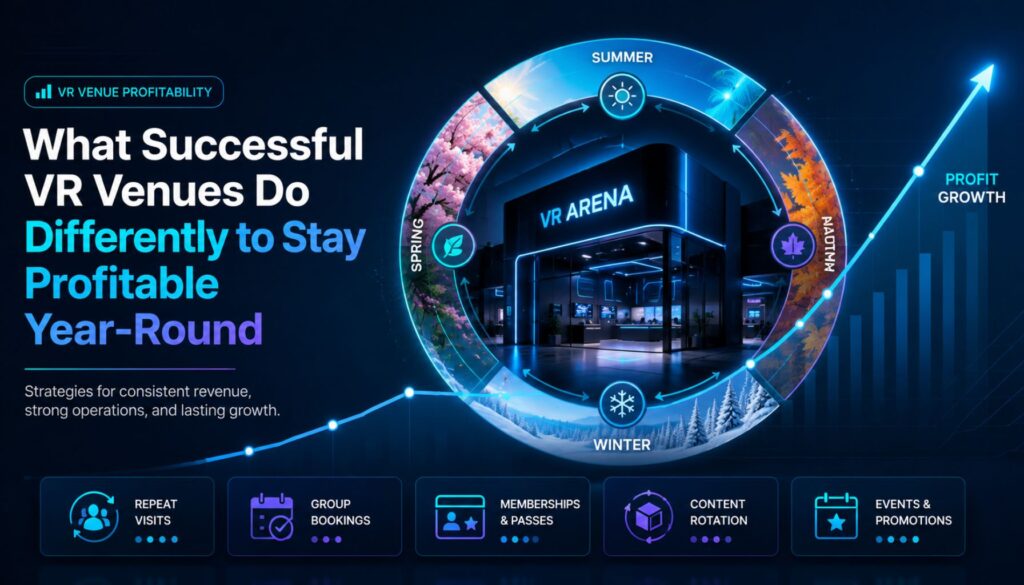
Most VR venues can attract attention when they first open. The harder test comes 12 to 24 months later, after launch coverage has faded and the first wave of local curiosity has passed. Industry guides place mature, well-run VR venues within a broad net margin range of 20 to 40 percent. Headset choice affects costs, but it rarely explains the full distance between the bottom and top of that range. The larger differences usually appear in demand generation, booking behavior, staff workflows, session throughput, repeat visits, and revenue outside paid headset time. That is where VR venue profitability becomes measurable. The 2026 attractions industry benchmark data, drawn from anonymized booking and transaction records across the sector, gives operators a useful way to compare their systems with wider market behavior. Advance bookings make demand more valuable and more visible Online bookings generate 45 percent of total revenue across attractions venues while accounting for only 33 percent of bookings. That means online bookings over-index on revenue by 12 percentage points. The benchmark does not isolate the reason. Larger groups, higher-value packages, advance upgrades, and add-on purchases could all contribute. The operational conclusion remains useful: advance bookings carry more revenue per booking and give the venue time to plan around them. A venue that reaches Wednesday with half its weekend sessions already committed can schedule staff against known demand, prepare for larger groups, and spot a soft weekend early enough to respond. A venue that relies mainly on walk-ins learns how the week performed while the week is already happening. The practical improvements are straightforward: Advance rates and group pricing can help, although the commitment matters more than the discount itself. Marketing keeps demand active throughout the year A short booking path helps convert interest, but the venue still needs to create that interest. Once opening coverage and local curiosity decline, year-round performance depends on a repeatable way to reach new customers and bring previous guests back. Attractions-industry guidance treats customer acquisition and retention as core revenue activities. Targeted campaigns, segmented guest communication, membership promotion, and post-visit follow-up can help venues generate bookings without depending entirely on walk-in traffic or seasonal demand. For a VR venue, the strongest campaigns usually begin with a specific audience and occasion: The marketing content should also make the experience easy to understand. Guests need to know how many people can play, how long the session lasts, whether players compete or cooperate, what age group it suits, and what makes the experience worth sharing. Generic headset footage creates awareness, but specific group scenarios give people a clearer reason to book. Guest data turns one-time promotion into a repeatable system. Venues can track where bookings originated, which packages generated revenue, how many guests returned, and which audiences filled normally quiet periods. A campaign that reliably fills four Tuesday sessions may contribute more to profitability than a post that reaches thousands of people without producing bookings. Marketing creates demand, the booking journey captures it, and venue operations determine how much of that revenue becomes margin and repeat business. Consistency is whatever survives a staff change Attractions venues often rely on seasonal and part-time staff, which limits how much operational quality can depend on one experienced employee. Every critical process that exists only in an experienced employee’s head creates a business risk. Guests experience that risk as waiting. Resets take longer. Briefings vary between staff members. Sessions start late because the person on shift is trying to remember which title launches in which way. A group that arrived on time spends part of its paid visit watching staff troubleshoot. Venues that hold steady through turnover standardize session launches, headset preparation, guest briefings, resets, and basic fault recovery. They maintain the same approved content library across the headset fleet and build reset steps into the workflow. By week ten, a new hire should be following the same operating pattern as an experienced team member. We covered the throughput side of this in Launching Games Without Breaking the Flow. Commercial VR content protects throughput A consumer title can be entertaining and still be awkward to run in a commercial venue. Venue-ready content needs clear onboarding, predictable session lengths, reliable multiplayer handling, simple reset behavior, and a commercial license. These elements determine how efficiently staff can move one group out and the next group in. When they are missing, the commercial cost appears as friction: The exact throughput target depends on session length, attraction format, and the number of stations in the venue. The principle stays consistent. When actual session capacity falls below the floor plan’s model, margin disappears into setup and reset time. Commercial licensing sits underneath the entire operation. Using a title in a paid venue requires more than access through a consumer storefront or commercial Steam account. We explain the distinction in VR Commercial Licensing Explained. The numbers that separate a steady venue from a seasonal one Guest-level metrics such as repeat visit rate and time to second visit are covered in How VR Entertainment Venues Turn First-Time Visitors Into Repeat Customers. The figures below answer a broader question: has the venue built enough recurring demand to hold through a quiet stretch? Members visit nearly four additional times per year Members visit 4.9 times per year, compared with 1.3 visits for non-members. That is an additional 3.6 visits per person annually. Membership revenue gives the venue a base of customers who already have a reason to return. It also gives the operator a group that can support weekday sessions, content rotation, member events, and quieter calendar periods. A membership still needs enough value to justify renewal. We cover the structure in How VR Arcades Actually Make Money. Party programs create future customers Guests return 41 percent of the time at venues that run parties, compared with 26 percent at venues that do not. That is a 15-point difference. Party packages already appeal to operators because they can combine group pricing, food and beverage, private space, and predictable scheduling. The benchmark
VR Room-Scale Classics Every VR Arcade Operator Should Know About
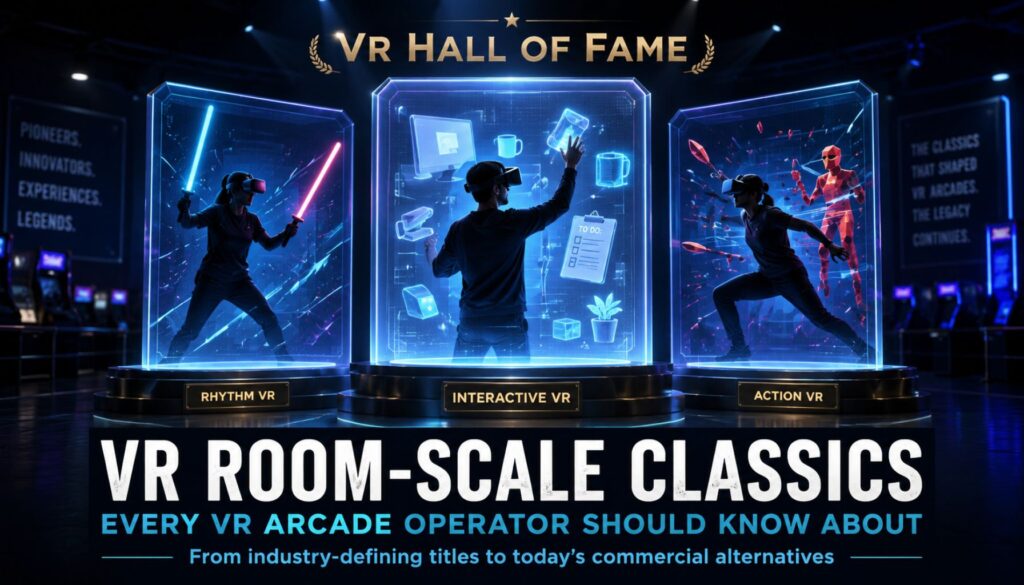
Players researching VR venues often arrive with a shortlist already in mind.These titles introduced millions of people to virtual reality and remain some of the most recognisable names in the medium. For operators building out a commercial venue, that recognition carries real weight: guests arrive already knowing these names, which shortens the conversation at the front desk considerably. The practical question is whether popularity and commercial availability still line up. For room-scale VR attractions, the answer varies by title, and it matters more than most operators expect when they start evaluating content. The Usual Suspects Every operator researching room-scale VR eventually runs into the same names. Beat Saber. Job Simulator. Superhot VR. These titles introduced millions of players to virtual reality and remain among the most recognizable experiences the industry has ever produced. For commercial operators, that recognition still carries weight. Guests often arrive already familiar with these games, making them natural starting points when discussing VR attractions. The practical question, however, is whether recognition and commercial availability still go hand in hand. For room-scale venues, the answer varies considerably from title to title, and understanding those differences can save operators a great deal of time when evaluating content for their attraction lineup. Beat Saber: The Rhythm Standard That Shaped Commercial VR Why it still comes up Beat Saber launched in 2018 and quickly became the benchmark for accessible VR gameplay. The core loop is simple enough to grasp in seconds: swing virtual sabers to slice color-coded blocks in time with music. First-time VR users could pick it up without prior gaming experience. Spectators understood it from across the room. That combination of spectator clarity and minimal onboarding made it one of the most effective room-scale attractions available during the early years of location-based VR. Guests who watched someone else play often booked a session immediately. The word-of-mouth effect was measurable at floor level. Where things stand for operators Meta acquired Beat Games, the studio behind Beat Saber, in late 2019. Following that acquisition, the title was pulled from the commercial arcade licensing ecosystem. The commercial licensing page went offline in June 2020, and arcades were advised to stop activating new stations by July 1 and to remove the game entirely by July 31 of that year. For operators evaluating content today, this means a title with strong consumer recognition has been unavailable for commercial VR deployment for several years. The guest recognition is real. The licensing route is closed. This is the most common licensing blind spot operators encounter when building out a room-scale content library: a title can remain culturally visible and frequently requested while being completely unavailable for commercial deployment. Commercial alternative: Synth Riders Operators looking for a commercially licensed rhythm game for their VR arcade often look at Synth Riders. The gameplay centers on freestyle movement to music rather than strict note-matching, which tends to produce more varied play styles and different kinds of spectator moments. The game supports up to 10 players in cross-platform multiplayer, includes 46 songs across multiple genres, and carries a local leaderboard mode suited to arcade environments. It was named a Game of the Year finalist at the VR Awards and featured in Forbes’ Top 50 VR Games of 2019. For operators, the spectator value that made rhythm games commercially effective translates directly: guests waiting nearby can understand what is happening on screen and want to try it themselves. The commercial license is available through SynthesisVR. View Synth Riders on SynthesisVR. Job Simulator: The Accessibility Benchmark Why it still gets requested Job Simulator launched alongside the HTC Vive in 2016 and became one of the most widely cited examples of successful VR onboarding. Players interact with everyday objects in simulated workplace environments: make coffee, answer phones, flip burgers. Nothing in the experience requires gaming familiarity. The humor lands across age groups, and children in particular respond to the low-stakes experimentation it encourages. For venue operators, it solved a specific problem: what do you put in front of a guest who has never worn a headset and has no frame of reference for what VR is? Job Simulator answered that question reliably for years across VR arcades and family entertainment centers worldwide. Where things stand for operators Job Simulator was available through commercial VR content platforms for a number of years after launch. It has since been removed from commercial licensing and is no longer available for deployment at VR arcades or location-based entertainment venues. Guests, particularly younger visitors and families, still request it by name. Operators evaluating room-scale content for those audiences will need to look at what is currently licensable. Commercial alternative: Clash of Chefs VR Clash of Chefs VR is a cooking competition game where players prepare meals against the clock, either in solo mode or against other players in online multiplayer. The physical interactions map to everyday kitchen tasks, which means very little explanation is needed before a session starts. The game was designed without teleportation or in-game movement, which removes one of the most common sources of motion discomfort for first-time VR users. The competitive multiplayer format adds a group booking angle that purely single-player experiences cannot offer: two guests competing in the same session, or players trying to beat a leaderboard score set by a previous group. For venues serving families, school groups, and social bookings, that dynamic extends the commercial usefulness of a single title across different session types. The commercial license is available through SynthesisVR. View Clash of Chefs VR on SynthesisVR. SUPERHOT VR: The Arcade Edition Built for Venues Why the mechanic still works SUPERHOT VR launched in 2017 with a premise that has held up unusually well: time moves only when you move. In a medium where players are still calibrating spatial awareness and physical confidence, that mechanic removed a critical source of anxiety. Players could pause, assess, and act on their own terms rather than reacting to a constant stream of incoming threats. The result was one of the most