
VR Room-Scale Classics Every VR Arcade Operator Should Know About
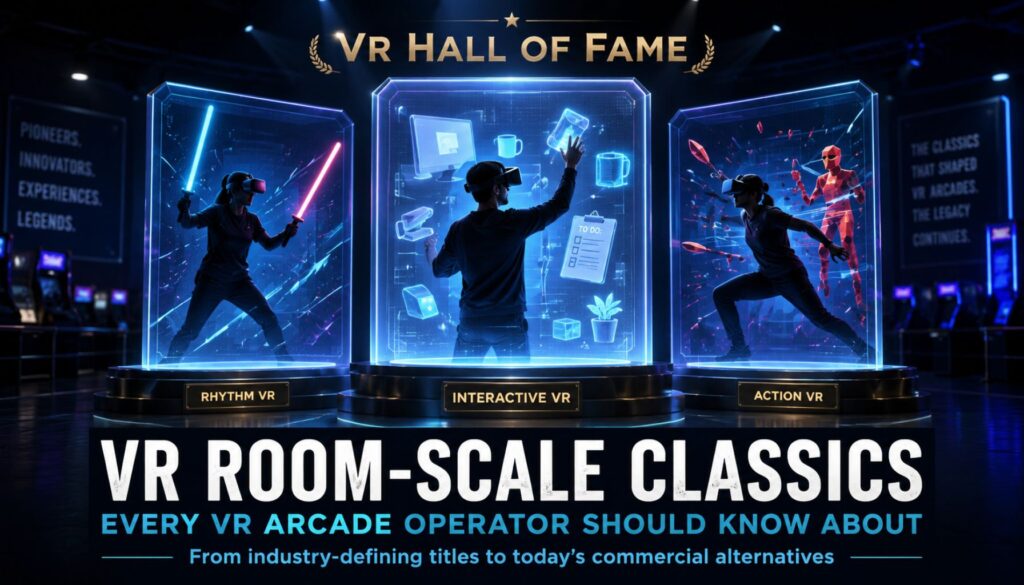
Players researching VR venues often arrive with a shortlist already in mind.These titles introduced millions of people to virtual reality and remain some of the most recognisable names in the medium. For operators building out a commercial venue, that recognition carries real weight: guests arrive already knowing these names, which shortens the conversation at the front desk considerably. The practical question is whether popularity and commercial availability still line up. For room-scale VR attractions, the answer varies by title, and it matters more than most operators expect when they start evaluating content. The Usual Suspects Every operator researching room-scale VR eventually runs into the same names. Beat Saber. Job Simulator. Superhot VR. These titles introduced millions of players to virtual reality and remain among the most recognizable experiences the industry has ever produced. For commercial operators, that recognition still carries weight. Guests often arrive already familiar with these games, making them natural starting points when discussing VR attractions. The practical question, however, is whether recognition and commercial availability still go hand in hand. For room-scale venues, the answer varies considerably from title to title, and understanding those differences can save operators a great deal of time when evaluating content for their attraction lineup. Beat Saber: The Rhythm Standard That Shaped Commercial VR Why it still comes up Beat Saber launched in 2018 and quickly became the benchmark for accessible VR gameplay. The core loop is simple enough to grasp in seconds: swing virtual sabers to slice color-coded blocks in time with music. First-time VR users could pick it up without prior gaming experience. Spectators understood it from across the room. That combination of spectator clarity and minimal onboarding made it one of the most effective room-scale attractions available during the early years of location-based VR. Guests who watched someone else play often booked a session immediately. The word-of-mouth effect was measurable at floor level. Where things stand for operators Meta acquired Beat Games, the studio behind Beat Saber, in late 2019. Following that acquisition, the title was pulled from the commercial arcade licensing ecosystem. The commercial licensing page went offline in June 2020, and arcades were advised to stop activating new stations by July 1 and to remove the game entirely by July 31 of that year. For operators evaluating content today, this means a title with strong consumer recognition has been unavailable for commercial VR deployment for several years. The guest recognition is real. The licensing route is closed. This is the most common licensing blind spot operators encounter when building out a room-scale content library: a title can remain culturally visible and frequently requested while being completely unavailable for commercial deployment. Commercial alternative: Synth Riders Operators looking for a commercially licensed rhythm game for their VR arcade often look at Synth Riders. The gameplay centers on freestyle movement to music rather than strict note-matching, which tends to produce more varied play styles and different kinds of spectator moments. The game supports up to 10 players in cross-platform multiplayer, includes 46 songs across multiple genres, and carries a local leaderboard mode suited to arcade environments. It was named a Game of the Year finalist at the VR Awards and featured in Forbes’ Top 50 VR Games of 2019. For operators, the spectator value that made rhythm games commercially effective translates directly: guests waiting nearby can understand what is happening on screen and want to try it themselves. The commercial license is available through SynthesisVR. View Synth Riders on SynthesisVR. Job Simulator: The Accessibility Benchmark Why it still gets requested Job Simulator launched alongside the HTC Vive in 2016 and became one of the most widely cited examples of successful VR onboarding. Players interact with everyday objects in simulated workplace environments: make coffee, answer phones, flip burgers. Nothing in the experience requires gaming familiarity. The humor lands across age groups, and children in particular respond to the low-stakes experimentation it encourages. For venue operators, it solved a specific problem: what do you put in front of a guest who has never worn a headset and has no frame of reference for what VR is? Job Simulator answered that question reliably for years across VR arcades and family entertainment centers worldwide. Where things stand for operators Job Simulator was available through commercial VR content platforms for a number of years after launch. It has since been removed from commercial licensing and is no longer available for deployment at VR arcades or location-based entertainment venues. Guests, particularly younger visitors and families, still request it by name. Operators evaluating room-scale content for those audiences will need to look at what is currently licensable. Commercial alternative: Clash of Chefs VR Clash of Chefs VR is a cooking competition game where players prepare meals against the clock, either in solo mode or against other players in online multiplayer. The physical interactions map to everyday kitchen tasks, which means very little explanation is needed before a session starts. The game was designed without teleportation or in-game movement, which removes one of the most common sources of motion discomfort for first-time VR users. The competitive multiplayer format adds a group booking angle that purely single-player experiences cannot offer: two guests competing in the same session, or players trying to beat a leaderboard score set by a previous group. For venues serving families, school groups, and social bookings, that dynamic extends the commercial usefulness of a single title across different session types. The commercial license is available through SynthesisVR. View Clash of Chefs VR on SynthesisVR. SUPERHOT VR: The Arcade Edition Built for Venues Why the mechanic still works SUPERHOT VR launched in 2017 with a premise that has held up unusually well: time moves only when you move. In a medium where players are still calibrating spatial awareness and physical confidence, that mechanic removed a critical source of anxiety. Players could pause, assess, and act on their own terms rather than reacting to a constant stream of incoming threats. The result was one of the most
How VR Arcades Can Adapt to Summer Demand Shifts and Capture More Indoor Entertainment Traffic
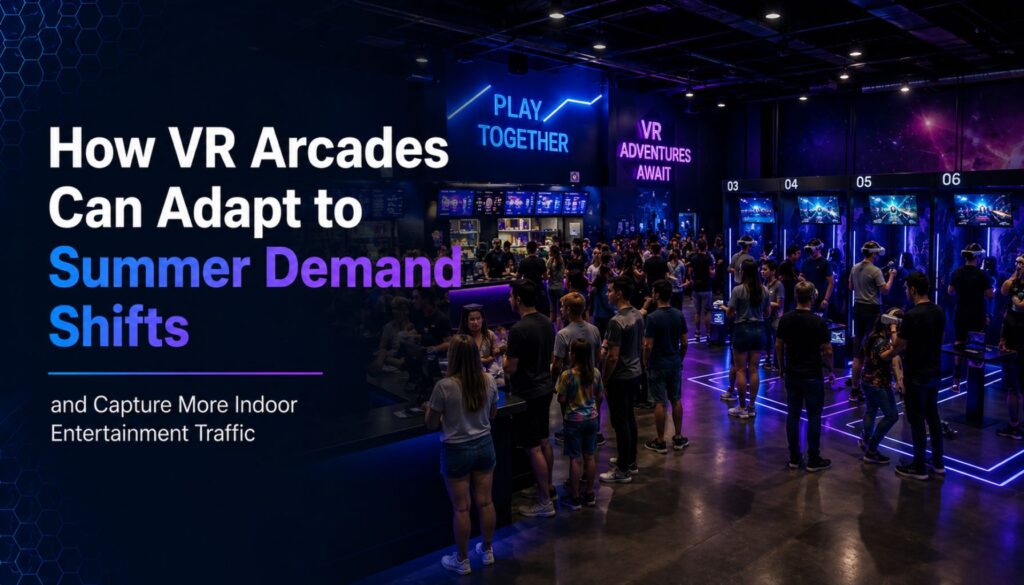
Most VR arcade operators expect summer to bring more visitors. What many find instead is that summer changes booking behavior more than it changes overall demand. Seasonal patterns vary considerably across commercial VR venues. Tourist destinations often welcome an influx of first-time visitors. Local family entertainment centers may see regulars disappear for holidays. A rainy afternoon can transform a quiet Wednesday into one of the busiest periods of the week with only a few hours’ notice. For VR arcades, FECs, and location-based entertainment venues, marketing your VR arcade effectively in summer comes down to understanding who is likely to visit, how they make booking decisions, and whether the venue is ready to respond when demand shifts without warning. How Summer Actually Changes VR Arcade Marketing and Traffic Summer rarely increases demand evenly. The more common pattern across commercial LBE venues is a reshaping of when and how bookings arrive. Weekend sessions often stay healthy. Weekday utilization becomes harder to predict. Tourist-heavy markets see more first-time visitors, while local venues lose regulars to travel and outdoor activities. These patterns tend to run in parallel rather than canceling each other out, which means operators serving both local and tourist audiences may see strong overall numbers while still struggling with utilization on specific days and sessions. One weekend should not be read as a trend. Summer demand tends to arrive in waves driven by weather, local events, school schedules, and travel patterns, so a strong Saturday tells you less than you might expect about the following week. Operators who plan around consistent utilization rather than occasional spikes tend to manage the season more effectively. Why Heatwaves and Rainy Days Are Your Best Walk-In Opportunities Weather is one of the most reliable same-day demand drivers for indoor entertainment venues, and summer is when that effect is most pronounced. When outdoor plans fall apart, consumers search for alternatives the same day. Operators in family entertainment and attraction sectors have consistently noted that rainy weekends drive stronger attendance than clear-sky holiday weekends in some markets, with outdoor competitors like mini golf and go-karts seeing slower traffic while indoor venues pick up the difference. The mechanism is straightforward: a family with an afternoon free and a change in weather needs an answer quickly. What they search for reflects that urgency. Queries like “indoor activities near me,” “things to do with kids,” “VR arcade near me,” and “rainy day activities” are high-intent searches from people ready to book that day. Venues that answer those searches with clear, practical information, session length, pricing, group size, age suitability, what to expect on arrival, convert that traffic at a higher rate than venues that bury the details. Local SEO visibility and a clean booking page matter more in this moment than any promotional campaign. Summer Visitors Are Not One Audience A family booking a birthday party, a camp coordinator managing forty kids, a tourist couple with two free hours, and a group of friends deciding last-minute what to do on a Friday night all land in the same venue. They found it differently, they need different things, and they make decisions on very different timelines. Operators who recognize these differences can build offers, messaging, and scheduling structures that match the actual booking journey rather than defaulting to one-size promotional language. The booking pattern column in the graphic above is particularly useful for session planning: families plan ahead, camps book in advance to manage logistics, tourists decide same-day, and social groups move on short notice. A venue that can accommodate all four simultaneously, without staff coordination becoming the limiting factor, is in a structurally stronger position than one that handles them well in sequence but struggles when they overlap. Why Local Search Visibility Matters More in Summer Many summer visitors have never heard of your venue before. They find it through Google Search, Google Maps, tourism sites, local directories, and increasingly through AI-powered search results that surface venue recommendations directly in the answer rather than a list of links. Discoverability at that moment depends on two things: whether the venue appears in the results, and whether the listing answers the practical questions quickly enough to convert. Visitors searching for last-minute indoor activities are not browsing. They want session length, pricing, group size limits, and age recommendations without having to dig. Venues that surface that information clearly, in their Google Business Profile, on their booking page, and in their site copy, tend to win that traffic over venues with better attractions but harder-to-navigate information. This is also where structured data and locally relevant page content start to matter for venues that want to compete in AI-assisted search, where the answer shown to a user is often pulled from a single well-organized source rather than ranked links. Platforms like ROLLER, which works with thousands of FEC and attraction operators globally, note that seasonal promotions and clear online booking flows are among the highest-impact changes venues can make before peak periods. What to Review Before Peak Summer Traffic Arrives The checklist below covers three areas operators should audit before the season peaks: booking experience, local visibility, and operational readiness. Small improvements in clarity often create more bookings than additional advertising spend. A pricing page that answers questions without extra clicks, a Google Business Profile updated with current hours and photos, and staff briefed on same-day demand spikes are each lower-cost interventions than a paid campaign, and each one compounds across every visitor who arrives from organic search over the course of a season. Managing the Operational Complexity That Comes With Seasonal Variety On a busy summer day, a VR arcade might run a birthday party in the morning, a summer camp group at midday, tourist walk-ins through the afternoon, and a social multiplayer session in the evening. Each of those groups needs different content, different session structures, and different levels of staff involvement. That variety is manageable when volume is moderate. During weather-driven spikes, when two or three groups arrive within a short window