
Week 11: What 600+ Locations Teach You About Free Roam
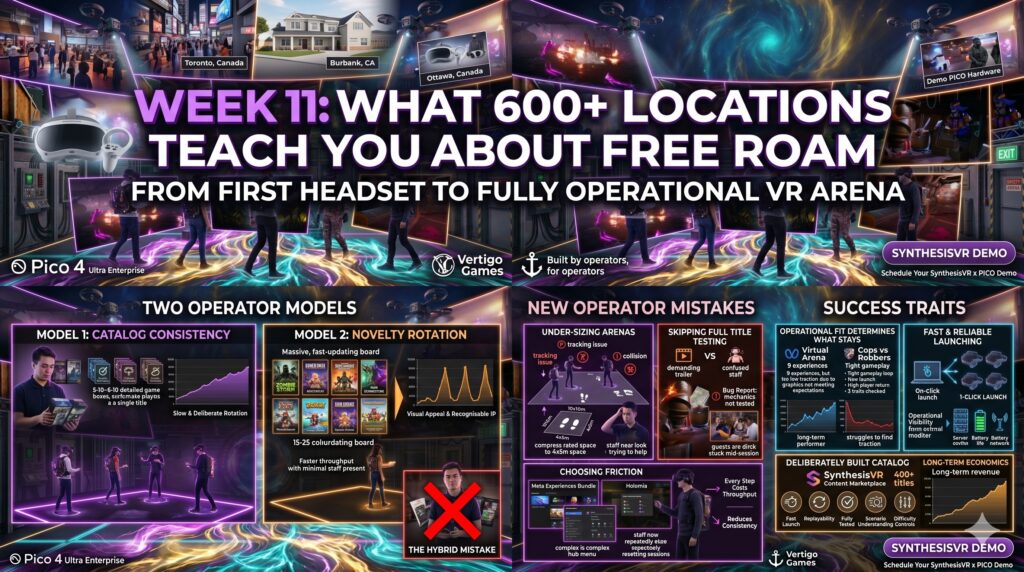
Part of the series: From First Headset to Fully Operational VR Arena A single venue gives operators one perspective on what works. Patterns only become visible when you can compare hundreds of free roam VR catalogs side by side, across markets, group sizes, staff models, and price points. After running 600+ locations on the SynthesisVR platform, the same observations keep appearing. The titles that succeed long-term are rarely the ones with the strongest launch trailers or the loudest marketing. They are the ones that fit how venues actually run. That gap between launch potential and operational fit is where most new operators lose money. The lessons below come from what our sales team hears every week from new venues, what our support team sees in the trial accounts and live operations they help troubleshoot, and the patterns visible across the global fleet. Two operator models, both valid Across the fleet, two distinct approaches to content strategy work. They are not better-or-worse versions of each other. They serve different business models, and the operators who succeed are the ones who pick a lane and commit. The first model is catalog consistency. These operators run 5 to 10 titles, know each game in detail, train staff on every scenario, and refine their lineup over months and years. Their content rotation is slow and deliberate. New titles get tested, evaluated against operational fit, and added only when they earn a permanent slot. The second model is novelty rotation. These operators offer 15 to 25 titles at any time, refresh their lineup regularly, and lean on visual appeal and recognisable IP to attract first-time visitors. Their guests come for the newest experience. Operations are designed around easy launching, minimal staff intervention, and titles simple enough to play without much guidance. Recent releases like Zombie Storm and Insiders fit this model, with strong graphics, fast onboarding, and gameplay that does not require staff to walk groups through complex scenarios. Both models generate revenue. The mistake is running a hybrid version of both without committing to either, which leaves operators with too many titles to operate well, not enough rotation to feel fresh, and staff who never quite master any of it. What actually makes a title perform long-term Visuals get a title in the door. They are not what keeps it in rotation. Our sales team works with new venues every week, and the same pattern comes up. Graphics drive the initial title selection. Operational fit determines what stays. A title can offer nine separate experiences and strong arena specs, like Virtual Arena, and still struggle to find traction because the visuals do not meet what guests now expect from a 2026 free roam VR experience. A simpler title like Holomia VR with less content on paper, holds rotations for years because the gameplay loop is tight, the launch is fast, and players return for it. The pattern across the fleet looks like this. Long-term performers tend to share three traits: fast and reliable launching, gameplay that staff can fully understand and support, and replayability that does not depend on novelty. They are also titles the operator has actually played through, scenario by scenario. That last point matters more than new operators tend to realise. When a guest gets stuck mid-session and the staff member running the venue cannot help them, the experience breaks. Our support team regularly receives bug reports for titles where the issue turns out to be a level mechanic the operator never tested. Some titles, like Corpus Animatum, include adjustable difficulty controls that let staff tune sessions to player skill, but those features only get used when the operator knows they exist. A small, well-understood catalog of commercial VR games supports that kind of operational fluency. A constantly rotating one does not. The mistakes new operators repeat most often Pattern recognition across 600+ locations gives a clear list of what new operators consistently get wrong. Three come up most often. Under-sizing arenas. A title rated for 6x6m and up to four players will not deliver a good experience in a 4x5m space. The arena specs developers publish are not aspirational targets. They reflect the minimum dimensions where the gameplay holds up. Compressing a recommended footprint to fit available space leads to player collisions, tracking issues, and reduced session quality. Both guests and staff feel it. Skipping full title testing. New operators routinely add games to their lineup based on a trailer and a launch demo. They do not play through the title at every difficulty level, every player count, every scenario. When guests get stuck or confused, staff have no answer. That gap shows up in reviews and rebooking rates faster than any other operational issue. Choosing titles with launch friction without recognising it. Some games require players to navigate hub menus or sub-launchers inside the headset before reaching gameplay. Meta Experiences Bundle and Holomia are two examples our support team flags often. The friction is not always obvious during evaluation, but it compounds across sessions. Every extra step costs throughput, increases the chance of staff intervention, and reduces the operational consistency that defines a profitable venue. Operators running these titles in commercial settings tend to either accept the trade-off knowingly, or move them out of the rotation after a few weeks of measuring reset times. Why catalog consistency tends to win for most venues For most operators, catalog consistency produces better long-term economics than novelty rotation. The reasons are operational, not philosophical. Reset cycles run faster when staff know the launch sequence cold. Guest satisfaction improves when staff can guide groups through any scenario. Repeat bookings increase when there is something familiar to come back to. Difficulty settings and scenario controls get used when operators know their catalog deeply enough to apply them. Arizona Sunshine earns its slot in long-term rotations precisely because operators who run it know how it performs at every player count and skill level. That knowledge compounds session by session. Novelty rotation can work, and
Standalone Free Roam Games Worth Adding to Your Lineup in 2026
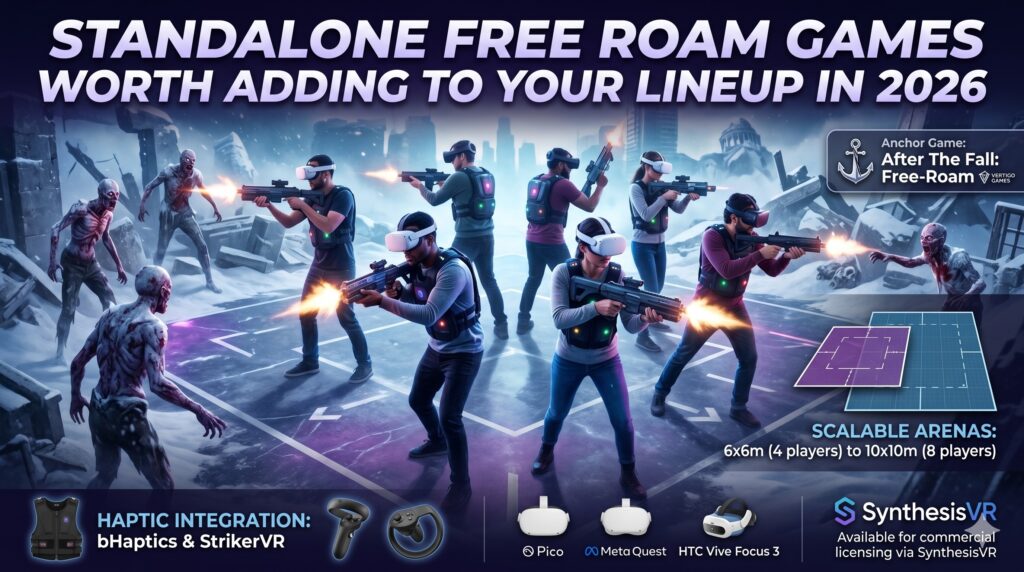
Most standalone VR free roam venues run on Pico, Meta Quest, or HTC Vive Focus 3 hardware, and the content question that matters is the same across all of them: which titles hold up under repeat play, and which go stale by month three. The operators who build stable rotations tend to do it the same way. They pick one AAA anchor guests recognise, one shorter session their staff can run fast during peak hours, and one title that no competing venue in the area can offer. This week covers a lineup built on that logic, starting with the anchor and following with two alternatives that expand what your library can do without expanding what your staff has to learn. Game Highlight: After The Fall: Free-Roam After The Fall: Free-Roam is a co-op VR shooter for up to 8 players from Vertigo Games, the studio behind Arizona Sunshine. Your guests walk into the booking already knowing the aesthetic and the genre because the IP carries weight outside the LBE market. That recognition matters for conversion at the counter, and it matters for repeat bookings when groups come back asking for “the zombie one” by name. The game itself scales across two arena footprints, 6x6m for up to 4 players and 10x10m for up to 8, so the same license covers smaller weekday groups and full weekend parties. Haptic integration with bHaptics and StrikerVR pushes the immersion past what most standalone titles deliver, which is the kind of detail regulars notice after their third or fourth session. The Snowbreed enemies, the post-apocalyptic Los Angeles setting, and the co-op objective-based structure give the session a clear arc that plays well with both first-timers and experienced VR players. Available on Pico, Meta Quest, and HTC Vive Focus 3 through SynthesisVR for commercial LBE licensing. Learn more: https://deployreality.com/synthesisvr/games/hmd-pico/after-the-fall-free-roam SynthesisVR Community Pages for Free Roam Games Alongside the game itself, SynthesisVR runs Community Pages built for Location-Based Entertainment VR operators, developers, and industry professionals. Check our After The Fall: Free-Roam: Community Page These pages work as living knowledge hubs, where operators can: Unlike traditional consumer-focused communities, SynthesisVR Community Pages are purpose-built for professionals, helping operators make informed decisions, improve uptime, and deliver better experiences to guests. This initiative reflects SynthesisVR’s long-standing commitment to not just distributing content, but supporting the businesses that run it. Annual License with Area Exclusivity Protect Your Market. Simplify Your Costs. After the Fall free roam free roam now offers a Fixed Location Annual License with built-in exclusivity within a 20 km (12.4 mile) radius. Nearby venues cannot offer the same title, helping you protect local demand and strengthen your competitive positioning. The Fixed Location model provides one flat fee that covers your entire venue up to the maximum supported player count, eliminating per-station tracking and simplifying budgeting. Why operators choose this model The Fixed Location license simplifies budgeting by offering a single flat fee per location, covering all supported stations without the need for per-minute tracking or variable billing. This allows operators to forecast costs more accurately, maintain stable margins, and reduce administrative overhead tied to usage monitoring. How to Evaluate Before You Commit The most reliable evaluation method is a staff session before a title enters your public rotation. It surfaces onboarding friction, space edge cases, and reset cycle times that spec sheets do not show. SynthesisVR offers free test access across the commercial VR games catalog, every title above available to trial before you license. SynthesisVR is a VR management platform built for LBE operators, with 350+ experiences available through one content marketplace. Every title here runs through the same interface as the rest of your library, with no additional platform switching or separate session management required. Browse the full standalone free roam catalog to see arena specs, player counts, and licensing options.Explore the full SynthesisVR content marketplace here!