
How Often Should VR Arcades Rotate Their Content?
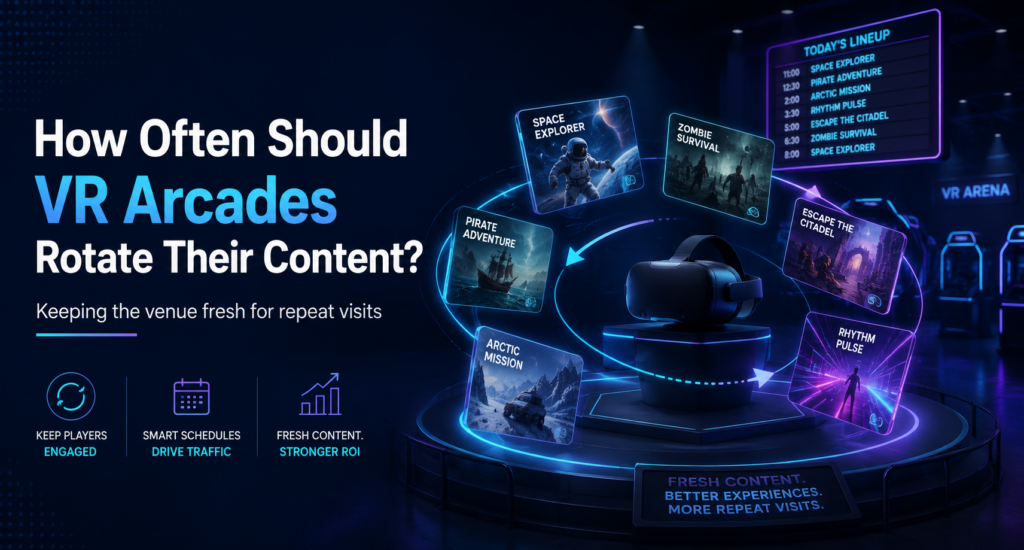
A VR arcade can have dozens of experiences available and still feel unchanged to a returning customer. That happens when the same few games stay at the front of the booking page, staff recommend the same titles, and regular guests see little reason to explore the rest of the library. VR arcade content rotation helps solve that problem. Rotation can create new reasons to visit, give regular customers something different to try, and give the venue fresh material to market. It can also help operators learn which experiences deserve a permanent place in the lineup. There is no universal rule that says a VR arcade should replace its games every 30, 60, or 90 days. A better rotation schedule follows customer behavior, venue type, seasonality, and the role each experience plays in the business. Entertainment venues have always relied on changing programming VR arcades are far from the only entertainment businesses that need to give customers reasons to return. A cinema keeps the same screens, seats, lobby, and projection equipment while its programming changes continuously. New films give previous customers another reason to visit the same building. Special screenings, themed programs, and events can create additional reasons to return between major releases. Arcades and family entertainment centers use a related model. The physical venue stays familiar, while operators change the attraction mix, promote different games, run competitions, and introduce new experiences over time. The wider attractions industry follows the same logic. IAAPA has highlighted how refreshed entertainment programming can support guest satisfaction, repeat visits, and spending. VR gives operators an especially flexible version of this model. The headset, PC, room-scale station, or free-roam arena can stay in place while the experience inside it changes. That makes content one of the most adjustable parts of a commercial VR attraction. Why newness matters for repeat business A great first visit does not automatically create a fifth visit. Customers eventually start asking what will be different next time. That question matters even more for local venues that depend on the same population throughout the year. Research into consumer variety-seeking behavior has examined how repeated consumption can reduce the appeal of choosing the same option again and increase interest in alternatives. That does not mean every guest wants a completely unfamiliar experience on every visit. Familiarity can be valuable, especially with competitive games, multiplayer favorites, and experiences where players improve over time. The opportunity comes from combining both. A customer might return to beat a previous score, introduce friends to a favorite multiplayer game, and then try one experience they have never played before. That mix gives the venue more ways to turn one successful visit into several. We explored the broader retention side of this in How VR Entertainment Venues Turn First-Time Visitors Into Repeat Customers. Content rotation becomes one of the tools operators can use once that return relationship starts. Content rotation also creates something new to market Operators sometimes treat content rotation as a library-management task. It also solves a marketing problem. A venue cannot tell the same local audience to “come try VR” indefinitely. Customers who already visited know what VR feels like. The next campaign needs a more specific reason to return. A newly featured cooperative adventure can become this month’s group recommendation. A competitive title can become the basis of a leaderboard challenge. A horror experience can lead a Halloween campaign. Family content can move forward during school breaks, while faster competitive experiences can support student or adult social promotions. One content change can give the venue material for its email list, social channels, website, in-venue screens, and staff recommendations. The experience itself does not even need to be new to the marketplace. A title that has spent a year inside a 30-game library may still be completely new to most customers. This gives operators an important distinction: you can rotate attention without constantly replacing inventory. Content rotation does not always mean buying new games Operators have several ways to make a VR lineup feel fresh. Featured-content rotation changes which existing games receive the most visibility. Staff can recommend a different experience, the website can feature it, and the venue can build a campaign around it. Event rotation changes how customers use familiar content. A leaderboard, tournament, weekly challenge, team night, or score target can renew an experience without changing the underlying game. VR arcade leaderboards are one example of turning existing content into a repeat challenge. Audience rotation changes which part of the library the venue promotes. Families, birthday groups, corporate teams, students, and experienced VR players rarely need the same recommendation. Seasonal rotation moves relevant experiences forward when customer interest changes. Horror can gain prominence before Halloween. Family and group content can take priority during school breaks. Competitive multiplayer can support weekday social offers when local traffic becomes more important. Library rotation involves the larger decision to add, remove, or replace titles. Operators usually need to do this less often than promotional rotation. Separating these types of rotation prevents a common mistake: assuming that keeping a venue fresh requires continuously licensing more content. How often should a VR arcade rotate content? A practical schedule can work across several timeframes. The monthly change does not need to involve a new commercial license. A venue may simply move an overlooked game into the featured position and support it with staff recommendations, short-form video, or a limited challenge. The quarterly review goes deeper. Operators can ask whether the library still covers enough genres, group sizes, skill levels, session lengths, and customer types. Player capacity matters here too. A strong four-player experience serves a different booking need from a six-player or eight-player attraction. How Many Players Should a VR Attraction Support? looks at that decision from the capacity and attraction-mix side. Let customer behavior trigger the bigger changes The calendar provides a useful review rhythm. Customer behavior should decide what actually changes. Start with how often guests select each experience. Then look at replay behavior. A title that attracts