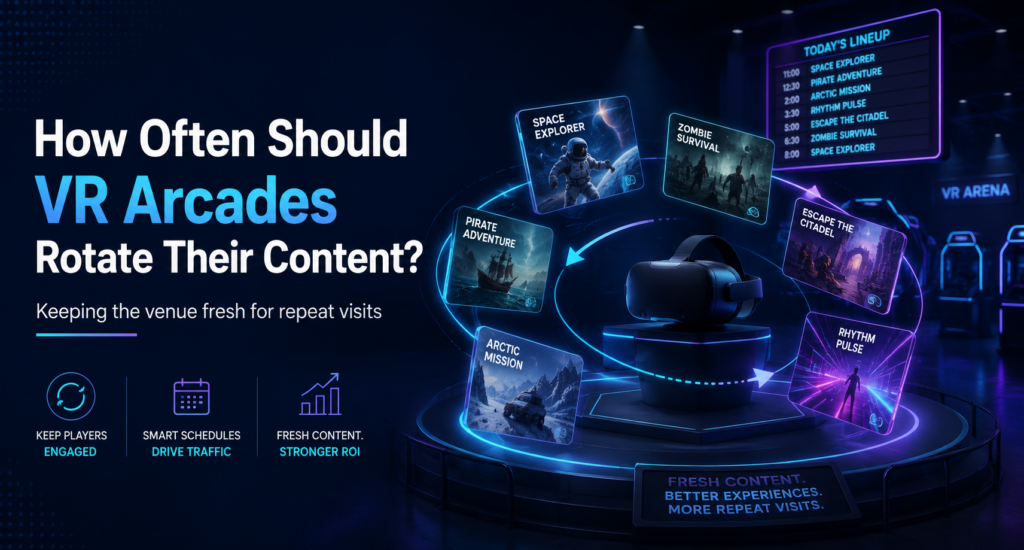
A VR arcade can have dozens of experiences available and still feel unchanged to a returning customer.
That happens when the same few games stay at the front of the booking page, staff recommend the same titles, and regular guests see little reason to explore the rest of the library.
VR arcade content rotation helps solve that problem. Rotation can create new reasons to visit, give regular customers something different to try, and give the venue fresh material to market. It can also help operators learn which experiences deserve a permanent place in the lineup.
There is no universal rule that says a VR arcade should replace its games every 30, 60, or 90 days. A better rotation schedule follows customer behavior, venue type, seasonality, and the role each experience plays in the business.
Entertainment venues have always relied on changing programming
VR arcades are far from the only entertainment businesses that need to give customers reasons to return.
A cinema keeps the same screens, seats, lobby, and projection equipment while its programming changes continuously. New films give previous customers another reason to visit the same building. Special screenings, themed programs, and events can create additional reasons to return between major releases.
Arcades and family entertainment centers use a related model. The physical venue stays familiar, while operators change the attraction mix, promote different games, run competitions, and introduce new experiences over time.
The wider attractions industry follows the same logic. IAAPA has highlighted how refreshed entertainment programming can support guest satisfaction, repeat visits, and spending.
VR gives operators an especially flexible version of this model. The headset, PC, room-scale station, or free-roam arena can stay in place while the experience inside it changes.
That makes content one of the most adjustable parts of a commercial VR attraction.
Why newness matters for repeat business
A great first visit does not automatically create a fifth visit.
Customers eventually start asking what will be different next time. That question matters even more for local venues that depend on the same population throughout the year.
Research into consumer variety-seeking behavior has examined how repeated consumption can reduce the appeal of choosing the same option again and increase interest in alternatives.
That does not mean every guest wants a completely unfamiliar experience on every visit. Familiarity can be valuable, especially with competitive games, multiplayer favorites, and experiences where players improve over time.
The opportunity comes from combining both.
A customer might return to beat a previous score, introduce friends to a favorite multiplayer game, and then try one experience they have never played before.
That mix gives the venue more ways to turn one successful visit into several.
We explored the broader retention side of this in How VR Entertainment Venues Turn First-Time Visitors Into Repeat Customers. Content rotation becomes one of the tools operators can use once that return relationship starts.
Content rotation also creates something new to market
Operators sometimes treat content rotation as a library-management task. It also solves a marketing problem.
A venue cannot tell the same local audience to “come try VR” indefinitely. Customers who already visited know what VR feels like.
The next campaign needs a more specific reason to return.
A newly featured cooperative adventure can become this month’s group recommendation. A competitive title can become the basis of a leaderboard challenge. A horror experience can lead a Halloween campaign. Family content can move forward during school breaks, while faster competitive experiences can support student or adult social promotions.
One content change can give the venue material for its email list, social channels, website, in-venue screens, and staff recommendations.
The experience itself does not even need to be new to the marketplace.
A title that has spent a year inside a 30-game library may still be completely new to most customers.
This gives operators an important distinction: you can rotate attention without constantly replacing inventory.
Content rotation does not always mean buying new games
Operators have several ways to make a VR lineup feel fresh.
Featured-content rotation changes which existing games receive the most visibility. Staff can recommend a different experience, the website can feature it, and the venue can build a campaign around it.
Event rotation changes how customers use familiar content. A leaderboard, tournament, weekly challenge, team night, or score target can renew an experience without changing the underlying game. VR arcade leaderboards are one example of turning existing content into a repeat challenge.
Audience rotation changes which part of the library the venue promotes. Families, birthday groups, corporate teams, students, and experienced VR players rarely need the same recommendation.
Seasonal rotation moves relevant experiences forward when customer interest changes. Horror can gain prominence before Halloween. Family and group content can take priority during school breaks. Competitive multiplayer can support weekday social offers when local traffic becomes more important.
Library rotation involves the larger decision to add, remove, or replace titles. Operators usually need to do this less often than promotional rotation.
Separating these types of rotation prevents a common mistake: assuming that keeping a venue fresh requires continuously licensing more content.
How often should a VR arcade rotate content?
A practical schedule can work across several timeframes.
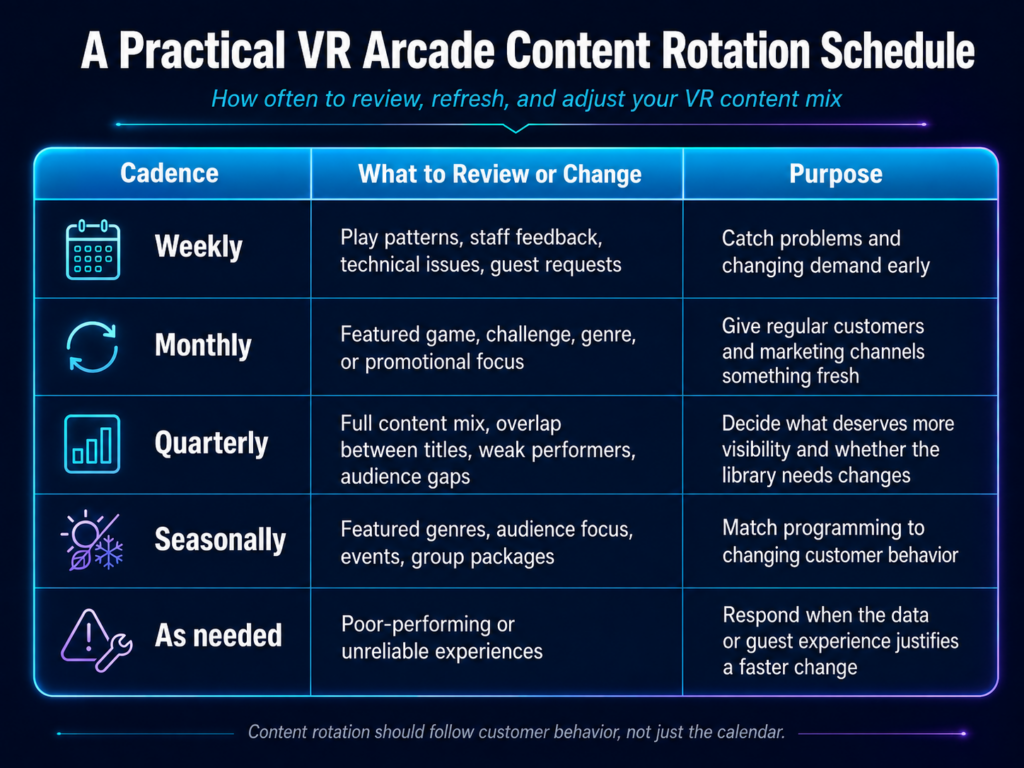
The monthly change does not need to involve a new commercial license. A venue may simply move an overlooked game into the featured position and support it with staff recommendations, short-form video, or a limited challenge.
The quarterly review goes deeper. Operators can ask whether the library still covers enough genres, group sizes, skill levels, session lengths, and customer types.
Player capacity matters here too. A strong four-player experience serves a different booking need from a six-player or eight-player attraction. How Many Players Should a VR Attraction Support? looks at that decision from the capacity and attraction-mix side.
Let customer behavior trigger the bigger changes
The calendar provides a useful review rhythm. Customer behavior should decide what actually changes.
Start with how often guests select each experience. Then look at replay behavior. A title that attracts plenty of first plays but almost no repeat sessions serves a different purpose from a competitive game that customers choose repeatedly.
Operators should also watch for operational friction.
If staff regularly struggle to explain a game, sessions take too long to launch, or technical problems interrupt bookings, that experience carries a cost beyond its licensing fee.
Audience fit matters as well. A venue might own several strong shooters while lacking enough family, cooperative, rhythm, educational, or escape content. In that case, the next addition should fill the gap instead of giving the venue another version of something it already has.
The same principle applies to multiplayer. What Makes a Good Multiplayer VR Experience for Out-of-Home Venues? looks at onboarding, group flow, and replayability beyond the basic player-count specification.
Do not rotate a strong performer just because it is old
New releases attract attention, but age alone tells an operator very little about commercial value.
Some experiences become long-term anchors because customers understand them quickly, staff can recommend them confidently, groups enjoy them, and returning players still want another round.
Competitive games can become stronger with familiarity. Players improve, scores become meaningful, and rematches create another reason to visit.
Social multiplayer titles can work similarly. A customer who already knows the experience may bring three new friends and effectively become part of the onboarding process.
The earlier Why Multiplayer VR Attractions Drive Repeat Visits and Higher Utilization guide makes the same broader point: the highest-performing experience does not always have to be the newest experience.
A successful rotation strategy protects those anchor titles while changing enough around them to keep the wider venue interesting.
Build a balanced library instead of chasing constant novelty
A content library earns its keep when different experiences perform different jobs.
One title may work well for first-time players. Another may fit birthday parties. A third may suit corporate groups. Competitive games can support repeat challenges, while longer cooperative experiences may justify premium group bookings.
Operators should therefore ask what role each title plays before deciding whether to keep or replace it.
This connects directly to the economics covered in How VR Arcades Actually Make Money. Revenue depends on more than selling individual sessions. Group bookings, repeat visitors, events, capacity use, and the attraction mix all influence how much value the same hardware can generate.
A large library with heavy overlap can create more choice without creating more useful variety.
A smaller, carefully selected library can sometimes serve more customer situations when every title has a clear purpose.
Where SynthesisVR fits into content rotation
Managing rotation becomes easier when operators can handle content, commercial licensing, and session delivery through the same VR management environment. SynthesisVR lets venues manage different experiences across PCVR, standalone, room-scale, and free-roam setups while adjusting what each attraction offers as customer demand changes.
That gives operators more freedom to test featured content, adapt the attraction mix, and introduce different experiences without rebuilding the operating workflow every time the marketing calendar changes.
Rotate for a reason
The best VR arcade content rotation schedule follows guest behavior more closely than a fixed calendar.
Review performance regularly. Give customers something different to discover each month. Reassess the wider library every few months. Use seasons and events to change what receives attention.
Keep the experiences that continue to earn their place.
The goal is a venue that customers recognize when they walk through the door, with enough change inside the headsets to give them another reason to come back.