
What Should Be Included in a New VR Venue Business Plan?
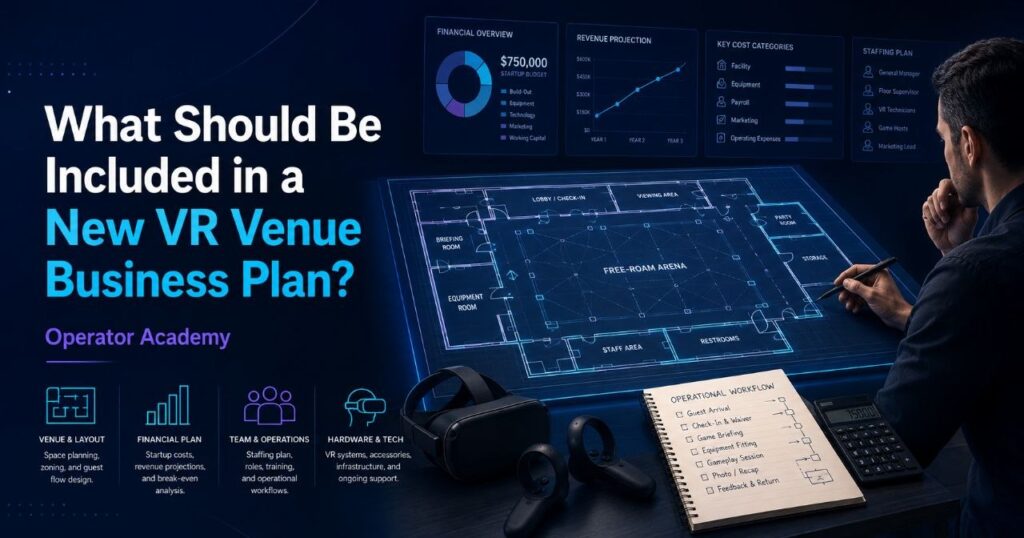
Opening a VR arcade or adding a commercial VR attraction to an existing entertainment venue starts with more than choosing headsets and finding a space. A useful VR arcade business plan should explain who the venue will serve, what those customers will book, how many sessions the operation can realistically deliver, what each session costs to run, and whether projected demand can support the investment. For a new VR venue, that means connecting traditional business planning with decisions that are specific to location-based VR: attraction format, playable space, headset capacity, commercial content licensing, VR management software, staffing, session turnaround, hardware maintenance, and content rotation. A plan that covers those areas gives an operator something more useful than a document for a lender or investor. It becomes the model against which the venue can test decisions before committing money. Start With the Type of VR Venue You Plan to Operate The term “VR arcade” covers several very different businesses. One operator may install six room-scale PCVR stations. Another may build a standalone free-roam arena for groups of six or eight. An existing family entertainment center might add VR alongside bowling, laser tag, or escape rooms. A larger location may combine several formats. Those models do not share the same requirements. A business plan should therefore define the attraction before estimating revenue: These choices affect almost every number that follows. An eight-headset venue, for example, could operate one eight-player attraction, two four-player experiences, or several smaller stations. Each configuration creates a different booking model, staffing requirement, throughput ceiling, and content library. The business plan should describe that operating model clearly enough that the financial assumptions can be traced back to something the venue can actually deliver. Define the Customers You Expect to Book “People interested in VR” is too broad to use as a target market. Most commercial entertainment purchases begin with an occasion. A parent may need an activity for a birthday. A group of friends may want something to do on Friday evening. A company may need a team-building activity. A teacher may be searching for an educational group visit. The market section of a VR venue business plan should identify the groups most likely to generate bookings in the local area and estimate how frequently those occasions occur. This can include families, birthday groups, tourists, students, schools, corporate teams, local social groups and repeat visitors. Competitor research should also extend beyond other VR venues. Customers may compare a VR booking with bowling, escape rooms, laser tag, cinema, trampoline parks, karting and other local entertainment. Understanding those alternatives helps answer two important questions: what customers already pay for entertainment in the area, and what reason will they have to choose your attraction? Build the Business Plan Around Sellable Capacity Headset count alone does not describe revenue capacity. A venue sells time inside an attraction. That makes the number of sessions a venue can deliver one of the most important assumptions in the business plan. A simple planning model is: Available sessions × average players per session × realistic utilization × average revenue per player The difficult part is making each assumption realistic. Suppose an arena can theoretically run eight sessions during its opening hours. That does not automatically mean the venue can sell eight sessions. The plan also needs to account for: Our free-roam operations series examined this directly in Week 9: Staff Training and the 15-Minute Cycle. In a venue running back-to-back group bookings, the reset window influences how many groups staff can serve in a day. A few extra minutes between every session can eventually remove an entire sellable time slot from the schedule. That is why throughput belongs in the business plan rather than appearing later as an operational problem. Separate Startup Investment From Ongoing Operating Costs New operators tend to notice the largest purchases first. Headsets, computers, networking equipment, furniture, leasehold improvements and arena construction are visible costs. They usually appear on the initial spreadsheet before the venue opens. The ongoing expenses deserve equal attention. A useful VR venue budget should separate capital expenditure, or CapEx, from operating expenditure, or OpEx. Typical startup costs can include: Ongoing costs may include rent, payroll, utilities, marketing, payment processing, maintenance, replacement equipment, commercial content licensing and VR management software. This distinction matters because the lowest initial equipment price does not always produce the lowest operating cost. In Week 4: The Math of a Successful Free Roam Arena, we looked at this through the CapEx versus OpEx lens. Hardware that requires frequent manual calibration, troubleshooting or device-by-device management creates labor costs that rarely appear on the original purchase order. A business plan should therefore estimate what the equipment costs to operate, not only what it costs to acquire. Budget for Commercial VR Hardware Hardware deserves its own section because a commercial VR headset has a very different job from a headset used at home. A venue may run the same devices for several sessions per day, across hundreds of guests, while staff need predictable tracking, charging, device control and fleet management. The plan should consider: For standalone free-roam deployments, PICO enterprise hardware has become one option widely used in location-based entertainment. Our free-roam series explored the reasons in Week 3: Why PICO Became the LBE Standard for Free Roam, including persistent mapping, device control, commercial deployment workflows and integration with centralized venue management. SynthesisVR also works with operators planning PICO deployments and can provide PICO enterprise hardware options alongside the platform setup. Operators preparing a new venue can contact the SynthesisVR team for a current hardware quote based on their required fleet size and deployment. That quote belongs in the business plan alongside the rest of the startup equipment budget. Include Commercial Content Licensing From the Beginning Content is another expense that operators sometimes underestimate because consumer VR has trained people to think in terms of buying a game once. Commercial use works differently. A consumer game purchase generally covers personal use. Running a VR title for paying customers