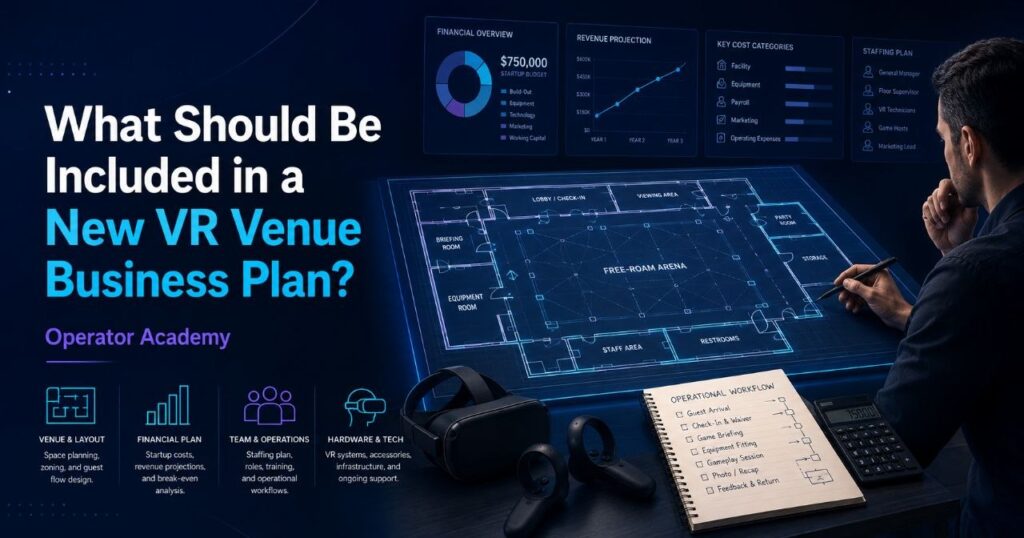
Opening a VR arcade or adding a commercial VR attraction to an existing entertainment venue starts with more than choosing headsets and finding a space.
A useful VR arcade business plan should explain who the venue will serve, what those customers will book, how many sessions the operation can realistically deliver, what each session costs to run, and whether projected demand can support the investment.
For a new VR venue, that means connecting traditional business planning with decisions that are specific to location-based VR: attraction format, playable space, headset capacity, commercial content licensing, VR management software, staffing, session turnaround, hardware maintenance, and content rotation.
A plan that covers those areas gives an operator something more useful than a document for a lender or investor. It becomes the model against which the venue can test decisions before committing money.
Start With the Type of VR Venue You Plan to Operate
The term “VR arcade” covers several very different businesses.
One operator may install six room-scale PCVR stations. Another may build a standalone free-roam arena for groups of six or eight. An existing family entertainment center might add VR alongside bowling, laser tag, or escape rooms. A larger location may combine several formats.
Those models do not share the same requirements.
A business plan should therefore define the attraction before estimating revenue:
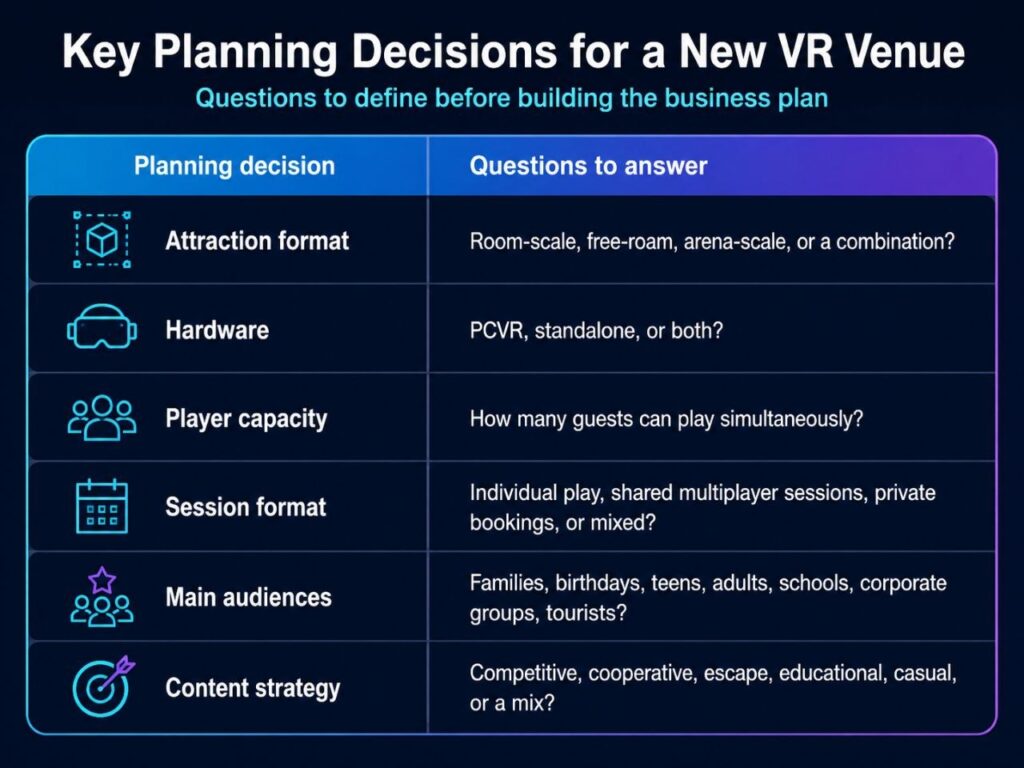
These choices affect almost every number that follows.
An eight-headset venue, for example, could operate one eight-player attraction, two four-player experiences, or several smaller stations. Each configuration creates a different booking model, staffing requirement, throughput ceiling, and content library.
The business plan should describe that operating model clearly enough that the financial assumptions can be traced back to something the venue can actually deliver.
Define the Customers You Expect to Book
“People interested in VR” is too broad to use as a target market.
Most commercial entertainment purchases begin with an occasion. A parent may need an activity for a birthday. A group of friends may want something to do on Friday evening. A company may need a team-building activity. A teacher may be searching for an educational group visit.
The market section of a VR venue business plan should identify the groups most likely to generate bookings in the local area and estimate how frequently those occasions occur.
This can include families, birthday groups, tourists, students, schools, corporate teams, local social groups and repeat visitors.
Competitor research should also extend beyond other VR venues. Customers may compare a VR booking with bowling, escape rooms, laser tag, cinema, trampoline parks, karting and other local entertainment.
Understanding those alternatives helps answer two important questions: what customers already pay for entertainment in the area, and what reason will they have to choose your attraction?
Build the Business Plan Around Sellable Capacity
Headset count alone does not describe revenue capacity.
A venue sells time inside an attraction.
That makes the number of sessions a venue can deliver one of the most important assumptions in the business plan.
A simple planning model is:
Available sessions × average players per session × realistic utilization × average revenue per player
The difficult part is making each assumption realistic.
Suppose an arena can theoretically run eight sessions during its opening hours. That does not automatically mean the venue can sell eight sessions.
The plan also needs to account for:
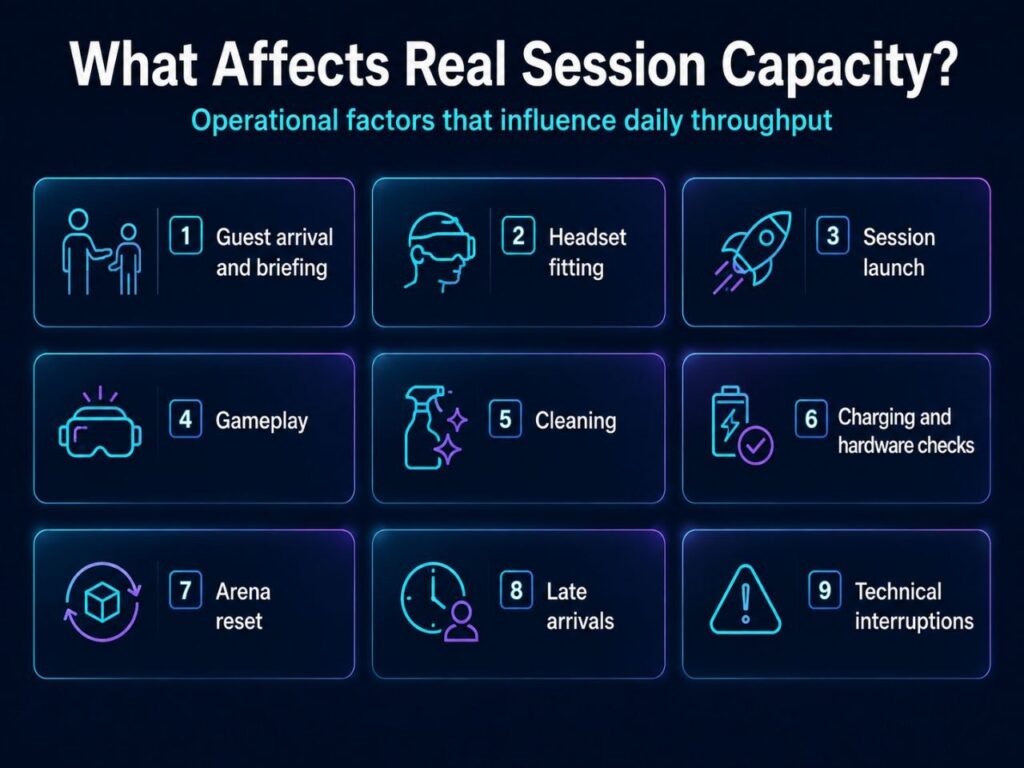
Our free-roam operations series examined this directly in Week 9: Staff Training and the 15-Minute Cycle. In a venue running back-to-back group bookings, the reset window influences how many groups staff can serve in a day. A few extra minutes between every session can eventually remove an entire sellable time slot from the schedule.
That is why throughput belongs in the business plan rather than appearing later as an operational problem.
Separate Startup Investment From Ongoing Operating Costs
New operators tend to notice the largest purchases first.
Headsets, computers, networking equipment, furniture, leasehold improvements and arena construction are visible costs. They usually appear on the initial spreadsheet before the venue opens.
The ongoing expenses deserve equal attention.
A useful VR venue budget should separate capital expenditure, or CapEx, from operating expenditure, or OpEx.
Typical startup costs can include:
- headset fleet;
- gaming PCs where required;
- routers and networking infrastructure;
- charging equipment;
- physical build-out;
- reception and staging areas;
- furniture;
- signage;
- spare hardware.
Ongoing costs may include rent, payroll, utilities, marketing, payment processing, maintenance, replacement equipment, commercial content licensing and VR management software.
This distinction matters because the lowest initial equipment price does not always produce the lowest operating cost.
In Week 4: The Math of a Successful Free Roam Arena, we looked at this through the CapEx versus OpEx lens. Hardware that requires frequent manual calibration, troubleshooting or device-by-device management creates labor costs that rarely appear on the original purchase order.
A business plan should therefore estimate what the equipment costs to operate, not only what it costs to acquire.
Budget for Commercial VR Hardware
Hardware deserves its own section because a commercial VR headset has a very different job from a headset used at home.
A venue may run the same devices for several sessions per day, across hundreds of guests, while staff need predictable tracking, charging, device control and fleet management.
The plan should consider:
- commercial warranty terms;
- expected daily usage;
- battery and charging workflow;
- device management;
- replacement units;
- controller replacement;
- hygiene equipment;
- networking requirements;
- support availability;
- compatibility with the planned content.
For standalone free-roam deployments, PICO enterprise hardware has become one option widely used in location-based entertainment. Our free-roam series explored the reasons in Week 3: Why PICO Became the LBE Standard for Free Roam, including persistent mapping, device control, commercial deployment workflows and integration with centralized venue management.
SynthesisVR also works with operators planning PICO deployments and can provide PICO enterprise hardware options alongside the platform setup. Operators preparing a new venue can contact the SynthesisVR team for a current hardware quote based on their required fleet size and deployment.
That quote belongs in the business plan alongside the rest of the startup equipment budget.
Include Commercial Content Licensing From the Beginning
Content is another expense that operators sometimes underestimate because consumer VR has trained people to think in terms of buying a game once.
Commercial use works differently.
A consumer game purchase generally covers personal use. Running a VR title for paying customers requires the appropriate commercial rights.
A new venue should therefore include VR content licensing in its operating-cost forecast and decide how it plans to manage that licensing before opening.
Commercial models vary by title. Depending on the experience, operators may encounter usage-based licensing, session-based models, fixed station fees, fixed location fees or other commercial arrangements.
This flexibility can help venues match content costs to their operating model, but the cost still needs a place in the financial forecast.
We covered this issue in detail in Week 10: Content Licensing: The Legal Minefield Most Operators Ignore. The article looks at why consumer licenses do not cover commercial arcade use and why licensing becomes harder to fix once a venue has already built a large library around informal processes.
The SynthesisVR commercial marketplace brings commercially licensed content into the same environment operators use to manage their venue. This gives operators a way to evaluate content, track usage and manage licensing rather than maintaining separate processes for every title.
For a business plan, the important point is simple: content has an operating cost and should appear in the forecast from day one.
Add the VR Management Platform to Operating Expenses
Another line item that belongs next to content licensing is the system used to operate the attraction.
A commercial venue needs more than a collection of headsets and games.
Staff have to launch sessions, monitor devices, manage content, track licensing, recover devices when something goes wrong and prepare the attraction for the next group.
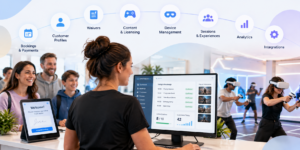
A VR arcade management system centralizes those processes.
The business plan should identify the management layer required by the chosen attraction model and understand which costs apply at launch and which appear as the operation grows.
This is particularly important in multiplayer and free-roam environments. Managing eight headsets individually may appear manageable during testing. It becomes very different when eight customers are waiting, another group arrives early and one device needs attention during the turnaround window.
SynthesisVR was originally developed inside a commercial VR arcade to coordinate hardware, content licensing and session operations. Local Manager connects supported stations and headsets so staff can manage the attraction through a common operational layer.
For the business plan, the platform should appear as part of the operating infrastructure rather than as an optional software expense added after launch.
New operators do not necessarily need to commit to a full paid management plan from day one. SynthesisVR’s Essential Access plan provides foundational access to the platform with no monthly commitment, including centralized content management and multiplayer launching. New accounts also receive $250 in software credit that can be used to test additional platform features as the venue develops its workflow.
For a new venue business plan, this can reduce the amount that needs to be allocated to management software during the earliest setup stage while still giving the operator a working platform to test content and operational workflows.
Build Staffing Around the Workflow
A staffing forecast should describe more than how many employees the venue needs.
It should describe what those employees need to do during one complete customer cycle.
For example:
A group arrives. Staff confirm the booking and player count. They explain the experience, fit the headsets, check controllers and batteries, launch the session, monitor the attraction, help if a problem occurs, collect the equipment afterward, clean it and prepare the space for the next group.
Now repeat that process several times during a busy Saturday.
The business plan should estimate staffing against peak operating conditions rather than quiet periods.
It should also consider training. If one experienced employee knows how to solve every hardware problem, that knowledge becomes an operational dependency.
The staff-training article from our free-roam series recommends documented workflows for greeting, briefing, hardware checks, session launch, monitoring and reset. Centralized management also reduces the amount of device-specific knowledge that every new employee needs to learn.
For financial planning, that connection matters:
simpler workflow → faster training → more predictable resets → greater practical capacity.
Staffing and technology decisions should therefore appear together in the business plan.
Plan for Downtime, Repairs and Replacement Hardware
Hardware will eventually need attention.
Controllers get damaged. Headsets need replacement. Charging cables fail. Software updates introduce unexpected behavior. Networks need troubleshooting.
A business plan does not need to predict every failure, but it should include a contingency for them.
Operators should consider maintaining spare equipment and budgeting for replacement parts rather than assuming every headset will remain available every day of the year.
The financial impact extends beyond the repair itself.
When one device takes a multiplayer attraction offline or reduces the number of players a group can bring, the venue may lose revenue while continuing to pay rent and labor.
Our free-roam cost analysis describes this as part of the operating cost that a simple hardware purchase comparison can miss. Reliability, maintenance time and session interruptions all influence the true cost of the fleet.
Decide How the Venue Will Bring Customers Back
The marketing section of the business plan should answer two separate questions:
How will customers discover the venue?
and
Why will they return after their first visit?
The first question covers local search, social media, partnerships, schools, hotels, tourism, paid advertising and group sales.
The second affects the economics of the business much more deeply.
A venue that relies entirely on new customers has to keep replacing every visitor it serves. A venue that builds birthday business, corporate bookings, school relationships, multiplayer competition, changing content and repeat social visits has more ways to use the same physical attraction repeatedly.
The business plan should therefore explain the expected mix between new and returning customers.
Content strategy belongs here too. A venue with access to different competitive, cooperative, escape, family and educational experiences can adapt the same hardware to several audiences and give previous visitors something different to play.
Stress-Test the Financial Assumptions
Once the revenue model looks attractive on paper, change the assumptions.
If the plan assumes 70 percent utilization, calculate what happens at 50 percent.
If Saturday carries most of the projected revenue, calculate the result of losing several sessions to technical downtime.
If the forecast assumes eight-player bookings, model an average group size of five.
If the operating plan depends on one staff member handling the entire attraction, model a Saturday where two groups arrive at the same time.
A useful stress-test table could look like this:
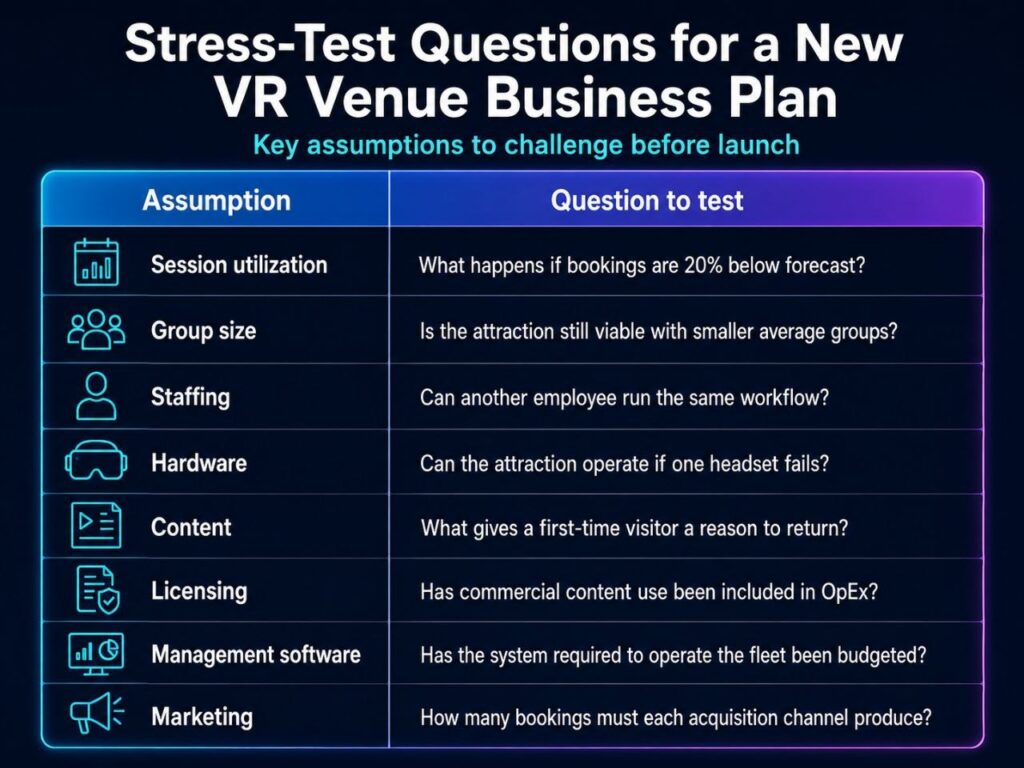
A business plan becomes far more useful when it explains what happens when the first forecast proves wrong.
What Should a VR Arcade Business Plan Include?
For quick reference, a new VR venue business plan should cover:
- The attraction format and venue concept.
- Target audiences and local entertainment market.
- Location and usable VR space.
- Headset and hardware requirements.
- Player capacity and session structure.
- Realistic daily throughput.
- Startup investment.
- Ongoing operating expenses.
- Commercial VR content licensing.
- VR management software.
- Staffing and training.
- Pricing and packages.
- Marketing and customer acquisition.
- Repeat-visit strategy.
- Revenue projections and break-even assumptions.
- Hardware replacement and downtime contingencies.
- Stress tests for weaker-than-expected demand.
Each part should connect to the next.
Hardware determines what can run. Space affects capacity. Capacity affects the booking model. The workflow affects throughput. Throughput affects revenue. Licensing, software, staff and maintenance affect the cost of producing that revenue.
That connection is what turns the document into an operating plan rather than a collection of optimistic numbers.
Build the Plan Before You Build the Venue
A VR venue business plan cannot predict exactly how customers will behave after opening.
It can expose assumptions while they are still inexpensive to change.
Before signing a lease or purchasing a full headset fleet, operators should know what attraction they want to run, how many customers it can realistically serve, what the complete operating stack will cost and which customer groups they expect to fill those sessions.
That includes the expenses that are easy to miss during early planning: commercial licensing, management software, spare hardware, staffing time and the operational cost of keeping the attraction ready between bookings.
SynthesisVR brings venue management and commercial VR content licensing into one platform and supports both PCVR and standalone attraction models. Operators planning a PICO-based venue can also contact the SynthesisVR team for a current PICO enterprise hardware quote and discuss the platform, hardware and content requirements for their planned setup.