
How Much Does It Cost to Start a VR Arcade? Build Your Own Startup Budget
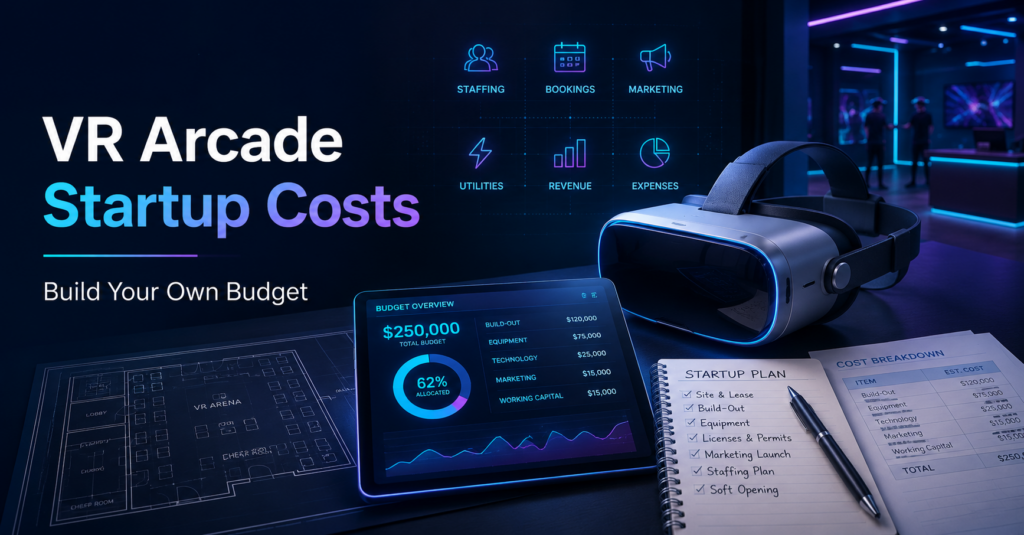
VR arcade startup costs can look completely different from one location to the next. Rent changes by city. Labor costs change by country. A four-headset standalone setup has a different cost structure from a PCVR arcade, a free-roam arena, or a family entertainment center adding VR to an existing attraction mix. That makes a single “average cost to open a VR arcade” difficult to use for serious planning. A better approach is to build the budget from your own market, venue, hardware, staffing, software, content, and revenue assumptions. We created a VR Arcade Startup Budget & Revenue Calculator to help you do exactly that. Use it alongside this guide to estimate your startup requirements, monthly operating costs, revenue potential, and break-even point. Start With the Local Market Before You Buy a Headset Hardware is one of the easier costs to identify. The local business case takes more work. Before choosing a venue or deciding how many stations to install, research what customers already pay for entertainment in your area. Look beyond other VR arcades. Your customers may also compare you with: Record the price, session length, group size, package structure, reviews, and target audience for each relevant attraction. Then ask a more useful question: What can your VR venue offer that the local market currently handles poorly? A university area may have demand for affordable multiplayer activities during weekday evenings. A family market may create more opportunity around birthdays and school breaks. An entertainment district may support longer social bookings, corporate groups, or competitive experiences. Your local demand should influence the venue before the equipment list does. Our guide to [VR arcade pricing, session prices, packages, and promotions] explains this process in more detail. 1. Calculate the Cost of the Venue For a new VR arcade, the premises usually create several expenses before the first customer arrives. Add the costs that apply to your location: An existing family entertainment center may already carry many of these costs. In that case, calculate the additional cost of adding VR rather than assigning the entire building expense to the attraction. A new standalone VR arcade needs to account for the full venue overhead. Keep the fit-out connected to the customer experience It is easy to spend heavily on futuristic décor before proving the business model. Customers still notice the basics first. Is the venue clean? Are staff helpful? Does the session start on time? Is the booking process clear? Does the group understand what to do? A simpler venue with excellent service, reliable operations, and the right experiences for its audience can build a stronger reputation than a more expensive space that struggles with those fundamentals. 2. Decide How Many Players You Actually Need to Serve Start with the booking model. A venue that expects groups of four has different hardware needs from an arena designed around eight-player birthday parties. A mixed venue may combine smaller room-scale stations with one larger multiplayer attraction. Work through this sequence: Space → audience → content → player capacity → hardware → booking model Our guide to [how many players a VR attraction should support] goes deeper into this decision. Once you know the sellable capacity, you can build the hardware budget. 3. Budget for More Hardware Than Your Sellable Capacity If you plan to sell six-player sessions, owning exactly six headsets creates a fragile operation. A damaged controller, charging issue, failed headset, or maintenance problem can immediately reduce the number of customers you can serve. Build spare capacity into the budget. For a standalone commercial setup, operators can evaluate devices such as the PICO 4 Ultra Enterprise. PICO positions the headset for enterprise use and supports tools designed for business and location-based entertainment deployments. Your hardware worksheet may include: Accessories can also support operational comfort. For example, BOBOVR offers optional battery straps compatible with the PICO 4 Ultra Enterprise. These add an external battery system that operators can swap while another battery charges. BOBOVR P4U Battery Strap They are optional. Include them only if they solve a real operating need in your setup. The same rule applies to every accessory: buy it because the venue needs it, rather than because it exists. 4. Include VR Management Software in the Monthly Model Running several headsets manually may appear manageable during a quiet test session. The workload changes when customers arrive together. Staff need to manage bookings, customers, sessions, content, station status, waivers, memberships, and different attraction formats while also taking care of the people standing in front of them. That is where a VR arcade management system becomes part of the operating model. SynthesisVR’s Ultimate plan currently combines tools including booking, online waivers, customer management, content control, memberships, discounts, gift vouchers, integrations, and station management. Rather than placing a fixed software price in a business plan that may become outdated, use the current SynthesisVR pricing page and calculate the cost for the number of stations you intend to operate. The important calculation is: Management platform cost per station × number of stations Software also affects the staffing model. Centralized station and session management can reduce repetitive manual work, giving staff more time to help customers. 5. Build Staffing Around the Work That Actually Happens Labor deserves more thought than simply entering an hourly wage. Calculate the fully loaded employment cost where possible, including employer costs that apply in your location. Then estimate: Opening hours per week × average staff required on shift × loaded hourly cost A small venue might test a model with one person during quieter periods and additional staff during evenings, weekends, or parties. A larger FEC, food-and-beverage operation, or high-throughput attraction may need considerably more. Ask what staff need to handle during the busiest hour: Automation can reduce repetitive work. It cannot replace hospitality. A technically impressive attraction with poor customer service creates a weak reason to return. 6. Plan for Commercial VR Content Licensing Commercial VR content also belongs in the operating budget. Consumer game purchases generally do not provide the
3 Cooperative PCVR Free-Roam Games for VR Arcades
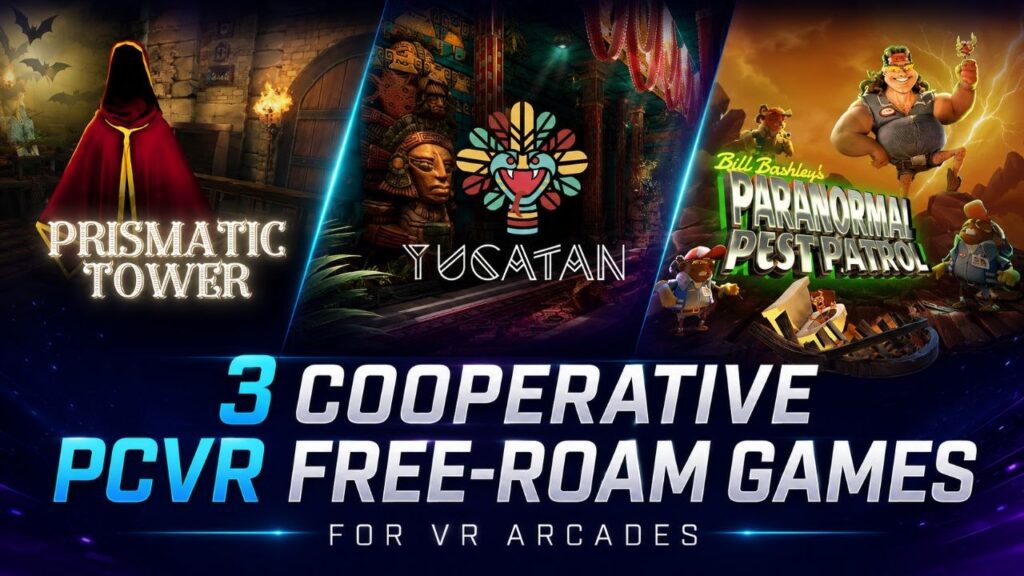
PCVR free-roam games do not have to follow the same formula. For VR arcades, free-roam can support fast group puzzles, longer communication-heavy challenges, or story-driven adventures where players depend on each other to progress. That range becomes useful when an operator wants to add variety without changing the underlying PCVR free-roam setup. For this week’s content spotlight, we picked three cooperative experiences from the SynthesisVR marketplace: Paranormal Pest Patrol, Prismatic Tower, and Yucatan. All three put teamwork at the center of the session, but they do it in very different ways. Three PCVR free-roam games at a glance Game Players Gameplay Starting play area Network status Paranormal Pest Patrol 2–8 7–15 min 5.2 × 5.2 m / 17 × 17 ft Network Veteran Prismatic Tower 2–4 45–55 min 4.6 × 4.6 m / 15.1 × 15.1 ft Network Debut Yucatan 1–8 40 min 4 × 5 m / 13.1 × 16.4 ft Network Veteran The specifications already hint at three different uses. Paranormal Pest Patrol can fit shorter group sessions and scale to eight players. Prismatic Tower gives smaller teams a longer puzzle experience. Yucatan combines a longer adventure with configurations that scale from one or two players to groups of eight. Paranormal Pest Patrol: short, social puzzle play for up to eight players Paranormal Pest Patrol sends players into a possessed home as a team of paranormal exterminators. The premise is deliberately light. Flying books, strange appliances, hidden demons and a loud self-proclaimed hero named Bill Bashley turn the experience into a comedy rather than a horror game. Underneath that humor sits an escape-room-style structure. Players need to observe the environment, find the paranormal pests and work through puzzles together. For a VR arcade, the session format is one of the more interesting parts. The marketplace lists gameplay at 7 to 15 minutes and supports several PCVR free-roam configurations: That creates options for venues running different arena sizes and booking formats. Paranormal Pest Patrol also includes a final score, so solving the experience does not have to end the replay conversation. A group can return and try to improve its previous result. The marketplace currently shows another useful signal: a five-star rating from 10 votes. The title also carries the Network Veteran designation, which identifies content from a studio with an established performance history across the DeployReality network. Operators can also find a Game Community directly from the listing. Technical support includes SynthesisVR Optimized multiplayer, Offline Multiplayer and a Standalone Game Server. Where it may fit: shorter family and friend-group sessions, larger bookings, puzzle fans, and venues looking for cooperative content outside the shooter category. Prismatic Tower: communication is the puzzle Prismatic Tower takes cooperation in a different direction. Two to four players enter a magical tower and move through a series of environmental puzzles. The important twist is that the group does not always have access to the same information. Players split between two rooms. One side may see the order of a sequence while the other side controls the objects. A clue discovered by one team may only become useful after they explain it to the players elsewhere. The game uses that idea throughout its puzzles. Players exchange items, decipher symbols, direct beams through prisms, mix ingredients and synchronize actions to move between floors. In other words, communication is not simply helpful. It is part of the game mechanic. Prismatic Tower supports 2–4 players in a 4.6 × 4.6 m / 15.1 × 15.1 ft PCVR free-roam area, with gameplay listed at 45 to 55 minutes. That puts it in a very different booking slot from Paranormal Pest Patrol. Rather than a short group challenge, Prismatic Tower can support a longer cooperative session for a smaller team. The title currently carries the Network Debut designation. This indicates that the publisher is still building its performance history across the DeployReality network. Its marketplace page also includes a Game Community, along with SynthesisVR Optimized multiplayer, Offline Multiplayer, a Standalone Game Server and an operator walkthrough. Where it may fit: smaller groups looking for a longer experience, escape-room audiences, corporate groups, and players who enjoy communication-heavy puzzles. Yucatan: cooperation on a larger adventure Yucatan moves further away from the traditional escape-room format. The experience sends players into a Mayan world built around an ancient prophecy, hidden gems and a final encounter with Quetzalcoatl. Instead of giving everyone one puzzle to solve at the same time, Yucatan can split a larger group into pairs. Each pair tackles challenges that use movement, dexterity, critical thinking and cooperation. The full group eventually comes back together for the final battle. That structure gives Yucatan an unusual way to handle larger bookings. The game supports: Gameplay runs for approximately 40 minutes. The pair-based format also means the experience can ask different things of different players. Quick reflexes may help in one challenge, while another rewards observation or problem-solving. That can work well for mixed groups where not everyone arrives with the same gaming or VR experience. Yucatan carries the Network Veteran designation and has a Game Community linked from its marketplace page. The listing also includes SynthesisVR Optimized multiplayer, Offline Multiplayer, a Standalone Game Server and an operator manual/walkthrough. Where it may fit: families, friend groups, larger bookings and guests looking for a story-driven cooperative adventure rather than a traditional shooter. The same free-roam format can serve very different bookings These three games share PCVR free-roam and cooperative multiplayer, but an operator would not necessarily sell them to the same customer in the same way. Paranormal Pest Patrol gives a group a quick challenge with comedy, puzzles and a score to chase. Prismatic Tower asks a smaller team to spend considerably longer communicating and working through connected puzzles. Yucatan stretches the cooperative format into a larger adventure that can accommodate up to eight players. That distinction becomes important when building a commercial VR content library. Player count alone does not tell you what role a game will play. Session length, arena size, audience, difficulty,
What Is the Difference Between VR Arcades, FECs, and Entertainment Centers?
A venue can call itself a VR arcade while running a free-roam arena, a party room, a full bar, and a birthday package that barely mentions headsets. Another venue can run twenty arcade machines and a snack counter and call itself an entertainment center. The name on the door tells you almost nothing. What matters is what the venue sells and how it builds the visit. A VR arcade earns most of its attraction revenue from VR sessions. An FEC spreads the visit across several attractions, events, food, and other revenue streams. For operators, the useful question isn’t which label fits. It’s what business model you’re actually running. A VR Arcade Runs on Session Revenue A VR arcade makes virtual reality the main reason to visit. The setup varies. One location runs six room-scale PCVR stations. Another runs a four-player free-roam arena. A larger arcade combines room-scale, free-roam, racing simulators, and several multiplayer formats. What connects them is the role VR plays in the business. The venue earns most of its attraction revenue by selling access to VR experiences. Staff spend their time managing headsets, launching sessions, onboarding players, maintaining equipment, selecting commercial content, and moving groups through available capacity. That makes a specific set of numbers matter: A six-headset arcade with one empty station loses sellable VR capacity. A free-roam venue that turns away six-player groups because its strongest experiences only support four faces a different capacity problem. Either way, VR sits at the center of the operating model. Related reading: How Do VR Arcades Actually Make Money? A Family Entertainment Center Sells the Whole Visit A family entertainment center, usually shortened to FEC, gives guests several activities in one location. The mix varies by venue: arcade and redemption games, bowling, laser tag, mini-golf, climbing, trampolines, indoor play, VR, party rooms, food and beverage. IAAPA treats family entertainment centers and location-based entertainment venues as major parts of the attractions industry, and its current FEC resources include immersive VR and interactive gaming within the attraction mix. That wider mix changes the business. A family arrives for a birthday party, spends time in the arcade, plays a VR attraction, orders food, and finishes with another activity. The operator has several chances to earn revenue during one visit, and more moving parts to coordinate: staffing, floor allocation, maintenance, food service, party schedules, attraction capacity, guest flow. VR has to work within that larger system, not run it. “Entertainment Center” Doesn’t Mean Much on Its Own People use the term for many location-based entertainment businesses, including FECs, arcades, immersive attractions, bowling venues, escape-room businesses, and mixed entertainment concepts. The name alone tells an operator very little. A business called an “entertainment center” might run twenty arcade machines and a snack counter. Another might cover several thousand square feet with bowling, VR, event rooms, food service, and multiple ticketed attractions. Look at attraction mix and revenue model before relying on the category name. VR Arcade vs FEC: Where the Business Models Split The clearest distinction shows up when you follow the customer journey and the money behind it. There’s no attraction count that automatically turns a VR arcade into an FEC. A venue can run several types of VR and stay a VR-first business. Room-scale PCVR, standalone free-roam, escape experiences, and racing can all serve different audiences while VR stays at the center of the visit. The shift happens when the wider venue starts carrying more of the customer experience and more of the revenue. The Sign Above the Door Can Stay the Same While the Business Changes Picture a venue that opens with eight room-scale VR stations. Customers book headset time, choose games, leave when the session ends. The operator adds a four-player free-roam arena. That changes the content mix and opens larger group bookings, though VR still drives the business. Then birthday demand grows. The venue adds a party room and builds two-hour group packages. Guests now spend part of the booking playing and part of it socializing. Food and drinks follow, because it works well while one group waits for the arena. The business still has “VR Arcade” on Google Maps. Operationally, it now behaves much more like a mixed entertainment venue. Each additional revenue line changes what the operator needs to optimize. Headset utilization still matters, but so do dwell time, package value, attraction flow, party capacity, and how much each group spends across the whole visit. Why VR Arcades Often Expand Their Attraction Mix A VR-only business has one clear advantage: focus. Staff learn one category deeply. Marketing stays clear. A small venue can concentrate its capital and floor space around a limited number of systems. That focus also creates a limit. A first-time customer can have a strong session and still ask a hard question three months later: what would I come back to do next? Content rotation solves part of that. Multiplayer formats, free-roam VR, VR escape rooms, competitive games, and different session lengths create variety without asking the operator to enter another attraction category. That’s why content strategy matters so much in a VR arcade. Some venues go further and add events, food, spectator areas, party space, or non-VR activities, because their customers are buying a wider occasion. The birthday parent wants a complete party. The corporate organizer wants a two-hour team event. A group of friends wants somewhere to spend the evening. At that point, selling headset minutes alone can undersell what the customer is actually buying. Related reading: How Often Should VR Arcades Rotate Their Content? Where VR Fits Inside an FEC The same VR attraction plays a different role once it enters an existing FEC. Take an FEC that already has bowling, redemption games, food, and birthday rooms. It doesn’t need VR to carry the venue. The attraction can instead give the business a premium multiplayer option, pull in older kids and adults, add another slot to party packages, or give repeat guests something new to book. That changes what the operator
How Often Should VR Arcades Rotate Their Content?
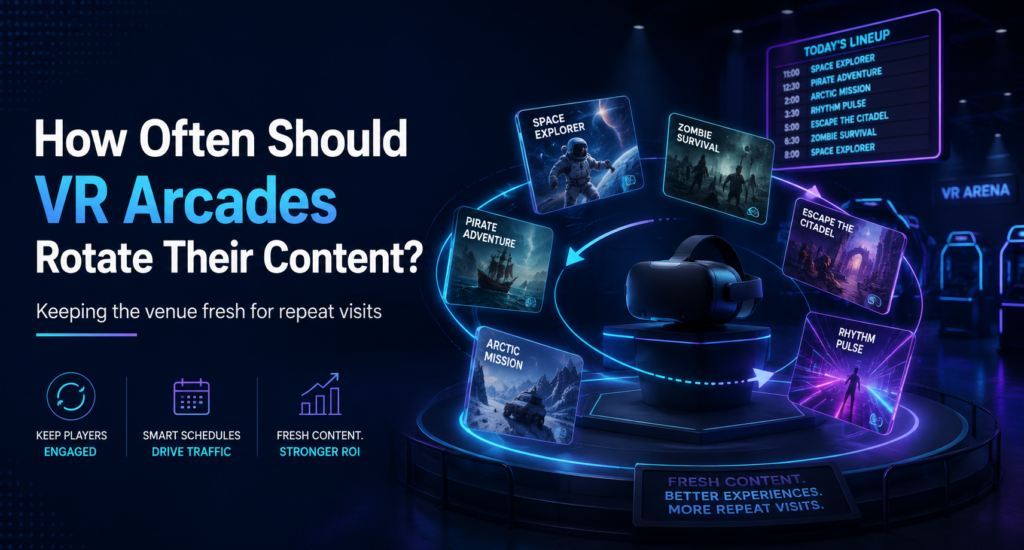
A VR arcade can have dozens of experiences available and still feel unchanged to a returning customer. That happens when the same few games stay at the front of the booking page, staff recommend the same titles, and regular guests see little reason to explore the rest of the library. VR arcade content rotation helps solve that problem. Rotation can create new reasons to visit, give regular customers something different to try, and give the venue fresh material to market. It can also help operators learn which experiences deserve a permanent place in the lineup. There is no universal rule that says a VR arcade should replace its games every 30, 60, or 90 days. A better rotation schedule follows customer behavior, venue type, seasonality, and the role each experience plays in the business. Entertainment venues have always relied on changing programming VR arcades are far from the only entertainment businesses that need to give customers reasons to return. A cinema keeps the same screens, seats, lobby, and projection equipment while its programming changes continuously. New films give previous customers another reason to visit the same building. Special screenings, themed programs, and events can create additional reasons to return between major releases. Arcades and family entertainment centers use a related model. The physical venue stays familiar, while operators change the attraction mix, promote different games, run competitions, and introduce new experiences over time. The wider attractions industry follows the same logic. IAAPA has highlighted how refreshed entertainment programming can support guest satisfaction, repeat visits, and spending. VR gives operators an especially flexible version of this model. The headset, PC, room-scale station, or free-roam arena can stay in place while the experience inside it changes. That makes content one of the most adjustable parts of a commercial VR attraction. Why newness matters for repeat business A great first visit does not automatically create a fifth visit. Customers eventually start asking what will be different next time. That question matters even more for local venues that depend on the same population throughout the year. Research into consumer variety-seeking behavior has examined how repeated consumption can reduce the appeal of choosing the same option again and increase interest in alternatives. That does not mean every guest wants a completely unfamiliar experience on every visit. Familiarity can be valuable, especially with competitive games, multiplayer favorites, and experiences where players improve over time. The opportunity comes from combining both. A customer might return to beat a previous score, introduce friends to a favorite multiplayer game, and then try one experience they have never played before. That mix gives the venue more ways to turn one successful visit into several. We explored the broader retention side of this in How VR Entertainment Venues Turn First-Time Visitors Into Repeat Customers. Content rotation becomes one of the tools operators can use once that return relationship starts. Content rotation also creates something new to market Operators sometimes treat content rotation as a library-management task. It also solves a marketing problem. A venue cannot tell the same local audience to “come try VR” indefinitely. Customers who already visited know what VR feels like. The next campaign needs a more specific reason to return. A newly featured cooperative adventure can become this month’s group recommendation. A competitive title can become the basis of a leaderboard challenge. A horror experience can lead a Halloween campaign. Family content can move forward during school breaks, while faster competitive experiences can support student or adult social promotions. One content change can give the venue material for its email list, social channels, website, in-venue screens, and staff recommendations. The experience itself does not even need to be new to the marketplace. A title that has spent a year inside a 30-game library may still be completely new to most customers. This gives operators an important distinction: you can rotate attention without constantly replacing inventory. Content rotation does not always mean buying new games Operators have several ways to make a VR lineup feel fresh. Featured-content rotation changes which existing games receive the most visibility. Staff can recommend a different experience, the website can feature it, and the venue can build a campaign around it. Event rotation changes how customers use familiar content. A leaderboard, tournament, weekly challenge, team night, or score target can renew an experience without changing the underlying game. VR arcade leaderboards are one example of turning existing content into a repeat challenge. Audience rotation changes which part of the library the venue promotes. Families, birthday groups, corporate teams, students, and experienced VR players rarely need the same recommendation. Seasonal rotation moves relevant experiences forward when customer interest changes. Horror can gain prominence before Halloween. Family and group content can take priority during school breaks. Competitive multiplayer can support weekday social offers when local traffic becomes more important. Library rotation involves the larger decision to add, remove, or replace titles. Operators usually need to do this less often than promotional rotation. Separating these types of rotation prevents a common mistake: assuming that keeping a venue fresh requires continuously licensing more content. How often should a VR arcade rotate content? A practical schedule can work across several timeframes. The monthly change does not need to involve a new commercial license. A venue may simply move an overlooked game into the featured position and support it with staff recommendations, short-form video, or a limited challenge. The quarterly review goes deeper. Operators can ask whether the library still covers enough genres, group sizes, skill levels, session lengths, and customer types. Player capacity matters here too. A strong four-player experience serves a different booking need from a six-player or eight-player attraction. How Many Players Should a VR Attraction Support? looks at that decision from the capacity and attraction-mix side. Let customer behavior trigger the bigger changes The calendar provides a useful review rhythm. Customer behavior should decide what actually changes. Start with how often guests select each experience. Then look at replay behavior. A title that attracts
3 StrikerVR Mavrik PRO-Supported Games for VR Arcades
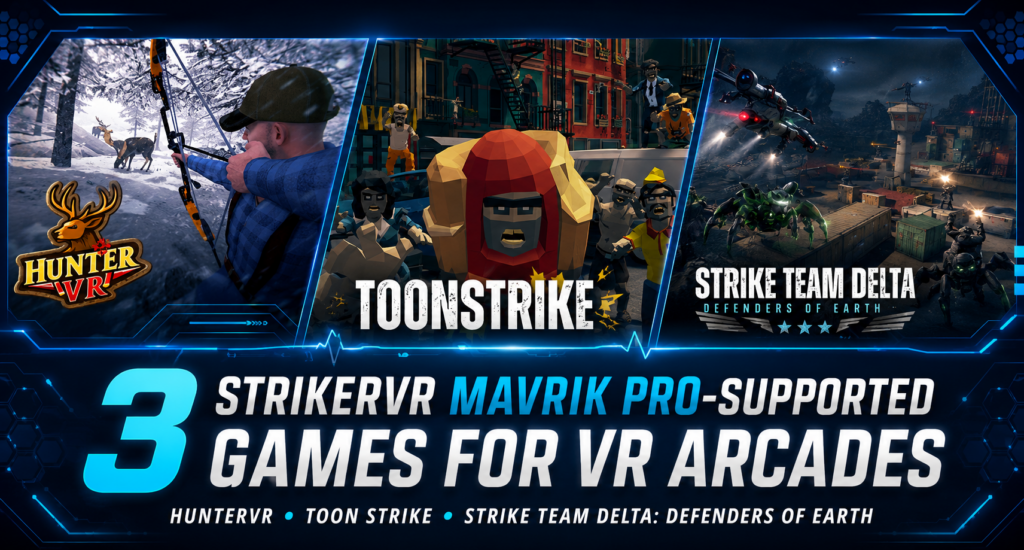
Operators who invest in haptic hardware need enough content variety to keep that hardware useful across different audiences and booking types. A blaster setup becomes more flexible when the same equipment can support a short competitive challenge, an accessible group experience, and a longer team mission. The StrikerVR Mavrik-Pro is designed specifically for enterprise VR deployments and supports recoil and haptic effects for commercial experiences. On the SynthesisVR marketplace, operators can find Mavrik PRO-supported titles across both standalone and PCVR free-roam configurations. We picked three that show different ways operators can use the hardware: HunterVR, Toon Strike, and Strike Team Delta: Defenders of Earth. HunterVR: short competitive sessions with flexible arena sizes HunterVR combines Mavrik PRO support with standalone hardware, leaderboard support, short sessions, and a relatively flexible starting footprint. This experience is brought to you by the same team behind the well-known Cops vs Robbers. The experience sends players into three environments where they compete on speed, accuracy, and precision while shooting moving wildlife targets. Bonus stages introduce shorter target challenges, giving players another score to improve on subsequent attempts. The marketplace lists gameplay at approximately 12 minutes and a suggested age of 14+. HunterVR also carries the Network Veteran designation on DeployReality. That status identifies content from a publisher with an established performance history across the DeployReality network, giving operators another piece of context when evaluating a title alongside gameplay and technical requirements. Its standalone support is another differentiator. HunterVR runs on PICO, Quest, and Focus 3 / Vision, with Mavrik PRO support listed directly on the marketplace. Those options let a venue start with a four-player configuration in a relatively compact area or scale the same experience to a larger group. HunterVR also lists offline multiplayer, a standalone game server, and leaderboard support. For operators who use scores to encourage repeat attempts or local challenges, that makes the competitive structure particularly relevant. The marketplace currently shows pay-per-minute, credit-based, and location-license options, along with a free test option. Toon Strike: a more accessible use of the same hardware Toon Strike takes the Mavrik PRO setup in a different direction. Its colorful visual style and lower suggested age make it easier to position for families, younger players, and groups that may have little previous VR experience. The marketplace lists Toon Strike as PCVR Free-Roam, with a suggested age of 7+ and gameplay of approximately 15 to 25 minutes. Its controller support includes StrikerVR, PPgun, Right PCVR Controller, and Mavrik PRO. The title currently carries the Network Debut designation. This means the publisher is still building its performance history across the DeployReality network. The badge gives operators useful context without making a judgment about the individual experience. Part of the Lightning Games Pack Toon Strike also gives operators a broader licensing consideration because the marketplace offers it through the Lightning Games Pack. The pack groups Toon Strike, Overrun, and Overrun 2, giving venues access to several Lightning VR experiences through the same content package. For an operator already using compatible PCVR free-roam hardware, that can expand the amount of content available for the same physical setup without evaluating each title as a completely separate attraction. This matters when planning content rotation. A game may fit one audience well, while the wider bundle gives staff more options for different groups arriving throughout the week. Strike Team Delta: Defenders of Earth for cooperative mission play Strike Team Delta: Defenders of Earth moves toward a more involved team experience. Players join Strike Team Delta to investigate alien crash sites, collect information, secure locations, and eventually defend their own base. The experience progresses through several missions, including a desert operation, Morgantown, Sweden, and a final confrontation. The structure gives the group shared objectives instead of building the session primarily around individual scores. The marketplace lists PCVR Free-Roam, a suggested age of 12+, and approximately 20 minutes of gameplay plus setup time. Hardware support includes StrikerVR, PPgun, Right PCVR Controller, and Mavrik PRO. Like Toon Strike, Strike Team Delta currently carries the Network Debut designation. For a venue, the distinction from HunterVR matters. HunterVR fits shorter accuracy-driven competition, while Strike Team Delta gives groups a longer cooperative scenario where progress depends on moving through a sequence of shared missions. One haptic setup, several types of sessions These three titles illustrate why hardware compatibility matters beyond a technical checklist. HunterVR can serve competitive groups looking for a short score-focused challenge. Toon Strike opens the same general hardware category to younger and more casual groups. Strike Team Delta gives operators a longer cooperative option with mission progression. They also span different technical setups. HunterVR runs on standalone PICO, Quest, and Focus 3 / Vision hardware, while Toon Strike and Strike Team Delta use PCVR free-roam configurations. Operators deciding how those formats fit into a venue can read our guide to PCVR vs Standalone VR for Commercial Venues. The arena ranges matter just as much as maximum player count. A ten-player title does not automatically require every venue to run its largest configuration. Available floor space, typical booking size, hardware, and content mix all influence the setup that makes commercial sense. We look at that decision in more detail in How Many Players Should a VR Attraction Support?. For group attractions, launch flow, player interaction, shared objectives, and session recovery also affect how well multiplayer content works in practice. See What Makes a Good Multiplayer VR Experience for Out-of-Home Venues? for a deeper look at those operational factors. Explore more Mavrik PRO-supported VR games HunterVR, Toon Strike, and Strike Team Delta are three examples from the wider commercial content catalog. Operators using StrikerVR hardware can browse Mavrik PRO-supported games on SynthesisVR to compare additional compatible experiences. The marketplace maintains a dedicated StrikerVR-supported content filter.
How Many Players Should a VR Attraction Support?
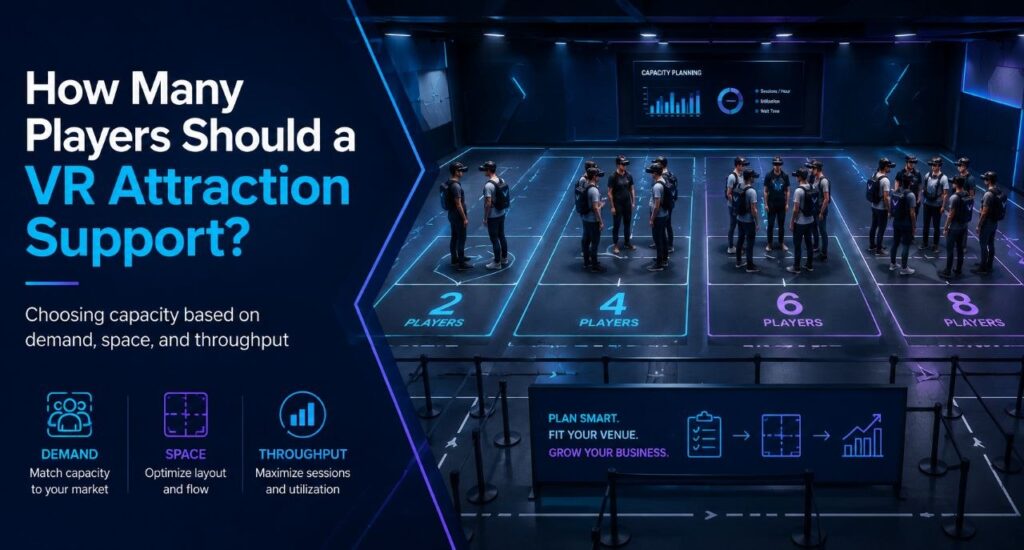
Often operators start this question backward. They decide they want to serve eight guests at once, then go looking for an eight-player attraction. But eight simultaneous guests can mean an eight-player arena, two four-player arenas, a six-player arena plus two room-scale stations, or eight independent room-scale units. Same peak capacity, four completely different businesses. Player count is what falls out at the end of a chain of choices that starts with your building and ends with your content. The decision chain Venue type sits inside this chain as context, not as the formula. A bowling center adding VR, a dedicated VR arcade, and an FEC building around group bookings all answer these questions differently, but none of them get to skip straight to “buy for six” or “buy for eight.” Start with the space you actually have Square footage sets the physical ceiling before anything else gets decided. It determines whether you’re looking at room-scale stations, one free-roam arena, several smaller arenas, or some mix of the two. A venue with 400 square feet to spare is choosing between formats before it ever gets to player count. This is also where the first real tradeoff shows up. The same footprint that holds one eight-player arena can often hold two four-player arenas instead, and those two setups behave nothing alike once you get past the headline number. Hardware, platform, and content: a triangle, not a checklist These three choices constrain each other, and there’s no clean order to work through them. Already own PICO headsets? That narrows content options before player count ever comes up. Chasing one specific title instead? PCVR might be the only place it runs, so hardware follows the content rather than the other way around. Running multiple locations changes the order again: many operators pick the management platform first, since one system across different hardware types matters more than any single game. Whichever one you decide first, it limits what the other two can be. Content needs specific hardware. Hardware needs a platform that can run it and report on it. The platform needs to support whatever mix of standalone, PCVR, wired, or streamed setups the content demands. What your audience actually needs from content This is usually the missing step in capacity planning, and it’s the one that should come before arena size gets decided. Birthdays, families with young kids, teenagers, enthusiasts, corporate groups, school trips, escape-room fans, and casual walk-ins all pull the content mix in different directions. A venue built around birthday packages needs different titles, and different group sizes, than one built around enthusiast repeat visits. Once you know who’s walking in, the content question gets specific. What do those guests want to play, and how many of them want to play it together? What that content requires Content is where the constraint actually bites. Free roam versus room scale, PCVR versus standalone, arena dimensions, and player count all come from the title itself, not from how many headsets you own. Most free-roam titles top out at four or six players in a single configuration. Buying eight headsets doesn’t change that. It just means eight headsets sitting on a shelf while the content that fits your audience runs four at a time. Take the two four-player arenas versus one eight-player arena question from the top of this piece. The two-arena setup gives an operator more compatible titles at that smaller player count, two bookings running at once, and better use of small-group demand on a normal Tuesday, while still hitting eight total players when both arenas are booked together on a Saturday. The eight-player arena gives up all of that flexibility for a configuration that only earns its keep when a full group of eight actually shows up. Neither is automatically the right call. It depends on what your audience actually books. Peak capacity and weekday utilization are different problems VR attraction planning works better when you separate peak demand from utilisation. This is the commercial core of the whole decision, and it’s easy to miss. Picture a Tuesday afternoon. A group of three arrives at a venue built as one eight-player arena. The operator can run that group at three of eight positions filled, or hold the session and wait for another group to fill the rest. Either way, most of that capacity sits idle for a slot that will never come close to selling out again before Friday. The same group at a venue built as two four-player arenas gets a session at three of four positions filled, close to full, while the second arena stays open for the next booking or for maintenance. Same total headset count as the eight-player venue. Very different Tuesday. A big configuration built for the weekend peak can leave a lot of equipment sitting unused Monday through Thursday. A modular setup, several smaller arenas or stations instead of one large one, can often handle the same peak while giving staff something sellable on a slow afternoon. Getting people through the building midweek is usually the harder problem than filling Saturday, and configuration is one of the few levers that actually moves it. The fleet model: capacity that changes shape A venue with a larger headset fleet doesn’t have to run the same configuration all week. The same hardware can be deployed differently depending on who’s booking: Capacity, in other words, doesn’t have to be fixed. It can flex by day and by booking type, which is a very different planning question than “large FEC equals eight to sixteen players.” This is also where a management platform earns its cost. Running PICO, Quest-compatible, and PCVR hardware side by side, and reconfiguring which content runs where as bookings change, needs one operational layer that can see and control all of it. SynthesisVR is built for exactly that: managing hardware, content, and session formats as one system instead of as separate silos an operator has to reconcile by hand. Configuring the venue around your content Once space,
VR Arcade Pricing: How to Set Session Prices, Packages, and Promotions
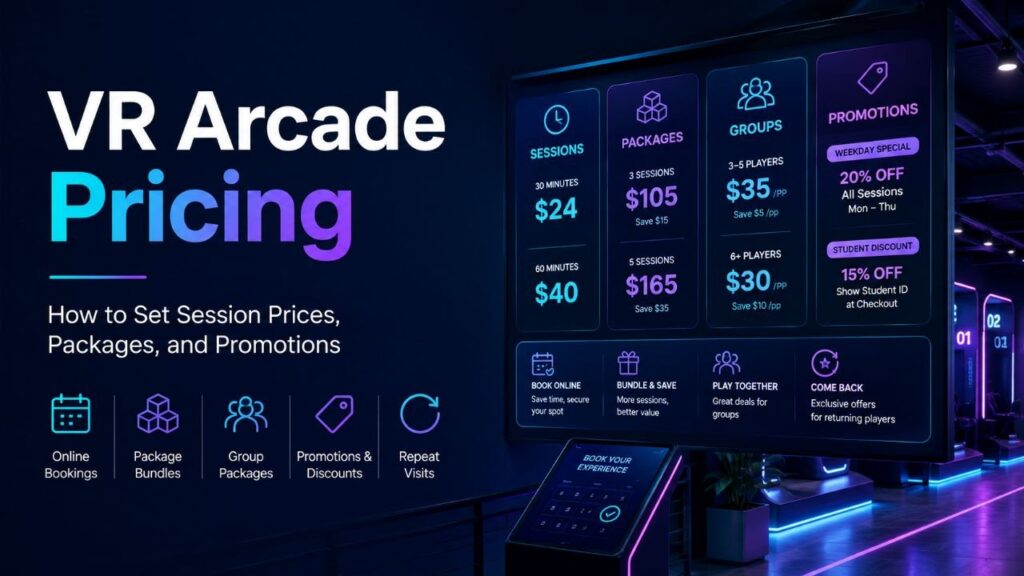
There is no universal number for VR arcade pricing. Two venues can run similar hardware and content, yet need different prices because they serve different customers, compete with different attractions, carry different costs, and sell different types of outings. A tourist-center arena, a suburban family entertainment center, and a university-town VR venue should not inherit the same rate card by default. A useful pricing process starts before the price itself. Define the local market, map the alternatives customers already buy, calculate the economic floor, decide what each package promises, and then test the result against real booking behavior. That approach draws on decades of retail, service, and pricing research rather than one current pricing formula. A practical VR arcade pricing framework The three questions work together. Cost-based pricing alone can ignore demand. Competitor matching can copy somebody else’s economics. Value language without a financial floor can create a popular offer that does not contribute enough to the venue. VR arcade pricing starts with the local market Wendell Smith’s 1956 work on market segmentation treated heterogeneous demand as a basic marketing reality: different groups can respond to different offers instead of behaving like one uniform market. For a physical venue, geography narrows that idea further. David Huff’s trade-area work defined the market around a geographically bounded pool of potential customers and the probability that they will choose a location. The U.S. Small Business Administration still advises small businesses to examine demand, market size, income, location, saturation, demographics, and what customers pay for alternatives. For a VR arcade, that means defining the realistic catchment area before copying a national or industry average. A venue near a tourist district may rely on one-time visitors with short decision windows. A suburban FEC may depend more on families, parties, schools, and repeat local groups. A university town can have strong evening demand but a lower willingness to pay for a premium single-player session. Research the customer’s real alternatives A venue that checks only other VR arcades sees too little of the market. Michael Porter’s competitive strategy work warned against viewing competition too narrowly. For an entertainment business, substitutes matter because customers usually begin with an occasion, budget, and group rather than a fixed commitment to VR. A family choosing a Saturday activity may compare VR with bowling, laser tag, a trampoline park, an escape room, karting, cinema, or another FEC. A company planning team building can compare the same VR venue with dinner, an escape room, a workshop, or a private event space. Research set Record Avoid Direct VR competitors Per-person price, duration, group size, private/shared format, packages, cancellation terms, memberships. Copying the headline price without understanding what the customer receives. Substitute entertainment Total group spend, time commitment, private access, food/party space, social proof, booking friction. Assuming VR competes only with VR. Local premium options What customers already pay for higher-end social experiences and events. Using household income alone as a willingness-to-pay measure. Low-cost alternatives Free or inexpensive activities that compete for the same time slot. Treating every lost booking as a pricing problem. Calculate the economic floor before testing value Pricing research has long treated price as a managerial decision with several inputs rather than a simple markup. Monroe and Della Bitta’s 1978 review examined the major pricing decisions managers face and the models used to support them. For a venue, the first financial check is straightforward: understand what each booking contributes after the costs that move with that sale, then test whether expected sales can cover fixed costs. SBA break-even guidance uses fixed costs, selling price, variable cost, and contribution margin for exactly this reason. A VR operator should include the costs that genuinely change with a session or package, then keep rent, salaried labor, insurance, depreciation, financing, and similar fixed costs visible in the wider model. Mixed attractions and packages often need separate calculations because a private arena booking does not behave like a single booth session. Related SynthesisVR reading: Free-Roam VR Arena Cost Analysis and How VR Arcades Actually Make Money Price the use case, not only the headset minutes B. Joseph Pine II and James H. Gilmore’s 1998 work on the experience economy argued that businesses can create economic value by staging an experience rather than competing only on the underlying good or service. Location-based entertainment fits that logic unusually well. A customer rarely wakes up wanting to buy 30 headset minutes. They may want a private activity for four friends, a birthday that is easy to host, a date-night plan, a school visit, or a team event that does not require the organizer to manage the details. Use case What the buyer may value Pricing structure to test Walk-in / first visit Low commitment, clarity, fast start. Per-person session or short introductory format. Friends / social group Playing together, simple group total, private access. Group bundle or private arena rate. Birthday Predictable total cost, host support, room time, smooth rotations. Named party package with clear inclusions. Corporate event Privacy, timing, invoicing, coordination, group confidence. Event package or private-hire rate. School / camp Per-head clarity, age fit, supervision, schedule control. Per-student or fixed group package. Related SynthesisVR reading: How to Market VR Arcade Birthday Parties for Summer Bookings Build packages when the customer is buying a bundle William Adams and Janet Yellen’s 1976 work formalized the economics of bundling. The research is technical, but the operator lesson is practical: a bundle can carry its own value and pricing logic instead of equaling the sum of every component sold separately. Four individual tickets and a private four-player arena package may use the same equipment, yet the second offer can include exclusivity, easier coordination, reserved time, a content choice, staff assistance, a score challenge, or another element that matters to the group. Birthday, school, and corporate packages deserve the same treatment. This also prevents a common pricing trap. If every package reduces to a minute-by-minute calculation, the operator invites customers to compare only time and price. Clear bundles create room to
3 VR Arcade Games That Turn Leaderboards Into Repeat Challenges
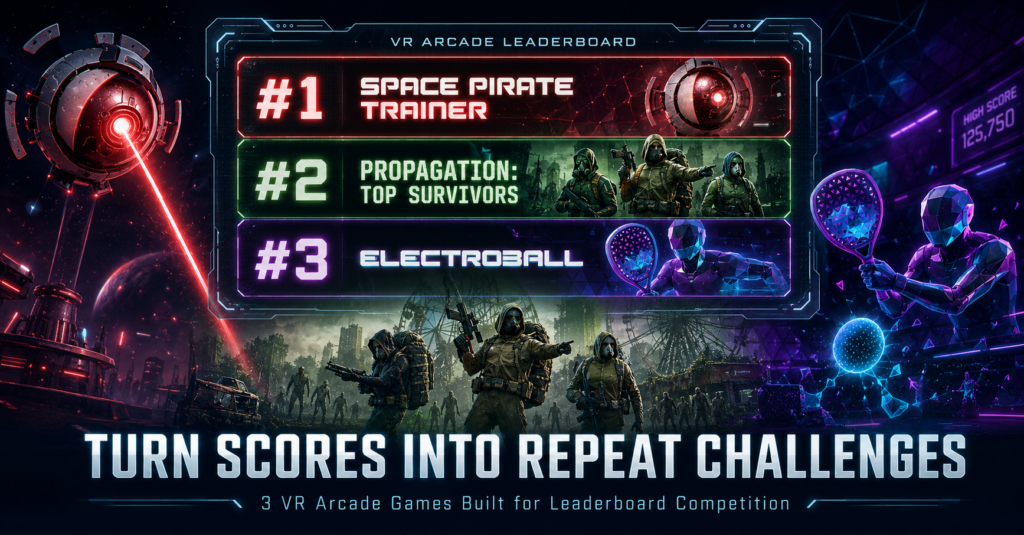
A VR session can end when the headset comes off. A score gives the player something to take with them. They may have beaten their friend, missed the venue record by a few points, or discovered that someone else moved ahead of them after they left. Suddenly, there is a reason to come back. There is a number to beat. For VR arcade operators, that competitive loop can extend the value of content already running in the venue. Daily high scores, weekly challenges, tournaments, and a visible Hall of Fame can turn individual sessions into something players continue talking about after they leave. Leaderboard competition does not have to work the same way in every game. One title can reward an individual high score. Another can give a group a shared benchmark. A direct competitive game can turn every match into a rematch opportunity. We picked three leaderboard-supported VR arcade games from the SynthesisVR content marketplace that approach that idea in very different ways. How does the SynthesisVR Leaderboard work in a VR arcade? The SynthesisVR Leaderboard Add-on automatically captures scores and rankings from supported VR games and displays the results in real time. Operators can run the leaderboard application on a Windows PC or Android device, including a front-desk screen, tablet, or TV. That gives the venue several ways to build competition around existing sessions. Operators can run local tournaments, display high scores on digital signage, create weekly challenges, or keep a longer-running Hall of Fame without asking staff to record every result manually. For a location-based entertainment VR venue, the important part is what happens after the score appears. Put the week’s best result on a screen near the front desk and the next player already knows what they need to beat. Three different leaderboard formats Space Pirate Trainer: the classic arcade high-score loop Space Pirate Trainer takes the logic of a traditional arcade cabinet and puts the player inside it. Players face waves of incoming droids, dodge lasers, and switch between weapons and gadgets while trying to push their score higher. Score chasing is part of the game’s identity. Its commercial listing explicitly frames the challenge around reaching the top rankings and entering the Space Pirate Trainer hall of fame. The title runs on PCVR in a room-scale setup. That makes the competitive objective easy for both staff and guests to understand. Finish the run. Check the score. Decide whether it is good enough. For an operator, very little additional explanation is needed to turn that into recurring programming. The venue could promote the highest score of the week, keep a monthly record, challenge customers to beat a staff score, or leave one long-running venue record for regular players to chase. It is the closest of these three games to the traditional arcade leaderboard model, which also makes it a useful starting point for venues introducing score-driven competition. Propagation: Top Survivors: make the group result matter Competition does not always require players to fight each other. Propagation: Top Survivors puts up to eight players together as survivors trying to make their way through a zombie-filled city. The team must reactivate ARES military anti-zombie devices before time runs out, with configurable session durations available for venue operations. The experience runs on PCVR room scale. That changes the leaderboard conversation. A birthday party, group of friends, or returning team already leaves with a shared story about what happened during the session. A leaderboard result gives that group an additional benchmark to remember and another target for a future visit. Instead of asking only, “Did we finish it?”, returning players have another question to answer: Can we improve on our last result? That makes cooperative competition particularly useful for venues serving repeat groups. The players can work together inside the game while still competing against their own previous performance or results set by other teams. Top Survivors also sits within the wider Wanadev catalog now available through SynthesisVR, alongside titles from the Propagation series and the former Octopod VR catalog. Electroball: competitive VR across PCVR and standalone Electroball takes the leaderboard idea in another direction. Players enter an electrified arena and use rackets to redirect balls into the opponent’s goal while defending their own. Balls can bounce from the arena walls, so positioning and timing influence how players create scoring opportunities. The objective is immediate. Score more than the other player. That makes the result easy to understand and gives the loser an equally obvious reason to ask for another round. Electroball also stands out in this group because of its hardware flexibility. The title supports PCVR Room Scale, PICO, and Quest, making it relevant to standalone VR arcades as well as traditional PCVR installations. It is available in English, French, and Spanish and is designed to be accessible to beginners. For operators, that creates a useful combination: a simple competitive concept, a measurable outcome, and support across several common commercial VR hardware setups. It is also a good example of why browsing a VR content marketplace by operational feature can be more useful than simply looking at the most familiar titles. A smaller game can fill a very specific role in the attraction mix. Turn leaderboard results into venue programming The game provides the result. The venue decides how visible and valuable that result becomes. A leaderboard can sit on a TV near reception with the week’s top scores. Regular players can return every Friday to defend their position. Birthday groups can compete internally. Staff can set a score for customers to beat. A venue can run a one-night tournament or keep a long-term record that becomes part of the local player community. The format does not need to be complicated. A simple “Beat this week’s score” challenge gives players a clear target before they enter the headset. A monthly reset gives more customers a realistic chance to reach first place. Keeping an all-time record alongside the monthly leaderboard gives the strongest players something harder to chase. Visibility
What Makes a Good Multiplayer VR Experience for Out-of-Home Venues?
Six players can enter the same virtual environment and still have six disconnected experiences. One player understands the controls immediately. Two are waiting to join the correct session. Another misses the opening instructions. By the time the full group is ready, the most experienced player has already taken control of the game. Strong multiplayer VR prevents that separation. It gets the group into the experience quickly, makes each player relevant to the outcome, and gives everyone a clear reason to play again. For an out-of-home VR venue, the experience begins before the first objective appears. Headset assignment, player pairing, session launch, recovery, and reset all influence whether a multiplayer title works as a commercial attraction. Good multiplayer begins before gameplay Guests usually see a simple process: put on the headset and start playing. The operator may see a much longer sequence. Staff need to assign the correct devices, identify the players, create the session, connect every headset, confirm tracking, choose the game settings, and ensure that everyone reaches the same starting point. Each additional menu or confirmation adds time. A step that takes only 20 seconds on one headset can create several minutes of delay across a group of six or eight players. That makes time to action one of the most useful ways to evaluate multiplayer VR for a venue. It measures the interval between assigning the group’s headsets and the moment every player begins meaningful gameplay. A commercially strong experience keeps that interval short. Players join the correct session easily, staff can confirm that every device has connected, and the full group enters the game together. The process should remain consistent across different employees and successive bookings. A visually impressive title can still become a difficult venue product when staff spend too much of the session preparing it. Visual 1 placement: Time to Action Headsets assigned → Players paired → Session joined → Tracking confirmed → Game launched → First meaningful action Show common friction points below the flow: manual lobby codes, repeated headset checks, individual calibration, and delayed players. The group should enter as one unit Multiplayer sessions lose energy when players begin at different times. One person may reach the lobby immediately while another remains on a loading screen. A third player may enter the wrong room. Staff then move between headsets, repeat instructions, and delay everyone who connected correctly. A strong multiplayer workflow treats the group as one operational unit. Each headset should be easy to identify, every player should enter the correct session, and staff should see when the group is ready without checking each device individually. This becomes particularly important during birthday parties, corporate events, school visits, and back-to-back weekend bookings. One delayed player can affect the timing of the whole group and every booking that follows. A smooth launch creates confidence. Players begin together, understand that the experience has started, and focus on the activity rather than the equipment. Room-scale and free-roam require different standards Room-scale and free-roam VR can both support multiplayer, although they create different relationships between the players, the hardware, and the physical venue. Room-scale multiplayer In a room-scale setup, each player normally remains inside an individual station or defined play area. The players connect through a shared virtual session while avatars, voice, objectives, and scoring create the multiplayer experience. Room-scale VR also exists in consumer environments. For a commercial venue, its value often comes from flexibility. The same stations may support multiplayer games, solo content, escape experiences, and other attraction categories. That flexibility does not remove the need for a strong operational workflow. Staff still need to connect the correct stations, place every player in the same lobby, launch the session together, and recover an individual device when something goes wrong. The gameplay must also justify the additional coordination. Players should see, hear, help, challenge, or depend on one another. Several people playing alongside each other with separate objectives may share a server without creating a meaningful group experience. Free-roam multiplayer Free-roam changes the connection between the physical venue and the virtual environment. Players walk through the same real space while seeing a shared virtual world. Their physical position, direction, and movement become part of the group interaction. Commercial free-roam depends on dedicated floor space, mapped boundaries, coordinated hardware, safety procedures, and operator-managed sessions. These requirements make it specifically an out-of-home format. The shared arena can create strong social presence, but it also raises the operational standard. Player alignment, tracking, boundary setup, headset assignment, server connection, and session synchronization all need to work together. A configuration problem on one room-scale station may affect one player. In free-roam, one tracking or alignment issue can delay the entire arena. The strongest free-roam experiences reduce repeated setup and make the arena behave predictably between sessions. Staff should not need to recalibrate the space, rebuild the lobby, or guide each headset through a separate joining process for every group. Guests may never see the full configuration process. They still experience every delay it creates. Visual 2 placement: Room-Scale vs. Free-Roam A two-column visual showing: Room-scale: individual stations, shared virtual session, flexible content rotation, station-level recovery. Free-roam: shared physical arena, coordinated tracking and boundaries, spatial group interaction, group-level operational impact. Every player should affect the outcome Shared space alone does not create meaningful multiplayer. Research into collaborative VR describes co-presence, the feeling of being together with another person in the same virtual environment, as a central part of multi-user experience design. The quality of collaboration also changes according to the task, communication methods, and feedback available to players. The other players need to matter. One person may defend an area while another completes an objective. Teammates might revive one another, solve connected puzzles, share resources, or contribute individual results to a team score. The structure can remain simple. Players only need to understand how their actions affect the rest of the group. This matters because commercial venues regularly serve mixed-skill audiences. One booking may include experienced players, first-time headset users, children, parents,
What Successful VR Venues Do Differently to Stay Profitable Year-Round
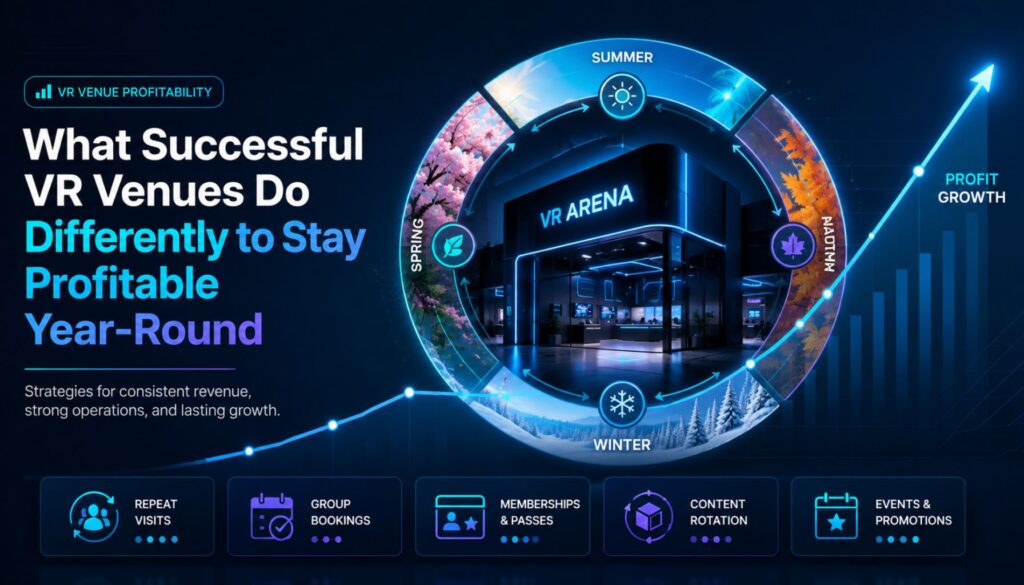
Most VR venues can attract attention when they first open. The harder test comes 12 to 24 months later, after launch coverage has faded and the first wave of local curiosity has passed. Industry guides place mature, well-run VR venues within a broad net margin range of 20 to 40 percent. Headset choice affects costs, but it rarely explains the full distance between the bottom and top of that range. The larger differences usually appear in demand generation, booking behavior, staff workflows, session throughput, repeat visits, and revenue outside paid headset time. That is where VR venue profitability becomes measurable. The 2026 attractions industry benchmark data, drawn from anonymized booking and transaction records across the sector, gives operators a useful way to compare their systems with wider market behavior. Advance bookings make demand more valuable and more visible Online bookings generate 45 percent of total revenue across attractions venues while accounting for only 33 percent of bookings. That means online bookings over-index on revenue by 12 percentage points. The benchmark does not isolate the reason. Larger groups, higher-value packages, advance upgrades, and add-on purchases could all contribute. The operational conclusion remains useful: advance bookings carry more revenue per booking and give the venue time to plan around them. A venue that reaches Wednesday with half its weekend sessions already committed can schedule staff against known demand, prepare for larger groups, and spot a soft weekend early enough to respond. A venue that relies mainly on walk-ins learns how the week performed while the week is already happening. The practical improvements are straightforward: Advance rates and group pricing can help, although the commitment matters more than the discount itself. Marketing keeps demand active throughout the year A short booking path helps convert interest, but the venue still needs to create that interest. Once opening coverage and local curiosity decline, year-round performance depends on a repeatable way to reach new customers and bring previous guests back. Attractions-industry guidance treats customer acquisition and retention as core revenue activities. Targeted campaigns, segmented guest communication, membership promotion, and post-visit follow-up can help venues generate bookings without depending entirely on walk-in traffic or seasonal demand. For a VR venue, the strongest campaigns usually begin with a specific audience and occasion: The marketing content should also make the experience easy to understand. Guests need to know how many people can play, how long the session lasts, whether players compete or cooperate, what age group it suits, and what makes the experience worth sharing. Generic headset footage creates awareness, but specific group scenarios give people a clearer reason to book. Guest data turns one-time promotion into a repeatable system. Venues can track where bookings originated, which packages generated revenue, how many guests returned, and which audiences filled normally quiet periods. A campaign that reliably fills four Tuesday sessions may contribute more to profitability than a post that reaches thousands of people without producing bookings. Marketing creates demand, the booking journey captures it, and venue operations determine how much of that revenue becomes margin and repeat business. Consistency is whatever survives a staff change Attractions venues often rely on seasonal and part-time staff, which limits how much operational quality can depend on one experienced employee. Every critical process that exists only in an experienced employee’s head creates a business risk. Guests experience that risk as waiting. Resets take longer. Briefings vary between staff members. Sessions start late because the person on shift is trying to remember which title launches in which way. A group that arrived on time spends part of its paid visit watching staff troubleshoot. Venues that hold steady through turnover standardize session launches, headset preparation, guest briefings, resets, and basic fault recovery. They maintain the same approved content library across the headset fleet and build reset steps into the workflow. By week ten, a new hire should be following the same operating pattern as an experienced team member. We covered the throughput side of this in Launching Games Without Breaking the Flow. Commercial VR content protects throughput A consumer title can be entertaining and still be awkward to run in a commercial venue. Venue-ready content needs clear onboarding, predictable session lengths, reliable multiplayer handling, simple reset behavior, and a commercial license. These elements determine how efficiently staff can move one group out and the next group in. When they are missing, the commercial cost appears as friction: The exact throughput target depends on session length, attraction format, and the number of stations in the venue. The principle stays consistent. When actual session capacity falls below the floor plan’s model, margin disappears into setup and reset time. Commercial licensing sits underneath the entire operation. Using a title in a paid venue requires more than access through a consumer storefront or commercial Steam account. We explain the distinction in VR Commercial Licensing Explained. The numbers that separate a steady venue from a seasonal one Guest-level metrics such as repeat visit rate and time to second visit are covered in How VR Entertainment Venues Turn First-Time Visitors Into Repeat Customers. The figures below answer a broader question: has the venue built enough recurring demand to hold through a quiet stretch? Members visit nearly four additional times per year Members visit 4.9 times per year, compared with 1.3 visits for non-members. That is an additional 3.6 visits per person annually. Membership revenue gives the venue a base of customers who already have a reason to return. It also gives the operator a group that can support weekday sessions, content rotation, member events, and quieter calendar periods. A membership still needs enough value to justify renewal. We cover the structure in How VR Arcades Actually Make Money. Party programs create future customers Guests return 41 percent of the time at venues that run parties, compared with 26 percent at venues that do not. That is a 15-point difference. Party packages already appeal to operators because they can combine group pricing, food and beverage, private space, and predictable scheduling. The benchmark