
What Entertainment Venues Should Know Before Adding VR Attractions
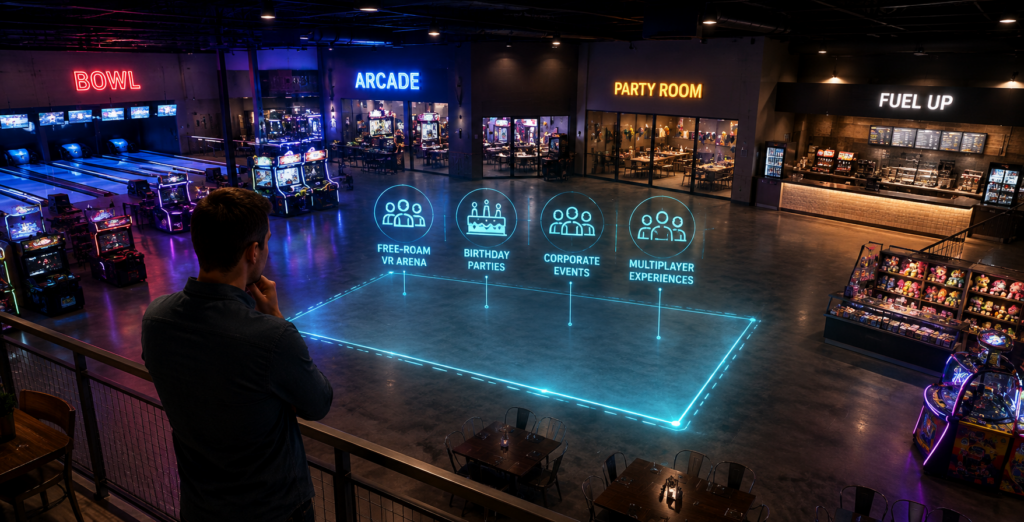
More family entertainment centers, arcades, trampoline parks, bowling venues, and attraction operators add VR every year, and the reasons are often similar. Some are looking to modernize aging attractions. Others want a weather-independent activity that performs during heatwaves, rainy weekends, and slower tourism periods. Many are searching for ways to attract group bookings, birthday parties, and younger audiences looking for social experiences rather than individual gameplay, building on the weekday utilization question this series covered last week. What surprises many first-time operators is how differently commercial VR behaves once the headsets start running daily sessions. A consumer who buys a headset for home manages a single device and a personal game library. A venue operating multiple headsets across hundreds of guests each week is managing a commercial attraction, with licensing requirements, content management, staff workflows, multiplayer coordination, and ongoing operational decisions layered on top. The hardware is the visible part of the investment, while the operational layer underneath it usually determines whether the attraction earns its floor space. Why Operators Keep Adding VR A decade ago, many venues treated VR as a novelty attraction. Today, commercial VR is an established category within location-based entertainment, and operators keep adding it because it solves several business challenges at once. Compared to many traditional attractions, VR often requires less physical space. It can help venues attract group bookings, provide an indoor entertainment option during extreme weather, and create experiences that guests cannot easily replicate at home. Many operators also value the flexibility VR introduces. A bowling lane delivers essentially the same experience year after year, and an escape room eventually reaches a point where returning guests already know the solution. VR attractions can evolve instead, through new content, seasonal experiences, different attraction formats, and multiplayer experiences that appeal to changing audiences over time. That flexibility becomes increasingly valuable as operators look for ways to keep guests returning throughout the year. Licensing Is Where Many First-Time Operators Get Stuck One of the most common surprises for new operators is discovering that consumer VR and commercial VR run on very different licensing models. A game available on a consumer storefront is not automatically approved for commercial use. Some developers offer separate commercial licenses, some work through dedicated commercial platforms, and others may not offer commercial licensing at all. For operators opening a venue, sorting through this becomes one of the most time-consuming parts of the research process. Questions that seemed simple at the planning stage get complicated fast: whether a title can run in a paid attraction, whether the license covers multiple headsets, whether multiplayer is included, and what happens when the developer pushes a content update. These questions rarely come up during early conversations about adding VR, yet they tend to become critical once operators move from planning into deployment. It’s one reason many commercial venues choose centralized content platforms that simplify licensing access and provide a larger catalog of commercially approved experiences through a single system. Operators who want the deeper mechanics of commercial licensing, including how studio agreements differ from consumer terms and what to check before signing, can find that covered in more detail in how VR content licensing works for LBE venues. What Makes a VR Attraction Commercially Viable A common mistake among new operators is treating headset selection as the primary business decision. Hardware matters, but it rarely determines long-term attraction performance on its own. The operators who get the strongest results tend to focus elsewhere: how quickly a session launches, how many guests can participate at once, what brings people back for a second visit, how often the content library gets refreshed, how much staff involvement a session actually requires, and how easily the attraction adapts to a birthday party one day and a corporate group the next. A technically impressive attraction can still struggle commercially if it creates bottlenecks at the booking desk, serves only a narrow audience, or gives guests no reason to return. The operators who do well tend to evaluate the entire guest experience rather than the device spec sheet alone. How VR Changes the Business Model This is where VR starts to diverge from many traditional attractions. A bowling lane generates revenue through scheduled games, an escape room typically serves one group at a time, and an arcade spreads revenue across dozens of individual machines. VR works differently: the same hardware can support cooperative adventures, competitive experiences, educational content, team-building activities, family-friendly games, and seasonal experiences without operators needing to replace the underlying attraction. For many venues, that changes how attraction value gets measured. Instead of evaluating a single game, operators end up evaluating the overall flexibility of the attraction itself. One content mix might perform well during summer tourism season, another might appeal more to birthday parties, and a different lineup might suit corporate events or school groups better, all while the physical infrastructure stays largely the same. The guest experience evolves around demand instead of the venue needing to rebuild around it. Free roam formats push this flexibility further, since the same tracked space can host different team sizes, mission types, and difficulty levels without new hardware. The tradeoff is that free roam introduces its own planning questions around arena layout and design and network setup, which matter enough that they deserve separate research before committing to a footprint. The Attraction Mix Question Many successful venues don’t add VR to replace an existing attraction. They add it to strengthen the overall mix. Some use VR to complement bowling, laser tag, escape rooms, or arcade floors. Others use it to create an indoor option during periods when weather affects attendance, expand birthday party offerings, or reach audiences who weren’t engaging strongly with the rest of the venue. The strongest implementations tend to fit into a broader venue strategy rather than operate in isolation, so before investing, operators benefit from getting clear on exactly what role VR will play inside the wider business. The goal usually isn’t to own VR equipment for
How Much Space Do You Need for a Free-Roam VR Arena? A Practical Guide for Operators
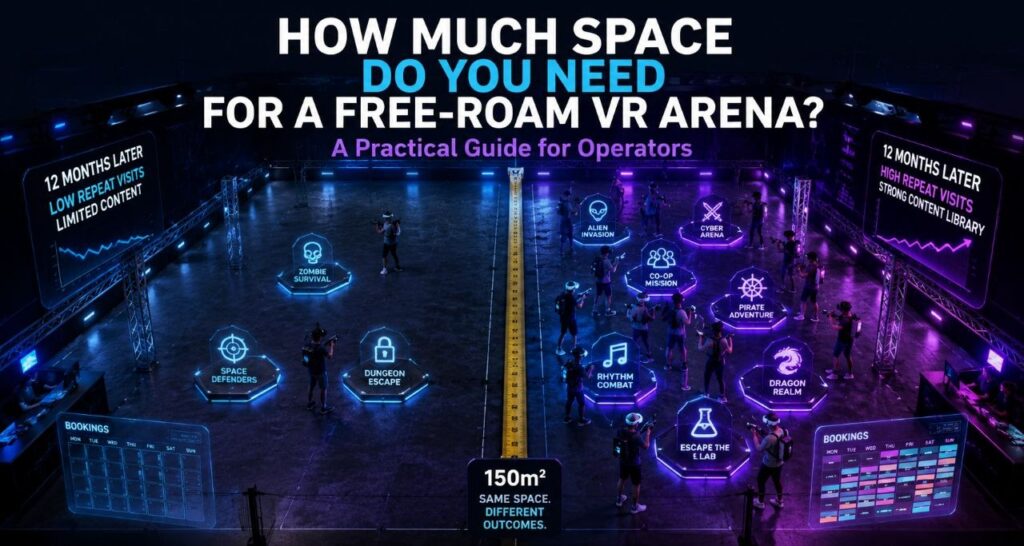
Two operators can open with the same floor plan and end up running completely different businesses. One launches with a handful of compatible experiences, burns through them within a few months, and watches repeat visit rates fall. The other builds a content rotation that supports birthday parties, corporate bookings, and returning regulars well into the second year. The space did not determine that outcome. The relationship between space, hardware, and content compatibility did. Most operators approaching this question want a number: minimum dimensions, something concrete for a lease negotiation or venue layout conversation. That number exists, and this article covers it. But the more important question is whether the footprint you choose gives you enough content range to run a profitable attraction twelve months after opening. What free-roam VR actually requires from a space Free-roam VR differs from room-scale in one practical way: players move independently through a shared physical space rather than standing in fixed positions. That movement creates simultaneous requirements for safety clearance, tracking reliability, and enough floor area that players are not colliding with each other or the play zone boundaries mid-session. Tracking systems, whether PCVR with external base stations or standalone inside-out on headsets like the PICO 4 Enterprise or HTC Vive Focus 3, need consistent line of sight across the full arena floor, low surface reflectivity, and adequate ceiling height. These requirements do not change with arena size, but they become harder to satisfy as the space grows and tracking zones multiply. The practical floor area question comes down to what the content itself requires. Across the commercial free-roam catalogue, 6x6m (20x20ft) is the standard minimum that the majority of titles are built around. Some compact titles run at 5x5m (16x16ft) or even 4x4m (13x13ft), but those represent a narrower selection. The 6x6m (20x20ft) threshold is where the bulk of available experiences become accessible. Arena size tiers and what each unlocks Commercial free-roam setups generally fall into four size bands. Each one changes not just capacity but content access. Entry: 5x5m / 16x16ft (25 sqm / 270 sq ft) A small number of titles are purpose-built for this footprint, typically compact shooters, escape room formats, and experiences designed for 2 to 4 players in tighter spaces. Great Train Outlaws, for example, runs at 5x5m for up to 4 players on PCVR. These setups can work as introductory or add-on attractions inside larger venues, but the content catalogue at this size is limited and operators tend to exhaust it faster than expected. Standard: 6x6m / 20x20ft (36 sqm / 390 sq ft) This is the most common minimum specification across the commercial free-roam catalogue, on both PCVR and standalone platforms. At 6x6m (20x20ft), the majority of available titles become accessible. Arizona Sunshine Remake: Free-Roam starts at 6x6m (20x20ft) for up to 4 players, available on both PCVR and standalone, and scales to 10x10m (33x33ft) for 8. Most operators opening a dedicated free-roam attraction should treat 6x6m as the baseline, not the floor. Mid: 8x8m / 26x26ft (64 sqm / 690 sq ft) Moving to 8x8m opens a meaningful jump in both player count and title variety. A significant portion of the catalogue lists 8x8m as the threshold for 6 to 8 player configurations. This is where team-based formats, competitive gameplay, and larger group bookings become viable without requiring a full large-arena footprint. Large: 10x10m / 33x33ft (100 sqm / 1,075 sq ft) The 10x10m tier unlocks the widest content library and the strongest commercial formats. After The Fall: Free-Roam illustrates the pattern clearly: at 6x6m (20x20ft) it supports 4 players, but the 8-player configuration requires 10x10m (33x33ft). Titles requiring this footprint tend to be the premium, high-capacity experiences, competitive league formats, large co-op missions, longer session durations, that justify higher ticket prices and drive stronger group booking performance. Why content compatibility matters as much as floor area When an operator locks in a footprint, they are also locking in a content ecosystem. Free-roam titles are built for specific arena dimensions, player counts, and hardware configurations. A game designed for 10x10m (33x33ft) with 8 players does not scale down to 6x6m (20x20ft) with 4. Content requiring PCVR tracking with external base stations cannot run on a standalone-only deployment. In practice, the titles available to a compact standalone arena are a genuine subset of what is available to a larger PCVR setup, and that subset narrows further at the entry tier. The question operators tend to underestimate is not “How many experiences do I have at launch?” It is “How long before my regular customers have played all of them?” A broader content library, and the ability to rotate in new titles regularly, is what extends the commercial life of the attraction past the initial novelty period. Operators who plan content strategy and footprint together tend to build more durable attractions than those who treat the two decisions separately. How space affects the commercial variables Session throughput is the first number most operators calculate: a 4-player session at 30 minutes plus 10 minutes of onboarding and reset gives roughly four sessions per hour per arena. Moving to 6 or 8 players changes the math, but it also changes which titles are accessible and which audience segments can be booked. Corporate groups, school trips, and birthday parties all have different minimum viable player counts, and a 4-player cap excludes a meaningful share of group booking demand. Audience flexibility follows from content range. A larger arena with diverse title options lets operators serve casual first-timers and returning experienced players on the same day by rotating experience types. A smaller arena with a narrower library tends to converge toward one primary audience, which limits growth when that segment is saturated. Infrastructure scalability is worth considering earlier than most operators do. A 6x6m arena built on an expandable PCVR backbone is relatively straightforward to grow. An arena built on standalone-only hardware may require a full equipment change to access the content catalogue that larger formats unlock. The setup decision often determines
How VR Arcades Fill Empty Weekday Sessions Without Discounting
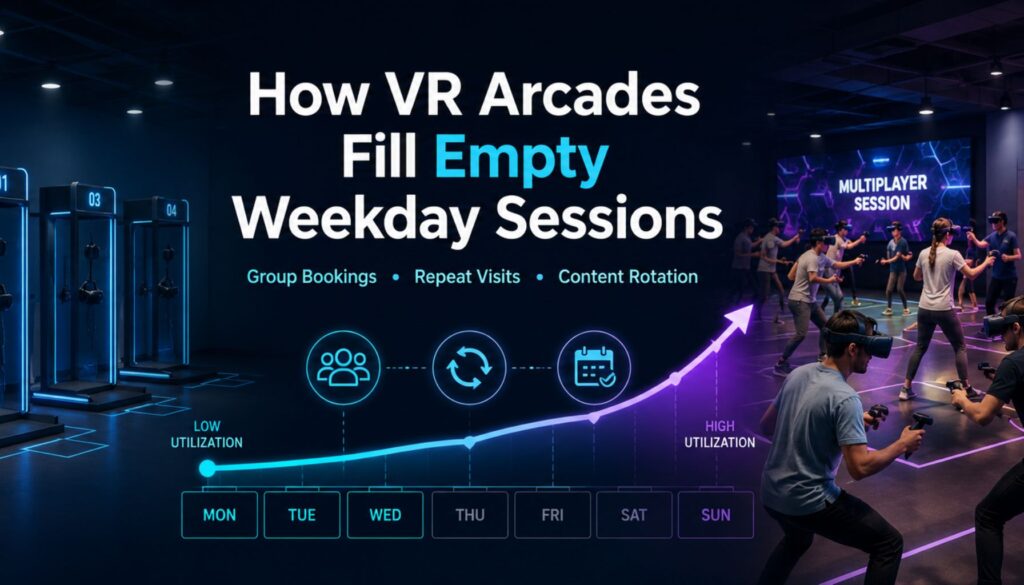
For most VR arcades, family entertainment centers (FECs), and location-based entertainment (LBE) venues, Friday evenings and weekends take care of themselves. The real operational challenge begins on Monday morning. Every empty VR session between Monday and Thursday represents revenue that can never be recovered. Unlike retail inventory, unused attraction capacity expires forever. Once a 3:00 PM session passes without players, that opportunity is gone. Many operators respond by introducing weekday discounts. While discounts may increase short-term bookings, they rarely solve the underlying problem. Over time, they can even reduce profitability by training customers to wait for lower prices. The strongest operators take a different approach. Rather than lowering prices, they redesign how weekday demand is created, packaged, and managed. They treat weekday utilization as an operational challenge—not simply a marketing one. Why Weekday Utilization Matters More Than It Looks A single underperforming weekday can offset gains from a strong Saturday. Across an entire year, consistent weekday gaps compound into a meaningful revenue shortfall, particularly for venues carrying fixed overhead on VR hardware and dedicated attraction space. Analysts estimate the location-based VR market will reach approximately $2.76 billion in 2026 and continue growing rapidly through the end of the decade. As more operators enter the market, long-term performance increasingly depends on operational consistency rather than novelty alone. Utilization influences several areas that operators often underestimate: A quieter Tuesday session often provides a better guest experience than a fully booked Saturday. That difference can influence reviews, referrals, and future bookings long after the session ends. Why Many VR Venues Struggle to Fill Weekday Sessions Empty weekdays rarely reflect a lack of interest in VR. More often, they reflect a mismatch between how the attraction is offered and how people organize their time during the week. Weekday audiences behave differently from weekend visitors. Families work around school schedules. Friend groups need low-friction planning and simple booking. Students coordinate around evening availability. Corporate groups require a clear reason to justify an outing during business hours. Tourists operate on unpredictable schedules and shorter decision windows. Many venues build their booking structure around peak weekend behavior and then expect those same systems to perform throughout the week. Across commercial VR venues, free-roam and room-scale attractions often attract different audiences and booking behaviors. Operators who understand those patterns tend to build more balanced attraction portfolios and create offers that fit specific weekday audiences rather than treating all bookings the same. Common friction points include: Operators regularly use group pricing for schools, sports teams, corporate outings, and social groups because those audiences can help fill capacity that would otherwise remain unused during off-peak periods. How Can VR Arcades Increase Weekday Bookings? Discounting can increase attention, but it does not always address the reasons people delay or avoid booking. Operators often discover that price is only one part of the equation. Weekday attendance depends just as heavily on how easily groups can organize, book, and commit to an experience. Across the broader FEC industry, structured group experiences consistently outperform discount-heavy approaches. Birthday packages, corporate events, school programs, and group offers simplify decision-making for organizers and reduce booking friction. The same principle applies directly to VR. A group of six friends can easily postpone a VR outing if one person must coordinate payments, explain the experience, and organize schedules. That same group is more likely to commit when presented with a simple package: “Six-player session. One booking. Clear pricing. Clear experience.” Tying package benefits to off-peak windows, school calendars, or local community schedules can help smooth demand throughout the week without reducing prices across the board. Operators in bowling centers, laser tag venues, and escape rooms have applied this approach for years. VR arcades that design around group booking behavior often see stronger weekday utilization because they make participation easier to organize. Why Repeat Visits Create More Stable Revenue Than Acquisition Spikes One-time visitors are difficult to predict. Repeat visitors create more consistent demand patterns and often generate greater value over time. Operators frequently focus on acquiring new players while underestimating how much weekday utilization depends on giving existing customers a reason to return. A local customer who visits twice per month often contributes more revenue across a year than a tourist who visits once during a holiday. One recurring pattern across commercial VR venues is that players rarely ask how many titles are available. They ask whether there is something new to try since their last visit. The challenge for many VR venues is content fatigue. VR experiences are highly immersive, but they are also finite. Once visitors feel they have experienced everything available, motivation to return declines. Content rotation helps address this challenge. Venues that regularly introduce new experiences, seasonal content, multiplayer options, or fresh attraction formats create natural opportunities for return visits. Over time, this helps shift the venue from being perceived as a one-time activity into a recurring social destination. Promoting new experiences through social media, email campaigns, loyalty programs, and in-venue signage gives operators a practical way to convert content updates into measurable return traffic. The Role of Attraction Variety and Social Session Design The strongest operators rarely depend on a single experience type to support weekday traffic. An attraction mix that includes competitive multiplayer experiences, shorter repeatable sessions, free-roam attractions, and room-scale content provides flexibility when serving different audience segments. Weekday utilization rates for entertainment venues often fall between 40% and 50%, compared to 75% to 85% during weekends. Successful operators plan around that reality rather than treating it as a temporary problem. Multiplayer VR experiences naturally align with how social groups plan activities. A group of friends, a student organization, a sports team, or a corporate department all require a reason to commit and a simple booking process. Clearly packaged multiplayer experiences remove barriers that often prevent those groups from converting. Operator Reality Check Several operators invested heavily in new hardware while weekday utilization remained inconsistent. Attendance often improved temporarily before returning to previous patterns. Many operators expect new equipment or newly
VR Room-Scale Classics Every VR Arcade Operator Should Know About
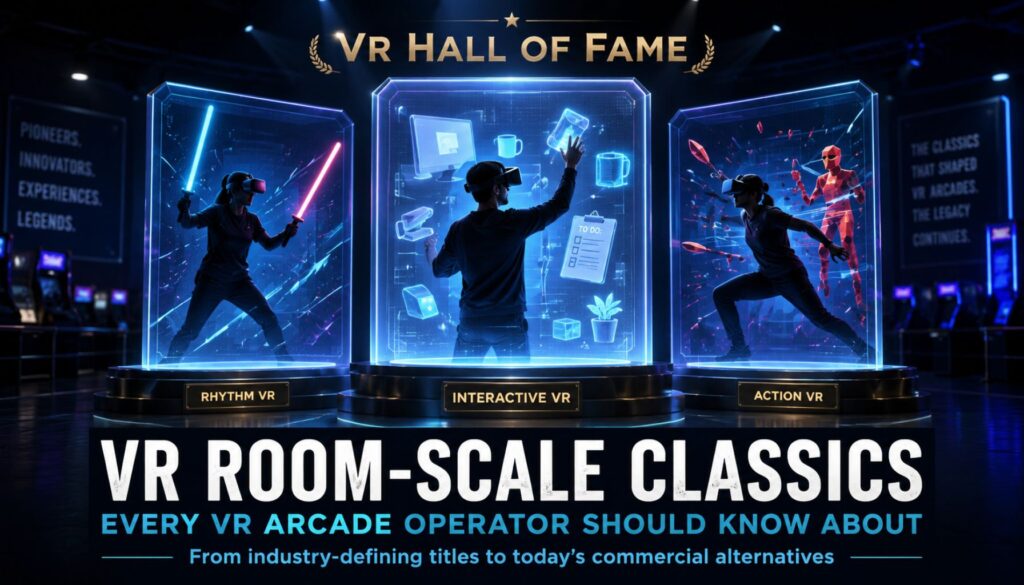
Players researching VR venues often arrive with a shortlist already in mind.These titles introduced millions of people to virtual reality and remain some of the most recognisable names in the medium. For operators building out a commercial venue, that recognition carries real weight: guests arrive already knowing these names, which shortens the conversation at the front desk considerably. The practical question is whether popularity and commercial availability still line up. For room-scale VR attractions, the answer varies by title, and it matters more than most operators expect when they start evaluating content. The Usual Suspects Every operator researching room-scale VR eventually runs into the same names. Beat Saber. Job Simulator. Superhot VR. These titles introduced millions of players to virtual reality and remain among the most recognizable experiences the industry has ever produced. For commercial operators, that recognition still carries weight. Guests often arrive already familiar with these games, making them natural starting points when discussing VR attractions. The practical question, however, is whether recognition and commercial availability still go hand in hand. For room-scale venues, the answer varies considerably from title to title, and understanding those differences can save operators a great deal of time when evaluating content for their attraction lineup. Beat Saber: The Rhythm Standard That Shaped Commercial VR Why it still comes up Beat Saber launched in 2018 and quickly became the benchmark for accessible VR gameplay. The core loop is simple enough to grasp in seconds: swing virtual sabers to slice color-coded blocks in time with music. First-time VR users could pick it up without prior gaming experience. Spectators understood it from across the room. That combination of spectator clarity and minimal onboarding made it one of the most effective room-scale attractions available during the early years of location-based VR. Guests who watched someone else play often booked a session immediately. The word-of-mouth effect was measurable at floor level. Where things stand for operators Meta acquired Beat Games, the studio behind Beat Saber, in late 2019. Following that acquisition, the title was pulled from the commercial arcade licensing ecosystem. The commercial licensing page went offline in June 2020, and arcades were advised to stop activating new stations by July 1 and to remove the game entirely by July 31 of that year. For operators evaluating content today, this means a title with strong consumer recognition has been unavailable for commercial VR deployment for several years. The guest recognition is real. The licensing route is closed. This is the most common licensing blind spot operators encounter when building out a room-scale content library: a title can remain culturally visible and frequently requested while being completely unavailable for commercial deployment. Commercial alternative: Synth Riders Operators looking for a commercially licensed rhythm game for their VR arcade often look at Synth Riders. The gameplay centers on freestyle movement to music rather than strict note-matching, which tends to produce more varied play styles and different kinds of spectator moments. The game supports up to 10 players in cross-platform multiplayer, includes 46 songs across multiple genres, and carries a local leaderboard mode suited to arcade environments. It was named a Game of the Year finalist at the VR Awards and featured in Forbes’ Top 50 VR Games of 2019. For operators, the spectator value that made rhythm games commercially effective translates directly: guests waiting nearby can understand what is happening on screen and want to try it themselves. The commercial license is available through SynthesisVR. View Synth Riders on SynthesisVR. Job Simulator: The Accessibility Benchmark Why it still gets requested Job Simulator launched alongside the HTC Vive in 2016 and became one of the most widely cited examples of successful VR onboarding. Players interact with everyday objects in simulated workplace environments: make coffee, answer phones, flip burgers. Nothing in the experience requires gaming familiarity. The humor lands across age groups, and children in particular respond to the low-stakes experimentation it encourages. For venue operators, it solved a specific problem: what do you put in front of a guest who has never worn a headset and has no frame of reference for what VR is? Job Simulator answered that question reliably for years across VR arcades and family entertainment centers worldwide. Where things stand for operators Job Simulator was available through commercial VR content platforms for a number of years after launch. It has since been removed from commercial licensing and is no longer available for deployment at VR arcades or location-based entertainment venues. Guests, particularly younger visitors and families, still request it by name. Operators evaluating room-scale content for those audiences will need to look at what is currently licensable. Commercial alternative: Clash of Chefs VR Clash of Chefs VR is a cooking competition game where players prepare meals against the clock, either in solo mode or against other players in online multiplayer. The physical interactions map to everyday kitchen tasks, which means very little explanation is needed before a session starts. The game was designed without teleportation or in-game movement, which removes one of the most common sources of motion discomfort for first-time VR users. The competitive multiplayer format adds a group booking angle that purely single-player experiences cannot offer: two guests competing in the same session, or players trying to beat a leaderboard score set by a previous group. For venues serving families, school groups, and social bookings, that dynamic extends the commercial usefulness of a single title across different session types. The commercial license is available through SynthesisVR. View Clash of Chefs VR on SynthesisVR. SUPERHOT VR: The Arcade Edition Built for Venues Why the mechanic still works SUPERHOT VR launched in 2017 with a premise that has held up unusually well: time moves only when you move. In a medium where players are still calibrating spatial awareness and physical confidence, that mechanic removed a critical source of anxiety. Players could pause, assess, and act on their own terms rather than reacting to a constant stream of incoming threats. The result was one of the most
Free-Roam VR vs Room-Scale VR: What Commercial Operators Actually Need to Know
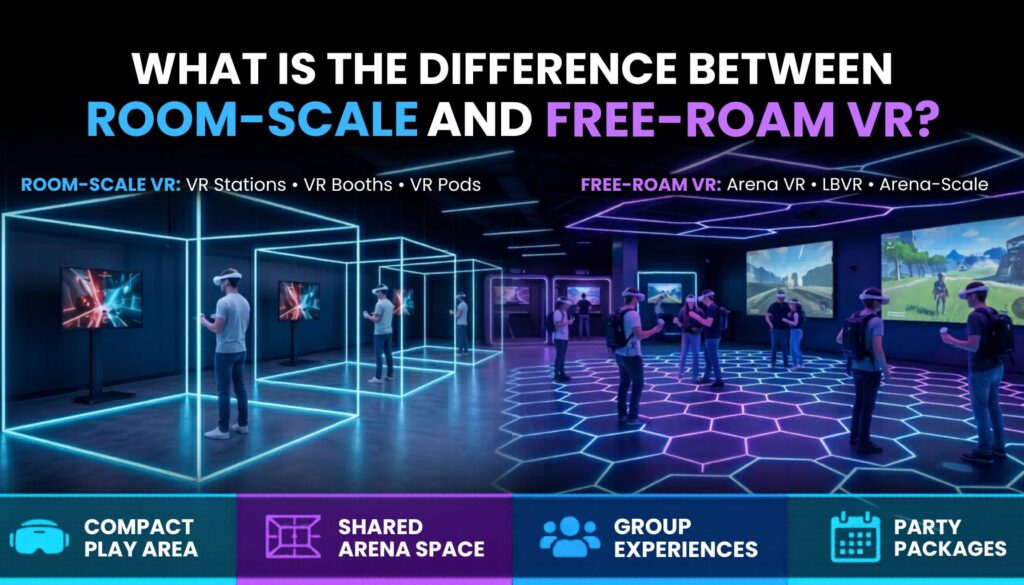
When people compare room-scale VR and free-roam VR, the discussion usually starts with space. Room-scale uses a smaller tracked area. Free-roam uses a larger physical arena where players walk naturally. That explanation is technically accurate. For commercial operators, it is also incomplete. Room-scale VR and free-roam VR are different attraction formats, each serving a different operational and commercial role inside a venue. They affect staffing requirements, player capacity, content strategy, floor plan decisions, and how a business generates revenue. Data from hundreds of commercial VR venues shows that operators rarely choose one format over the other: they build around free-roam as the primary investment, then layer room-scale around it to serve a different part of the guest experience. Understanding why that pattern works is more useful than debating which format is “better.” What Does Room-Scale VR Mean? The debate around free-roam VR vs room-scale VR usually starts with space. Room-scale VR refers to experiences that take place within a defined tracked play area, typically a minimum of 2×2 meters and ideally 2.5×2.5 meters per player or group. Within that space, players can walk, crouch, turn, and interact physically rather than sitting or standing in a fixed position. The setup can take several forms. Some operators build enclosed rooms with solid walls. Others use curtain dividers or open floor plans with clearly marked boundaries. A monitor facing outward so waiting guests can watch gameplay in progress is standard across all configurations. The experience may support a single player or a small multiplayer group, as long as all players share the same tracked area. Across the industry this format goes by several names: VR stations, VR booths, VR pods. These are not distinct attraction categories. They describe different ways of delivering the same format, whether that means an open play position on a venue floor, a partitioned booth for privacy and organization, or a branded enclosed unit with custom theming. The format is consistent: compact, defined play space with flexible deployment. Because room-scale setups require relatively little floor area and integrate into most existing layouts, operators use them to add attraction variety, increase density, or introduce new content without major venue redesigns. That flexibility matters most when a venue is already anchored by a larger attraction and needs to fill the surrounding floor plan productively. What Does Free-Roam VR Mean? Free-roam VR allows multiple players to walk through a shared virtual environment together, each wearing a wireless headset, navigating the same physical arena at the same time. Where room-scale defines a boundary for each player, free-roam removes that boundary. Everyone in the experience occupies one shared arena space, physically moving alongside each other while interacting inside the same virtual world. The format is commonly referred to as free-roam VR, arena VR, or arena-scale VR. Within the industry, location-based VR and LBVR are broader terms that often apply here as well. The technology behind free-roam has changed significantly over the past several years. Early commercial setups relied on backpack PCs: players wore full computing rigs on their backs through the experience, and tracking depended on external sensor arrays that required significant setup time between sessions. Modern free-roam operates differently. Standalone headsets with inside-out tracking have largely replaced backpack systems. Arenas are designed specifically to support stable tracking: floor markers, aruco patterns, and walls with non-repeating visual textures give headsets consistent reference points as players move. The result is more reliable tracking, faster resets, and simpler day-to-day operations. Arena size in free-roam is not fixed by a single standard. Most commercial free-roam titles are designed around a 6x6m (20x20ft) play space, which has become the practical baseline for operators because it unlocks the widest range of available content. Larger arenas, typically around 10x10m, support more simultaneous players or give players more physical room, though player counts do not always scale with the additional space. Some titles allow operators to adapt the experience to a different play space size, but that flexibility is less common across the catalog. The practical starting point for most operators is sizing the arena around the content library they want to run, not the other way around. Free-roam experiences are built around what the format does well: multiplayer cooperation and competition, physical exploration across a large shared space, and social play where every participant is present in the same environment at once. The Practical Difference: Movement and Play Area The most visible difference between the two formats is how players move. In room-scale VR, movement stays within a compact tracked area per player. In free-roam VR, walking is central to the experience: players navigate the arena physically and the virtual world responds to where they actually are. From an operator perspective, that produces meaningfully different venue requirements. The choice is rarely about which format is technically superior. It is about which format fits the venue being built and the audience it serves. Why Free-Roam Draws Stronger Commercial Interest Several factors have made free-roam VR the more discussed format among venue operators, and data from commercial deployments reflects that priority consistently. The clearest factor is replicability. A consumer at home can buy a headset, clear some furniture, and run a room-scale experience. The quality differs from a commercial setup, but the format is accessible. Free-roam arenas are not. No home environment accommodates a shared arena with multiple simultaneous players, calibrated tracking walls, and the session infrastructure a venue provides. Content reinforces that gap in a specific way. Titles like Arizona Sunshine Remake: Free-Roam and After the Fall: Free-Roam are built exclusively for commercial venue deployment. They have no consumer release. A guest who already owns a home headset still has a clear reason to book: the experience they want does not exist on any device they can buy. That content exclusivity also has a less obvious commercial benefit. VR content licensing structured through a commercial platform closes the route that consumer versions leave open. Room-scale content that exists in consumer ecosystems can be acquired and run by any venue regardless
How Family Entertainment Centers Use VR Attractions During Heatwaves and Rainy Days
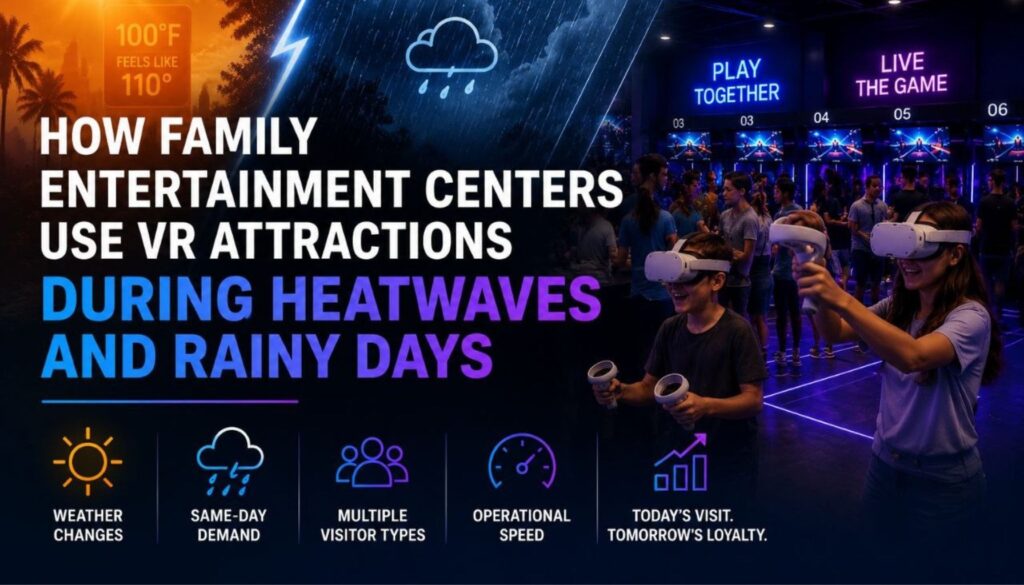
Why Indoor Attractions Benefit When Outdoor Plans Change A heatwave pushes temperatures past what most families will tolerate outdoors. A summer storm cancels afternoon plans. A tourist group abandons the beach and starts searching for something to do indoors. Within a few hours, a quiet weekday turns into one of the busiest periods of the week and the venues that capture that traffic are rarely the loudest marketers. They are the ones that were operationally ready before the weather changed. For VR arcades, family entertainment centers, and location-based entertainment venues, weather-driven demand is some of the highest-intent traffic the season produces. These visitors are actively looking for something to do today. Converting that interest into a booking depends on local visibility, a clear booking journey, and the operational capacity to deliver when multiple groups arrive in a short window. The foundations of local visibility and seasonal positioning are covered in the first article in this series: How VR Arcades Can Adapt to Summer Demand Shifts and Capture More Indoor Entertainment Traffic. Why VR Attractions Benefit When Outdoor Plans Change Extreme weather does not create leisure demand from nothing. It shifts existing demand from one category of venue to another. When heat, rain, or poor air quality makes outdoor activities less appealing, consumers look for indoor alternatives and the family entertainment center sector is one of the primary beneficiaries of that shift. Research on North American FEC market growth consistently shows strong demand for indoor, experience-driven attractions, particularly those that support group participation. This is why FECs frequently combine multiple attractions under one roof. Bowling, arcades, indoor mini golf, karting, laser tag, escape rooms, and VR experiences all compete for the same visitor at the same moment. When outdoor plans collapse, VR arcades sit inside that same consideration set, which makes how the venue presents itself online, and how quickly it can operate when guests arrive, commercially significant. The Same-Day Booking Moment Weather-driven visitors behave differently from planned visitors. A birthday party may be booked weeks in advance. A school group outing may be organized months ahead. A family escaping a heatwave often decides within hours, a tourist dealing with unexpected rain may search for local attractions that afternoon, and a friend group whose outdoor plans fell apart wants an immediate alternative. These visitors are not researching extensively. They want answers: Can we book today? How much does it cost? How many people can play, and for how long? Is it suitable for children? The venue that surfaces that information fastest, with accurate hours and a clear booking path, usually wins the session. Google has increasingly emphasized accurate, specific business information as a core factor in local discoverability, including within AI-powered search results, which raises the cost of having outdated or incomplete listings during demand spikes. Multiple Visitor Types, One Peak Period One of the more common operational mistakes during weather-driven surges is treating the incoming traffic as a single audience. In practice, a busy heatwave afternoon can bring families prioritizing supervision and simplicity, tourists who need an easy-to-understand experience within a tight schedule, teenagers and young adults focused on multiplayer social experiences, and pre-booked birthday parties already on the calendar, all arriving within the same two-hour window. Managing those groups simultaneously is where manual coordination breaks down. Staff who are troubleshooting headsets cannot simultaneously onboard walk-ins. A session running late for one group delays the next group booking. The multiplayer coordination that works smoothly during a planned birthday party can stall under unplanned volume if the workflow depends on individual staff judgment rather than repeatable process. Operational Readiness During Demand Spikes Several venue operators have described the same pattern: strong walk-in traffic during a heatwave, followed by the realization that session launch bottlenecks were limiting how much revenue they could actually capture. Weather creates the demand. Operations determine how much of it converts. A five-minute delay launching a session affects the next booking. A slow headset preparation process reduces throughput during peak hours. When a staff member troubleshoots a hardware issue, every walk-in waiting in the lobby is evaluating whether the venue is worth the wait. The venues that consistently capture weather-driven revenue tend to treat session launch speed, multiplayer coordination, and guest onboarding as operational disciplines rather than ad hoc decisions, the same disciplines that protect throughput and group booking quality throughout the rest of the season. Five Things to Review Before the Next Weather Spike 1. Audit your local listings. Verify operating hours, contact information, photos, and booking links across your Google Business Profile. Inaccurate or incomplete listings cost bookings on the highest-intent days of the season. 2. Simplify the booking journey. Pricing, session length, age recommendations, and group sizes should be visible without requiring visitors to search through multiple pages. Same-day traffic has low patience for friction. 3. Prepare for different visitor profiles. Build recommended experience paths for families, tourist groups, friend groups, and larger parties before demand arrives rather than improvising at the desk. 4. Audit session launch procedures. Map where staff lose time during onboarding, headset preparation, and multiplayer setup. A documented workflow that any team member can follow consistently is the difference between 20-minute and 35-minute session launch cycles. 5. Build a weather response plan. Have marketing assets, social posts, and operational procedures ready in advance. Reacting after a heatwave warning has already been issued leaves less time to capture the most valuable part of the traffic window. From Weather Traffic to Repeat Visits Weather-driven traffic is short-term in nature, but the relationships it creates can last through autumn and beyond. A family that discovers the venue during a rainy weekend can become a future birthday party booking. A tourist group that had a smooth session experience generates reviews and referrals that continue driving organic traffic after the weather changes. The venues that benefit most from these spikes tend to focus on converting the visit into a relationship: capturing contact information, offering a clear return incentive, and delivering a session experience consistent enough
3 PCVR Games That Keep Competitive Groups Coming Back This Summer
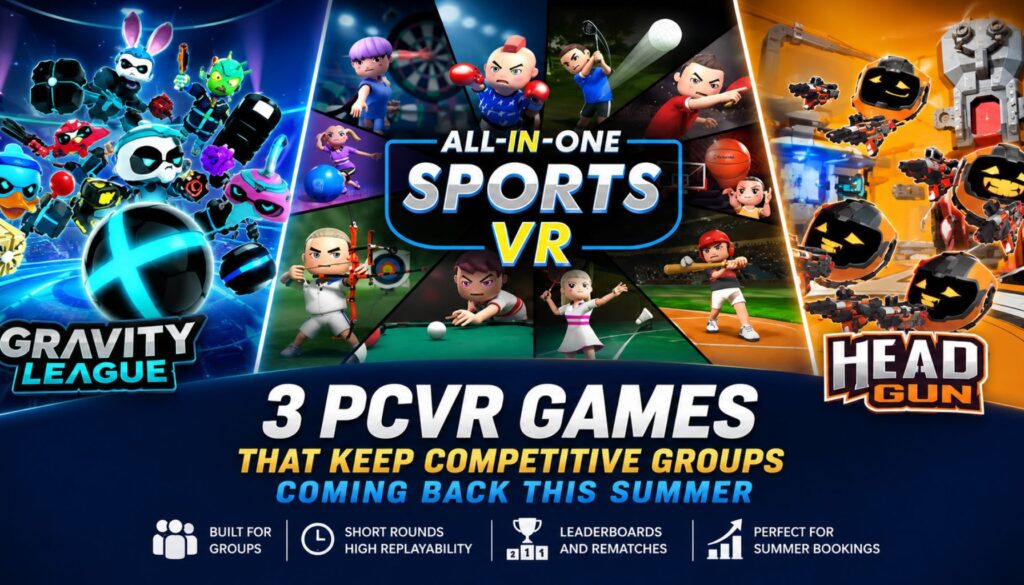
Competitive PCVR games often appeal to a different type of guest than narrative-driven experiences. Some groups walk into a VR session ready to explore. Others walk in ready to compete, compare scores, and ask for a rematch. For those groups, the best games are the ones that create momentum fast. Clear rules, short rounds, and visible progress keep players engaged because the goal feels close, the outcome feels fair, and every round gives them a new chance to do better. That pattern lines up with what motivation research has shown for decades: people tend to increase effort as they get closer to a goal, and the presence of a rival raises that effort further. Clark Hull first documented the goal-gradient effect in 1932, finding that effort accelerates as a goal comes within reach. Gavin J. Kilduff at New York University later confirmed that competing directly against someone raises both motivation and measurable performance, even when no prize is involved. In a venue setting, that combination translates into rematches, leaderboard chases, and groups that book again because the last match did not go the way they wanted. A birthday group with mixed experience levels, a summer camp operating on a schedule, or a corporate booking looking for team-based competition often responds well to the same formula: short rounds, simple rules, and enough variety to make the next match feel worth taking. When players can see their progress and immediately try again, the session becomes more than a one-time playthrough. These three PCVR room-scale titles are built around that logic. Why Competitive PCVR Games Perform Differently in Commercial Venues Not every multiplayer VR experience creates the same booking behavior. Multiplayer score-driven formats introduce a different dynamic because players leave with a clear outcome. Someone wins, someone loses, and someone usually wants another chance. For VR arcade operators, that often translates into longer engagement within a booking, stronger replayability, and easier tournament-style programming for birthdays, camps, corporate events, and group outings. A three-minute match can generate multiple rounds within a single session, allowing venues to keep groups engaged without extending booking times. Competitive experiences also simplify onboarding. Players typically understand the objective immediately, which reduces explanation time and allows staff to focus on session management rather than lengthy game briefings. For venues managing multiple groups throughout the day, those small time savings can compound across dozens of sessions. The result is often a content category that supports throughput, repeat visits, and social competition without requiring complex setup or extensive staff intervention. Gravity League PCVR room-scale | Pico | Quest | Focus 3 | 1-4 players | 3 minutes per match | No age limit | Network Veteran Zero-gravity sports where players use Gravity Gloves to drive a ball into the opposing goal. The mechanics read like full-body air hockey: the objective is visible immediately, the physics respond the way guests expect, and nobody needs to ask what they are supposed to do. A group of four understands the game within thirty seconds of putting on a headset, which means staff spend that time watching rather than explaining. Matches run three minutes. A birthday group can run a full round-robin bracket inside a single booking slot and still have time for a rematch. Standalone support across Pico 4 Enterprise, Quest, and Focus 3 alongside PCVR room-sacle version gives operators flexibility across different station configurations without a separate licensing decision. Wacky Party Mode widens the appeal for mixed-skill groups where guests range from experienced players to first-timers. For operators, the three-minute match structure creates flexibility throughout the day. A venue can run quick rematches, mini-tournaments, or round-robin formats without affecting booking schedules. That makes Gravity League particularly useful for birthday parties, youth groups, and competitive corporate sessions where participants want multiple opportunities to improve their score. Players describe it as competitive, customization-friendly, and easy to replay. The Network Veteran badge on the SynthesisVR marketplace reflects an established performance track record across the network. Game page: deployreality.com/synthesisvr/games/gravity-league HeadGun PCVR Room Scale | 2-10 players | No age limit | No blood | SynthesisVR CDN Optimized Ten players competing simultaneously is an unusual spec for a room scale title. HeadGun supports it through transformable maps that reconfigure based on player count, so a group of four and a group of ten are each playing a version sized for their session rather than the same map at different densities.Three modes give staff a natural structure for longer group sessions: Deathmatch to warm up, Team Deathmatch once the group has found its footing, then Capture the Flag for guests who want a shared team objective over a personal kill count. The ability to support between two and ten players also gives operators flexibility when group sizes vary. Rather than building separate programming around different attendance levels, venues can accommodate smaller and larger groups within the same attraction, helping maintain attraction utilization throughout the day without requiring different content setups. Single-button controls and an integrated tutorial back the zero-learning-curve claim with something concrete: players do not need a staff briefing to start. The September 2024 update added operator-configurable motion sickness controls and French and Chinese Simplified localization, relevant for venues with multilingual guests or international group bookings. Rated 0+ with no blood and no aggression, which removes the age conversation at the front desk entirely. Reviewer coverage frames it as a smooth-running arcade shooter with accessible controls. For operators, that translates to a title that works across birthday groups, camp sessions, and corporate bookings without requiring a different setup or briefing for each audience. Game page: deployreality.com/synthesisvr/games/headgun All-In-One Sports VR PCVR Room Scale | Pico | Quest | 1-2 players per station | No age limit | SynthesisVR CDN Optimized Ten sports disciplines under a single license: Baseball, Archery, Ping Pong, Basketball, Bowling, Badminton, Golf, Darts, Billiards, Boxing. Real-time PvP across most disciplines. The mechanics transfer because guests already know the movement vocabulary: a darts throw, a basketball arc, a tennis return. That prior knowledge compresses the learning curve
How VR Arcades Can Adapt to Summer Demand Shifts and Capture More Indoor Entertainment Traffic
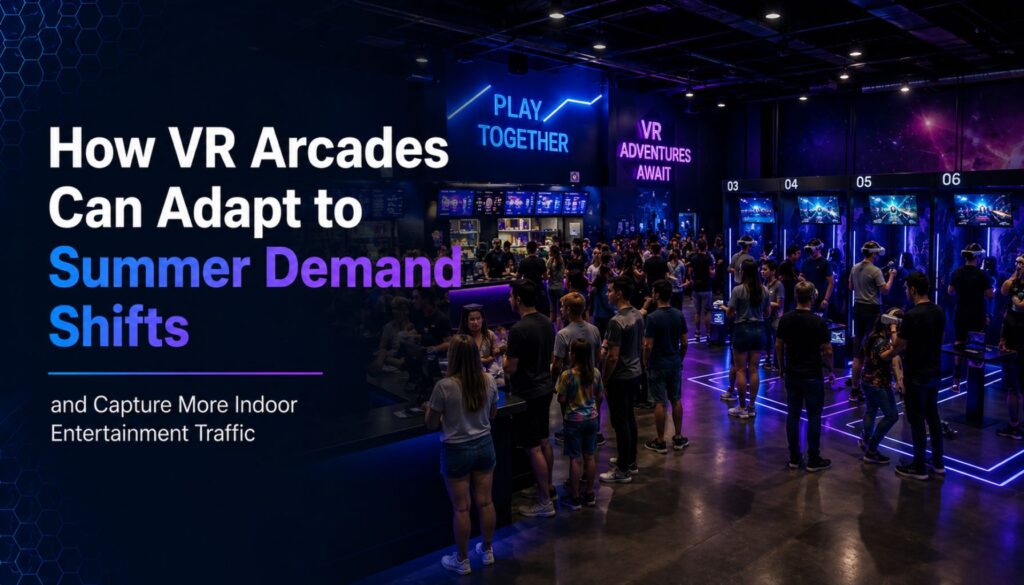
Most VR arcade operators expect summer to bring more visitors. What many find instead is that summer changes booking behavior more than it changes overall demand. Seasonal patterns vary considerably across commercial VR venues. Tourist destinations often welcome an influx of first-time visitors. Local family entertainment centers may see regulars disappear for holidays. A rainy afternoon can transform a quiet Wednesday into one of the busiest periods of the week with only a few hours’ notice. For VR arcades, FECs, and location-based entertainment venues, marketing your VR arcade effectively in summer comes down to understanding who is likely to visit, how they make booking decisions, and whether the venue is ready to respond when demand shifts without warning. How Summer Actually Changes VR Arcade Marketing and Traffic Summer rarely increases demand evenly. The more common pattern across commercial LBE venues is a reshaping of when and how bookings arrive. Weekend sessions often stay healthy. Weekday utilization becomes harder to predict. Tourist-heavy markets see more first-time visitors, while local venues lose regulars to travel and outdoor activities. These patterns tend to run in parallel rather than canceling each other out, which means operators serving both local and tourist audiences may see strong overall numbers while still struggling with utilization on specific days and sessions. One weekend should not be read as a trend. Summer demand tends to arrive in waves driven by weather, local events, school schedules, and travel patterns, so a strong Saturday tells you less than you might expect about the following week. Operators who plan around consistent utilization rather than occasional spikes tend to manage the season more effectively. Why Heatwaves and Rainy Days Are Your Best Walk-In Opportunities Weather is one of the most reliable same-day demand drivers for indoor entertainment venues, and summer is when that effect is most pronounced. When outdoor plans fall apart, consumers search for alternatives the same day. Operators in family entertainment and attraction sectors have consistently noted that rainy weekends drive stronger attendance than clear-sky holiday weekends in some markets, with outdoor competitors like mini golf and go-karts seeing slower traffic while indoor venues pick up the difference. The mechanism is straightforward: a family with an afternoon free and a change in weather needs an answer quickly. What they search for reflects that urgency. Queries like “indoor activities near me,” “things to do with kids,” “VR arcade near me,” and “rainy day activities” are high-intent searches from people ready to book that day. Venues that answer those searches with clear, practical information, session length, pricing, group size, age suitability, what to expect on arrival, convert that traffic at a higher rate than venues that bury the details. Local SEO visibility and a clean booking page matter more in this moment than any promotional campaign. Summer Visitors Are Not One Audience A family booking a birthday party, a camp coordinator managing forty kids, a tourist couple with two free hours, and a group of friends deciding last-minute what to do on a Friday night all land in the same venue. They found it differently, they need different things, and they make decisions on very different timelines. Operators who recognize these differences can build offers, messaging, and scheduling structures that match the actual booking journey rather than defaulting to one-size promotional language. The booking pattern column in the graphic above is particularly useful for session planning: families plan ahead, camps book in advance to manage logistics, tourists decide same-day, and social groups move on short notice. A venue that can accommodate all four simultaneously, without staff coordination becoming the limiting factor, is in a structurally stronger position than one that handles them well in sequence but struggles when they overlap. Why Local Search Visibility Matters More in Summer Many summer visitors have never heard of your venue before. They find it through Google Search, Google Maps, tourism sites, local directories, and increasingly through AI-powered search results that surface venue recommendations directly in the answer rather than a list of links. Discoverability at that moment depends on two things: whether the venue appears in the results, and whether the listing answers the practical questions quickly enough to convert. Visitors searching for last-minute indoor activities are not browsing. They want session length, pricing, group size limits, and age recommendations without having to dig. Venues that surface that information clearly, in their Google Business Profile, on their booking page, and in their site copy, tend to win that traffic over venues with better attractions but harder-to-navigate information. This is also where structured data and locally relevant page content start to matter for venues that want to compete in AI-assisted search, where the answer shown to a user is often pulled from a single well-organized source rather than ranked links. Platforms like ROLLER, which works with thousands of FEC and attraction operators globally, note that seasonal promotions and clear online booking flows are among the highest-impact changes venues can make before peak periods. What to Review Before Peak Summer Traffic Arrives The checklist below covers three areas operators should audit before the season peaks: booking experience, local visibility, and operational readiness. Small improvements in clarity often create more bookings than additional advertising spend. A pricing page that answers questions without extra clicks, a Google Business Profile updated with current hours and photos, and staff briefed on same-day demand spikes are each lower-cost interventions than a paid campaign, and each one compounds across every visitor who arrives from organic search over the course of a season. Managing the Operational Complexity That Comes With Seasonal Variety On a busy summer day, a VR arcade might run a birthday party in the morning, a summer camp group at midday, tourist walk-ins through the afternoon, and a social multiplayer session in the evening. Each of those groups needs different content, different session structures, and different levels of staff involvement. That variety is manageable when volume is moderate. During weather-driven spikes, when two or three groups arrive within a short window
Unlock Weekday Revenue with Step into Webb on SynthesisVR: Free-Roam VR School Field Trips
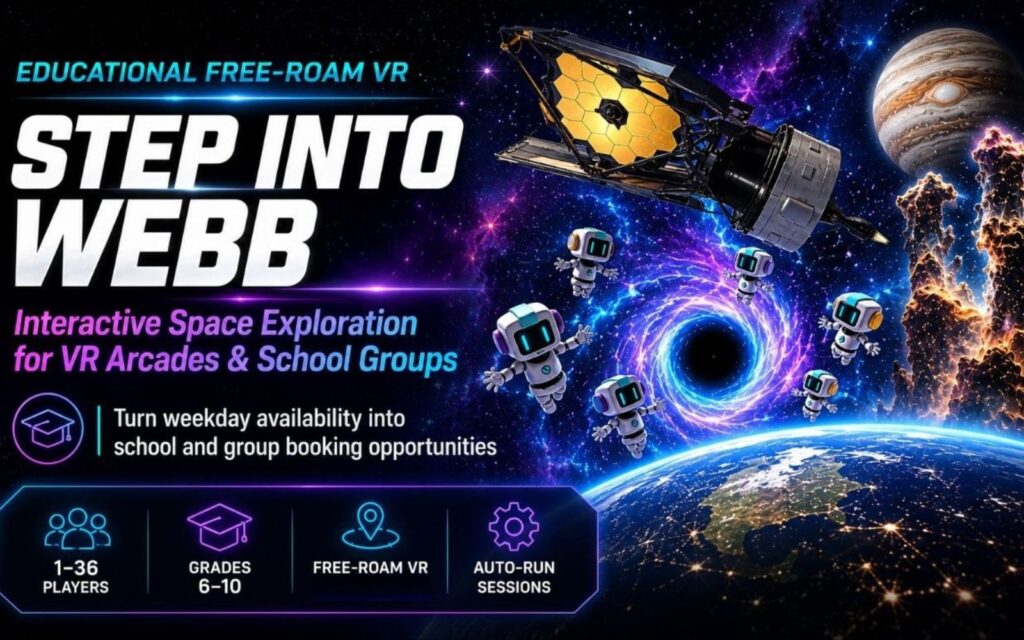
Weekday Schedules Often Look Different from Weekend Traffic Many VR arcades and family entertainment centers eventually run into the same pattern. Weekend sessions stay busy while weekday schedules often leave unused capacity between bookings. Operators usually try filling those gaps with discounts, shorter promotions, or social campaigns. School field trips and educational group bookings create another opportunity because they bring structured visits during periods that are often quieter. The challenge is operational. Educational experiences only work when venues can run them without creating additional complexity for staff. Step Into Webb joins SynthesisVR as an educational free-roam VR experience designed around interactive space exploration, multiplayer participation, and structured group experiences. Practical Ways Venues Can Introduce Educational VR Experiences Operators looking at educational programming usually evaluate a few practical areas before adding new content. Create booking packages around structured schedules Schools and educational groups often operate around fixed time windows. Step Into Webb supports approximately 15–20 minute VR sessions, while the broader activity flow can support experiences around 60 minutes, making it easier to structure larger group visits. Build offers around group participation Support for 1–36 players gives venues flexibility for school trips, STEM programs, camps, and educational events. Support educational outcomes alongside entertainment Teachers and organizers often need reasons beyond entertainment alone. Space exploration, teamwork, discovery, and collaborative objectives create stronger value for educational groups. Keep onboarding simple for staff Additional staffing requirements quickly create operational friction. Educational VR content works best when staff can run sessions consistently without extensive training. Step Into Webb: Interactive Space Exploration in Free-Roam VR Step Into Webb places players inside an interactive journey inspired by the James Webb Space Telescope. Built using authentic NASA-based assets and models, players physically move through space environments and explore locations including: The experience combines movement, multiplayer exploration, and collaborative discovery inside a free-roam VR environment. Mission Control Simplifies Session Flow Educational content frequently raises one operational question first: “How much staff involvement will this require?” Mission Control helps reduce coordination requirements by allowing operators to: Students rotate between VR exploration and supporting activities while virtual guides manage progression and pacing. The goal is straightforward operation without requiring staff members to become classroom instructors or dedicated game masters. Dedicated Game Community Resources for Operators Launching new content often creates practical questions that go beyond installing a title. Operators may need guidance around setup, troubleshooting, deployment, or ideas for structuring larger educational groups. Step Into Webb includes access to a dedicated Game Community directly within the platform where operators can access: For operators introducing educational VR into an existing attraction mix, these resources can reduce onboarding time and create a smoother path from installation to live operation. Technical Specifications Supported Platforms: Licensing Models: Supporting Educational Programming Across Different Venue Types Operators running location-based entertainment VR venues rarely rely on one attraction type alone. Educational VR can fit naturally alongside birthday parties, family activities, group bookings, and traditional entertainment content while helping venues create additional weekday opportunities. Within the SynthesisVR VR content marketplace, operators can manage educational content alongside broader free-roam VR and multiplayer experiences across standalone environments. Looking to expand your attraction mix with educational free-roam VR experiences designed for school groups and structured group bookings? Explore Step Into Webb on SynthesisVR.
EDUCATION VR
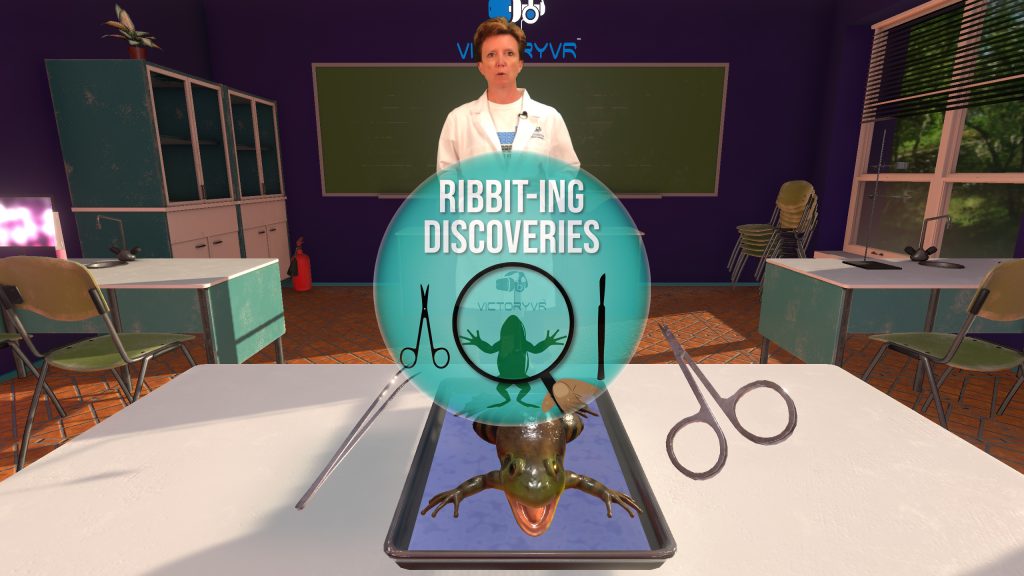
VIRTUAL REALITY SCIENCE CURRICULUM Los Angeles, CA (May 08, 2021) — SYNTHESIS VR is excited to re-introduce you to VictoryXR’s Science Curricula. The first – and only – virtual reality science curricula aligned with the Next Generation Science Standards (NGSS). Educators can rest easy knowing that each VR experience correlates with a specific standard or substandard within the NGSS in addition to the standards for the state of Texas (TEKS) and the state of Florida (CPALMS). VictoryXR’s 48 educational science units contain a total of 240 unique virtual reality experiences covering Earth & Space Science, Engineering, Life Science, and Physical Science. WHY EDUCATIONAL CONTENT? The current pandemic has thrown a wrench into every industry imaginable, but especially the entertainment and social industry has taken the biggest hit economically. Traditionally VR locations have been busy during weekends and holidays and locations have been grappling in finding different ways to bring customers during the week. Creating weekly programs based on education, creating lesson plans and creative after-school programs are one of the ways locations have found success. Now with SynthesisVR educational content, you can easily create lesson plans, and weekly programs to fill this void. Please click here for all our content. MULTIPLE LICENSE METHODS With our partnership with VictoryXR we have come up with multiple license methods to accommodate all locations. Fixed Fee – For $125 a month you can now get all the VictoryXR content with over 240 unique virtual reality experiences for your entire location. This price is not for one headset but for your entire location. If you think this fee cannot be justified during the start you can license certain lessons (content) for only $5 per month per headset. Giving you more flexibility and control. If a fixed fee is not your cup of tea license content based on pay-per-minute usage by paying only $0.06 (6c) every minute. For questions about implementing these, lesson plans please feel free to contact us at info@synthesisvr.com For more details please visit: EDUCATION CONTENT PAGE SynthesisVR is a premium management and content licensing platform for location-based entertainment centers around the world. For questions related to the game or Synthesis VR please email info@synthesisvr.com