
How Much Guidance Should VR Arcade Staff Give Players?
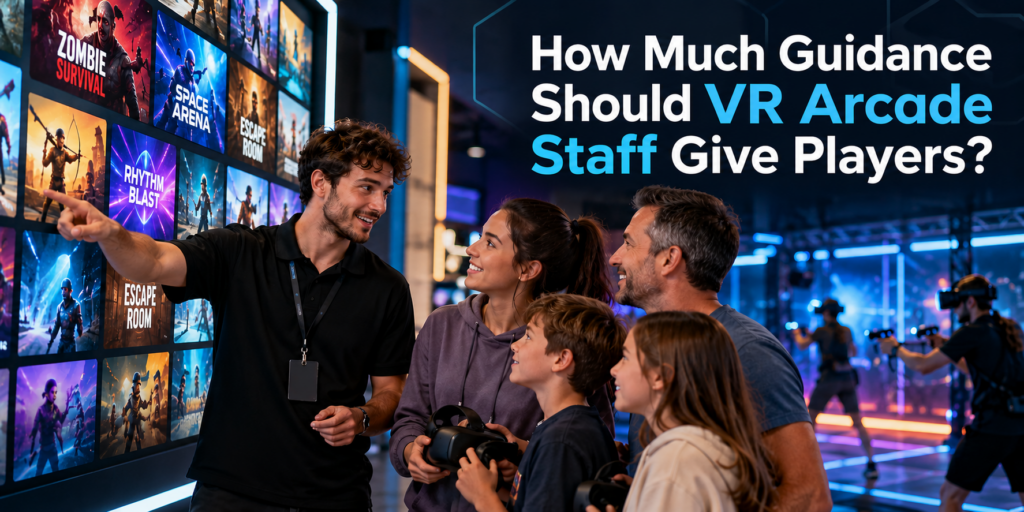
A strong VR content library gives customers choice, but choice alone does not guarantee a good experience. Staff still need to understand who an experience is for, how it starts, what players need to know before putting on the headset, and when they may need help. That makes staff guidance an important part of running a VR arcade, particularly for first-time visitors who have little idea what to choose or what to expect. Why VR Players Need More Guidance Than They May Realize Experienced VR players may arrive knowing exactly what they want. Many customers do not. A family with children, a birthday group, two adults trying VR for the first time and a group of experienced gamers can all walk into the same venue with very different expectations. Asking them to browse a large game library without guidance puts much of the decision on the customer. The goal is not to make the decision for the customer. It is to turn a potentially overwhelming library into a manageable set of experiences that fit the group. Staff Should Know the Content They Are Offering This was one of the interesting issues raised in our recent conversations with VR arcade operators. Adding an experience to the library and waiting to see whether customers play it provides limited information about whether the content itself is working. A game may receive little play because customers cannot tell what it is from the title or thumbnail. Staff may rarely recommend it. Players may start it without understanding the objective. A group may choose something poorly suited to its size or experience level. The operator can then conclude that customers simply do not like the game. That conclusion may be wrong. Before staff recommend an experience, they should ideally know: What is the experience about?Staff should be able to explain the basic premise in one or two sentences. Who is it suitable for?Consider age, VR experience, group size, physical intensity and genre. How does the experience begin?Some games are immediately intuitive. Others require players to understand controls, roles or objectives before the session starts. What commonly causes players difficulty?Knowing where people tend to get stuck allows staff to intervene quickly instead of leaving players frustrated. What hardware and play space does it require?A recommendation still has to work with the venue’s available setup. This is one reason properly testing VR arcade games before adding them to the active library matters. Staff who have actually played an experience can explain it much more naturally than staff working from a title and description alone. Guidance Starts Before the Headset Goes On Some of the most useful guidance happens before gameplay begins. A good introduction does not need to become a five-minute tutorial. In many cases, players only need a few pieces of information: What am I trying to do?Give the player the objective. What do I need to know to get started?Explain the essential controls or interaction. What should I expect?If players will move between stages, communicate with teammates, physically turn around or encounter something intense, tell them beforehand. This is especially important with first-time VR users. They are learning the game and learning how to interact in VR at the same time. Giving them the right information before the session can reduce confusion once the headset is on. During the Game, Help Without Taking Over There is another extreme operators should avoid: over-guiding. A puzzle is less satisfying if a staff member immediately gives away the solution. Exploration loses its appeal if someone constantly tells players where to go. Experienced players may want very little assistance. The best level of support therefore changes with the player and the experience. Staff should know when a player is discovering and when a player is simply stuck. Someone experimenting with different solutions may be enjoying the game exactly as intended. Someone repeating the same failed interaction for several minutes may need a small prompt. Start with the least intrusive intervention: Prompt → hint → explanation → direct assistance That preserves player agency while preventing frustration from consuming a large part of a paid session. Technical Problems Need Fast Intervention Gameplay guidance and technical support are different. If tracking fails, a controller disconnects, a headset loses connection or the game does not progress correctly, waiting for the player to solve the problem wastes session time. Staff need enough familiarity with both the content and the venue setup to recognize when the problem is technical. This becomes particularly important during busy periods. A problem that takes an experienced staff member 30 seconds to identify can consume several minutes when the person supervising the session does not know what normal gameplay should look like. Knowing the game is therefore part of troubleshooting it. Better Recommendations Can Improve Content Utilization Staff knowledge also affects which games get played. Imagine a venue has 40 experiences available, but employees confidently recommend only five because those are the games they know best. From the customer’s perspective, the venue effectively has a five-game library. The remaining content may be technically available, but it is doing little work for the business. Training staff across a carefully selected range of experiences can help venues make better use of the content they already license. It also gives operators better information when deciding what to keep, rotate or replace. Instead of asking only: “How often was this game launched?” operators can also ask: “Did we recommend it to the right customers?” That is a much more useful question when evaluating content performance. Build a Simple Content Knowledge System for Staff Staff do not need to memorize every detail of every game. A simple internal reference can make recommendations much easier. For each active experience, record: This also makes onboarding new employees easier. Rather than expecting them to learn an entire commercial VR library at once, operators can establish a core group of experiences every staff member should know well and expand from there. Let Your VR Management System Handle the
How Long Should a VR Arcade Session Be?
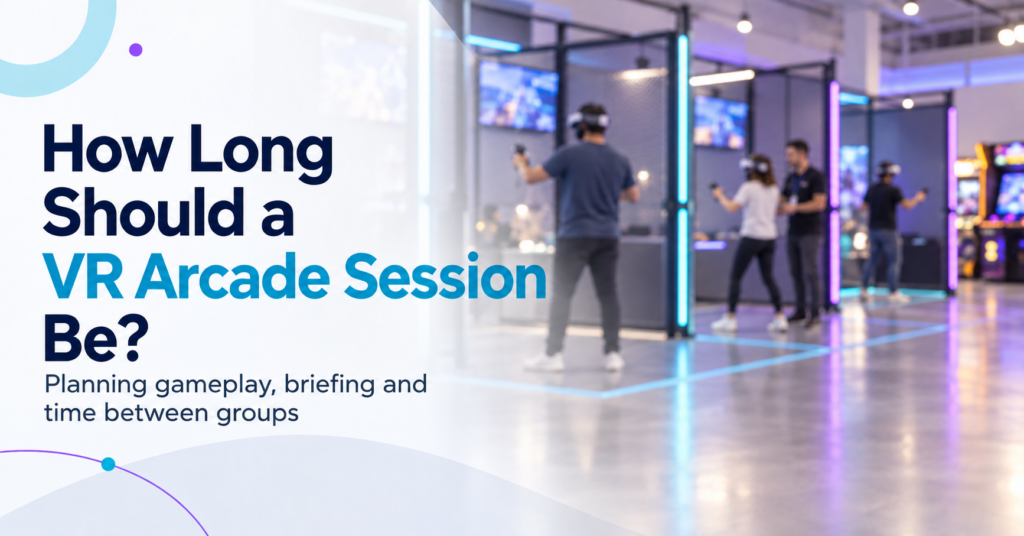
There is no standard VR arcade session length. Commercial VR experiences currently range from a few minutes for fast competitive rounds to 30 or 45 minutes for free-roam missions and narrative experiences. Some venues then add another 10 to 15 minutes for briefing, headset fitting, and preparation. For an operator, the useful question is therefore: How much gameplay creates a satisfying experience while still fitting the attraction, audience, booking schedule, and operating model? The answer starts by separating three different clocks that often get grouped together as “session length.” Gameplay Time, Booking Time, and Operating Time Are Different A customer might book 30 minutes of VR, but the attraction can occupy venue capacity for much longer. Consider the full cycle: Briefing and fitting → Launch → Gameplay → Exit → Reset If guests play for 30 minutes, need 10 minutes for preparation, and staff need another 5 minutes before the next group, the attraction occupies a 45-minute operating block. That distinction matters because the game duration does not determine how many sessions a venue can actually run. The previous SynthesisVR guide on VR attraction performance looked at this from the measurement side. A nominal 30-minute attraction can become a 40-minute or 45-minute cycle once onboarding, launch, and reset enter the calculation. For session planning, operators should define three times clearly: Time What it measures Gameplay time Minutes the customer actively spends inside the experience Guest booking time The time the customer should allow for the booked activity Operating cycle Time from preparing one group until the attraction is ready for the next Commercial VR Already Uses Very Different Session Lengths Current commercial VR formats show why one universal session duration would make little sense. Some HOLOGATE arena titles support playtimes as short as 3, 5, 8, or 10 minutes. SynthesisVR marketplace title Critical Mass lists an approximate session duration of 10 to 15 minutes. Teller Falls can run individual themes in roughly 10 to 15 minutes or its complete experience in 25 to 30 minutes. At the other end, Zero Latency offers formats built around 15- and 30-minute sessions and currently offers some experiences in 30- and 45-minute versions. VR escape venues commonly advertise around 40 to 45 minutes of actual play, with preparation extending the complete visit toward an hour. The range reflects different products. A five-minute competitive match can produce a complete result, a winner, and an immediate rematch. A 30-minute cooperative mission needs enough time for the group to progress through the experience. An escape-style attraction needs time for exploration, puzzles, and narrative development. The operator should start with what the experience needs to feel complete, then build the commercial session around it. Match Session Length to the Experience Structure Session duration works best when it follows the natural rhythm of the content. Fast competitive games often lend themselves to shorter rounds because the outcome arrives quickly. Scores, wins, losses, and leaderboards create natural stopping points. Customers can play again without repeating a long introduction. Cooperative shooters and free-roam missions usually need more time to establish the objective, let the team settle into its roles, and give players a meaningful progression. Narrative and escape experiences generally need longer uninterrupted periods because their value comes partly from completing a story or solving a sequence of challenges. That does not mean every competitive game should run for ten minutes or every escape game should run for 45. The current commercial market already contains plenty of exceptions. A better operator question is: At what point does this specific experience feel finished rather than cut short? That becomes the starting duration to test. Shorter Sessions Do Not Automatically Mean Better Throughput Short sessions create more theoretical booking slots, but every session carries some fixed operational time. Imagine two formats. Format A 15 minutes gameplay10 minutes briefing and fitting5 minutes reset 30-minute total cycle Format B 30 minutes gameplay10 minutes briefing and fitting5 minutes reset 45-minute total cycle Format A can theoretically complete two cycles per hour. Format B completes around 1.3. But look at the same example from the customer’s side. In Format A, only 50% of the attraction cycle is gameplay. In Format B, gameplay accounts for roughly 67% of the cycle. That gives operators a useful planning calculation: Playable-Time Ratio Gameplay time ÷ full operating cycle × 100 This is not an established industry KPI. It is a simple planning measure that helps show how much of each operating block goes toward the experience customers actually came to play. The highest ratio does not automatically produce the best business model either. A short competitive attraction can work extremely well when customers replay it, groups move through quickly, or the format supports walk-ins. A longer session may suit private bookings or premium experiences. The calculation simply exposes the tradeoff. Longer Sessions Have Their Own Limits Adding more gameplay time can increase perceived value, but only while the experience continues to hold the player’s attention and comfort. VR research does not support one universal maximum session duration. Exposure time interacts with content, locomotion, software design, and individual susceptibility. Research into cybersickness has found substantial variation between users and between different types of VR content. For an arcade operator, that makes observation more useful than adopting a generic rule. Watch when customers naturally want to stop. Track early exits. Listen for complaints about fatigue or discomfort. Compare first-time visitors with experienced players. An intense free-movement shooter and a calm exploration experience can place very different demands on players over the same 30 minutes. Group Size Changes the Session Before Gameplay Even Begins Session length should also be tested with the group size the venue actually expects to serve. Preparing two experienced players can take very little time. Preparing six or eight first-time visitors may involve headset assignment, fitting, player identification, explanation, calibration, multiplayer connection, and questions from several people at once. The SynthesisVR multiplayer guide makes this operational difference clear: even a small repeated step can become several minutes of preparation
Is Your VR Venue Ready to Add Another Attraction?
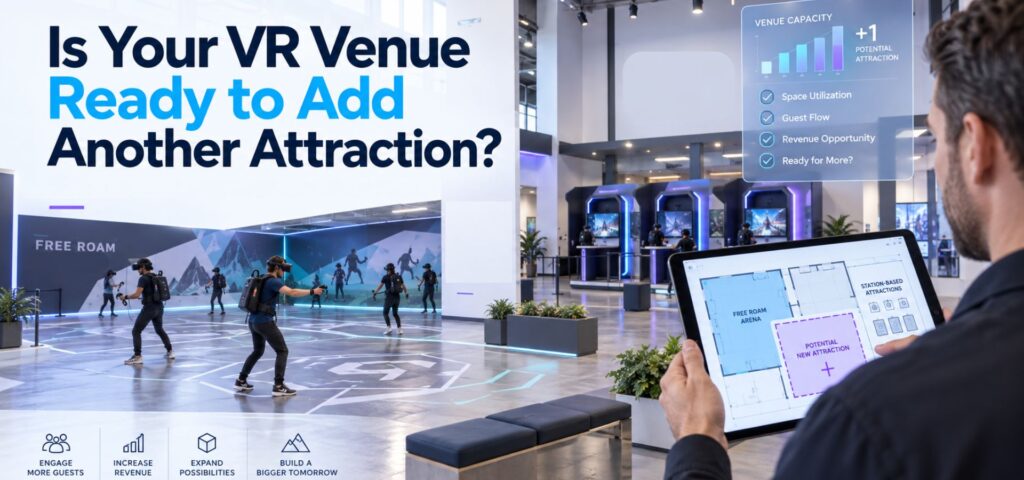
Adding another attraction can feel like the obvious next step when a VR venue starts getting busier. Perhaps weekend slots are filling consistently. Birthday groups are getting larger. Customers are asking for more variety. There may be unused floor space that could support another free-roam arena, a few standalone stations, or a different type of multiplayer experience. The question is whether the venue actually needs more capacity yet. Adding hardware increases the number of experiences a venue can sell, but it also adds another schedule, another set of devices, more content decisions, additional staff responsibilities, and another attraction that needs to earn its place on the floor. Before expanding, operators should look at what their current setup is already telling them. Start With the Capacity You Already Have A busy Saturday does not necessarily mean an attraction has reached its capacity. Look at utilization across the full week. An eight-player arena that regularly fills during birthday bookings may still spend large parts of weekday afternoons unused. A venue with several room-scale stations may appear busy because customers arrive continuously, while individual stations remain empty between bookings. That distinction matters because expansion solves a capacity problem. It does much less for a demand problem. Our guide to How Many Players Should a VR Attraction Support? looks at this from the booking-model side. Eight simultaneous players can mean one eight-player arena, two four-player experiences, or several smaller attractions. The useful capacity depends on the way customers actually book. Identify the Booking the Current Venue Cannot Serve The strongest reason to add another attraction is usually a specific booking opportunity. For example, a four-player setup may work well for walk-ins but become difficult when birthday groups regularly arrive with eight or twelve guests. A free-roam arena may handle large social groups well while leaving couples and smaller groups with limited options. The gap could also be demographic. A venue with mostly competitive shooters might receive regular family traffic without enough suitable content. Another location may serve casual players well but lack an attraction strong enough for repeat visits from experienced groups. Before expanding, define the gap clearly: Which customer or booking type could we serve better if this attraction existed? That question is more useful than asking whether a new attraction looks impressive. We recently explored the same principle from the content side in How to Choose VR Arcade Games for Different Customer Groups. Hardware, space, group size, staff workflow, and audience fit all affect whether an experience works commercially. Check Whether More Capacity Creates More Throughput The theoretical capacity of an attraction and the number of sessions staff can actually deliver are rarely identical. Suppose a venue adds a second multiplayer attraction. That may allow two groups to play at once. It may also mean staff now need to: If the existing team already struggles during back-to-back bookings, another attraction can increase pressure without creating the expected number of additional sellable sessions. This is why throughput belongs in the expansion calculation. The VR Arcade Business Plan guide uses a simple starting model: available sessions × average players per session × realistic utilization × average revenue per player The important word is realistic. Session capacity has to account for onboarding, resets, maintenance, delays, and staff workload rather than relying on the maximum number printed on the attraction specification. Watch What Happens During Your Busiest Hour Peak periods often reveal more than weekly revenue totals. Observe one genuinely busy hour at the venue. Where does the line form? Is staff waiting for headsets to become available? Are customers waiting for a play space, or are they waiting for an employee to launch the experience? Does one attraction finish while another group is still being prepared? Are staff moving between several systems to check bookings, launch content, or resolve device problems? These observations help distinguish between a physical capacity constraint and an operational constraint. That matters because adding another attraction only directly fixes the first one. The wider attractions industry sees the same issue. IAAPA’s recent guidance for FEC operators describes how multiple attractions, staff roles, and guest touchpoints can allow small operational problems to compound quickly. That is useful context for VR venues because expansion usually increases coordination before it increases complexity anywhere else. Make Sure the New Attraction Adds Something to the Mix Another attraction should have a role. It might increase capacity for large parties. It might create a lower-cost option for couples and small groups. It could introduce cooperative content alongside an existing competitive offer. It may give families something accessible while older visitors use a more intense free-roam experience. Or it could make an underused part of the building commercially productive. The risk is adding an attraction that competes with the venue’s existing offer for the same customers. If two attractions target the same audience, group size, price range, and occasion, operators may simply divide existing demand between them. A useful attraction mix gives customers different reasons to book. Our article on VR arcade content rotation makes a related point: customer behavior should drive changes to the lineup. Operators can look at selection frequency, repeat requests, operational friction, and audience gaps before deciding what belongs in the mix. Calculate the Full Cost of the Expansion The hardware purchase is only one part of the decision. Depending on the attraction, expansion can introduce costs for: It can also introduce a less visible cost: floor space. A large attraction needs to earn enough to justify the area it occupies. That is particularly important when comparing free-roam with smaller station-based formats. Our guide to free-roam VR arena space requirements explains why footprint, hardware, and available content should be evaluated together rather than treating square footage as a standalone requirement. Operators building the financial model can also use our VR Arcade Startup Budget and Revenue guide. Although it was designed around new venues, the same logic applies to expansion: build the investment around your own capacity, labor, hardware, software, content, and revenue assumptions
How to Build Halloween VR Arcade Packages for Different Audiences

Halloween gives VR arcades an easy reason to change what customers see, promote experiences that may spend less time in the spotlight during the rest of the year, and create a seasonal offer around content they already have access to. The timing matters. Halloween VR arcade packages should be ready before customers start deciding what to do in late October. In our recent guide to planning VR arcade seasonal promotions before demand peaks, we suggested starting internal planning around six to eight weeks before a major event, followed by the main customer-facing campaign roughly four to six weeks ahead. For Halloween 2026, that window is already open. Operators starting now still have time to choose content, define the offer, test the experience, prepare the booking page, and begin promotion well before October 31. The offer itself can stay simple. A venue might sell a themed block of VR time with several Halloween game choices. Another might add snacks, drinks, a group photo, or a small Halloween treat. A free-roam venue can reserve the arena for a dedicated spooky session. The right format depends on who the venue wants to bring in. Start With the Audience Before Choosing the Scare Halloween content covers a much wider range than traditional horror. A family with younger players may want pumpkins, ghosts, candy, and supernatural themes without intense scares. A group of teenagers or young adults may want something more suspenseful, social, or competitive. Adult groups can move into darker escape experiences, psychological horror, zombies, and stronger jump scares. That is why the content decision should start with the customer rather than the genre. The same principle applies throughout the year. Our guide to choosing VR arcade games for different customer groups looks at audience fit alongside hardware, available space, player capacity, session length, and staff workflow. A Halloween campaign simply gives operators a seasonal reason to apply the same process. A useful starting point is to define the intensity of each Halloween offer clearly. Labels such as Family Spooky, Scary, and Full Horror can help customers understand what they are booking before they arrive. Turn Halloween Content Into a Bookable Package A seasonal offer works better when customers can understand it in a few seconds. The venue can keep the entry-level package focused entirely on VR. Food, drinks, party space, or other extras can sit in higher tiers if the operation supports them. The packaging principles are similar to those we covered in our guide to VR arcade birthday party packages. Customers respond better when the total visit length, group size, price, session format, and included extras are clear before checkout. For Halloween, the additional question is simple: How scary is this going to be? Answer that on the booking page. Where to Find Halloween VR Content Operators running PCVR and room-scale stations can start with the dedicated Halloween VR content category. It currently brings together titles such as Halloween Candy Reclaim, The Obsessive Shadow, Fear of the Dark, Cosmodread, Dreadhalls, Escape Bloody Mary, and AFFECTED: The Manor, among others. Free-roam operators should also browse the dedicated SynthesisVR free-roam library. The free-roam section separates content by setups including PCVR, PICO, HTC Focus, and Quest, which matters when an operator needs Halloween content that fits an existing arena rather than a room-scale station. That distinction also helps operators avoid choosing a Halloween title based on theme alone and discovering later that the platform, player count, or physical footprint does not fit the venue. Family-Friendly Halloween VR Family Halloween content can use the season without turning the visit into a horror experience. Halloween Candy Reclaim is a PCVR room-scale example built specifically around that idea. Players use pickle guns while recovering stolen candy from Halloween creatures. The experience describes itself as family-friendly and intentionally non-scary, with pumpkins, ghosts, skeletons, candy, seven levels, multiple difficulty settings, and local multiplayer. For a free-roam setup, Paranormal Pest Patrol offers another direction. Groups become paranormal exterminators dealing with mischievous demons inside a possessed house. Its comedic tone, simple controls, puzzle structure, E10+ rating, and support for groups of two to eight players make it easier to position as a spooky group adventure rather than full horror. Either could sit inside a family package with a fixed session length, Halloween snack, photo spot, or small treat at the end. The commercial value comes from the packaging. Parents do not need to understand the difference between every title in the library. They need to know that the experience fits their group and that nobody is walking into something far scarier than expected. Give Social Groups Something Spookier Older groups give operators room to increase the intensity. Fear of the Dark runs on PCVR room-scale and supports multiplayer for up to five people. Players protect the torch carrier while moving through a village filled with zombies, werewolves, monsters, bats, and other threats. Multiple difficulty settings give operators some flexibility around the group they are serving. Free-roam venues can look at experiences such as The Hallow, a PCVR free-roam title for two to eight players. Its supernatural 19th-century premise sends the group searching for abnormal activity under the guidance of a mysterious magician. This type of content can support a Halloween social offer aimed at friend groups, students, and young adults. The marketing can focus on bringing the group together, choosing how brave they want to be, and booking a fixed evening slot. We covered the wider booking behavior of this audience in How VR Entertainment Centers Attract Student Groups and Young Adult Audiences. Social-first promotion, clear pricing, multiplayer content, and a quick mobile booking path become especially relevant when the customer may decide on the activity with friends only a few days before the visit. Build a Stronger Horror Option for Adults Some customers will actively search for the most intense experience the venue can offer. For PCVR room-scale stations, AFFECTED: The Manor focuses heavily on atmosphere, lighting, audio, and a guided route through a haunted environment. Its design also makes
How to Build an Educational VR Program for Schools and Groups
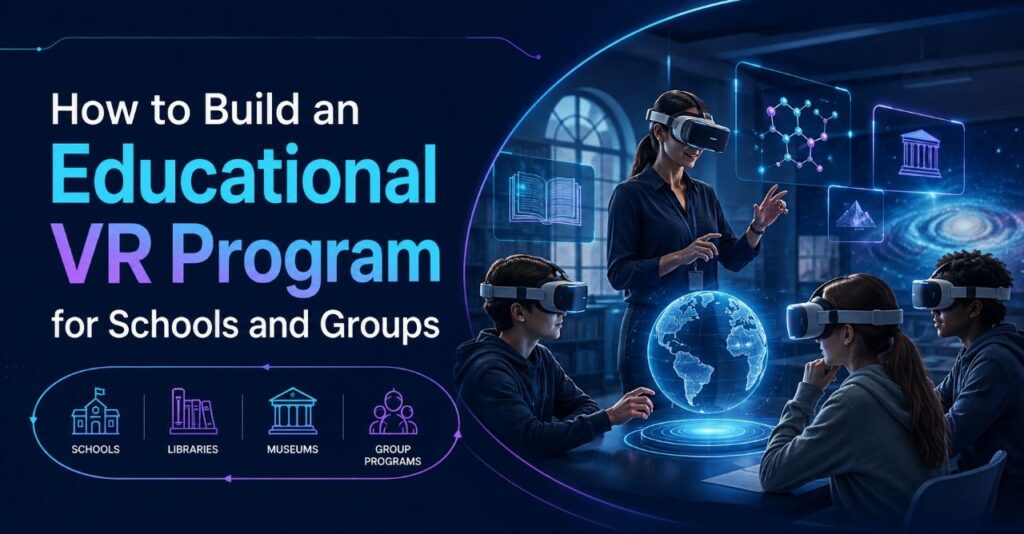
Building an educational VR program for schools takes more than adding educational content to a headset fleet. Teachers need to understand what students will learn, which ages the activity suits, how a full class will move through the experience, how long the visit will take, and what the school will pay. Libraries, museums, science centers, and other institutions face many of the same questions when adding VR to their educational programming. For VR arcades and location-based entertainment venues, school groups can also create a new use for weekday capacity. Operators already have much of the infrastructure in place: headsets, staff, commercial VR content, and experience managing groups. The next step is turning those resources into a program that a teacher or institution can confidently book. Building a program a teacher can approve Established field trip providers make practical information easy to find. Teachers usually need the age or grade range, learning focus, program duration, group capacity, supervision requirements, accessibility information, arrival instructions, and price before they can move a trip forward. An educational VR offer needs the same clarity. A page that simply says “Educational VR available for school groups” still leaves most of the planning with the teacher. A stronger offer explains what students will explore, how the experience connects to a subject, how many students can attend, how the class moves through the available headsets, and what happens during the rest of the visit. A simple way to plan the offer is to work backward from the questions the school needs answered: This also changes how an operator chooses educational VR content. Instead of starting with a list of available experiences, start with the school use case. A biology experience might support a science visit. A virtual field trip could connect with geography or history. Engineering content may fit a STEM program. The content has a clearer role once there is a program around it. A short VR experience can support a full school visit The VR portion does not need to fill the entire booking. During our recent Step Into Webb education webinar, Adventure Portal demonstrated how a relatively short immersive experience can sit inside a longer structured lesson. Step Into Webb itself runs for around 15 minutes and targets students in grades 6 through 10. The wider program can combine that VR session with supporting tasks and teacher-led activities. For a venue, that creates the possibility of a 45- or 60-minute school visit without keeping every student inside VR for the full hour. A class might begin together with an introduction to the subject. Smaller groups then move through the VR experience while other students work on related activities. The groups rotate until everyone has completed the immersive portion, then come together again for a discussion or recap. Supporting activities give the visit more structure and help connect what students see inside VR with the wider learning objective. This becomes especially useful when the immersive experience itself lasts 10 or 15 minutes. The venue can build a much richer educational program around that time rather than stretching the VR session simply to fill an hour. Class capacity is bigger than headset count One of the first questions operators often ask is how a venue with six or eight headsets can host a full class. The answer is in the program design. During the Step Into Webb webinar, one example used a class of 30 students and eight available headsets. The class could split into smaller groups. One group enters VR while the other students complete related activities, then the groups rotate. The exact numbers will differ from one location to another. Available space, staff, student age, experience length, and headset capacity all influence the final setup. Still, the example highlights an important distinction: Educational capacity does not have to equal headset capacity. An operator should calculate how many students can complete the entire program during the available booking window, rather than using the number of headsets as the maximum class size. This can make educational VR practical for venues that would never consider buying enough hardware for an entire school class to enter VR simultaneously. Using existing weekday capacity For an established VR arcade, school visits can fit into a very different part of the weekly schedule from regular entertainment bookings. A class arriving on Tuesday morning does not compete directly with the birthday parties, friend groups, or free-roam sessions that drive weekend and evening demand. The venue also already has much of the infrastructure required to deliver the program. Staff understand headset setup and cleaning. The venue has group onboarding procedures, commercial VR hardware, content, physical space, and a VR management system supporting the headset fleet. Education gives those existing resources another commercial use. During our education webinar, one operator described running regular field trips and having hosted several school groups within a single day. Their existing program combines educational activities with VR and uses different areas of the venue to move students through the visit. That example shows why the operational design matters as much as the content. Staff need to know when each rotation starts, where students wait, which headsets are ready, how long each activity lasts, and who supervises each part of the group. Once the venue establishes that workflow, the next school visit becomes much easier to run. Educational VR inside schools Schools and universities can also operate VR directly. A school with its own headset fleet has a different set of priorities from an entertainment venue. The institution may want one set of hardware to serve several classes, teachers, and subjects throughout the academic year. A biology class might use the headsets for anatomy or natural science. Another teacher could use the same fleet for engineering, Earth science, history, or a virtual field trip later in the term. The educational value of the hardware grows when the institution can reuse it across different subjects and age groups. Content breadth therefore becomes an important planning question. A school investing in
3 Cooperative PCVR Free-Roam Games for VR Arcades
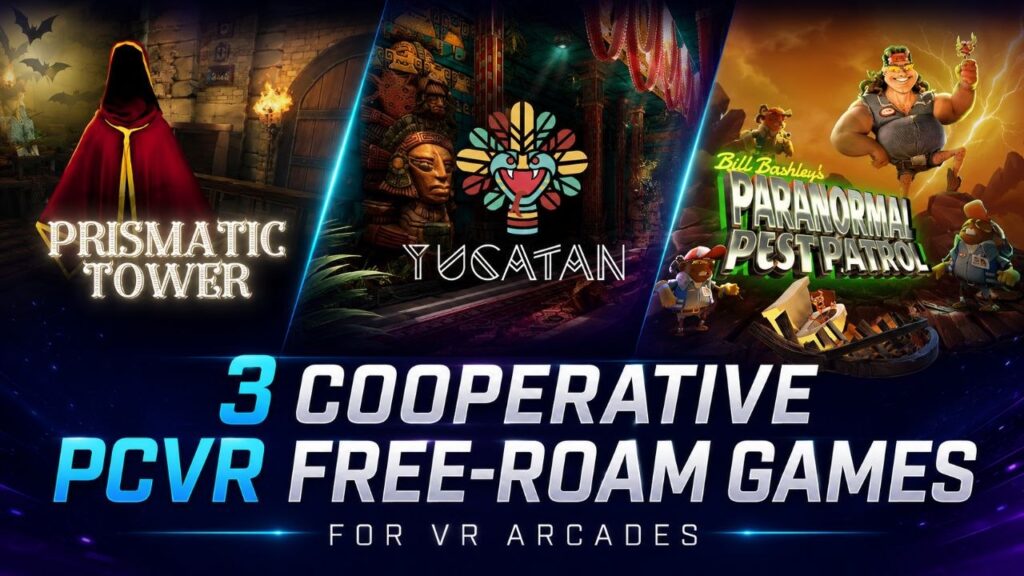
PCVR free-roam games do not have to follow the same formula. For VR arcades, free-roam can support fast group puzzles, longer communication-heavy challenges, or story-driven adventures where players depend on each other to progress. That range becomes useful when an operator wants to add variety without changing the underlying PCVR free-roam setup. For this week’s content spotlight, we picked three cooperative experiences from the SynthesisVR marketplace: Paranormal Pest Patrol, Prismatic Tower, and Yucatan. All three put teamwork at the center of the session, but they do it in very different ways. Three PCVR free-roam games at a glance Game Players Gameplay Starting play area Network status Paranormal Pest Patrol 2–8 7–15 min 5.2 × 5.2 m / 17 × 17 ft Network Veteran Prismatic Tower 2–4 45–55 min 4.6 × 4.6 m / 15.1 × 15.1 ft Network Debut Yucatan 1–8 40 min 4 × 5 m / 13.1 × 16.4 ft Network Veteran The specifications already hint at three different uses. Paranormal Pest Patrol can fit shorter group sessions and scale to eight players. Prismatic Tower gives smaller teams a longer puzzle experience. Yucatan combines a longer adventure with configurations that scale from one or two players to groups of eight. Paranormal Pest Patrol: short, social puzzle play for up to eight players Paranormal Pest Patrol sends players into a possessed home as a team of paranormal exterminators. The premise is deliberately light. Flying books, strange appliances, hidden demons and a loud self-proclaimed hero named Bill Bashley turn the experience into a comedy rather than a horror game. Underneath that humor sits an escape-room-style structure. Players need to observe the environment, find the paranormal pests and work through puzzles together. For a VR arcade, the session format is one of the more interesting parts. The marketplace lists gameplay at 7 to 15 minutes and supports several PCVR free-roam configurations: That creates options for venues running different arena sizes and booking formats. Paranormal Pest Patrol also includes a final score, so solving the experience does not have to end the replay conversation. A group can return and try to improve its previous result. The marketplace currently shows another useful signal: a five-star rating from 10 votes. The title also carries the Network Veteran designation, which identifies content from a studio with an established performance history across the DeployReality network. Operators can also find a Game Community directly from the listing. Technical support includes SynthesisVR Optimized multiplayer, Offline Multiplayer and a Standalone Game Server. Where it may fit: shorter family and friend-group sessions, larger bookings, puzzle fans, and venues looking for cooperative content outside the shooter category. Prismatic Tower: communication is the puzzle Prismatic Tower takes cooperation in a different direction. Two to four players enter a magical tower and move through a series of environmental puzzles. The important twist is that the group does not always have access to the same information. Players split between two rooms. One side may see the order of a sequence while the other side controls the objects. A clue discovered by one team may only become useful after they explain it to the players elsewhere. The game uses that idea throughout its puzzles. Players exchange items, decipher symbols, direct beams through prisms, mix ingredients and synchronize actions to move between floors. In other words, communication is not simply helpful. It is part of the game mechanic. Prismatic Tower supports 2–4 players in a 4.6 × 4.6 m / 15.1 × 15.1 ft PCVR free-roam area, with gameplay listed at 45 to 55 minutes. That puts it in a very different booking slot from Paranormal Pest Patrol. Rather than a short group challenge, Prismatic Tower can support a longer cooperative session for a smaller team. The title currently carries the Network Debut designation. This indicates that the publisher is still building its performance history across the DeployReality network. Its marketplace page also includes a Game Community, along with SynthesisVR Optimized multiplayer, Offline Multiplayer, a Standalone Game Server and an operator walkthrough. Where it may fit: smaller groups looking for a longer experience, escape-room audiences, corporate groups, and players who enjoy communication-heavy puzzles. Yucatan: cooperation on a larger adventure Yucatan moves further away from the traditional escape-room format. The experience sends players into a Mayan world built around an ancient prophecy, hidden gems and a final encounter with Quetzalcoatl. Instead of giving everyone one puzzle to solve at the same time, Yucatan can split a larger group into pairs. Each pair tackles challenges that use movement, dexterity, critical thinking and cooperation. The full group eventually comes back together for the final battle. That structure gives Yucatan an unusual way to handle larger bookings. The game supports: Gameplay runs for approximately 40 minutes. The pair-based format also means the experience can ask different things of different players. Quick reflexes may help in one challenge, while another rewards observation or problem-solving. That can work well for mixed groups where not everyone arrives with the same gaming or VR experience. Yucatan carries the Network Veteran designation and has a Game Community linked from its marketplace page. The listing also includes SynthesisVR Optimized multiplayer, Offline Multiplayer, a Standalone Game Server and an operator manual/walkthrough. Where it may fit: families, friend groups, larger bookings and guests looking for a story-driven cooperative adventure rather than a traditional shooter. The same free-roam format can serve very different bookings These three games share PCVR free-roam and cooperative multiplayer, but an operator would not necessarily sell them to the same customer in the same way. Paranormal Pest Patrol gives a group a quick challenge with comedy, puzzles and a score to chase. Prismatic Tower asks a smaller team to spend considerably longer communicating and working through connected puzzles. Yucatan stretches the cooperative format into a larger adventure that can accommodate up to eight players. That distinction becomes important when building a commercial VR content library. Player count alone does not tell you what role a game will play. Session length, arena size, audience, difficulty,
3 StrikerVR Mavrik PRO-Supported Games for VR Arcades
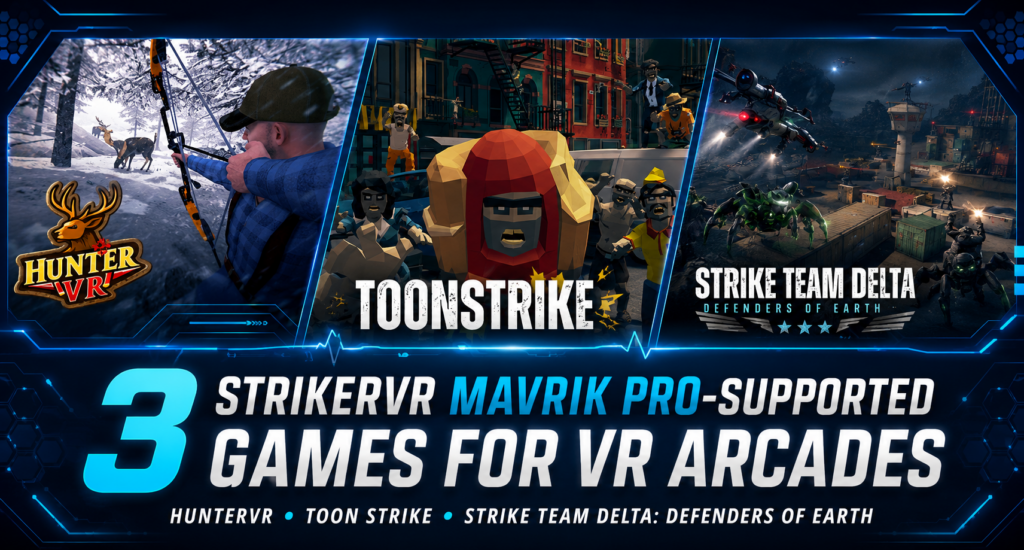
Operators who invest in haptic hardware need enough content variety to keep that hardware useful across different audiences and booking types. A blaster setup becomes more flexible when the same equipment can support a short competitive challenge, an accessible group experience, and a longer team mission. The StrikerVR Mavrik-Pro is designed specifically for enterprise VR deployments and supports recoil and haptic effects for commercial experiences. On the SynthesisVR marketplace, operators can find Mavrik PRO-supported titles across both standalone and PCVR free-roam configurations. We picked three that show different ways operators can use the hardware: HunterVR, Toon Strike, and Strike Team Delta: Defenders of Earth. HunterVR: short competitive sessions with flexible arena sizes HunterVR combines Mavrik PRO support with standalone hardware, leaderboard support, short sessions, and a relatively flexible starting footprint. This experience is brought to you by the same team behind the well-known Cops vs Robbers. The experience sends players into three environments where they compete on speed, accuracy, and precision while shooting moving wildlife targets. Bonus stages introduce shorter target challenges, giving players another score to improve on subsequent attempts. The marketplace lists gameplay at approximately 12 minutes and a suggested age of 14+. HunterVR also carries the Network Veteran designation on DeployReality. That status identifies content from a publisher with an established performance history across the DeployReality network, giving operators another piece of context when evaluating a title alongside gameplay and technical requirements. Its standalone support is another differentiator. HunterVR runs on PICO, Quest, and Focus 3 / Vision, with Mavrik PRO support listed directly on the marketplace. Those options let a venue start with a four-player configuration in a relatively compact area or scale the same experience to a larger group. HunterVR also lists offline multiplayer, a standalone game server, and leaderboard support. For operators who use scores to encourage repeat attempts or local challenges, that makes the competitive structure particularly relevant. The marketplace currently shows pay-per-minute, credit-based, and location-license options, along with a free test option. Toon Strike: a more accessible use of the same hardware Toon Strike takes the Mavrik PRO setup in a different direction. Its colorful visual style and lower suggested age make it easier to position for families, younger players, and groups that may have little previous VR experience. The marketplace lists Toon Strike as PCVR Free-Roam, with a suggested age of 7+ and gameplay of approximately 15 to 25 minutes. Its controller support includes StrikerVR, PPgun, Right PCVR Controller, and Mavrik PRO. The title currently carries the Network Debut designation. This means the publisher is still building its performance history across the DeployReality network. The badge gives operators useful context without making a judgment about the individual experience. Part of the Lightning Games Pack Toon Strike also gives operators a broader licensing consideration because the marketplace offers it through the Lightning Games Pack. The pack groups Toon Strike, Overrun, and Overrun 2, giving venues access to several Lightning VR experiences through the same content package. For an operator already using compatible PCVR free-roam hardware, that can expand the amount of content available for the same physical setup without evaluating each title as a completely separate attraction. This matters when planning content rotation. A game may fit one audience well, while the wider bundle gives staff more options for different groups arriving throughout the week. Strike Team Delta: Defenders of Earth for cooperative mission play Strike Team Delta: Defenders of Earth moves toward a more involved team experience. Players join Strike Team Delta to investigate alien crash sites, collect information, secure locations, and eventually defend their own base. The experience progresses through several missions, including a desert operation, Morgantown, Sweden, and a final confrontation. The structure gives the group shared objectives instead of building the session primarily around individual scores. The marketplace lists PCVR Free-Roam, a suggested age of 12+, and approximately 20 minutes of gameplay plus setup time. Hardware support includes StrikerVR, PPgun, Right PCVR Controller, and Mavrik PRO. Like Toon Strike, Strike Team Delta currently carries the Network Debut designation. For a venue, the distinction from HunterVR matters. HunterVR fits shorter accuracy-driven competition, while Strike Team Delta gives groups a longer cooperative scenario where progress depends on moving through a sequence of shared missions. One haptic setup, several types of sessions These three titles illustrate why hardware compatibility matters beyond a technical checklist. HunterVR can serve competitive groups looking for a short score-focused challenge. Toon Strike opens the same general hardware category to younger and more casual groups. Strike Team Delta gives operators a longer cooperative option with mission progression. They also span different technical setups. HunterVR runs on standalone PICO, Quest, and Focus 3 / Vision hardware, while Toon Strike and Strike Team Delta use PCVR free-roam configurations. Operators deciding how those formats fit into a venue can read our guide to PCVR vs Standalone VR for Commercial Venues. The arena ranges matter just as much as maximum player count. A ten-player title does not automatically require every venue to run its largest configuration. Available floor space, typical booking size, hardware, and content mix all influence the setup that makes commercial sense. We look at that decision in more detail in How Many Players Should a VR Attraction Support?. For group attractions, launch flow, player interaction, shared objectives, and session recovery also affect how well multiplayer content works in practice. See What Makes a Good Multiplayer VR Experience for Out-of-Home Venues? for a deeper look at those operational factors. Explore more Mavrik PRO-supported VR games HunterVR, Toon Strike, and Strike Team Delta are three examples from the wider commercial content catalog. Operators using StrikerVR hardware can browse Mavrik PRO-supported games on SynthesisVR to compare additional compatible experiences. The marketplace maintains a dedicated StrikerVR-supported content filter.
3 VR Arcade Games That Turn Leaderboards Into Repeat Challenges
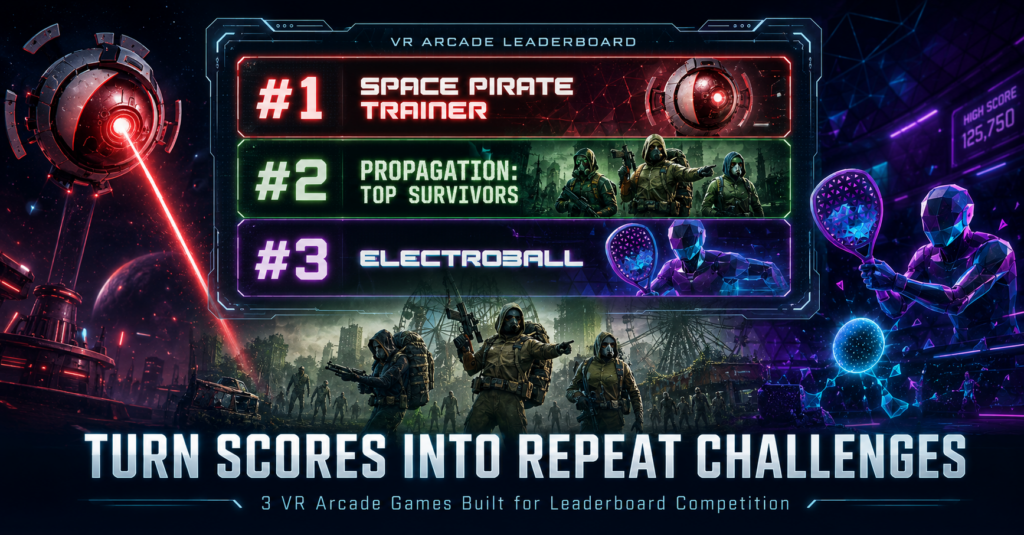
A VR session can end when the headset comes off. A score gives the player something to take with them. They may have beaten their friend, missed the venue record by a few points, or discovered that someone else moved ahead of them after they left. Suddenly, there is a reason to come back. There is a number to beat. For VR arcade operators, that competitive loop can extend the value of content already running in the venue. Daily high scores, weekly challenges, tournaments, and a visible Hall of Fame can turn individual sessions into something players continue talking about after they leave. Leaderboard competition does not have to work the same way in every game. One title can reward an individual high score. Another can give a group a shared benchmark. A direct competitive game can turn every match into a rematch opportunity. We picked three leaderboard-supported VR arcade games from the SynthesisVR content marketplace that approach that idea in very different ways. How does the SynthesisVR Leaderboard work in a VR arcade? The SynthesisVR Leaderboard Add-on automatically captures scores and rankings from supported VR games and displays the results in real time. Operators can run the leaderboard application on a Windows PC or Android device, including a front-desk screen, tablet, or TV. That gives the venue several ways to build competition around existing sessions. Operators can run local tournaments, display high scores on digital signage, create weekly challenges, or keep a longer-running Hall of Fame without asking staff to record every result manually. For a location-based entertainment VR venue, the important part is what happens after the score appears. Put the week’s best result on a screen near the front desk and the next player already knows what they need to beat. Three different leaderboard formats Space Pirate Trainer: the classic arcade high-score loop Space Pirate Trainer takes the logic of a traditional arcade cabinet and puts the player inside it. Players face waves of incoming droids, dodge lasers, and switch between weapons and gadgets while trying to push their score higher. Score chasing is part of the game’s identity. Its commercial listing explicitly frames the challenge around reaching the top rankings and entering the Space Pirate Trainer hall of fame. The title runs on PCVR in a room-scale setup. That makes the competitive objective easy for both staff and guests to understand. Finish the run. Check the score. Decide whether it is good enough. For an operator, very little additional explanation is needed to turn that into recurring programming. The venue could promote the highest score of the week, keep a monthly record, challenge customers to beat a staff score, or leave one long-running venue record for regular players to chase. It is the closest of these three games to the traditional arcade leaderboard model, which also makes it a useful starting point for venues introducing score-driven competition. Propagation: Top Survivors: make the group result matter Competition does not always require players to fight each other. Propagation: Top Survivors puts up to eight players together as survivors trying to make their way through a zombie-filled city. The team must reactivate ARES military anti-zombie devices before time runs out, with configurable session durations available for venue operations. The experience runs on PCVR room scale. That changes the leaderboard conversation. A birthday party, group of friends, or returning team already leaves with a shared story about what happened during the session. A leaderboard result gives that group an additional benchmark to remember and another target for a future visit. Instead of asking only, “Did we finish it?”, returning players have another question to answer: Can we improve on our last result? That makes cooperative competition particularly useful for venues serving repeat groups. The players can work together inside the game while still competing against their own previous performance or results set by other teams. Top Survivors also sits within the wider Wanadev catalog now available through SynthesisVR, alongside titles from the Propagation series and the former Octopod VR catalog. Electroball: competitive VR across PCVR and standalone Electroball takes the leaderboard idea in another direction. Players enter an electrified arena and use rackets to redirect balls into the opponent’s goal while defending their own. Balls can bounce from the arena walls, so positioning and timing influence how players create scoring opportunities. The objective is immediate. Score more than the other player. That makes the result easy to understand and gives the loser an equally obvious reason to ask for another round. Electroball also stands out in this group because of its hardware flexibility. The title supports PCVR Room Scale, PICO, and Quest, making it relevant to standalone VR arcades as well as traditional PCVR installations. It is available in English, French, and Spanish and is designed to be accessible to beginners. For operators, that creates a useful combination: a simple competitive concept, a measurable outcome, and support across several common commercial VR hardware setups. It is also a good example of why browsing a VR content marketplace by operational feature can be more useful than simply looking at the most familiar titles. A smaller game can fill a very specific role in the attraction mix. Turn leaderboard results into venue programming The game provides the result. The venue decides how visible and valuable that result becomes. A leaderboard can sit on a TV near reception with the week’s top scores. Regular players can return every Friday to defend their position. Birthday groups can compete internally. Staff can set a score for customers to beat. A venue can run a one-night tournament or keep a long-term record that becomes part of the local player community. The format does not need to be complicated. A simple “Beat this week’s score” challenge gives players a clear target before they enter the headset. A monthly reset gives more customers a realistic chance to reach first place. Keeping an all-time record alongside the monthly leaderboard gives the strongest players something harder to chase. Visibility
How Much Space Do You Need for a Free-Roam VR Arena? A Practical Guide for Operators
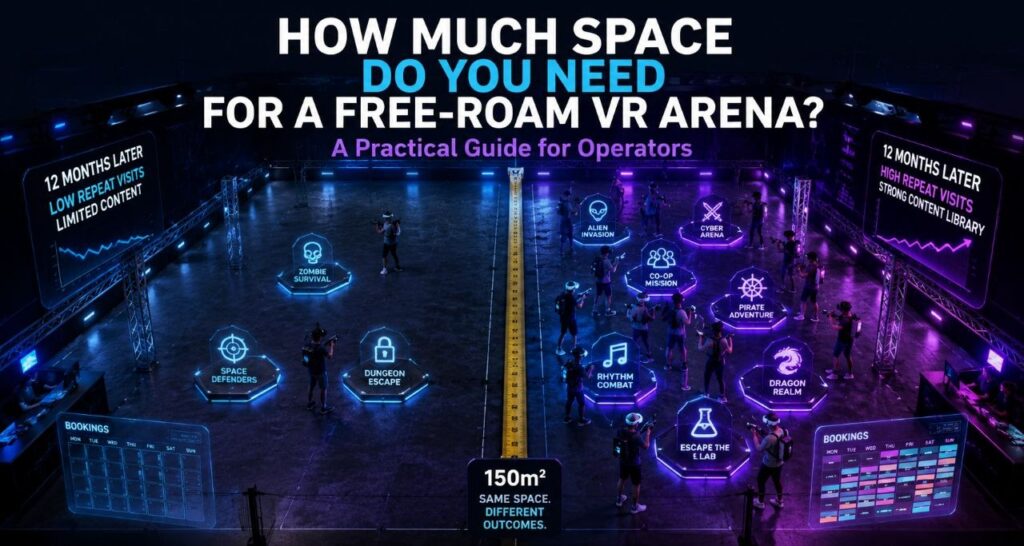
Two operators can open with the same floor plan and end up running completely different businesses. One launches with a handful of compatible experiences, burns through them within a few months, and watches repeat visit rates fall. The other builds a content rotation that supports birthday parties, corporate bookings, and returning regulars well into the second year. The space did not determine that outcome. The relationship between space, hardware, and content compatibility did. Most operators approaching this question want a number: minimum dimensions, something concrete for a lease negotiation or venue layout conversation. That number exists, and this article covers it. But the more important question is whether the footprint you choose gives you enough content range to run a profitable attraction twelve months after opening. What free-roam VR actually requires from a space Free-roam VR differs from room-scale in one practical way: players move independently through a shared physical space rather than standing in fixed positions. That movement creates simultaneous requirements for safety clearance, tracking reliability, and enough floor area that players are not colliding with each other or the play zone boundaries mid-session. Tracking systems, whether PCVR with external base stations or standalone inside-out on headsets like the PICO 4 Enterprise or HTC Vive Focus 3, need consistent line of sight across the full arena floor, low surface reflectivity, and adequate ceiling height. These requirements do not change with arena size, but they become harder to satisfy as the space grows and tracking zones multiply. The practical floor area question comes down to what the content itself requires. Across the commercial free-roam catalogue, 6x6m (20x20ft) is the standard minimum that the majority of titles are built around. Some compact titles run at 5x5m (16x16ft) or even 4x4m (13x13ft), but those represent a narrower selection. The 6x6m (20x20ft) threshold is where the bulk of available experiences become accessible. Arena size tiers and what each unlocks Commercial free-roam setups generally fall into four size bands. Each one changes not just capacity but content access. Entry: 5x5m / 16x16ft (25 sqm / 270 sq ft) A small number of titles are purpose-built for this footprint, typically compact shooters, escape room formats, and experiences designed for 2 to 4 players in tighter spaces. Great Train Outlaws, for example, runs at 5x5m for up to 4 players on PCVR. These setups can work as introductory or add-on attractions inside larger venues, but the content catalogue at this size is limited and operators tend to exhaust it faster than expected. Standard: 6x6m / 20x20ft (36 sqm / 390 sq ft) This is the most common minimum specification across the commercial free-roam catalogue, on both PCVR and standalone platforms. At 6x6m (20x20ft), the majority of available titles become accessible. Arizona Sunshine Remake: Free-Roam starts at 6x6m (20x20ft) for up to 4 players, available on both PCVR and standalone, and scales to 10x10m (33x33ft) for 8. Most operators opening a dedicated free-roam attraction should treat 6x6m as the baseline, not the floor. Mid: 8x8m / 26x26ft (64 sqm / 690 sq ft) Moving to 8x8m opens a meaningful jump in both player count and title variety. A significant portion of the catalogue lists 8x8m as the threshold for 6 to 8 player configurations. This is where team-based formats, competitive gameplay, and larger group bookings become viable without requiring a full large-arena footprint. Large: 10x10m / 33x33ft (100 sqm / 1,075 sq ft) The 10x10m tier unlocks the widest content library and the strongest commercial formats. After The Fall: Free-Roam illustrates the pattern clearly: at 6x6m (20x20ft) it supports 4 players, but the 8-player configuration requires 10x10m (33x33ft). Titles requiring this footprint tend to be the premium, high-capacity experiences, competitive league formats, large co-op missions, longer session durations, that justify higher ticket prices and drive stronger group booking performance. Why content compatibility matters as much as floor area When an operator locks in a footprint, they are also locking in a content ecosystem. Free-roam titles are built for specific arena dimensions, player counts, and hardware configurations. A game designed for 10x10m (33x33ft) with 8 players does not scale down to 6x6m (20x20ft) with 4. Content requiring PCVR tracking with external base stations cannot run on a standalone-only deployment. In practice, the titles available to a compact standalone arena are a genuine subset of what is available to a larger PCVR setup, and that subset narrows further at the entry tier. The question operators tend to underestimate is not “How many experiences do I have at launch?” It is “How long before my regular customers have played all of them?” A broader content library, and the ability to rotate in new titles regularly, is what extends the commercial life of the attraction past the initial novelty period. Operators who plan content strategy and footprint together tend to build more durable attractions than those who treat the two decisions separately. How space affects the commercial variables Session throughput is the first number most operators calculate: a 4-player session at 30 minutes plus 10 minutes of onboarding and reset gives roughly four sessions per hour per arena. Moving to 6 or 8 players changes the math, but it also changes which titles are accessible and which audience segments can be booked. Corporate groups, school trips, and birthday parties all have different minimum viable player counts, and a 4-player cap excludes a meaningful share of group booking demand. Audience flexibility follows from content range. A larger arena with diverse title options lets operators serve casual first-timers and returning experienced players on the same day by rotating experience types. A smaller arena with a narrower library tends to converge toward one primary audience, which limits growth when that segment is saturated. Infrastructure scalability is worth considering earlier than most operators do. A 6x6m arena built on an expandable PCVR backbone is relatively straightforward to grow. An arena built on standalone-only hardware may require a full equipment change to access the content catalogue that larger formats unlock. The setup decision often determines
How VR Arcades Fill Empty Weekday Sessions Without Discounting
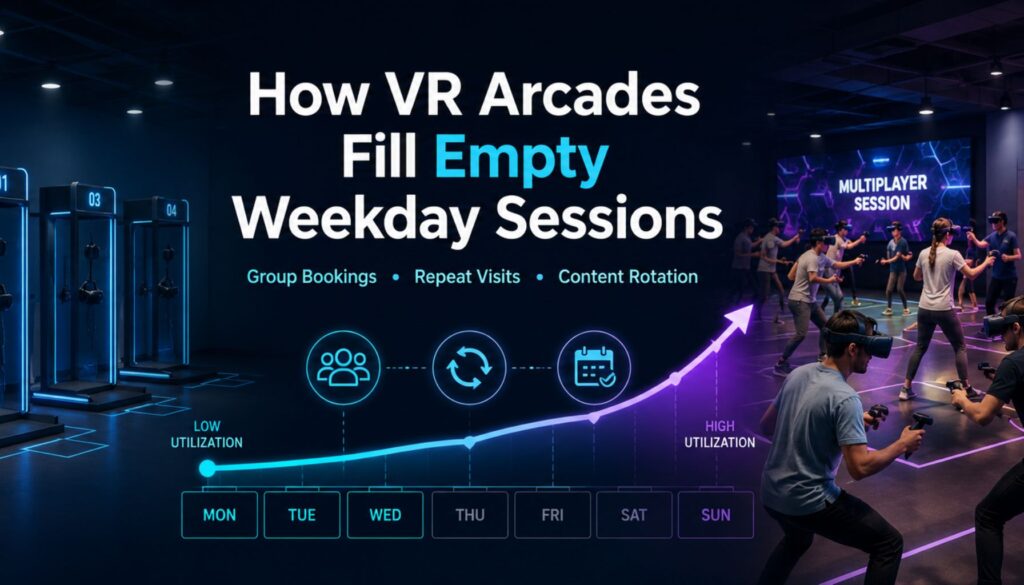
For most VR arcades, family entertainment centers (FECs), and location-based entertainment (LBE) venues, Friday evenings and weekends take care of themselves. The real operational challenge begins on Monday morning. Every empty VR session between Monday and Thursday represents revenue that can never be recovered. Unlike retail inventory, unused attraction capacity expires forever. Once a 3:00 PM session passes without players, that opportunity is gone. Many operators respond by introducing weekday discounts. While discounts may increase short-term bookings, they rarely solve the underlying problem. Over time, they can even reduce profitability by training customers to wait for lower prices. The strongest operators take a different approach. Rather than lowering prices, they redesign how weekday demand is created, packaged, and managed. They treat weekday utilization as an operational challenge—not simply a marketing one. Why Weekday Utilization Matters More Than It Looks A single underperforming weekday can offset gains from a strong Saturday. Across an entire year, consistent weekday gaps compound into a meaningful revenue shortfall, particularly for venues carrying fixed overhead on VR hardware and dedicated attraction space. Analysts estimate the location-based VR market will reach approximately $2.76 billion in 2026 and continue growing rapidly through the end of the decade. As more operators enter the market, long-term performance increasingly depends on operational consistency rather than novelty alone. Utilization influences several areas that operators often underestimate: A quieter Tuesday session often provides a better guest experience than a fully booked Saturday. That difference can influence reviews, referrals, and future bookings long after the session ends. Why Many VR Venues Struggle to Fill Weekday Sessions Empty weekdays rarely reflect a lack of interest in VR. More often, they reflect a mismatch between how the attraction is offered and how people organize their time during the week. Weekday audiences behave differently from weekend visitors. Families work around school schedules. Friend groups need low-friction planning and simple booking. Students coordinate around evening availability. Corporate groups require a clear reason to justify an outing during business hours. Tourists operate on unpredictable schedules and shorter decision windows. Many venues build their booking structure around peak weekend behavior and then expect those same systems to perform throughout the week. Across commercial VR venues, free-roam and room-scale attractions often attract different audiences and booking behaviors. Operators who understand those patterns tend to build more balanced attraction portfolios and create offers that fit specific weekday audiences rather than treating all bookings the same. Common friction points include: Operators regularly use group pricing for schools, sports teams, corporate outings, and social groups because those audiences can help fill capacity that would otherwise remain unused during off-peak periods. How Can VR Arcades Increase Weekday Bookings? Discounting can increase attention, but it does not always address the reasons people delay or avoid booking. Operators often discover that price is only one part of the equation. Weekday attendance depends just as heavily on how easily groups can organize, book, and commit to an experience. Across the broader FEC industry, structured group experiences consistently outperform discount-heavy approaches. Birthday packages, corporate events, school programs, and group offers simplify decision-making for organizers and reduce booking friction. The same principle applies directly to VR. A group of six friends can easily postpone a VR outing if one person must coordinate payments, explain the experience, and organize schedules. That same group is more likely to commit when presented with a simple package: “Six-player session. One booking. Clear pricing. Clear experience.” Tying package benefits to off-peak windows, school calendars, or local community schedules can help smooth demand throughout the week without reducing prices across the board. Operators in bowling centers, laser tag venues, and escape rooms have applied this approach for years. VR arcades that design around group booking behavior often see stronger weekday utilization because they make participation easier to organize. Why Repeat Visits Create More Stable Revenue Than Acquisition Spikes One-time visitors are difficult to predict. Repeat visitors create more consistent demand patterns and often generate greater value over time. Operators frequently focus on acquiring new players while underestimating how much weekday utilization depends on giving existing customers a reason to return. A local customer who visits twice per month often contributes more revenue across a year than a tourist who visits once during a holiday. One recurring pattern across commercial VR venues is that players rarely ask how many titles are available. They ask whether there is something new to try since their last visit. The challenge for many VR venues is content fatigue. VR experiences are highly immersive, but they are also finite. Once visitors feel they have experienced everything available, motivation to return declines. Content rotation helps address this challenge. Venues that regularly introduce new experiences, seasonal content, multiplayer options, or fresh attraction formats create natural opportunities for return visits. Over time, this helps shift the venue from being perceived as a one-time activity into a recurring social destination. Promoting new experiences through social media, email campaigns, loyalty programs, and in-venue signage gives operators a practical way to convert content updates into measurable return traffic. The Role of Attraction Variety and Social Session Design The strongest operators rarely depend on a single experience type to support weekday traffic. An attraction mix that includes competitive multiplayer experiences, shorter repeatable sessions, free-roam attractions, and room-scale content provides flexibility when serving different audience segments. Weekday utilization rates for entertainment venues often fall between 40% and 50%, compared to 75% to 85% during weekends. Successful operators plan around that reality rather than treating it as a temporary problem. Multiplayer VR experiences naturally align with how social groups plan activities. A group of friends, a student organization, a sports team, or a corporate department all require a reason to commit and a simple booking process. Clearly packaged multiplayer experiences remove barriers that often prevent those groups from converting. Operator Reality Check Several operators invested heavily in new hardware while weekday utilization remained inconsistent. Attendance often improved temporarily before returning to previous patterns. Many operators expect new equipment or newly