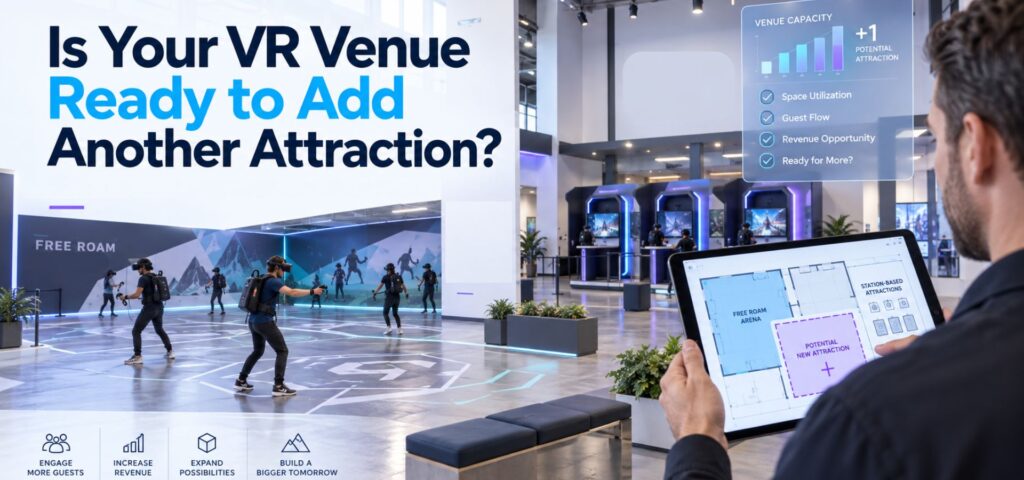
Adding another attraction can feel like the obvious next step when a VR venue starts getting busier.
Perhaps weekend slots are filling consistently. Birthday groups are getting larger. Customers are asking for more variety. There may be unused floor space that could support another free-roam arena, a few standalone stations, or a different type of multiplayer experience.
The question is whether the venue actually needs more capacity yet.
Adding hardware increases the number of experiences a venue can sell, but it also adds another schedule, another set of devices, more content decisions, additional staff responsibilities, and another attraction that needs to earn its place on the floor.
Before expanding, operators should look at what their current setup is already telling them.
Start With the Capacity You Already Have
A busy Saturday does not necessarily mean an attraction has reached its capacity.
Look at utilization across the full week.
An eight-player arena that regularly fills during birthday bookings may still spend large parts of weekday afternoons unused. A venue with several room-scale stations may appear busy because customers arrive continuously, while individual stations remain empty between bookings.
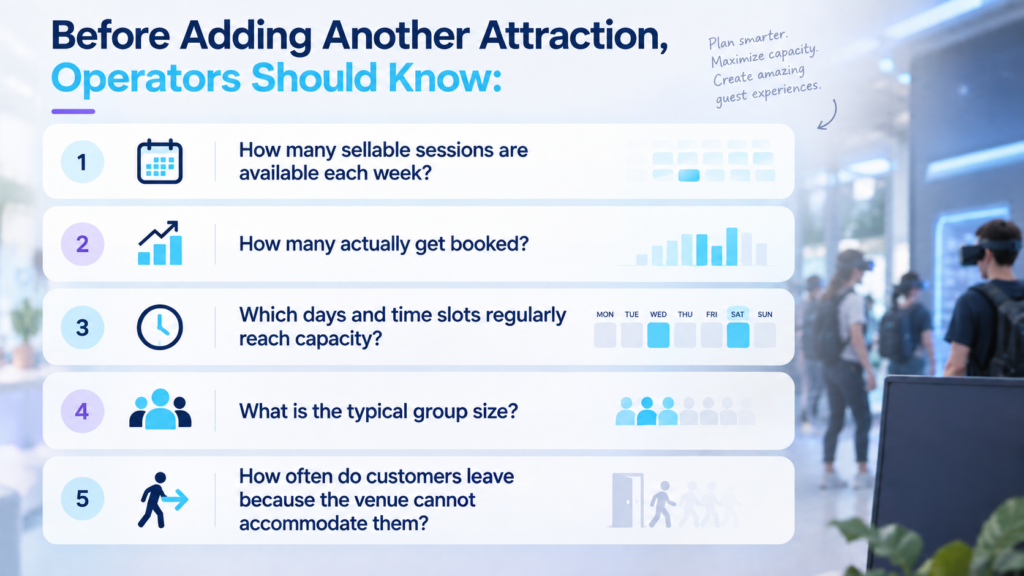
That distinction matters because expansion solves a capacity problem. It does much less for a demand problem.
Our guide to How Many Players Should a VR Attraction Support? looks at this from the booking-model side. Eight simultaneous players can mean one eight-player arena, two four-player experiences, or several smaller attractions. The useful capacity depends on the way customers actually book.
Identify the Booking the Current Venue Cannot Serve
The strongest reason to add another attraction is usually a specific booking opportunity.
For example, a four-player setup may work well for walk-ins but become difficult when birthday groups regularly arrive with eight or twelve guests. A free-roam arena may handle large social groups well while leaving couples and smaller groups with limited options.
The gap could also be demographic.
A venue with mostly competitive shooters might receive regular family traffic without enough suitable content. Another location may serve casual players well but lack an attraction strong enough for repeat visits from experienced groups.
Before expanding, define the gap clearly:
Which customer or booking type could we serve better if this attraction existed?
That question is more useful than asking whether a new attraction looks impressive.
We recently explored the same principle from the content side in How to Choose VR Arcade Games for Different Customer Groups. Hardware, space, group size, staff workflow, and audience fit all affect whether an experience works commercially.
Check Whether More Capacity Creates More Throughput
The theoretical capacity of an attraction and the number of sessions staff can actually deliver are rarely identical.
Suppose a venue adds a second multiplayer attraction.
That may allow two groups to play at once. It may also mean staff now need to:
- prepare two groups simultaneously
- explain two different experiences
- distribute and fit more headsets
- manage cleaning and charging
- troubleshoot two active sessions
- reset both attractions before the next bookings
- coordinate groups moving through the venue
If the existing team already struggles during back-to-back bookings, another attraction can increase pressure without creating the expected number of additional sellable sessions.
This is why throughput belongs in the expansion calculation.
The VR Arcade Business Plan guide uses a simple starting model:
available sessions × average players per session × realistic utilization × average revenue per player
The important word is realistic. Session capacity has to account for onboarding, resets, maintenance, delays, and staff workload rather than relying on the maximum number printed on the attraction specification.
Watch What Happens During Your Busiest Hour
Peak periods often reveal more than weekly revenue totals.
Observe one genuinely busy hour at the venue.
Where does the line form?
Is staff waiting for headsets to become available?
Are customers waiting for a play space, or are they waiting for an employee to launch the experience?
Does one attraction finish while another group is still being prepared?
Are staff moving between several systems to check bookings, launch content, or resolve device problems?
These observations help distinguish between a physical capacity constraint and an operational constraint.
That matters because adding another attraction only directly fixes the first one.
The wider attractions industry sees the same issue. IAAPA’s recent guidance for FEC operators describes how multiple attractions, staff roles, and guest touchpoints can allow small operational problems to compound quickly.
That is useful context for VR venues because expansion usually increases coordination before it increases complexity anywhere else.
Make Sure the New Attraction Adds Something to the Mix
Another attraction should have a role.
It might increase capacity for large parties.
It might create a lower-cost option for couples and small groups.
It could introduce cooperative content alongside an existing competitive offer.
It may give families something accessible while older visitors use a more intense free-roam experience.
Or it could make an underused part of the building commercially productive.
The risk is adding an attraction that competes with the venue’s existing offer for the same customers.
If two attractions target the same audience, group size, price range, and occasion, operators may simply divide existing demand between them.
A useful attraction mix gives customers different reasons to book.
Our article on VR arcade content rotation makes a related point: customer behavior should drive changes to the lineup. Operators can look at selection frequency, repeat requests, operational friction, and audience gaps before deciding what belongs in the mix.
Calculate the Full Cost of the Expansion
The hardware purchase is only one part of the decision.
Depending on the attraction, expansion can introduce costs for:
- additional headsets and spare devices
- PCs or networking equipment
- commercial content licensing
- management software
- physical construction or arena preparation
- charging and storage
- staff hours
- staff training
- insurance
- replacement equipment
- marketing the new offer
It can also introduce a less visible cost: floor space.
A large attraction needs to earn enough to justify the area it occupies.
That is particularly important when comparing free-roam with smaller station-based formats. Our guide to free-roam VR arena space requirements explains why footprint, hardware, and available content should be evaluated together rather than treating square footage as a standalone requirement.
Operators building the financial model can also use our VR Arcade Startup Budget and Revenue guide. Although it was designed around new venues, the same logic applies to expansion: build the investment around your own capacity, labor, hardware, software, content, and revenue assumptions instead of relying on a generic industry average.
Stress-Test the Attraction Before Committing
A simple expansion forecast should include more than the best-case scenario.
Ask what happens if the attraction reaches only 50% of the expected bookings.
What if the average group is four players instead of eight?
What if another employee is required during peak periods?
What if one headset regularly needs to remain available as a spare?
What happens during the first few months before customers know the attraction exists?
These questions do not mean the expansion is a bad idea. They show whether the business case survives normal operating friction.
IAAPA’s 2025 Entertainment Center Benchmark Report reflects this wider approach to performance by looking across attraction offerings, admissions, staffing, guest behavior, revenue, and expenses rather than evaluating attractions through revenue alone.
That is a useful mindset for VR operators as well.
Make Sure the Existing Operation Is Repeatable First
Expansion becomes much easier when the current attraction already runs consistently.
Staff should know how to launch sessions, recover from common problems, move groups between bookings, and prepare equipment for the next customers without relying on the owner to supervise every step.
Content should also have a clear place in the operation.
Which experiences work for first-time players?
Which ones fit birthday groups?
Which titles generate repeat requests?
Which ones require more staff intervention than expected?
These are the types of operational patterns we explored in our Free Roam VR data from 600+ locations. Venues can operate successfully with very different content strategies, but the strongest models tend to be deliberate about how the attraction actually runs.
That is also where this article differs from that earlier series.
The question here comes before expansion:
Is the existing operation stable enough to support another layer of complexity?
Where VR Management Becomes Part of the Expansion Decision
Adding another attraction usually means adding more content, devices, sessions, and staff interactions.
For a small setup, operators may be able to manage some of those processes separately. As the attraction mix grows, having a common operational layer becomes more important.
SynthesisVR allows operators to manage supported PCVR and standalone setups, commercial content, multiplayer launches, and venue operations through the same broader environment. The operational benefit during expansion is consistency: staff can add capacity without rebuilding the workflow around a completely separate management process.
The platform does not decide whether an attraction makes commercial sense. The operator still needs to understand demand, utilization, staffing, audience fit, and return on investment.
It can make the expanded operation easier to run once that decision is made.
A Pre-Expansion Checklist for VR Operators
Before adding another VR attraction, ask:
- Are we regularly reaching capacity, or only during a few peak periods?
- Which booking type are we currently unable to serve?
- What average group size do we actually see?
- Will the new attraction add capacity, variety, or both?
- Can current staff operate it during peak traffic?
- How will it affect session turnaround?
- Does it complement the existing attraction mix?
- What is the full operating cost, beyond hardware?
- What happens if utilization is lower than forecast?
- Can the venue run the existing attractions consistently without owner intervention?
If those answers are clear, expansion becomes a business decision rather than a guess.
If several answers are still uncertain, the existing venue may have more capacity to unlock first.
Expansion Should Solve a Problem You Can Name
A second arena, another row of headsets, or a new standalone attraction can create meaningful new revenue opportunities for a VR venue.
The strongest expansion cases start with a specific constraint.
A booking type the venue cannot accommodate.
A customer segment the current attraction mix does not serve.
A recurring capacity shortage.
Or demand that reliably exceeds the sessions already available.
Understand that constraint first. Then choose the attraction that solves it.
Planning another VR attraction? Explore how SynthesisVR supports commercial VR content, session management, and growing attraction mixes.