
How VR Arcades Can Bring Customers Back With Simple Email Campaigns
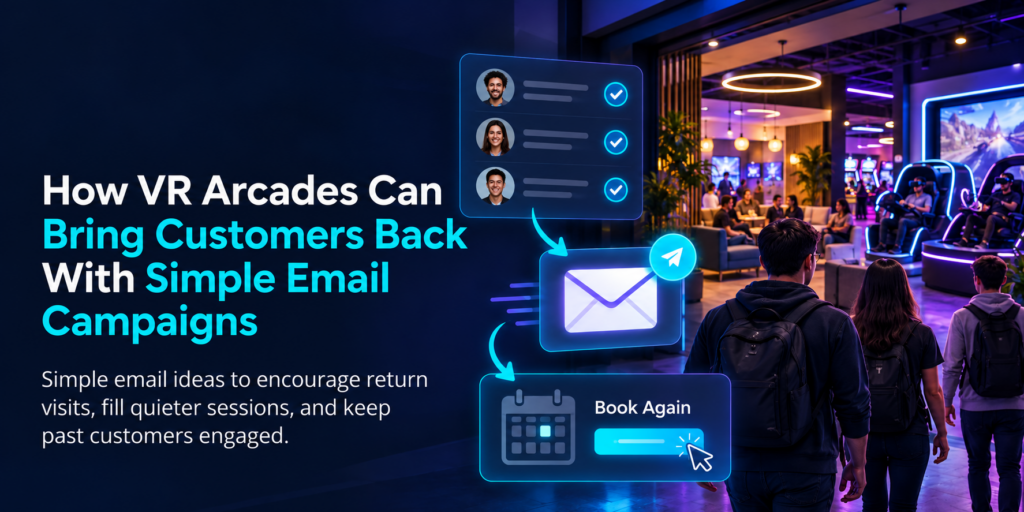
Your next booking could come from someone who has already visited your arcade. When did you last email them? During a recent conversation with VR arcade operators, one venue owner raised a familiar issue. They had collected customer contact details over time but hadn’t done anything with that information. They knew they should be emailing their customers. They simply hadn’t started. This is an opportunity worth exploring. Every customer who has visited your VR arcade already knows where you are, what you offer, and what playing VR feels like. Yet without regular communication, they might never hear about your new games, weekday specials, birthday packages, or seasonal events. A simple email can give previous visitors a reason to return. And you don’t need a marketing department, expensive software, or a complicated campaign to get started. Why Email Marketing Still Matters for VR Arcades in 2026 Email remains a useful way for businesses to maintain relationships with existing customers. According to the Data & Marketing Association’s Email Benchmarking Report 2026, email performance remains strong, with improving deliverability, declining unsubscribe rates, and record click-through rates across the UK market. For VR arcade operators, the practical advantage is straightforward. Your customers don’t necessarily follow your social media accounts. They might miss an announcement about a new multiplayer game or a weekday promotion. But if they’ve agreed to receive your emails, you have a way to communicate directly with them. You can remind them about an experience they enjoyed, introduce something new, or invite them back with a specific offer. The most useful messages answer one question: Why should this customer visit again? 6 Simple Emails Every VR Arcade Can Send You don’t need to create a new promotion every week. Start with the experiences, offers, and events your venue already has. Here are six practical email campaigns worth trying. The goal is to make each email useful and easy to act on. A customer who visited for a multiplayer session might be interested in a new cooperative game. A parent who previously booked a birthday party may appreciate information about your current group packages. Even a short message can be effective when the offer matches the audience. 3 Ready-to-Use Email Templates for Your VR Arcade You can adapt these examples for your venue, replace the placeholders, and include a direct link to your booking page. Template 1: Thank Customers and Invite Them Back Template 2: Announce New Games Template 3: Fill Quieter Weekday Sessions What About Birthdays, Holidays, and Customers Who Haven’t Returned? Once you’ve sent your first few emails, you can expand into other occasions. Birthday invitations: If you’ve collected birthday information appropriately, remind eligible customers about group celebrations. Focus on what your package includes, the number of players, and how to book. Seasonal emails: Promote family entertainment during school breaks, Halloween experiences in October, or group activities during holiday periods. Returning customer emails: Reach out to customers who haven’t visited recently with a relevant game recommendation or invitation. If your records support it, start with customers whose last visit was approximately 60–90 days ago. You can also tailor messages to the type of experience customers previously enjoyed, provided you have reliable preference information and the appropriate permission to use it. These emails don’t need to be long. One clear offer and one booking link are often enough. How to Start Email Marketing for Your VR Arcade in 30 Minutes If you’ve never sent a marketing email to your customers, start small. Step 1: Check your existing customer contacts (5 minutes) Look at the contact information your venue already collects through bookings, customer registrations, or other systems. Identify which customers can legally receive marketing communications. Having an email address on file does not automatically mean you can use it for promotions. Step 2: Choose one reason to email (5 minutes) Perhaps you’ve added a game, have availability on Tuesday afternoons, or want to encourage first-time visitors to book again. Start with one clear message for one relevant audience. Step 3: Pick a simple email tool (10 minutes) If you’re contacting a small number of customers individually, your existing business email may be sufficient. For regular campaigns, a dedicated email marketing platform makes it easier to manage audiences, templates, unsubscribes, and performance. Tool Suitable for Gmail or Outlook Occasional individual communication Mailchimp Newsletters, promotions, and customer lists Brevo Email campaigns and automated workflows MailerLite Simple newsletters and email sequences ActiveCampaign Advanced customer segmentation and automation Use a dedicated marketing platform for bulk promotional emails rather than sending mass messages through an ordinary personal inbox. Step 4: Write and send your first campaign (10 minutes) Choose one of the templates above. Replace the placeholders, check that your booking link works, and send a test email to yourself. Make sure the message clearly identifies your business and includes the required unsubscribe option. You now have your first campaign ready. The next step is to check whether anyone booked because of it. How SynthesisVR Can Support Customer Email Marketing If your VR arcade uses SynthesisVR, you may already have access to useful customer information and integration options. Within the SynthesisVR Web Console, the Customers page allows operators to view registered customer accounts, including names, email addresses where supplied, registration dates, and membership information. Customer details may be collected through SynthesisVR online bookings or waiver forms, depending on your venue setup. This provides a starting point for reviewing your existing customer records and identifying where you may need to improve marketing consent collection. For venues ready to automate more of their communication, SynthesisVR also provides integrations with email marketing platforms. Mailchimp integration SynthesisVR’s Mailchimp integration can synchronize customer information, including new registrations and booking-related data, with Mailchimp audiences. This can reduce manual data entry and help operators maintain their email lists. Marketing permissions and audience settings still need to be configured correctly. ActiveCampaign integration For operators who want more advanced workflows, the ActiveCampaign integration supports customer data synchronization and personalized marketing automation. Depending on the information
How Often Should VR Arcades Rotate Their Content?
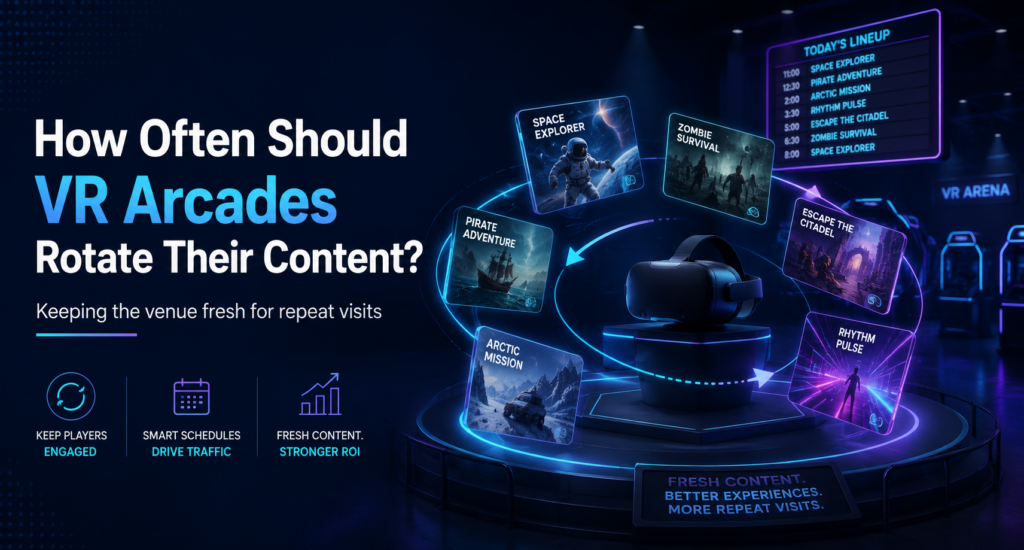
A VR arcade can have dozens of experiences available and still feel unchanged to a returning customer. That happens when the same few games stay at the front of the booking page, staff recommend the same titles, and regular guests see little reason to explore the rest of the library. VR arcade content rotation helps solve that problem. Rotation can create new reasons to visit, give regular customers something different to try, and give the venue fresh material to market. It can also help operators learn which experiences deserve a permanent place in the lineup. There is no universal rule that says a VR arcade should replace its games every 30, 60, or 90 days. A better rotation schedule follows customer behavior, venue type, seasonality, and the role each experience plays in the business. Entertainment venues have always relied on changing programming VR arcades are far from the only entertainment businesses that need to give customers reasons to return. A cinema keeps the same screens, seats, lobby, and projection equipment while its programming changes continuously. New films give previous customers another reason to visit the same building. Special screenings, themed programs, and events can create additional reasons to return between major releases. Arcades and family entertainment centers use a related model. The physical venue stays familiar, while operators change the attraction mix, promote different games, run competitions, and introduce new experiences over time. The wider attractions industry follows the same logic. IAAPA has highlighted how refreshed entertainment programming can support guest satisfaction, repeat visits, and spending. VR gives operators an especially flexible version of this model. The headset, PC, room-scale station, or free-roam arena can stay in place while the experience inside it changes. That makes content one of the most adjustable parts of a commercial VR attraction. Why newness matters for repeat business A great first visit does not automatically create a fifth visit. Customers eventually start asking what will be different next time. That question matters even more for local venues that depend on the same population throughout the year. Research into consumer variety-seeking behavior has examined how repeated consumption can reduce the appeal of choosing the same option again and increase interest in alternatives. That does not mean every guest wants a completely unfamiliar experience on every visit. Familiarity can be valuable, especially with competitive games, multiplayer favorites, and experiences where players improve over time. The opportunity comes from combining both. A customer might return to beat a previous score, introduce friends to a favorite multiplayer game, and then try one experience they have never played before. That mix gives the venue more ways to turn one successful visit into several. We explored the broader retention side of this in How VR Entertainment Venues Turn First-Time Visitors Into Repeat Customers. Content rotation becomes one of the tools operators can use once that return relationship starts. Content rotation also creates something new to market Operators sometimes treat content rotation as a library-management task. It also solves a marketing problem. A venue cannot tell the same local audience to “come try VR” indefinitely. Customers who already visited know what VR feels like. The next campaign needs a more specific reason to return. A newly featured cooperative adventure can become this month’s group recommendation. A competitive title can become the basis of a leaderboard challenge. A horror experience can lead a Halloween campaign. Family content can move forward during school breaks, while faster competitive experiences can support student or adult social promotions. One content change can give the venue material for its email list, social channels, website, in-venue screens, and staff recommendations. The experience itself does not even need to be new to the marketplace. A title that has spent a year inside a 30-game library may still be completely new to most customers. This gives operators an important distinction: you can rotate attention without constantly replacing inventory. Content rotation does not always mean buying new games Operators have several ways to make a VR lineup feel fresh. Featured-content rotation changes which existing games receive the most visibility. Staff can recommend a different experience, the website can feature it, and the venue can build a campaign around it. Event rotation changes how customers use familiar content. A leaderboard, tournament, weekly challenge, team night, or score target can renew an experience without changing the underlying game. VR arcade leaderboards are one example of turning existing content into a repeat challenge. Audience rotation changes which part of the library the venue promotes. Families, birthday groups, corporate teams, students, and experienced VR players rarely need the same recommendation. Seasonal rotation moves relevant experiences forward when customer interest changes. Horror can gain prominence before Halloween. Family and group content can take priority during school breaks. Competitive multiplayer can support weekday social offers when local traffic becomes more important. Library rotation involves the larger decision to add, remove, or replace titles. Operators usually need to do this less often than promotional rotation. Separating these types of rotation prevents a common mistake: assuming that keeping a venue fresh requires continuously licensing more content. How often should a VR arcade rotate content? A practical schedule can work across several timeframes. The monthly change does not need to involve a new commercial license. A venue may simply move an overlooked game into the featured position and support it with staff recommendations, short-form video, or a limited challenge. The quarterly review goes deeper. Operators can ask whether the library still covers enough genres, group sizes, skill levels, session lengths, and customer types. Player capacity matters here too. A strong four-player experience serves a different booking need from a six-player or eight-player attraction. How Many Players Should a VR Attraction Support? looks at that decision from the capacity and attraction-mix side. Let customer behavior trigger the bigger changes The calendar provides a useful review rhythm. Customer behavior should decide what actually changes. Start with how often guests select each experience. Then look at replay behavior. A title that attracts
How VR Entertainment Venues Turn First-Time Visitors Into Repeat Customers
By the end of August, a VR venue’s guest list is usually the longest it will be all year. First-time bookings come in from tourists and from families killing a rainy afternoon. Some walk in on a whim after seeing a friend’s video. A single follow-up email or a discount code in September won’t turn that list into a customer base. Most of it has already forgotten the visit by then. A first-time guest hasn’t paid for themselves yet, not in any real sense. Getting them through the door costs something: an ad, a discount, a slow afternoon spent chatting them up at the front desk. That cost lands whether they ever come back or not. A guest who visits four times splits it four ways. One who visits once never splits it at all. Repeat behavior isn’t a nice outcome sitting on top of a good season. It’s where a first visit actually turns into a return on what it took to earn it. How VR Arcades Transition From Summer Traffic to Local Repeat Visitors covered the first half of this problem. Sort visitors at booking. Sell the second visit before the guest leaves the building. Build a monthly reason to come back. That gets a first-timer to book again once. It doesn’t explain what happens next, and next is where most venues quietly stop. Sort guests before you decide what to tell any of them A tourist, a birthday parent, and a local teenager who came in with friends are not the same guest wearing different clothes. Send all three the same “come back soon” message, and you waste it on at least two of them. None of this needs a marketing department. It needs a booking system that tags visit history, booking source, and what a guest actually played. Then the next message can speak to who they are, instead of the same one going out to everyone. The third visit decides whether it’s a habit or a coincidence What separates visit one from visit two is usually the offer: a discount, an invitation, a reason stated clearly enough to act on. What separates visit two from visit three is whether anything actually changed. Picture a guest’s second visit looking identical to their first: same headset, same game, same layout. They quietly file the venue under “done that.” They stop opening the next email. Content rotation is what decides whether a second visit turns into a third. A returning guest needs the second experience to feel different from the first. A rotating multiplayer lineup is the cheapest way to create that difference. It doesn’t require buying anything new. Content is what makes the second and third visit feel different Every operator agrees content should rotate. Fewer actually run it as a schedule with a name attached. A cadence that holds up in practice looks simple. One featured multiplayer title changes every month. Staff get a briefing and a new promo photo goes up before the swap. Every quarter, someone reviews the full catalog and checks what guests are actually replaying against what’s gathering dust. Seasonal and holiday-tied content, a Halloween tournament, a school-break event, a leaderboard reset, gives locals a reason to plan a visit around a date. That beats waiting for one more generic reminder. Without someone responsible for making the swap happen on a fixed date, “we rotate content” stays a good intention. It quietly reverts to whatever has been running since June. Follow-up has to match where each guest actually is Selling the second visit at checkout gets the first repeat booking. Keeping that guest past visit two takes follow-up timed to the individual, not to a shared send date. A guest who hasn’t rebooked thirty days after their last visit needs a different message than one who hasn’t rebooked in ninety. At thirty days, a simple nudge tied to whatever’s new that month usually works, because the visit is still fresh in their mind. At sixty, that guest needs a stronger reason: a themed event, a new season, something worth the trip back. By ninety days without a return visit, most guests have effectively lapsed. They belong on a separate, less frequent list, not the regular monthly send. Send a single “come back soon” campaign to the whole list, and it’s just a broadcast. A system responds to each guest’s own clock instead. Status and perks work harder than another discount code Regulars stop responding to the offer that got them in the door the first time. What still moves them is proof that you remember they’ve been in before. That can mean early access to a new multiplayer title before it goes live for everyone else. It can mean priority booking during a busy weekend slot. It can mean a leaderboard rank that carries over between visits. None of this requires a formal membership program. It requires remembering, visibly, that a guest has been in before, and giving them something a first-timer doesn’t get. That’s what keeps a third or fourth visit from feeling like the same transaction on repeat. A guest’s own clip sells the next visit better than your marketing does VR is one of the few attractions where the experience is genuinely worth filming. Picture a group failing a co-op mission, or a losing team taking heckles from whoever’s watching the spectator screen. That footage brings a friend group back with new people faster than any paid ad. Prompting it costs nothing. Position the spectator screen where it’s easy to film. Have a staff member offer to record the last thirty seconds of a session. Add a simple “bring a friend” offer for whoever books off someone else’s visit. Referrals and shared clips grow the guest list without adding to the acquisition cost this whole piece is trying to avoid. Local repeat guests carry the entire calendar once summer ends A repeat rate that feels like a bonus on top of steady July tourist traffic becomes something else
How VR Arcades Fill Empty Weekday Sessions Without Discounting
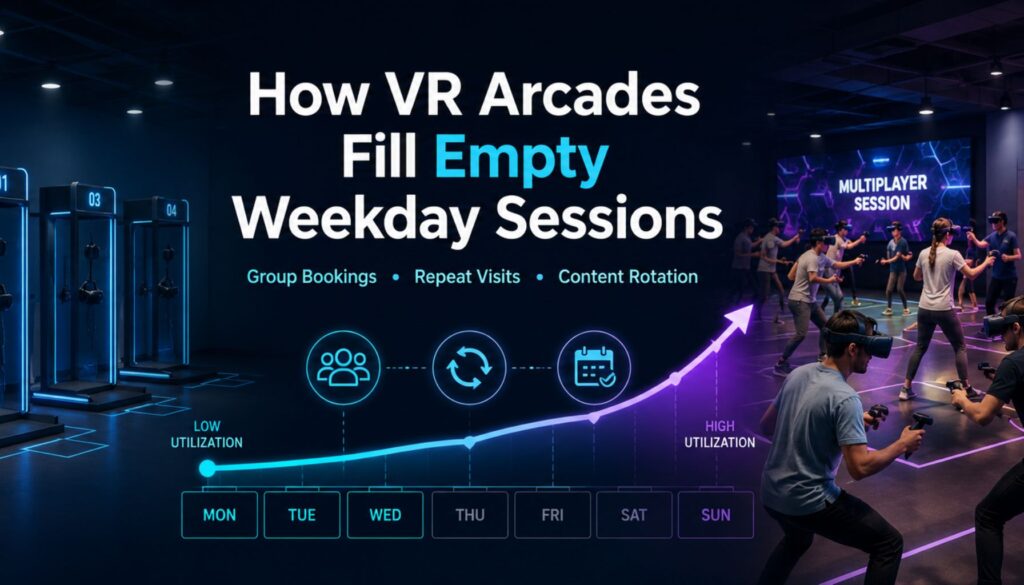
For most VR arcades, family entertainment centers (FECs), and location-based entertainment (LBE) venues, Friday evenings and weekends take care of themselves. The real operational challenge begins on Monday morning. Every empty VR session between Monday and Thursday represents revenue that can never be recovered. Unlike retail inventory, unused attraction capacity expires forever. Once a 3:00 PM session passes without players, that opportunity is gone. Many operators respond by introducing weekday discounts. While discounts may increase short-term bookings, they rarely solve the underlying problem. Over time, they can even reduce profitability by training customers to wait for lower prices. The strongest operators take a different approach. Rather than lowering prices, they redesign how weekday demand is created, packaged, and managed. They treat weekday utilization as an operational challenge—not simply a marketing one. Why Weekday Utilization Matters More Than It Looks A single underperforming weekday can offset gains from a strong Saturday. Across an entire year, consistent weekday gaps compound into a meaningful revenue shortfall, particularly for venues carrying fixed overhead on VR hardware and dedicated attraction space. Analysts estimate the location-based VR market will reach approximately $2.76 billion in 2026 and continue growing rapidly through the end of the decade. As more operators enter the market, long-term performance increasingly depends on operational consistency rather than novelty alone. Utilization influences several areas that operators often underestimate: A quieter Tuesday session often provides a better guest experience than a fully booked Saturday. That difference can influence reviews, referrals, and future bookings long after the session ends. Why Many VR Venues Struggle to Fill Weekday Sessions Empty weekdays rarely reflect a lack of interest in VR. More often, they reflect a mismatch between how the attraction is offered and how people organize their time during the week. Weekday audiences behave differently from weekend visitors. Families work around school schedules. Friend groups need low-friction planning and simple booking. Students coordinate around evening availability. Corporate groups require a clear reason to justify an outing during business hours. Tourists operate on unpredictable schedules and shorter decision windows. Many venues build their booking structure around peak weekend behavior and then expect those same systems to perform throughout the week. Across commercial VR venues, free-roam and room-scale attractions often attract different audiences and booking behaviors. Operators who understand those patterns tend to build more balanced attraction portfolios and create offers that fit specific weekday audiences rather than treating all bookings the same. Common friction points include: Operators regularly use group pricing for schools, sports teams, corporate outings, and social groups because those audiences can help fill capacity that would otherwise remain unused during off-peak periods. How Can VR Arcades Increase Weekday Bookings? Discounting can increase attention, but it does not always address the reasons people delay or avoid booking. Operators often discover that price is only one part of the equation. Weekday attendance depends just as heavily on how easily groups can organize, book, and commit to an experience. Across the broader FEC industry, structured group experiences consistently outperform discount-heavy approaches. Birthday packages, corporate events, school programs, and group offers simplify decision-making for organizers and reduce booking friction. The same principle applies directly to VR. A group of six friends can easily postpone a VR outing if one person must coordinate payments, explain the experience, and organize schedules. That same group is more likely to commit when presented with a simple package: “Six-player session. One booking. Clear pricing. Clear experience.” Tying package benefits to off-peak windows, school calendars, or local community schedules can help smooth demand throughout the week without reducing prices across the board. Operators in bowling centers, laser tag venues, and escape rooms have applied this approach for years. VR arcades that design around group booking behavior often see stronger weekday utilization because they make participation easier to organize. Why Repeat Visits Create More Stable Revenue Than Acquisition Spikes One-time visitors are difficult to predict. Repeat visitors create more consistent demand patterns and often generate greater value over time. Operators frequently focus on acquiring new players while underestimating how much weekday utilization depends on giving existing customers a reason to return. A local customer who visits twice per month often contributes more revenue across a year than a tourist who visits once during a holiday. One recurring pattern across commercial VR venues is that players rarely ask how many titles are available. They ask whether there is something new to try since their last visit. The challenge for many VR venues is content fatigue. VR experiences are highly immersive, but they are also finite. Once visitors feel they have experienced everything available, motivation to return declines. Content rotation helps address this challenge. Venues that regularly introduce new experiences, seasonal content, multiplayer options, or fresh attraction formats create natural opportunities for return visits. Over time, this helps shift the venue from being perceived as a one-time activity into a recurring social destination. Promoting new experiences through social media, email campaigns, loyalty programs, and in-venue signage gives operators a practical way to convert content updates into measurable return traffic. The Role of Attraction Variety and Social Session Design The strongest operators rarely depend on a single experience type to support weekday traffic. An attraction mix that includes competitive multiplayer experiences, shorter repeatable sessions, free-roam attractions, and room-scale content provides flexibility when serving different audience segments. Weekday utilization rates for entertainment venues often fall between 40% and 50%, compared to 75% to 85% during weekends. Successful operators plan around that reality rather than treating it as a temporary problem. Multiplayer VR experiences naturally align with how social groups plan activities. A group of friends, a student organization, a sports team, or a corporate department all require a reason to commit and a simple booking process. Clearly packaged multiplayer experiences remove barriers that often prevent those groups from converting. Operator Reality Check Several operators invested heavily in new hardware while weekday utilization remained inconsistent. Attendance often improved temporarily before returning to previous patterns. Many operators expect new equipment or newly