
Is Your VR Venue Ready to Add Another Attraction?
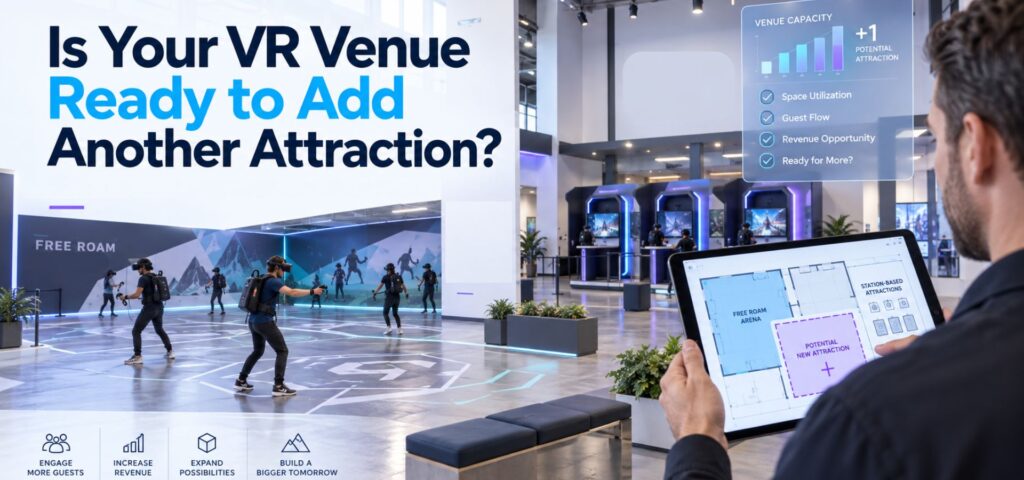
Adding another attraction can feel like the obvious next step when a VR venue starts getting busier. Perhaps weekend slots are filling consistently. Birthday groups are getting larger. Customers are asking for more variety. There may be unused floor space that could support another free-roam arena, a few standalone stations, or a different type of multiplayer experience. The question is whether the venue actually needs more capacity yet. Adding hardware increases the number of experiences a venue can sell, but it also adds another schedule, another set of devices, more content decisions, additional staff responsibilities, and another attraction that needs to earn its place on the floor. Before expanding, operators should look at what their current setup is already telling them. Start With the Capacity You Already Have A busy Saturday does not necessarily mean an attraction has reached its capacity. Look at utilization across the full week. An eight-player arena that regularly fills during birthday bookings may still spend large parts of weekday afternoons unused. A venue with several room-scale stations may appear busy because customers arrive continuously, while individual stations remain empty between bookings. That distinction matters because expansion solves a capacity problem. It does much less for a demand problem. Our guide to How Many Players Should a VR Attraction Support? looks at this from the booking-model side. Eight simultaneous players can mean one eight-player arena, two four-player experiences, or several smaller attractions. The useful capacity depends on the way customers actually book. Identify the Booking the Current Venue Cannot Serve The strongest reason to add another attraction is usually a specific booking opportunity. For example, a four-player setup may work well for walk-ins but become difficult when birthday groups regularly arrive with eight or twelve guests. A free-roam arena may handle large social groups well while leaving couples and smaller groups with limited options. The gap could also be demographic. A venue with mostly competitive shooters might receive regular family traffic without enough suitable content. Another location may serve casual players well but lack an attraction strong enough for repeat visits from experienced groups. Before expanding, define the gap clearly: Which customer or booking type could we serve better if this attraction existed? That question is more useful than asking whether a new attraction looks impressive. We recently explored the same principle from the content side in How to Choose VR Arcade Games for Different Customer Groups. Hardware, space, group size, staff workflow, and audience fit all affect whether an experience works commercially. Check Whether More Capacity Creates More Throughput The theoretical capacity of an attraction and the number of sessions staff can actually deliver are rarely identical. Suppose a venue adds a second multiplayer attraction. That may allow two groups to play at once. It may also mean staff now need to: If the existing team already struggles during back-to-back bookings, another attraction can increase pressure without creating the expected number of additional sellable sessions. This is why throughput belongs in the expansion calculation. The VR Arcade Business Plan guide uses a simple starting model: available sessions × average players per session × realistic utilization × average revenue per player The important word is realistic. Session capacity has to account for onboarding, resets, maintenance, delays, and staff workload rather than relying on the maximum number printed on the attraction specification. Watch What Happens During Your Busiest Hour Peak periods often reveal more than weekly revenue totals. Observe one genuinely busy hour at the venue. Where does the line form? Is staff waiting for headsets to become available? Are customers waiting for a play space, or are they waiting for an employee to launch the experience? Does one attraction finish while another group is still being prepared? Are staff moving between several systems to check bookings, launch content, or resolve device problems? These observations help distinguish between a physical capacity constraint and an operational constraint. That matters because adding another attraction only directly fixes the first one. The wider attractions industry sees the same issue. IAAPA’s recent guidance for FEC operators describes how multiple attractions, staff roles, and guest touchpoints can allow small operational problems to compound quickly. That is useful context for VR venues because expansion usually increases coordination before it increases complexity anywhere else. Make Sure the New Attraction Adds Something to the Mix Another attraction should have a role. It might increase capacity for large parties. It might create a lower-cost option for couples and small groups. It could introduce cooperative content alongside an existing competitive offer. It may give families something accessible while older visitors use a more intense free-roam experience. Or it could make an underused part of the building commercially productive. The risk is adding an attraction that competes with the venue’s existing offer for the same customers. If two attractions target the same audience, group size, price range, and occasion, operators may simply divide existing demand between them. A useful attraction mix gives customers different reasons to book. Our article on VR arcade content rotation makes a related point: customer behavior should drive changes to the lineup. Operators can look at selection frequency, repeat requests, operational friction, and audience gaps before deciding what belongs in the mix. Calculate the Full Cost of the Expansion The hardware purchase is only one part of the decision. Depending on the attraction, expansion can introduce costs for: It can also introduce a less visible cost: floor space. A large attraction needs to earn enough to justify the area it occupies. That is particularly important when comparing free-roam with smaller station-based formats. Our guide to free-roam VR arena space requirements explains why footprint, hardware, and available content should be evaluated together rather than treating square footage as a standalone requirement. Operators building the financial model can also use our VR Arcade Startup Budget and Revenue guide. Although it was designed around new venues, the same logic applies to expansion: build the investment around your own capacity, labor, hardware, software, content, and revenue assumptions
VR Arcade Pricing: How to Set Session Prices, Packages, and Promotions
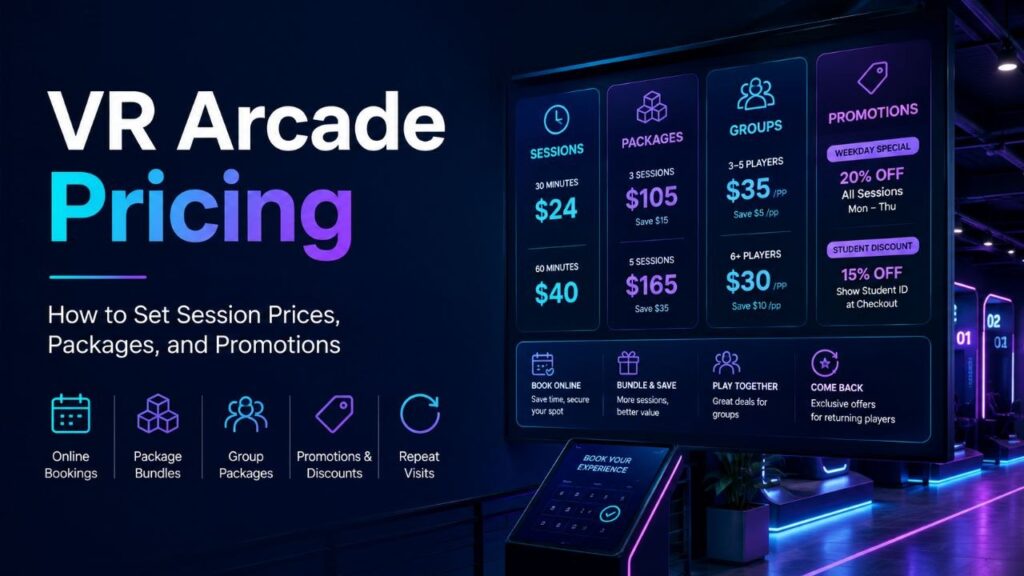
There is no universal number for VR arcade pricing. Two venues can run similar hardware and content, yet need different prices because they serve different customers, compete with different attractions, carry different costs, and sell different types of outings. A tourist-center arena, a suburban family entertainment center, and a university-town VR venue should not inherit the same rate card by default. A useful pricing process starts before the price itself. Define the local market, map the alternatives customers already buy, calculate the economic floor, decide what each package promises, and then test the result against real booking behavior. That approach draws on decades of retail, service, and pricing research rather than one current pricing formula. A practical VR arcade pricing framework The three questions work together. Cost-based pricing alone can ignore demand. Competitor matching can copy somebody else’s economics. Value language without a financial floor can create a popular offer that does not contribute enough to the venue. VR arcade pricing starts with the local market Wendell Smith’s 1956 work on market segmentation treated heterogeneous demand as a basic marketing reality: different groups can respond to different offers instead of behaving like one uniform market. For a physical venue, geography narrows that idea further. David Huff’s trade-area work defined the market around a geographically bounded pool of potential customers and the probability that they will choose a location. The U.S. Small Business Administration still advises small businesses to examine demand, market size, income, location, saturation, demographics, and what customers pay for alternatives. For a VR arcade, that means defining the realistic catchment area before copying a national or industry average. A venue near a tourist district may rely on one-time visitors with short decision windows. A suburban FEC may depend more on families, parties, schools, and repeat local groups. A university town can have strong evening demand but a lower willingness to pay for a premium single-player session. Research the customer’s real alternatives A venue that checks only other VR arcades sees too little of the market. Michael Porter’s competitive strategy work warned against viewing competition too narrowly. For an entertainment business, substitutes matter because customers usually begin with an occasion, budget, and group rather than a fixed commitment to VR. A family choosing a Saturday activity may compare VR with bowling, laser tag, a trampoline park, an escape room, karting, cinema, or another FEC. A company planning team building can compare the same VR venue with dinner, an escape room, a workshop, or a private event space. Research set Record Avoid Direct VR competitors Per-person price, duration, group size, private/shared format, packages, cancellation terms, memberships. Copying the headline price without understanding what the customer receives. Substitute entertainment Total group spend, time commitment, private access, food/party space, social proof, booking friction. Assuming VR competes only with VR. Local premium options What customers already pay for higher-end social experiences and events. Using household income alone as a willingness-to-pay measure. Low-cost alternatives Free or inexpensive activities that compete for the same time slot. Treating every lost booking as a pricing problem. Calculate the economic floor before testing value Pricing research has long treated price as a managerial decision with several inputs rather than a simple markup. Monroe and Della Bitta’s 1978 review examined the major pricing decisions managers face and the models used to support them. For a venue, the first financial check is straightforward: understand what each booking contributes after the costs that move with that sale, then test whether expected sales can cover fixed costs. SBA break-even guidance uses fixed costs, selling price, variable cost, and contribution margin for exactly this reason. A VR operator should include the costs that genuinely change with a session or package, then keep rent, salaried labor, insurance, depreciation, financing, and similar fixed costs visible in the wider model. Mixed attractions and packages often need separate calculations because a private arena booking does not behave like a single booth session. Related SynthesisVR reading: Free-Roam VR Arena Cost Analysis and How VR Arcades Actually Make Money Price the use case, not only the headset minutes B. Joseph Pine II and James H. Gilmore’s 1998 work on the experience economy argued that businesses can create economic value by staging an experience rather than competing only on the underlying good or service. Location-based entertainment fits that logic unusually well. A customer rarely wakes up wanting to buy 30 headset minutes. They may want a private activity for four friends, a birthday that is easy to host, a date-night plan, a school visit, or a team event that does not require the organizer to manage the details. Use case What the buyer may value Pricing structure to test Walk-in / first visit Low commitment, clarity, fast start. Per-person session or short introductory format. Friends / social group Playing together, simple group total, private access. Group bundle or private arena rate. Birthday Predictable total cost, host support, room time, smooth rotations. Named party package with clear inclusions. Corporate event Privacy, timing, invoicing, coordination, group confidence. Event package or private-hire rate. School / camp Per-head clarity, age fit, supervision, schedule control. Per-student or fixed group package. Related SynthesisVR reading: How to Market VR Arcade Birthday Parties for Summer Bookings Build packages when the customer is buying a bundle William Adams and Janet Yellen’s 1976 work formalized the economics of bundling. The research is technical, but the operator lesson is practical: a bundle can carry its own value and pricing logic instead of equaling the sum of every component sold separately. Four individual tickets and a private four-player arena package may use the same equipment, yet the second offer can include exclusivity, easier coordination, reserved time, a content choice, staff assistance, a score challenge, or another element that matters to the group. Birthday, school, and corporate packages deserve the same treatment. This also prevents a common pricing trap. If every package reduces to a minute-by-minute calculation, the operator invites customers to compare only time and price. Clear bundles create room to
How VR Entertainment Venues Turn First-Time Visitors Into Repeat Customers
By the end of August, a VR venue’s guest list is usually the longest it will be all year. First-time bookings come in from tourists and from families killing a rainy afternoon. Some walk in on a whim after seeing a friend’s video. A single follow-up email or a discount code in September won’t turn that list into a customer base. Most of it has already forgotten the visit by then. A first-time guest hasn’t paid for themselves yet, not in any real sense. Getting them through the door costs something: an ad, a discount, a slow afternoon spent chatting them up at the front desk. That cost lands whether they ever come back or not. A guest who visits four times splits it four ways. One who visits once never splits it at all. Repeat behavior isn’t a nice outcome sitting on top of a good season. It’s where a first visit actually turns into a return on what it took to earn it. How VR Arcades Transition From Summer Traffic to Local Repeat Visitors covered the first half of this problem. Sort visitors at booking. Sell the second visit before the guest leaves the building. Build a monthly reason to come back. That gets a first-timer to book again once. It doesn’t explain what happens next, and next is where most venues quietly stop. Sort guests before you decide what to tell any of them A tourist, a birthday parent, and a local teenager who came in with friends are not the same guest wearing different clothes. Send all three the same “come back soon” message, and you waste it on at least two of them. None of this needs a marketing department. It needs a booking system that tags visit history, booking source, and what a guest actually played. Then the next message can speak to who they are, instead of the same one going out to everyone. The third visit decides whether it’s a habit or a coincidence What separates visit one from visit two is usually the offer: a discount, an invitation, a reason stated clearly enough to act on. What separates visit two from visit three is whether anything actually changed. Picture a guest’s second visit looking identical to their first: same headset, same game, same layout. They quietly file the venue under “done that.” They stop opening the next email. Content rotation is what decides whether a second visit turns into a third. A returning guest needs the second experience to feel different from the first. A rotating multiplayer lineup is the cheapest way to create that difference. It doesn’t require buying anything new. Content is what makes the second and third visit feel different Every operator agrees content should rotate. Fewer actually run it as a schedule with a name attached. A cadence that holds up in practice looks simple. One featured multiplayer title changes every month. Staff get a briefing and a new promo photo goes up before the swap. Every quarter, someone reviews the full catalog and checks what guests are actually replaying against what’s gathering dust. Seasonal and holiday-tied content, a Halloween tournament, a school-break event, a leaderboard reset, gives locals a reason to plan a visit around a date. That beats waiting for one more generic reminder. Without someone responsible for making the swap happen on a fixed date, “we rotate content” stays a good intention. It quietly reverts to whatever has been running since June. Follow-up has to match where each guest actually is Selling the second visit at checkout gets the first repeat booking. Keeping that guest past visit two takes follow-up timed to the individual, not to a shared send date. A guest who hasn’t rebooked thirty days after their last visit needs a different message than one who hasn’t rebooked in ninety. At thirty days, a simple nudge tied to whatever’s new that month usually works, because the visit is still fresh in their mind. At sixty, that guest needs a stronger reason: a themed event, a new season, something worth the trip back. By ninety days without a return visit, most guests have effectively lapsed. They belong on a separate, less frequent list, not the regular monthly send. Send a single “come back soon” campaign to the whole list, and it’s just a broadcast. A system responds to each guest’s own clock instead. Status and perks work harder than another discount code Regulars stop responding to the offer that got them in the door the first time. What still moves them is proof that you remember they’ve been in before. That can mean early access to a new multiplayer title before it goes live for everyone else. It can mean priority booking during a busy weekend slot. It can mean a leaderboard rank that carries over between visits. None of this requires a formal membership program. It requires remembering, visibly, that a guest has been in before, and giving them something a first-timer doesn’t get. That’s what keeps a third or fourth visit from feeling like the same transaction on repeat. A guest’s own clip sells the next visit better than your marketing does VR is one of the few attractions where the experience is genuinely worth filming. Picture a group failing a co-op mission, or a losing team taking heckles from whoever’s watching the spectator screen. That footage brings a friend group back with new people faster than any paid ad. Prompting it costs nothing. Position the spectator screen where it’s easy to film. Have a staff member offer to record the last thirty seconds of a session. Add a simple “bring a friend” offer for whoever books off someone else’s visit. Referrals and shared clips grow the guest list without adding to the acquisition cost this whole piece is trying to avoid. Local repeat guests carry the entire calendar once summer ends A repeat rate that feels like a bonus on top of steady July tourist traffic becomes something else
Free-Roam VR vs Room-Scale VR: What Commercial Operators Actually Need to Know
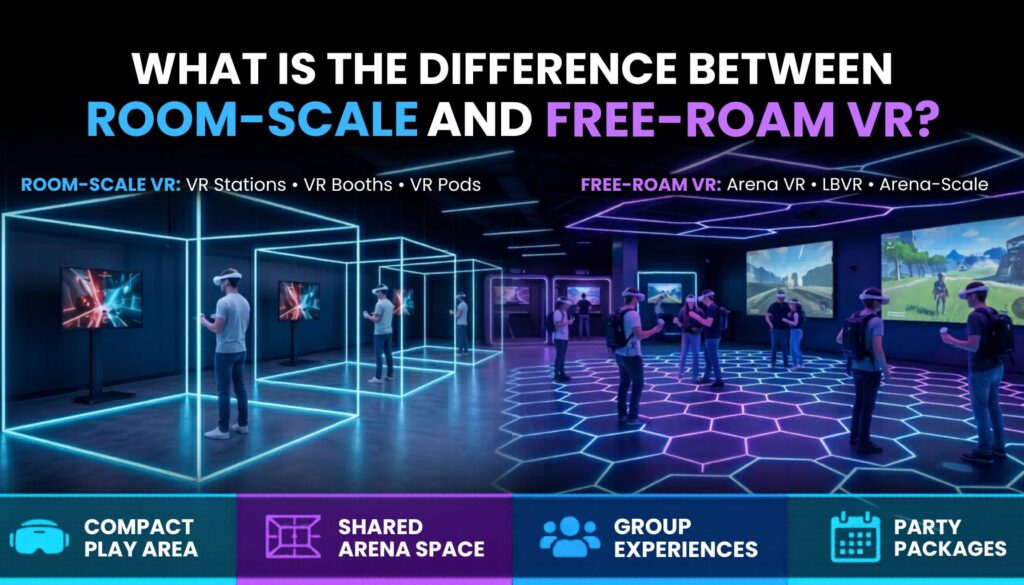
When people compare room-scale VR and free-roam VR, the discussion usually starts with space. Room-scale uses a smaller tracked area. Free-roam uses a larger physical arena where players walk naturally. That explanation is technically accurate. For commercial operators, it is also incomplete. Room-scale VR and free-roam VR are different attraction formats, each serving a different operational and commercial role inside a venue. They affect staffing requirements, player capacity, content strategy, floor plan decisions, and how a business generates revenue. Data from hundreds of commercial VR venues shows that operators rarely choose one format over the other: they build around free-roam as the primary investment, then layer room-scale around it to serve a different part of the guest experience. Understanding why that pattern works is more useful than debating which format is “better.” What Does Room-Scale VR Mean? The debate around free-roam VR vs room-scale VR usually starts with space. Room-scale VR refers to experiences that take place within a defined tracked play area, typically a minimum of 2×2 meters and ideally 2.5×2.5 meters per player or group. Within that space, players can walk, crouch, turn, and interact physically rather than sitting or standing in a fixed position. The setup can take several forms. Some operators build enclosed rooms with solid walls. Others use curtain dividers or open floor plans with clearly marked boundaries. A monitor facing outward so waiting guests can watch gameplay in progress is standard across all configurations. The experience may support a single player or a small multiplayer group, as long as all players share the same tracked area. Across the industry this format goes by several names: VR stations, VR booths, VR pods. These are not distinct attraction categories. They describe different ways of delivering the same format, whether that means an open play position on a venue floor, a partitioned booth for privacy and organization, or a branded enclosed unit with custom theming. The format is consistent: compact, defined play space with flexible deployment. Because room-scale setups require relatively little floor area and integrate into most existing layouts, operators use them to add attraction variety, increase density, or introduce new content without major venue redesigns. That flexibility matters most when a venue is already anchored by a larger attraction and needs to fill the surrounding floor plan productively. What Does Free-Roam VR Mean? Free-roam VR allows multiple players to walk through a shared virtual environment together, each wearing a wireless headset, navigating the same physical arena at the same time. Where room-scale defines a boundary for each player, free-roam removes that boundary. Everyone in the experience occupies one shared arena space, physically moving alongside each other while interacting inside the same virtual world. The format is commonly referred to as free-roam VR, arena VR, or arena-scale VR. Within the industry, location-based VR and LBVR are broader terms that often apply here as well. The technology behind free-roam has changed significantly over the past several years. Early commercial setups relied on backpack PCs: players wore full computing rigs on their backs through the experience, and tracking depended on external sensor arrays that required significant setup time between sessions. Modern free-roam operates differently. Standalone headsets with inside-out tracking have largely replaced backpack systems. Arenas are designed specifically to support stable tracking: floor markers, aruco patterns, and walls with non-repeating visual textures give headsets consistent reference points as players move. The result is more reliable tracking, faster resets, and simpler day-to-day operations. Arena size in free-roam is not fixed by a single standard. Most commercial free-roam titles are designed around a 6x6m (20x20ft) play space, which has become the practical baseline for operators because it unlocks the widest range of available content. Larger arenas, typically around 10x10m, support more simultaneous players or give players more physical room, though player counts do not always scale with the additional space. Some titles allow operators to adapt the experience to a different play space size, but that flexibility is less common across the catalog. The practical starting point for most operators is sizing the arena around the content library they want to run, not the other way around. Free-roam experiences are built around what the format does well: multiplayer cooperation and competition, physical exploration across a large shared space, and social play where every participant is present in the same environment at once. The Practical Difference: Movement and Play Area The most visible difference between the two formats is how players move. In room-scale VR, movement stays within a compact tracked area per player. In free-roam VR, walking is central to the experience: players navigate the arena physically and the virtual world responds to where they actually are. From an operator perspective, that produces meaningfully different venue requirements. The choice is rarely about which format is technically superior. It is about which format fits the venue being built and the audience it serves. Why Free-Roam Draws Stronger Commercial Interest Several factors have made free-roam VR the more discussed format among venue operators, and data from commercial deployments reflects that priority consistently. The clearest factor is replicability. A consumer at home can buy a headset, clear some furniture, and run a room-scale experience. The quality differs from a commercial setup, but the format is accessible. Free-roam arenas are not. No home environment accommodates a shared arena with multiple simultaneous players, calibrated tracking walls, and the session infrastructure a venue provides. Content reinforces that gap in a specific way. Titles like Arizona Sunshine Remake: Free-Roam and After the Fall: Free-Roam are built exclusively for commercial venue deployment. They have no consumer release. A guest who already owns a home headset still has a clear reason to book: the experience they want does not exist on any device they can buy. That content exclusivity also has a less obvious commercial benefit. VR content licensing structured through a commercial platform closes the route that consumer versions leave open. Room-scale content that exists in consumer ecosystems can be acquired and run by any venue regardless