
Week 12: Scaling From One Arena to a Franchise
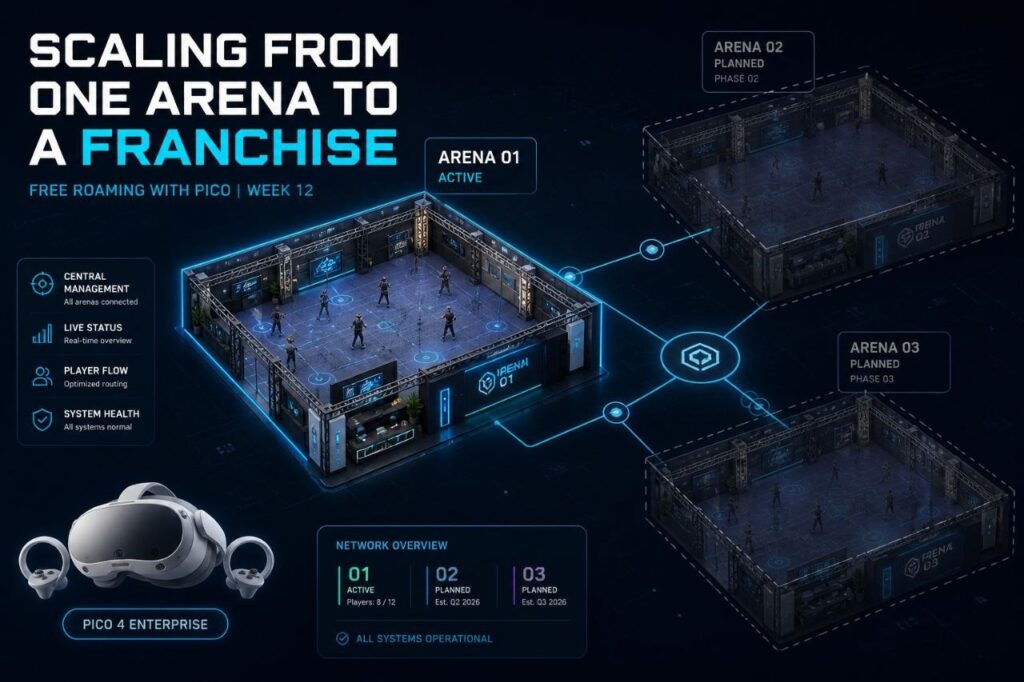
Why the biggest barrier to a second location is not money Twelve weeks ago, this series started with a single question: what does free roam actually mean? Not as a marketing concept, but as a live operating system with moving parts, competing demands, and very little margin for error once customers are in the space. Every week since has added another layer. Tracking. Networking. Calibration. Content licensing. Staff cycles. Session automation. Each topic, its own problem. Each solved problem, a prerequisite for the next. This final week asks the natural follow-on question: what happens when it works at one location, and you want to do it again somewhere else? The honest answer is that most operators who reach this point are not prepared for how different the question becomes. Replication Is Not the Same as Repetition Opening a second location feels like proof of success. Revenue is stable at the first site. Demand is real. The model works. Expansion seems like the logical next step. What changes at location two is the nature of the business entirely. A single-site operation can survive on proximity, informal communication, and the founder being present when something breaks. A two-site operation cannot share any of those things. What worked because you were there will not work because your manager is there instead, unless you have converted everything you know into something they can follow without you. Often scaling failures are caused by systems that were never designed to scale, not necessarily caused by a lack of ambition or capital. This is not a VR-specific problem. It is a universal truth about physical operations. The franchise industry has been running this experiment at scale for decades. The data is not encouraging: only 16% of franchisors ever reach the 100-location milestone. The median number of franchise locations is 38. The vast majority of operators who attempt multi-location expansion stall before they get there. The reason is consistent across industries: the operation was built for one location, optimized for one location, and was never designed to be replicated. It worked because of specific people in a specific place making specific daily decisions that existed nowhere except in their heads. What Actually Breaks at Location Two In a VR arena context, the failure points are predictable once you know what to look for. They are not dramatic. Nobody walks in one morning to find the business has collapsed. Instead, a series of small, reasonable decisions compound into a structural gap between how fast you are growing and how well your operations can keep up. Here is what typically breaks: Hardware control At one location, a fleet is manageable through familiarity. The manager knows each headset, knows which ones drift, knows which require an extra calibration step. At two locations, that knowledge does not transfer. Without centralized visibility across both sites, firmware changes, battery status, and device behavior become invisible problems. A consumer headset update that changes the operating environment overnight is a manageable inconvenience at one site. At three sites, it is an operational failure. Calibration and environment profiles Operators who solved calibration at location one by storing boundary data and space maps in a centralized system open a second location with a replicable asset. Operators who solved it by having one skilled staff member walk the space every morning have built something that cannot be reproduced. They have to rebuild it from zero, every time, at every new site. Content licensing compliance A single location can handle licensing informally when the operator knows the catalog and tracks usage personally. Add a second location, and the compliance surface doubles. Add a third, and the problem is no longer manageable without a platform that tracks usage across all sites and keeps every location within its licensing terms automatically. Operators who discovered this late have rarely found it cheap to fix. Staff dependency This one is the most common failure point and the hardest to diagnose in advance. A single location can survive on one expert employee who knows the system. That employee cannot be in two places at once. A second location staffed by people who are learning the operation through verbal instructions rather than documented systems will not run the same experience. It will run a rough approximation of it, degrading further with every staff turnover cycle. OPERATOR REALITY CHECK The biggest barrier to expansion is not money. It is inconsistency. A location that cannot reproduce the same setup twice will struggle to reproduce it ten times. The operators who scale successfully are almost never the ones with the most capital. They are the ones who treated their first location as a system to be documented, not a business to be managed by feel. The Difference Between a Venue and a System There is a version of a VR arcade that is a place. The owner knows it intimately. Staff figure things out. Sessions work because experienced people are present and paying attention. That version is not scalable. There is another version that is a system. Setup is documented. Staff follow a process, not a person. Hardware is monitored centrally. Content is licensed and tracked automatically. Session launch does not depend on which employee is working that shift. That version can be reproduced. The difference between them is not technology. It is whether the operational knowledge that lives in people has been extracted and built into processes that survive staff turnover, absent founders, and new locations that have never seen the original. Firms that scale smoothly have playbooks. The ones that don’t end up with multiple locations that each operate like independent businesses sharing a name. Operators who have watched franchise models attempt to take hold in this industry over the years will recognize the pattern. We have seen enough of these attempts to know that the limiting factor is rarely ambition or capital. It is almost always the absence of a replicable system. The first location is often strong. The jump to a second or third