Part of the series: From First Headset to Fully Operational VR Arena
Week 7 covered how calibration drift quietly erodes session quality over time and how a stable spatial map removes the problem from your daily routine. Week 8 moves to the next constraint on throughput: the moment between groups, when the physical space is clear but the session still has not started.
For many free roam venues, that gap is longer than it needs to be.
Why the Launch Matters More Than the Game
We have spent years watching venues lose time not to hardware and not to content, but to the launch itself. Staff moving through headsets one by one, putting each on to find the right title and confirm the session. A device that did not get the right session queued. One player watching a menu while five others are already moving through the arena. These are not exceptional circumstances. They are the default outcome of a manual process running against a multi-headset free roam fleet during a busy Saturday.
The time lost compounds. A venue running six to eight sessions a day does not just lose those minutes once. It loses them every group, every turnaround, across the whole operating week. And because the launch is a staff-dependent step, its length varies. An experienced operator runs it faster. A new hire runs it slower. On a day when your best person calls in sick, the gap between those two shows up directly in throughput.
Customers do not remember the delay in minutes. They remember what it looked like. A staff member visibly troubleshooting at the edge of the play space while a group stands waiting in headsets is the image that stays with people. The experience starts before the game does, and that part is entirely within your control.
The Cost of Headset-Side Menus
In a free roam arena, launching a game from inside the headset means putting on each device, navigating to the right title, and confirming the session, one headset at a time, across a fleet that might be six, eight, or ten units per group. Each step takes a moment. Across dozens of sessions a day, those moments become a measurable part of operational workload. During peak hours, the repetition increases the chance of a missed step.
There is a staffing dimension that deserves more attention. The LBE industry runs structurally lean. Ben Davenport, CEO of VRsenal, put it plainly in a VIVE Business industry report: “Everybody’s chronically understaffed. A lot of places that have staffed VR systems are literally having those systems sit idle because they cannot get people to operate them.” It is a pattern operators acknowledge openly. When your launch process depends on experienced staff executing the same sequence every time, you have built operational fragility directly into your busiest hours.
Training a new team member to match the speed of an experienced one takes longer than most venues expect. When that person leaves, the gap shows up in session turnaround times before anything else does.
How Automation Changes the Equation
The shift from manual to centralised launch changes more than speed.
In free roam, every player in the arena needs to enter the experience simultaneously. A partial launch, where some headsets are in the game and others are still on a menu, is not just an efficiency problem. A player still navigating a headset menu while others are already moving through a shared physical space creates a real safety risk. Staff attention split across multiple devices during a launch is attention that is not on the arena floor. Centralised launch removes that split.
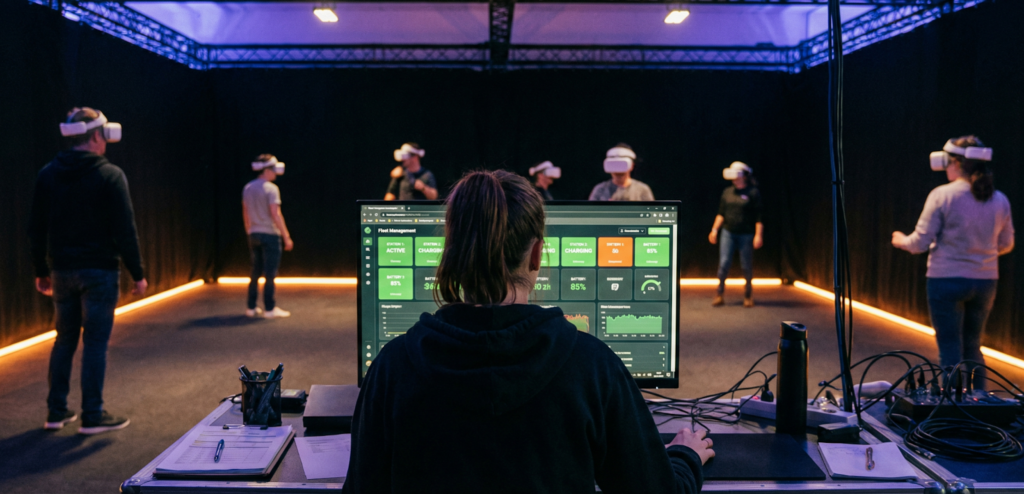
When a single command sends the correct game to every headset at once, the staff-to-session ratio changes. One operator manages the full fleet from a dashboard, stepping in only when something actually needs attention. David Bardos, CEO of Univrse, framed the industry challenge directly in a 2026 analysis of free roam infrastructure: what scales free roam as a format is not the quality of individual experiences alone. It is operational reliability at the session level, repeated cleanly across every group, every day. Solving it on a one-off basis can produce great experiences, but it rarely produces a scalable operation.
The revenue implication is direct. Free roam sessions for groups of six to eight players at standard LBE pricing generate significant revenue per slot. Every ten minutes of lost capacity, repeated across a full operating day, compounds into real lost revenue by the end of the week. Venues that tracked session completion rates and reset times against their workflows found operational stability, not headline hardware specs, was the variable separating profitable locations from one that felt perpetually squeezed.
Why “One-Click” Is a Philosophy, Not a Feature
The phrase gets used as product shorthand, but what it describes is an approach to operations.
Every manual step in a venue workflow is a variable. Variables produce inconsistency. Inconsistency erodes both throughput and guest experience over time. “One-click launch” means the complexity of coordinating a multi-headset session sits with the system, not distributed across individual staff actions. Whether the implementation is literally one button or a short configured sequence, the logic is the same: the human decision point is the session itself, not the mechanics of starting it.
Game Presets extend this further. A preset stores a complete launch configuration, game title, player count, game mode, difficulty, session settings and makes it reusable instantly. Staff select the preset and the session launches with the intended setup already applied. The experience sold to the customer matches the experience delivered. Groups get identical gameplay across visits. Multi-station launches stay synchronised. Small configuration differences that staff may not notice become obvious to players; presets eliminate them.
Venues that run operations around this logic report a consistent pattern. New staff reach operational competence faster because fewer steps require memorisation or experience. Peak hours run closer to theoretical capacity. The mental load on team members during busy periods drops, which has measurable effects on both retention and the quality of guest interaction.
What This Looks Like in Practice
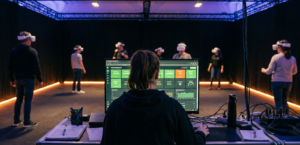
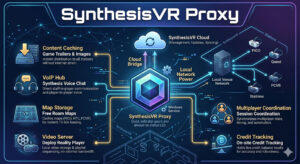
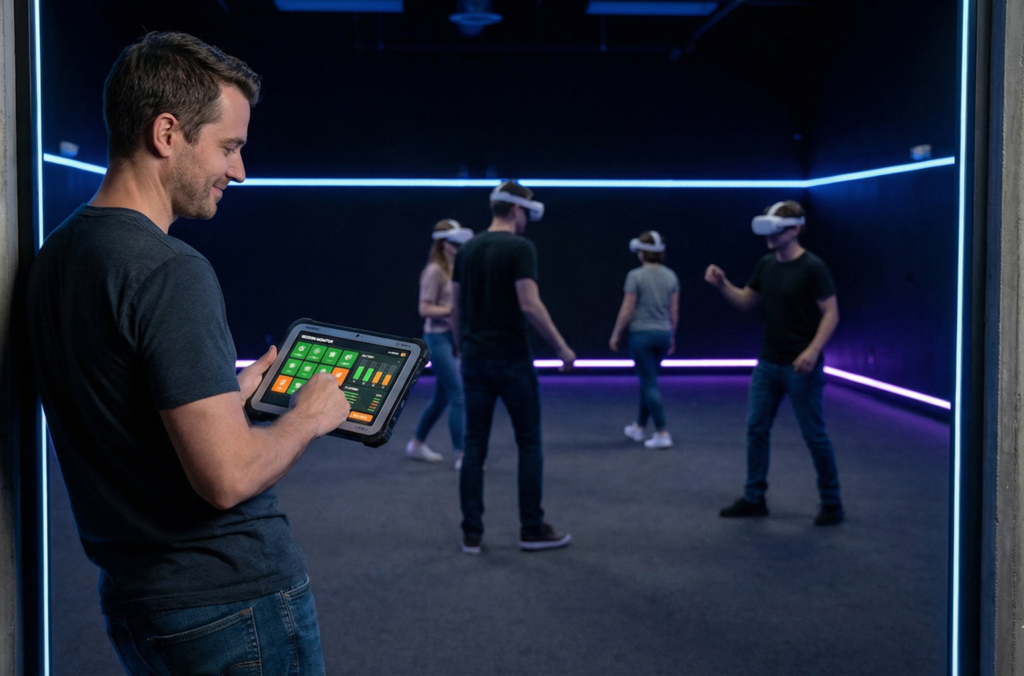
SynthesisVR operators running PICO 4 Ultra Enterprise headsets manage their full session launch from Local Manager. Game selection, fleet assignment, and session start happen from the desk. The headsets receive the instruction and players enter the experience.
The same system that manages the launch monitors session status in real time. If a headset does not receive the launch signal, it shows up on the dashboard before the guest notices. Staff respond to the exception rather than scanning every device to confirm the launch completed.
For venues running multiple simultaneous sessions across different spaces, this matters even more. Managing two or three concurrent groups manually tends to require dedicated staff per arena. Centralised launch and monitoring changes that ratio, one operator, multiple active arenas.
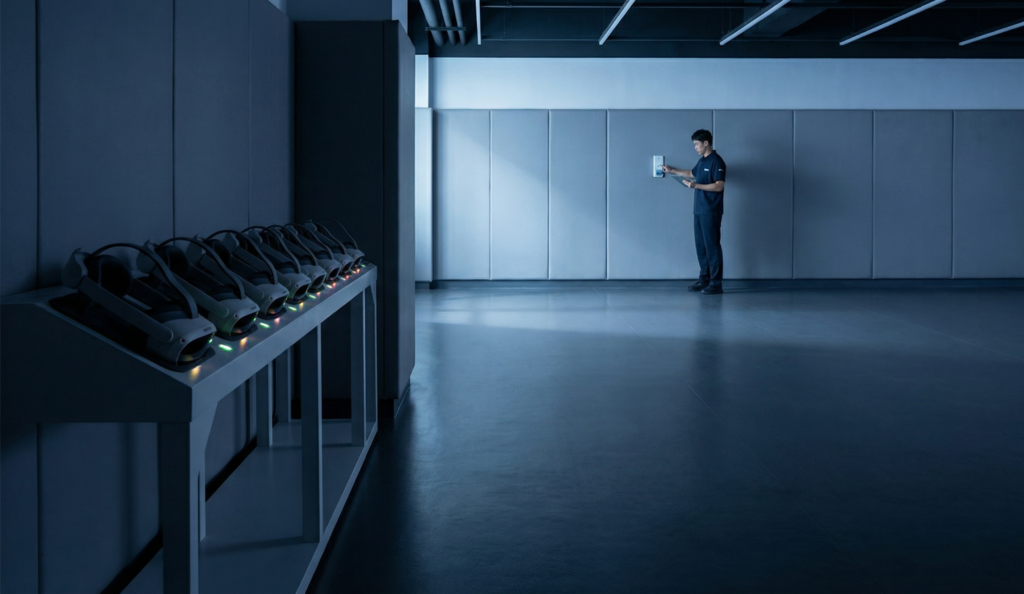
The Gap Between Groups
Reset time between groups is a real operational metric, even at venues not yet tracking it.
The window from one group leaving the arena to the next group entering an active experience covers headset collection, battery and hygiene checks, and the launch sequence. Each step can be tightened or extended depending on the systems and workflows in place.
Manual game launch is one of the most variable steps in that window. Its length depends on staff speed, familiarity with the titles in the rotation, and how many devices need individual attention. Automated launch removes that variability and puts a short, fixed ceiling on that part of the reset.
For a venue running six to eight free roam sessions per day in a single arena, saving five minutes per group turnaround adds up to 30 to 40 minutes of recovered operating time daily. Across a full week, that is several hours, time that either becomes additional session capacity or simply reduces the pressure on staff during peak periods. Neither outcome is small.
Coming Up in Week 9
With the physical space, network, calibration, and launch sequence working consistently, the constraint on throughput shifts to team-level operations. Week 9 covers why throughput is the real profit driver for LBE venues, how to design operations around systems rather than individuals, and why reset time between groups is the KPI most operators are not tracking but should be.
Run a Tighter Operation from Day One
Manual launches, headset-side menus, and inconsistent session starts are solvable problems. SynthesisVR gives operators a centralized launch and monitoring workflow built for the realities of running a free roam venue at pace.
Trusted by 600+ locations worldwide.
To schedule a demo or to have a chat about the VR Business, reach out to the onboarding team directly.