Free roam VR in location-based entertainment VR didn’t scale because it became popular. It scaled because tracking, device control, and deployment workflows matured enough to support continuous commercial use.
In Week 1: What Free Roam Actually Means (And Why It Breaks So Often), we discussed how free roam VR is an operational model that stresses tracking, synchronization, safety, and staff simultaneously.
In Week 2: The Consumer Trap: When the Wrong Assumptions Cost You Money, we explored how consumer device assumptions often collapse under commercial pressure in a high-throughput VR arcade.
This week focuses on a key turning point in the industry: why PICO became widely adopted as the LBE standard for free roam VR arenas. But telling that story properly means acknowledging something important first.
HTC, through the Focus line and its location-based tooling, helped create the modern “inside-out free roam” wave. PICO didn’t invent the phenomenon, it took the baton and ran with it, doubling down on LBE-first deployment, mapping distribution, and operational consistency.
The answer sits at the intersection of tracking maturity, LBE-grade operating systems, spatial synchronization, and developer alignment.
Inside-Out Tracking Reached Commercial Reliability
Early free roam deployments often depended on external tracking infrastructure. Base stations required precise placement. Networking needed careful configuration. Calibration routines added recurring maintenance. These setups worked, but scaling them inside a busy room scale VR arcade or a full VR arena game environment introduced operational complexity.
Inside-out tracking changed the equation.
Modern headsets combine SLAM (Simultaneous Localization and Mapping), high-speed inertial sensors, and sensor fusion to track position in real time without external hardware. SLAM enables the headset to build a live model of its environment by identifying anchor points and continuously updating its position within that map.
A major reason inside-out tracking became viable for commercial use is that it removed the most fragile parts of earlier installations: external hardware dependencies and constant re-calibration. In practice, this translated into faster setup, reduced physical infrastructure, more flexible layout design, lower ongoing tracking maintenance, and easier expansion from small to large multiplayer zones.
This is one of the reasons the market moved from “PCVR-only thinking” to a new reality where both PCVR arcades (wireless streaming) and standalone VR arcades could support free roam at scale.
HTC Focus 3 Helped Trigger the Free Roam Shift
It’s hard to talk about the “free roam boom” without giving credit to HTC’s enterprise push.
HTC VIVE Focus 3 and HTC’s LBE tooling helped standardize the idea that inside-out, standalone devices could be deployed commercially with more control than consumer ecosystems. HTC’s own documentation for LBE Mode explicitly frames the concept: multiple standalone headsets tracked inside a large play area for “truly free-roaming” experiences, and it references support up to 1,000 square meters for Focus devices in LBE Mode. 
For many operators, that mattered because it changed the conversation from “Can standalone work for LBE?” to “How do we run it reliably, every day, with groups?”
But the story didn’t stop at “inside-out is possible.” The next leap was making it operationally repeatable.
LBE Grade Device Environment for Out-of-Home VR
In a location-based venue, headsets function as operational tools. They are part of a live attraction running on schedule, not personal devices tied to individual accounts.
This is where enterprise ecosystems separated themselves from consumer ones.
HTC invested heavily in enterprise fleet management and kiosk control through its business stack (for example VIVE Business+ and device management tooling).
PICO’s LBE grade operating environment is structured specifically for out-of-home deployment. Rather than centering the experience around a consumer storefront, it emphasizes controlled rollout, administrative oversight, and predictable behavior across multiple devices.
PICO’s business OS architecture, as outlined in its official Business documentation, separates commercial deployment from consumer distribution layers and allows devices to operate without requiring personal user accounts. This simplifies fleet provisioning and reduces friction during installation and scaling.
Key capabilities relevant to free roam VR operations include account-free deployment for multi-headset environments, a dedicated business OS branch designed for commercial use, custom kiosk configurations that define exactly what launches at startup, administrative control over system menus and hardware buttons, and a clear separation between business applications and consumer ecosystems.
According to PICO Business technical materials, this OS layer is designed to support centralized device management and LBE features such as synchronized session control and map deployment. This aligns directly with the needs of commercial VR arcades and free roam arenas, where operational consistency determines throughput and revenue stability.
For operators managing a commercial VR attraction, uniform device behavior matters. Staff turnover is common. Weekend peak hours leave little margin for troubleshooting. Devices that behave predictably across resets and sessions reduce intervention and protect session flow.
In free roam VR environments, stability at the device level directly affects session timing, multiplayer synchronization, and the ability to maintain continuous group bookings without disruption.
Boundary Sharing as Infrastructure for Multiplayer Free Roam
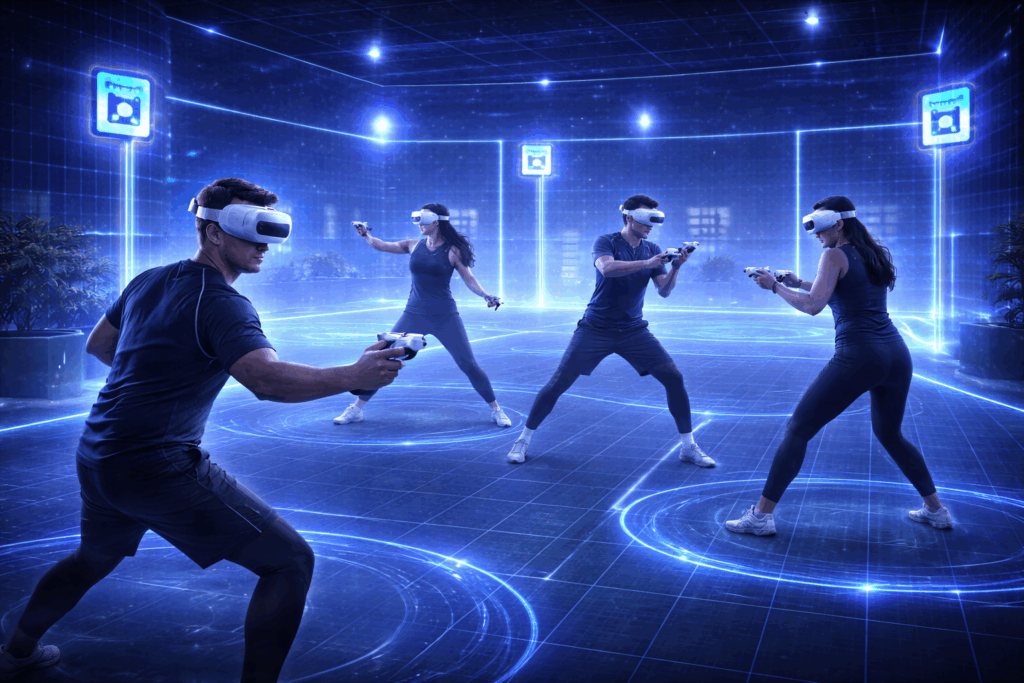
Free roam VR arenas rely on precise spatial alignment across multiple headsets. When six or eight players move inside the same physical play zone, every device must reference the exact same coordinate system. Even small positional inconsistencies can affect immersion, gameplay logic, and safety in a commercial free roam VR environment.
Boundary sharing establishes a unified spatial framework across devices. In practice, this means virtual walls correspond precisely to physical walls, obstacles remain fixed for every participant, teammates appear accurately positioned in shared space, proximity awareness reflects real-world player movement, and persistent virtual objects remain anchored across sessions.
Shared spatial anchor systems are widely used in spatial computing to synchronize multiple devices within a unified coordinate system. In commercial location-based entertainment VR environments, this synchronization becomes foundational to multiplayer reliability. In large-scale VR arena software deployments, boundary sharing is structural infrastructure rather than an optional feature.
PICO’s LBE Mode extends this concept to arena-scale deployments. According to official PICO Business LBE documentation, operators can generate a master environment map and distribute it across multiple headsets to ensure synchronized positioning within a standalone VR arcade or hybrid arena.
Arena-scale mapping supports environments up to 1,000 square meters, enabling large free roam VR attractions with consistent spatial logic suitable for high-throughput commercial venues.
For added positional stability, PICO supports ArUco marker integration. These physical visual markers act as fixed spatial anchors, reducing cumulative drift during extended sessions and allowing sub-centimeter alignment accuracy in large play spaces. Technical references for this approach are outlined within PICO’s LBE API materials and broader SLAM research.
The operational implications are significant: faster session resets without redrawing boundaries, reduced recalibration between groups, improved multiplayer immersion, better real-world collision awareness, and higher reliability during peak hours. In large multiplayer arenas, synchronized boundaries are foundational to consistent performance and safe gameplay within a professional VR arcade management system.
Why Developers Prioritize PICO Compatibility
Commercial VR developers approach platform selection differently than consumer-focused app creators. In location-based entertainment VR, software must perform reliably in high-throughput environments where devices run continuously and multiplayer synchronization is critical.
When evaluating a platform for free roam VR deployment, developers typically consider stability during prolonged commercial operation, access to system-level configuration controls, support for large shared play areas, scalable fleet deployment workflows, and predictable OS behavior across update cycles. These factors directly influence how well a title performs inside a structured free roam VR management environment.
PICO’s business-focused operating environment exposes system-level APIs and SDK capabilities that allow deeper control over device behavior, kiosk configurations, and session orchestration. According to PICO Business documentation, enterprise SDK access supports customized deployment models and multi-device coordination suited for LBE venues and VR venue management software ecosystems.
Hardware capability also plays a role. The PICO 4 Ultra Enterprise runs on Snapdragon XR2 Gen 2 architecture with expanded memory capacity, providing computational headroom for multiplayer logic, persistent spatial anchors, and high-fidelity standalone rendering. Qualcomm’s XR2 platform overview outlines the performance class required for advanced spatial computing workloads in standalone devices.
For developers building commercial VR games and free roam VR games for business environments, these factors reduce technical uncertainty. They gain structured business-grade application distribution, greater control over update timing, native support for arena-scale mapping, and less reliance on custom external tracking infrastructure.
Open standards such as OpenXR further reinforce this ecosystem by enabling cross-platform spatial development through standardized APIs for device interaction and spatial anchors. When hardware architecture, operating system design, and spatial toolsets align with LBE operational requirements, developers can build experiences optimized specifically for out-of-home VR deployment.
This alignment between device capability and commercial deployment needs explains why many multiplayer free roam titles increasingly prioritize PICO compatibility when targeting VR arcade software environments and scalable LBE VR platforms.
When Hardware Stability Shifts the Challenge
As free roam VR hardware matured, the nature of venue pressure changed.
Reliable tracking, synchronized boundaries, and predictable device behavior removed many early technical disruptions. Sessions became more stable, multiplayer alignment improved, and device-level troubleshooting decreased.
That stability revealed a different constraint: the operational layer.
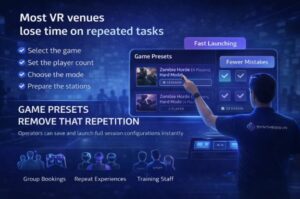
Free roam venues began concentrating on launching multiple headsets simultaneously, coordinating timed group sessions, resetting arenas quickly between bookings, maintaining real-time visibility across active stations, and managing device usage and VR commercial license requirements throughout peak hours.
When hardware behaves consistently, inefficiencies become more visible. Delays between sessions, manual coordination, and fragmented control systems begin to directly impact throughput and revenue inside a commercial VR attraction management environment.
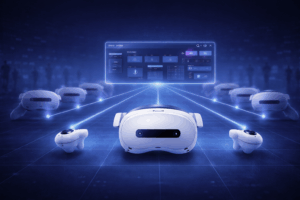
This is the layer where venue management platforms like SynthesisVR emerged to address the operational gap: providing centralized session control, content deployment, commercial usage tracking, and fleet oversight from a single interface. Rather than managing each headset individually, operators can launch, monitor, and reset sessions across an entire arena without leaving the front desk, effectively operating through a unified VR location management platform.
The more reliable the hardware becomes, the more important that operational layer is to running a profitable standalone VR arcade or multi-arena venue.
Commercial free roam VR requires orchestration that scales with reliability. The more stable the hardware becomes, the more important centralized coordination becomes.
Operator Reality Check
Operators who adopted LBE-grade standalone headsets often saw immediate improvement in tracking performance and boundary stability. What changed next was not the hardware — it was where operator attention shifted.
Instead of troubleshooting drift or recalibrating play areas, teams began concentrating on managing eight or more headsets during peak demand, turning over birthday groups without delay, relaunching sessions within minutes, and overseeing multiple arenas from a single control point through structured VR management software.
In high-volume LBE environments, hardware reliability becomes expected. Profitability is shaped by session flow, time management, and structured control across the venue. Operators running PICO fleets alongside platforms like SynthesisVR report that the combination, stable hardware paired with centralized management, is what finally allows them to scale bookings without scaling headcount proportionally.
Free roam VR succeeds when hardware stability is paired with operational discipline. The venues reaching consistent throughput are running better systems around those devices, not just better headsets.
If you would like to see how SynthesisVR and the PICO 4 Ultra Enterprise work together to simplify free roam operations, contact us to schedule a demo call at your convenience.