
How Much Guidance Should VR Arcade Staff Give Players?
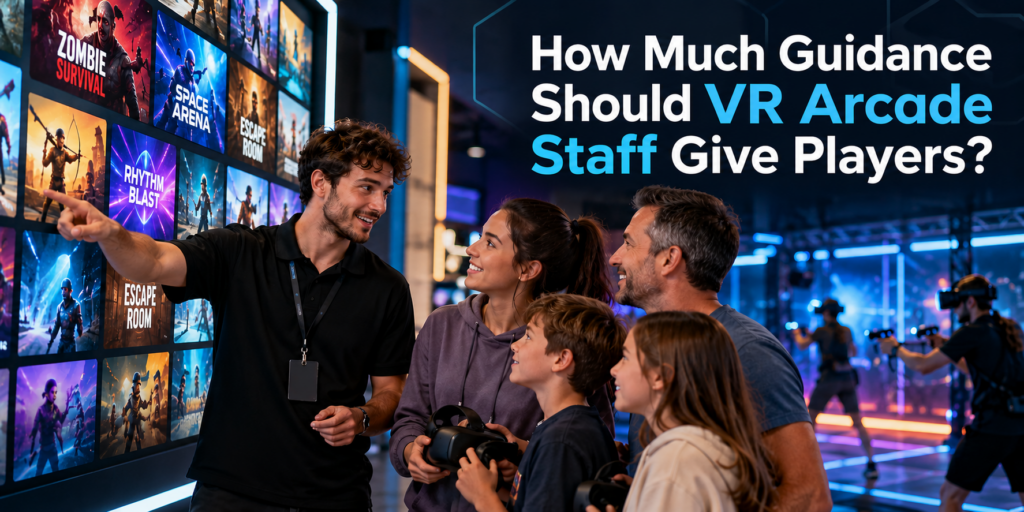
A strong VR content library gives customers choice, but choice alone does not guarantee a good experience. Staff still need to understand who an experience is for, how it starts, what players need to know before putting on the headset, and when they may need help. That makes staff guidance an important part of running a VR arcade, particularly for first-time visitors who have little idea what to choose or what to expect. Why VR Players Need More Guidance Than They May Realize Experienced VR players may arrive knowing exactly what they want. Many customers do not. A family with children, a birthday group, two adults trying VR for the first time and a group of experienced gamers can all walk into the same venue with very different expectations. Asking them to browse a large game library without guidance puts much of the decision on the customer. The goal is not to make the decision for the customer. It is to turn a potentially overwhelming library into a manageable set of experiences that fit the group. Staff Should Know the Content They Are Offering This was one of the interesting issues raised in our recent conversations with VR arcade operators. Adding an experience to the library and waiting to see whether customers play it provides limited information about whether the content itself is working. A game may receive little play because customers cannot tell what it is from the title or thumbnail. Staff may rarely recommend it. Players may start it without understanding the objective. A group may choose something poorly suited to its size or experience level. The operator can then conclude that customers simply do not like the game. That conclusion may be wrong. Before staff recommend an experience, they should ideally know: What is the experience about?Staff should be able to explain the basic premise in one or two sentences. Who is it suitable for?Consider age, VR experience, group size, physical intensity and genre. How does the experience begin?Some games are immediately intuitive. Others require players to understand controls, roles or objectives before the session starts. What commonly causes players difficulty?Knowing where people tend to get stuck allows staff to intervene quickly instead of leaving players frustrated. What hardware and play space does it require?A recommendation still has to work with the venue’s available setup. This is one reason properly testing VR arcade games before adding them to the active library matters. Staff who have actually played an experience can explain it much more naturally than staff working from a title and description alone. Guidance Starts Before the Headset Goes On Some of the most useful guidance happens before gameplay begins. A good introduction does not need to become a five-minute tutorial. In many cases, players only need a few pieces of information: What am I trying to do?Give the player the objective. What do I need to know to get started?Explain the essential controls or interaction. What should I expect?If players will move between stages, communicate with teammates, physically turn around or encounter something intense, tell them beforehand. This is especially important with first-time VR users. They are learning the game and learning how to interact in VR at the same time. Giving them the right information before the session can reduce confusion once the headset is on. During the Game, Help Without Taking Over There is another extreme operators should avoid: over-guiding. A puzzle is less satisfying if a staff member immediately gives away the solution. Exploration loses its appeal if someone constantly tells players where to go. Experienced players may want very little assistance. The best level of support therefore changes with the player and the experience. Staff should know when a player is discovering and when a player is simply stuck. Someone experimenting with different solutions may be enjoying the game exactly as intended. Someone repeating the same failed interaction for several minutes may need a small prompt. Start with the least intrusive intervention: Prompt → hint → explanation → direct assistance That preserves player agency while preventing frustration from consuming a large part of a paid session. Technical Problems Need Fast Intervention Gameplay guidance and technical support are different. If tracking fails, a controller disconnects, a headset loses connection or the game does not progress correctly, waiting for the player to solve the problem wastes session time. Staff need enough familiarity with both the content and the venue setup to recognize when the problem is technical. This becomes particularly important during busy periods. A problem that takes an experienced staff member 30 seconds to identify can consume several minutes when the person supervising the session does not know what normal gameplay should look like. Knowing the game is therefore part of troubleshooting it. Better Recommendations Can Improve Content Utilization Staff knowledge also affects which games get played. Imagine a venue has 40 experiences available, but employees confidently recommend only five because those are the games they know best. From the customer’s perspective, the venue effectively has a five-game library. The remaining content may be technically available, but it is doing little work for the business. Training staff across a carefully selected range of experiences can help venues make better use of the content they already license. It also gives operators better information when deciding what to keep, rotate or replace. Instead of asking only: “How often was this game launched?” operators can also ask: “Did we recommend it to the right customers?” That is a much more useful question when evaluating content performance. Build a Simple Content Knowledge System for Staff Staff do not need to memorize every detail of every game. A simple internal reference can make recommendations much easier. For each active experience, record: This also makes onboarding new employees easier. Rather than expecting them to learn an entire commercial VR library at once, operators can establish a core group of experiences every staff member should know well and expand from there. Let Your VR Management System Handle the
What Can You Run in an 8×8m or Larger PCVR Arena?
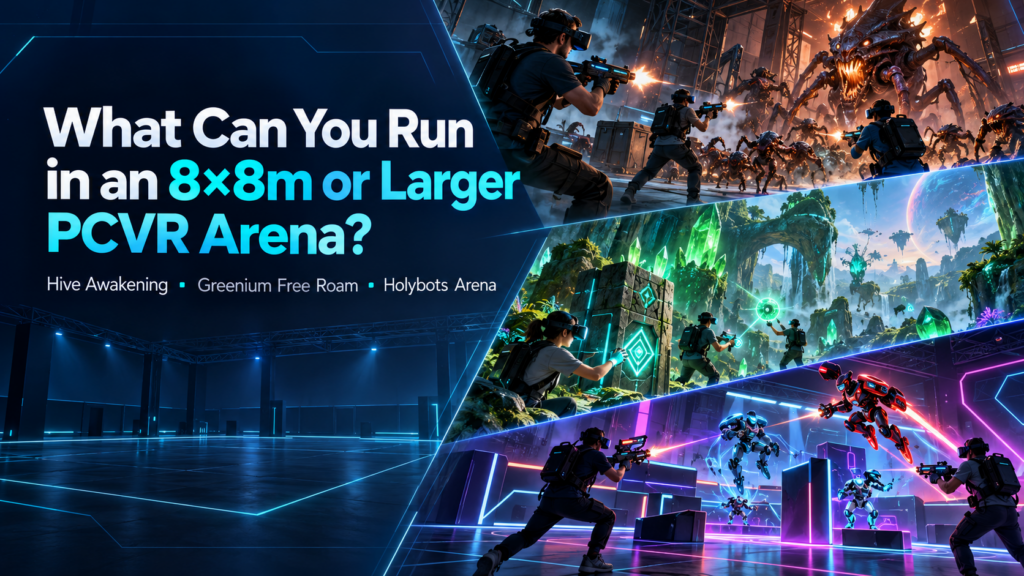
Once a VR venue dedicates 64 square meters or more to a free-roam attraction, content selection becomes a bigger operational decision. The physical space can support experiences that give groups considerably more freedom to move, but arena size alone does not determine how that space performs commercially. Player capacity, game format, audience fit, replayability, and the variety of experiences available for the same footprint all matter. For this article, we are looking specifically at PCVR free-roam experiences with configurations of 8×8 meters or larger. Three titles on the SynthesisVR marketplace illustrate how differently operators can use that space: Swarms: Hive Awakening, Greenium Free Roam, and Holybots Arena. What changes when a PCVR arena reaches 8×8 meters? An 8×8 meter play area gives operators 64 m² of shared physical space. A 10×10 meter arena increases that to 100 m², while some configurations go considerably further. That additional room matters because free-roam gameplay can use physical movement as part of the experience. Players can spread out, reposition themselves, work together across a shared environment, or compete for control of the arena. The commercial question is therefore larger than, “Will this game fit?” Operators also need to ask what audiences the arena can serve and how many different reasons they can give customers to book the same physical attraction. The three examples below show how one broad arena category can accommodate cooperative action, puzzle-driven adventures, and competitive PvP. Swarms: Hive Awakening: PCVR free roam at serious scale Swarms: Hive Awakening supports two notably large configurations: Arena Players 8×8 m 1–8 16×12 m 1–8 The 16×12 meter option is particularly interesting because it represents 192 m² of playable space. In Hive Awakening, players form a team of elite fighters sent to the Corigis-B12 mining facility to stop an invasion. The cooperative format gives operators a clear group experience for friends, parties, and teams that want to play together rather than rotate through individual stations. For an operator, Hive Awakening also demonstrates an important point about large-arena PCVR. Once a venue can support eight players across a substantial shared area, the attraction starts functioning as a group destination within the venue rather than simply another headset activity. The larger configuration also raises practical questions about floor allocation, networking, PC infrastructure, staff supervision, and how frequently the venue can fill an eight-player session. Those factors should be considered alongside the experience itself when planning an arena of this size. Greenium Free Roam: using a large arena for puzzles and cooperation Large free-roam arenas do not have to revolve around combat. Greenium Free Roam takes a different approach. Players become scientists exploring a distant planet, solving puzzles, confronting poachers, and upgrading their ship while working together to secure valuable crystals. Its available configurations scale progressively with both space and group size: Arena Players 8×8 m 2–8 9×9 m 2–9 10×10 m 2–10 The title can therefore scale from an eight-player 64 m² arena to a ten-player 100 m² setup. That makes Greenium useful when thinking about attraction variety. A venue may have customers who enjoy free-roam VR but are less interested in a pure shooter. Cooperative puzzles and exploration give operators another way to use the same physical investment while targeting groups looking for teamwork and shared problem-solving. It also illustrates why player count matters alongside square meters. Expanding from an 8×8 to a 10×10 configuration can increase the supported group from eight to ten players, which may affect how an operator structures private bookings, parties, or group packages. Holybots Arena: turning the same footprint into competitive PvP Holybots Arena brings another format into the mix: fast-paced player-versus-player free-roam. Players choose an archetype and enter a futuristic robot arena, turning the physical space into a competitive multiplayer environment. Its larger configurations include: Arena Players 8×8 m 2–4 9×8 m 2–6 9×9 m 2–6 10×10 m 2–8 This creates a different operational proposition from either Hive Awakening or Greenium. Rather than bringing a large cooperative group through one shared adventure, operators can use the arena for competitive matches that encourage players to challenge friends, change strategies, and play again. That difference becomes important when planning a content library. A venue with one large PCVR arena may want experiences that give customers genuinely different reasons to return rather than several titles that deliver essentially the same style of session. One large arena can support very different attraction formats These three titles show why arena size should be considered together with content strategy. Hive Awakening can use an exceptionally large 16×12 meter space for an eight-player cooperative experience. Greenium Free Roam scales up to 10×10 meters and ten players while emphasizing puzzles and teamwork. Holybots Arena uses up to 10×10 meters for competitive PvP. The hardware investment and floor allocation behind a large PCVR arena may remain relatively stable while the guest experience changes considerably. That gives operators an opportunity to think about the arena as a flexible attraction platform. A group might visit for a cooperative science-fiction campaign one month, return for a puzzle-focused adventure, and later compete against each other in PvP. Content rotation can therefore help make the physical space useful to more than one audience and create additional reasons for previous visitors to come back. Before dedicating 64 to 192 m² to free-roam VR Larger arenas also carry a larger opportunity cost. Every square meter devoted to VR could otherwise hold another attraction, seating, party space, circulation, or revenue-generating equipment. Operators therefore need to evaluate more than the maximum supported dimensions. Look at realistic group sizes, expected utilization, session flow, hardware requirements, staff involvement, and the number of experiences that can run within the chosen configuration. An arena that technically supports ten players only creates ten-player capacity when the venue can consistently attract, onboard, and operate those groups. The strongest setup is usually one where the space, player capacity, content mix, and target audience make sense together. Managing a larger PCVR content mix As the attraction grows, managing different games, player groups, and session configurations
3 Spooky VR Games for Arcades to Feature This Fall
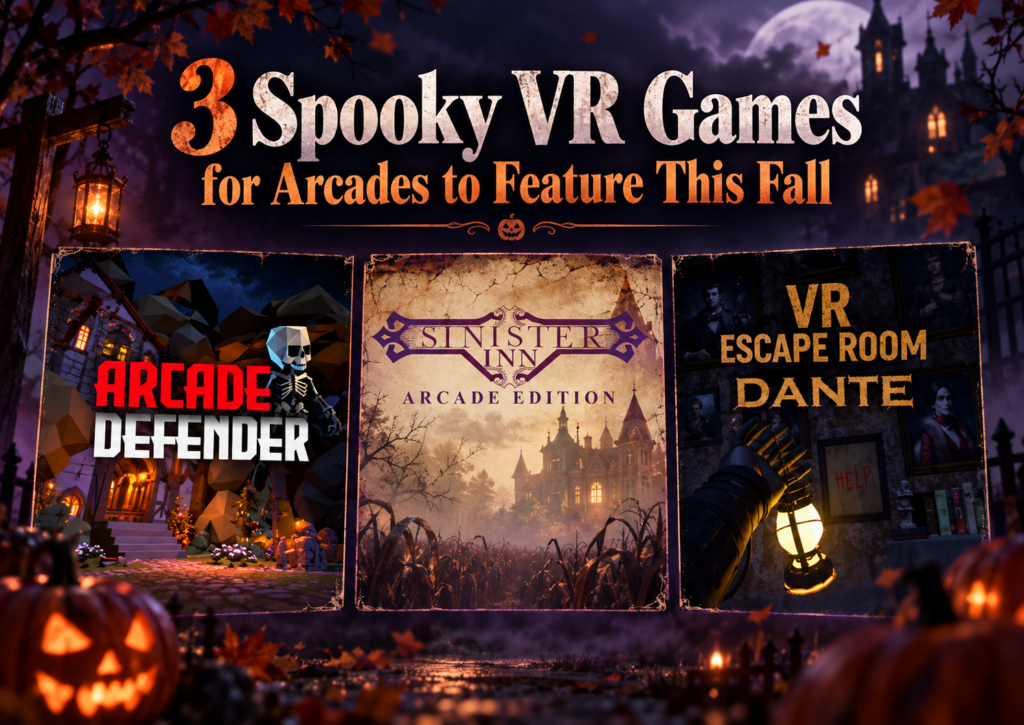
Spooky VR games for arcades can fill very different roles in a fall content lineup. One venue may need something light enough for families and mixed groups, while another wants a longer haunted escape experience or a quick scare that fits between other attractions. That variety matters as fall events, Halloween bookings, student outings, and group visits begin to pick up. Instead of building the whole seasonal offer around one type of horror experience, operators can choose content that fits different audiences, session lengths, hardware setups, and available play space. We recently looked at three very different options available through SynthesisVR: Arcade Defender, VR Escape Room: Dante – Haunted House, and Sinister Inn. Together, they show how broad the “spooky VR” category can be. If you are already planning a larger seasonal promotion, our guide to building Halloween VR arcade packages covers timing, audience segmentation, packaging, and promotion. Here, we are going deeper into the games themselves. Game Players Session Hardware Format Suggested Fit Arcade Defender 1–8 Adjustable PICO, Quest Free-roam Families, teens, mixed groups VR Escape Room: Dante – Haunted House 2–6 30–40 min PCVR, Standalone Free-roam and Room Scale Friends, older groups, escape room fans Sinister Inn 1 3 min PICO, Quest, Focus 3 / Vision Free-roam walkthrough Short horror attraction, add-on experience Arcade Defender: A Lighter Spooky Option for Larger Groups A fall attraction does not always need to be genuinely frightening. For venues serving families, younger teens, birthday groups, and mixed-age visitors, lighter seasonal content can often fit more bookings. Arcade Defender takes that route. Players defend a village from waves of small monsters as they try to make it through the night. The theme stays spooky enough for the season while keeping the presentation accessible, with a suggested age of 12+. Operationally, the flexibility is one of its strongest points. Arcade Defender supports 1 to 8 players, runs on PICO and Quest, and uses an adaptive free-roam area with a maximum size of 10 × 10 meters, or 32.8 × 32.8 feet. Playtime can also be adjusted. That combination gives operators room to use the title in different ways. A smaller group can play without needing to fill every available headset, while a larger booking can turn it into a shared attraction. Adjustable playtime can also help when operators are building the game into a wider package rather than selling it as the entire visit. The title requires an internet connection and uses a standalone game server. For venues already operating standalone free-roam VR, that makes the hardware fit particularly relevant. There is also a Game Community available for Arcade Defender. Operators considering the experience can use that space to share feedback and learn from other venues running the title. Where Arcade Defender fits this fall Arcade Defender makes sense when a venue wants seasonal atmosphere without limiting the audience to dedicated horror fans. It could sit comfortably inside a family Halloween package, an after-school promotion, or a fall group offer where some guests may enjoy spooky themes but have little interest in intense horror. Its group capacity also makes it the broadest option of the three titles in this article. VR Escape Room: Dante – Haunted House for a Longer Group Session Some groups want more than a seasonal backdrop. They want to enter the haunted house, explore it together, solve problems, and stay in that world for most of their booking. VR Escape Room: Dante – Haunted House moves much closer to that type of experience. Dante supports 2 to 6 players and runs for approximately 30 to 40 minutes, giving operators a full-length cooperative VR escape room rather than a quick seasonal add-on. The experience supports both PCVR and standalone hardware. Venues can run it in a 5 × 5 meter free-roam area, equivalent to 16.4 × 16.4 feet, and it is also available in a room-scale configuration. That flexibility is useful because the experience does not depend on one venue layout. An operator running a dedicated free-roam area can use the larger physical format, while another location may have a room-scale setup that better fits its existing floor plan. The longer session also changes how a venue might sell it. A 30 to 40 minute haunted escape can form the main attraction in a booking. That makes it particularly relevant for groups of friends, older teens, adult social bookings, couples, and customers who already understand the appeal of escape rooms. The cooperative format gives guests something to focus on together throughout the session. Horror provides the atmosphere, while the escape room structure gives the group a shared objective. Dante requires an internet connection and supports a standalone game server. Its SynthesisVR listing also includes access to a Game Community, giving operators another place to compare experiences and share practical feedback. A natural crossover between VR arcades and escape rooms Dante also gives venues a useful marketing angle outside Halloween itself. “Haunted VR escape room” communicates the experience more clearly to a local audience than a game title alone. Customers already understand what an escape room is, and the haunted-house theme adds a seasonal reason to try it during fall. That makes Dante useful well beyond a single Halloween weekend. Operators can promote it throughout September and October, then keep it available for customers who actively look for horror or escape room content later in the year. Sinister Inn: Three Minutes, No Controllers, Just Keep Walking Sinister Inn takes the haunted-house idea in a completely different direction. The entire experience lasts three minutes. There are no controllers to learn and no puzzles to solve. A player physically walks through the halls of the Sinister Inn and experiences what happens along the way. That simplicity is central to the attraction. The inn belongs to Isabelle H. Minister, whose spirit has become intertwined with the property. The player enters alone and follows the route through the building, with the experience built around movement, atmosphere, anticipation, and the question of what might appear around
Is Your VR Venue Ready to Add Another Attraction?
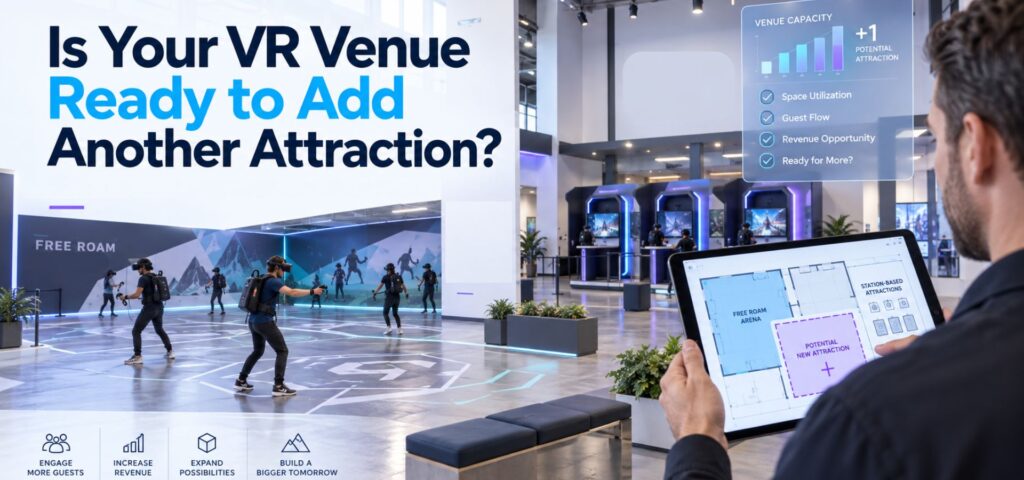
Adding another attraction can feel like the obvious next step when a VR venue starts getting busier. Perhaps weekend slots are filling consistently. Birthday groups are getting larger. Customers are asking for more variety. There may be unused floor space that could support another free-roam arena, a few standalone stations, or a different type of multiplayer experience. The question is whether the venue actually needs more capacity yet. Adding hardware increases the number of experiences a venue can sell, but it also adds another schedule, another set of devices, more content decisions, additional staff responsibilities, and another attraction that needs to earn its place on the floor. Before expanding, operators should look at what their current setup is already telling them. Start With the Capacity You Already Have A busy Saturday does not necessarily mean an attraction has reached its capacity. Look at utilization across the full week. An eight-player arena that regularly fills during birthday bookings may still spend large parts of weekday afternoons unused. A venue with several room-scale stations may appear busy because customers arrive continuously, while individual stations remain empty between bookings. That distinction matters because expansion solves a capacity problem. It does much less for a demand problem. Our guide to How Many Players Should a VR Attraction Support? looks at this from the booking-model side. Eight simultaneous players can mean one eight-player arena, two four-player experiences, or several smaller attractions. The useful capacity depends on the way customers actually book. Identify the Booking the Current Venue Cannot Serve The strongest reason to add another attraction is usually a specific booking opportunity. For example, a four-player setup may work well for walk-ins but become difficult when birthday groups regularly arrive with eight or twelve guests. A free-roam arena may handle large social groups well while leaving couples and smaller groups with limited options. The gap could also be demographic. A venue with mostly competitive shooters might receive regular family traffic without enough suitable content. Another location may serve casual players well but lack an attraction strong enough for repeat visits from experienced groups. Before expanding, define the gap clearly: Which customer or booking type could we serve better if this attraction existed? That question is more useful than asking whether a new attraction looks impressive. We recently explored the same principle from the content side in How to Choose VR Arcade Games for Different Customer Groups. Hardware, space, group size, staff workflow, and audience fit all affect whether an experience works commercially. Check Whether More Capacity Creates More Throughput The theoretical capacity of an attraction and the number of sessions staff can actually deliver are rarely identical. Suppose a venue adds a second multiplayer attraction. That may allow two groups to play at once. It may also mean staff now need to: If the existing team already struggles during back-to-back bookings, another attraction can increase pressure without creating the expected number of additional sellable sessions. This is why throughput belongs in the expansion calculation. The VR Arcade Business Plan guide uses a simple starting model: available sessions × average players per session × realistic utilization × average revenue per player The important word is realistic. Session capacity has to account for onboarding, resets, maintenance, delays, and staff workload rather than relying on the maximum number printed on the attraction specification. Watch What Happens During Your Busiest Hour Peak periods often reveal more than weekly revenue totals. Observe one genuinely busy hour at the venue. Where does the line form? Is staff waiting for headsets to become available? Are customers waiting for a play space, or are they waiting for an employee to launch the experience? Does one attraction finish while another group is still being prepared? Are staff moving between several systems to check bookings, launch content, or resolve device problems? These observations help distinguish between a physical capacity constraint and an operational constraint. That matters because adding another attraction only directly fixes the first one. The wider attractions industry sees the same issue. IAAPA’s recent guidance for FEC operators describes how multiple attractions, staff roles, and guest touchpoints can allow small operational problems to compound quickly. That is useful context for VR venues because expansion usually increases coordination before it increases complexity anywhere else. Make Sure the New Attraction Adds Something to the Mix Another attraction should have a role. It might increase capacity for large parties. It might create a lower-cost option for couples and small groups. It could introduce cooperative content alongside an existing competitive offer. It may give families something accessible while older visitors use a more intense free-roam experience. Or it could make an underused part of the building commercially productive. The risk is adding an attraction that competes with the venue’s existing offer for the same customers. If two attractions target the same audience, group size, price range, and occasion, operators may simply divide existing demand between them. A useful attraction mix gives customers different reasons to book. Our article on VR arcade content rotation makes a related point: customer behavior should drive changes to the lineup. Operators can look at selection frequency, repeat requests, operational friction, and audience gaps before deciding what belongs in the mix. Calculate the Full Cost of the Expansion The hardware purchase is only one part of the decision. Depending on the attraction, expansion can introduce costs for: It can also introduce a less visible cost: floor space. A large attraction needs to earn enough to justify the area it occupies. That is particularly important when comparing free-roam with smaller station-based formats. Our guide to free-roam VR arena space requirements explains why footprint, hardware, and available content should be evaluated together rather than treating square footage as a standalone requirement. Operators building the financial model can also use our VR Arcade Startup Budget and Revenue guide. Although it was designed around new venues, the same logic applies to expansion: build the investment around your own capacity, labor, hardware, software, content, and revenue assumptions
What Successful VR Venues Do Differently to Stay Profitable Year-Round
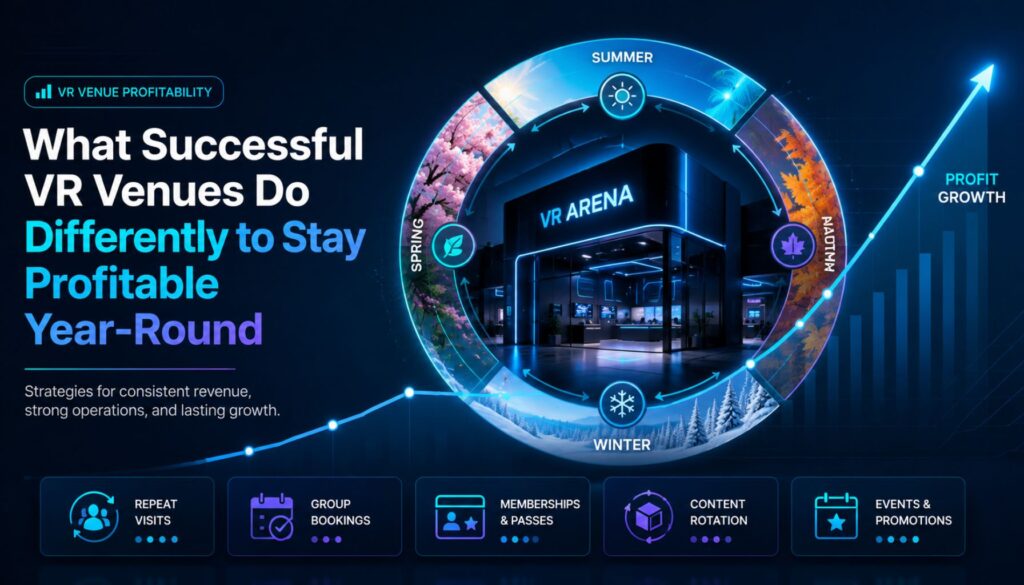
Most VR venues can attract attention when they first open. The harder test comes 12 to 24 months later, after launch coverage has faded and the first wave of local curiosity has passed. Industry guides place mature, well-run VR venues within a broad net margin range of 20 to 40 percent. Headset choice affects costs, but it rarely explains the full distance between the bottom and top of that range. The larger differences usually appear in demand generation, booking behavior, staff workflows, session throughput, repeat visits, and revenue outside paid headset time. That is where VR venue profitability becomes measurable. The 2026 attractions industry benchmark data, drawn from anonymized booking and transaction records across the sector, gives operators a useful way to compare their systems with wider market behavior. Advance bookings make demand more valuable and more visible Online bookings generate 45 percent of total revenue across attractions venues while accounting for only 33 percent of bookings. That means online bookings over-index on revenue by 12 percentage points. The benchmark does not isolate the reason. Larger groups, higher-value packages, advance upgrades, and add-on purchases could all contribute. The operational conclusion remains useful: advance bookings carry more revenue per booking and give the venue time to plan around them. A venue that reaches Wednesday with half its weekend sessions already committed can schedule staff against known demand, prepare for larger groups, and spot a soft weekend early enough to respond. A venue that relies mainly on walk-ins learns how the week performed while the week is already happening. The practical improvements are straightforward: Advance rates and group pricing can help, although the commitment matters more than the discount itself. Marketing keeps demand active throughout the year A short booking path helps convert interest, but the venue still needs to create that interest. Once opening coverage and local curiosity decline, year-round performance depends on a repeatable way to reach new customers and bring previous guests back. Attractions-industry guidance treats customer acquisition and retention as core revenue activities. Targeted campaigns, segmented guest communication, membership promotion, and post-visit follow-up can help venues generate bookings without depending entirely on walk-in traffic or seasonal demand. For a VR venue, the strongest campaigns usually begin with a specific audience and occasion: The marketing content should also make the experience easy to understand. Guests need to know how many people can play, how long the session lasts, whether players compete or cooperate, what age group it suits, and what makes the experience worth sharing. Generic headset footage creates awareness, but specific group scenarios give people a clearer reason to book. Guest data turns one-time promotion into a repeatable system. Venues can track where bookings originated, which packages generated revenue, how many guests returned, and which audiences filled normally quiet periods. A campaign that reliably fills four Tuesday sessions may contribute more to profitability than a post that reaches thousands of people without producing bookings. Marketing creates demand, the booking journey captures it, and venue operations determine how much of that revenue becomes margin and repeat business. Consistency is whatever survives a staff change Attractions venues often rely on seasonal and part-time staff, which limits how much operational quality can depend on one experienced employee. Every critical process that exists only in an experienced employee’s head creates a business risk. Guests experience that risk as waiting. Resets take longer. Briefings vary between staff members. Sessions start late because the person on shift is trying to remember which title launches in which way. A group that arrived on time spends part of its paid visit watching staff troubleshoot. Venues that hold steady through turnover standardize session launches, headset preparation, guest briefings, resets, and basic fault recovery. They maintain the same approved content library across the headset fleet and build reset steps into the workflow. By week ten, a new hire should be following the same operating pattern as an experienced team member. We covered the throughput side of this in Launching Games Without Breaking the Flow. Commercial VR content protects throughput A consumer title can be entertaining and still be awkward to run in a commercial venue. Venue-ready content needs clear onboarding, predictable session lengths, reliable multiplayer handling, simple reset behavior, and a commercial license. These elements determine how efficiently staff can move one group out and the next group in. When they are missing, the commercial cost appears as friction: The exact throughput target depends on session length, attraction format, and the number of stations in the venue. The principle stays consistent. When actual session capacity falls below the floor plan’s model, margin disappears into setup and reset time. Commercial licensing sits underneath the entire operation. Using a title in a paid venue requires more than access through a consumer storefront or commercial Steam account. We explain the distinction in VR Commercial Licensing Explained. The numbers that separate a steady venue from a seasonal one Guest-level metrics such as repeat visit rate and time to second visit are covered in How VR Entertainment Venues Turn First-Time Visitors Into Repeat Customers. The figures below answer a broader question: has the venue built enough recurring demand to hold through a quiet stretch? Members visit nearly four additional times per year Members visit 4.9 times per year, compared with 1.3 visits for non-members. That is an additional 3.6 visits per person annually. Membership revenue gives the venue a base of customers who already have a reason to return. It also gives the operator a group that can support weekday sessions, content rotation, member events, and quieter calendar periods. A membership still needs enough value to justify renewal. We cover the structure in How VR Arcades Actually Make Money. Party programs create future customers Guests return 41 percent of the time at venues that run parties, compared with 26 percent at venues that do not. That is a 15-point difference. Party packages already appeal to operators because they can combine group pricing, food and beverage, private space, and predictable scheduling. The benchmark
Free-Roam VR vs Room-Scale VR: What Commercial Operators Actually Need to Know
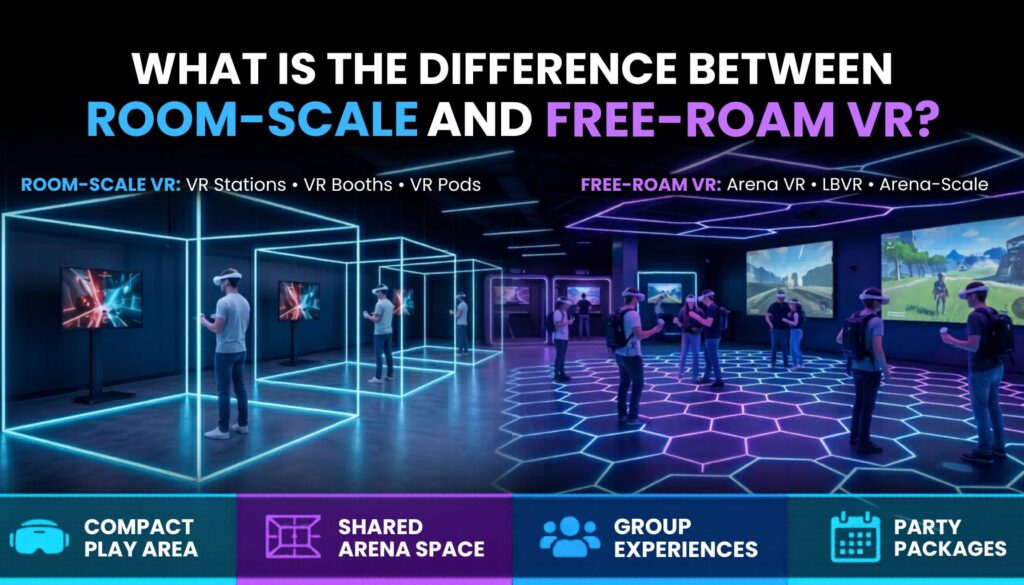
When people compare room-scale VR and free-roam VR, the discussion usually starts with space. Room-scale uses a smaller tracked area. Free-roam uses a larger physical arena where players walk naturally. That explanation is technically accurate. For commercial operators, it is also incomplete. Room-scale VR and free-roam VR are different attraction formats, each serving a different operational and commercial role inside a venue. They affect staffing requirements, player capacity, content strategy, floor plan decisions, and how a business generates revenue. Data from hundreds of commercial VR venues shows that operators rarely choose one format over the other: they build around free-roam as the primary investment, then layer room-scale around it to serve a different part of the guest experience. Understanding why that pattern works is more useful than debating which format is “better.” What Does Room-Scale VR Mean? The debate around free-roam VR vs room-scale VR usually starts with space. Room-scale VR refers to experiences that take place within a defined tracked play area, typically a minimum of 2×2 meters and ideally 2.5×2.5 meters per player or group. Within that space, players can walk, crouch, turn, and interact physically rather than sitting or standing in a fixed position. The setup can take several forms. Some operators build enclosed rooms with solid walls. Others use curtain dividers or open floor plans with clearly marked boundaries. A monitor facing outward so waiting guests can watch gameplay in progress is standard across all configurations. The experience may support a single player or a small multiplayer group, as long as all players share the same tracked area. Across the industry this format goes by several names: VR stations, VR booths, VR pods. These are not distinct attraction categories. They describe different ways of delivering the same format, whether that means an open play position on a venue floor, a partitioned booth for privacy and organization, or a branded enclosed unit with custom theming. The format is consistent: compact, defined play space with flexible deployment. Because room-scale setups require relatively little floor area and integrate into most existing layouts, operators use them to add attraction variety, increase density, or introduce new content without major venue redesigns. That flexibility matters most when a venue is already anchored by a larger attraction and needs to fill the surrounding floor plan productively. What Does Free-Roam VR Mean? Free-roam VR allows multiple players to walk through a shared virtual environment together, each wearing a wireless headset, navigating the same physical arena at the same time. Where room-scale defines a boundary for each player, free-roam removes that boundary. Everyone in the experience occupies one shared arena space, physically moving alongside each other while interacting inside the same virtual world. The format is commonly referred to as free-roam VR, arena VR, or arena-scale VR. Within the industry, location-based VR and LBVR are broader terms that often apply here as well. The technology behind free-roam has changed significantly over the past several years. Early commercial setups relied on backpack PCs: players wore full computing rigs on their backs through the experience, and tracking depended on external sensor arrays that required significant setup time between sessions. Modern free-roam operates differently. Standalone headsets with inside-out tracking have largely replaced backpack systems. Arenas are designed specifically to support stable tracking: floor markers, aruco patterns, and walls with non-repeating visual textures give headsets consistent reference points as players move. The result is more reliable tracking, faster resets, and simpler day-to-day operations. Arena size in free-roam is not fixed by a single standard. Most commercial free-roam titles are designed around a 6x6m (20x20ft) play space, which has become the practical baseline for operators because it unlocks the widest range of available content. Larger arenas, typically around 10x10m, support more simultaneous players or give players more physical room, though player counts do not always scale with the additional space. Some titles allow operators to adapt the experience to a different play space size, but that flexibility is less common across the catalog. The practical starting point for most operators is sizing the arena around the content library they want to run, not the other way around. Free-roam experiences are built around what the format does well: multiplayer cooperation and competition, physical exploration across a large shared space, and social play where every participant is present in the same environment at once. The Practical Difference: Movement and Play Area The most visible difference between the two formats is how players move. In room-scale VR, movement stays within a compact tracked area per player. In free-roam VR, walking is central to the experience: players navigate the arena physically and the virtual world responds to where they actually are. From an operator perspective, that produces meaningfully different venue requirements. The choice is rarely about which format is technically superior. It is about which format fits the venue being built and the audience it serves. Why Free-Roam Draws Stronger Commercial Interest Several factors have made free-roam VR the more discussed format among venue operators, and data from commercial deployments reflects that priority consistently. The clearest factor is replicability. A consumer at home can buy a headset, clear some furniture, and run a room-scale experience. The quality differs from a commercial setup, but the format is accessible. Free-roam arenas are not. No home environment accommodates a shared arena with multiple simultaneous players, calibrated tracking walls, and the session infrastructure a venue provides. Content reinforces that gap in a specific way. Titles like Arizona Sunshine Remake: Free-Roam and After the Fall: Free-Roam are built exclusively for commercial venue deployment. They have no consumer release. A guest who already owns a home headset still has a clear reason to book: the experience they want does not exist on any device they can buy. That content exclusivity also has a less obvious commercial benefit. VR content licensing structured through a commercial platform closes the route that consumer versions leave open. Room-scale content that exists in consumer ecosystems can be acquired and run by any venue regardless