
Running 360 Video in a Commercial VR Venue
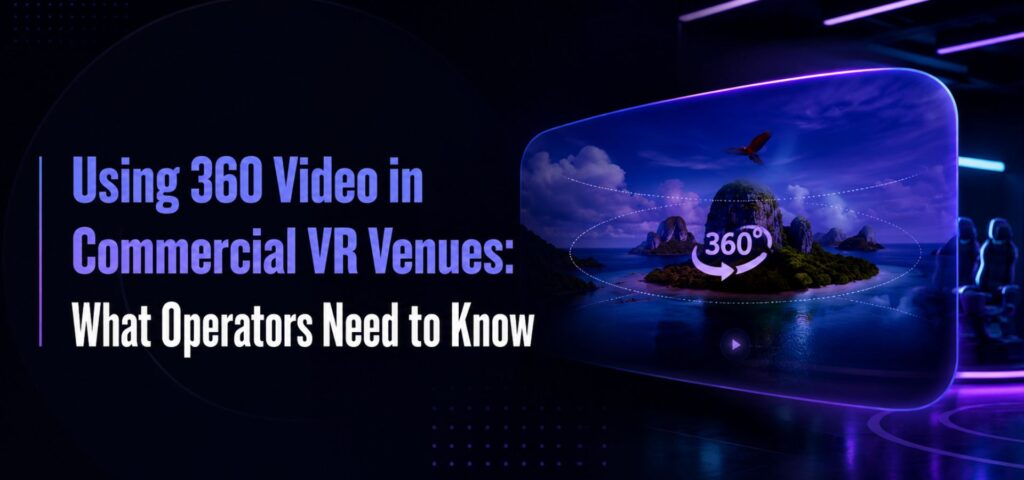
Most VR venue planning starts with the catalog: which games pull the best crowds, which titles support the most players, which escape rooms keep groups coming back. Game-led content carries the core of the business for VR arcades and LBVR locations. There are sessions, though, where a guided viewing experience fits the room better than a competitive multiplayer title. A school group on a tight schedule, a corporate booking that needs a consistent walkthrough, a trade show booth running the same content every fifteen minutes, a tourism partner showing off a destination: these all call for content that repeats cleanly, guides easily, and asks almost nothing of a first-time user. That is where 360 video earns a place in the attraction mix. Why 360 video still works in a venue 360 video suits sessions where the goal is controlled viewing rather than active play. It needs no complex controls, no deep onboarding, and no full game loop, which makes it a low-friction option for audiences who have never put on a headset. For school groups, corporate teams, museum guests, or booth visitors with five minutes to spare, a short immersive clip often lands better than a session that asks them to learn a game first. The commercial backdrop supports the format. Location-based VR sits inside a broader out-of-home immersive market that analysts expect to keep growing through the rest of the decade, even though their estimates of its size vary widely. For an operator, the practical read is steady demand for varied, low-friction immersive content that a venue can put in front of mixed audiences. What Deploy Reality Player is Deploy Reality Player is a commercial VR video player built by Deploy Reality, the parent company of SynthesisVR. It plays monoscopic, stereoscopic, and 360-degree video on PCVR room-scale rigs and on standalone headsets including Pico, Quest, and Focus 3 / Vision. The real value sits in the commercial layer around playback: one operator launching the same content across a bank of headsets, keeping viewers in sync, and running a session without handing a controller to every guest. Where it fits in a venue For VR arcade and LBVR operators, 360 video widens what the headset fleet can do between game sessions. It supports seasonal programming, short intro experiences (demo sessions) for first-timers, travel and destination content, and add-on viewings before or after a main booking. The operational payoff is utilization, since you get more reasons to keep headsets earning across the day rather than only during peak game slots. For training and education providers, the value sits in repeatability. A safety walkthrough, an equipment familiarization clip, or a guided site tour plays the same way for every participant, which is what institutional learning content needs. The format also holds up under study: a peer-reviewed experiment with primary school pupils found that 360-degree video field trips produced consistently higher content recall than standard video, with stronger engagement and a greater sense of immersion. Schools running virtual field trips and corporate teams running onboarding get a consistent experience without building a game around it. For events, trade shows, and brand activations, time is the constraint. Staff need content that starts fast, explains itself, and repeats all day. A 360 tour of a property, factory, or destination works even when a visitor only has a few minutes, and a booth can keep the queue moving without a technical operator minding each headset. Museums, tourism boards, and cultural venues use the same workflow to place guests inside locations that are otherwise hard, costly, or impossible to reach: heritage sites, protected nature, historical reconstructions, or remote destinations. The evidence here is encouraging. A study in the journal Sensors evaluated a VR experience that used 360-degree storytelling to take users through a submerged archaeological site, and recorded high levels of presence, immersion, and engagement using both participant questionnaires and EEG brain-activity readings. The operational side of playing 360 video commercially Playing a single 360 video on one headset is trivial, but running it across a venue is a different job. A staff member may need to launch the same clip on several headsets at once, start everyone together, sequence a playlist, and keep playback steady when venue Wi-Fi is unreliable. A consumer video app does none of this, while Deploy Reality Player runs every part of it from one control point. Session synchronization keeps a group watching the same frame at the same time, which matters when a guide is narrating or a class is meant to react together. Spectator view mirrors the headset feed onto a PC screen, so staff, parents, or waiting guests can follow along and a presenter can talk to what the group sees. Offline playback runs from locally stored files, so a busy session never depends on a live connection. Controller-free operation lets a guest get in and start viewing without a tutorial, and a centralized control panel runs play, pause, and seek across every active station from one place. Seeking through the timeline works while playback is paused, which keeps a guided session from drifting out of sync. Formats, platforms, and two limits to plan around The player handles monoscopic, stereoscopic, and 360-degree footage, with support for equirectangular 360, equirectangular 180, and 3:2 cubemap projections. It runs on PCVR room-scale setups through SteamVR and on standalone Pico, Quest, and Focus 3 / Vision headsets. The community page documents the full codec, container, and streaming reference, along with hardware notes and step-by-step setup. Two limits are worth knowing before you plan content. The player works only with your own VR videos, so you need the rights to anything you run through it. And it does not accept direct YouTube URLs; SynthesisVR includes YouTubeVR automation for Meta Quest headsets only, and any commercial use of YouTube content remains your responsibility to license with the rights holder. Licensing and setup Deploy Reality Player is available through the SynthesisVR content marketplace and runs on the free SynthesisVR Essential Access subscription, so an operator
PCVR vs Standalone VR for Commercial Venues
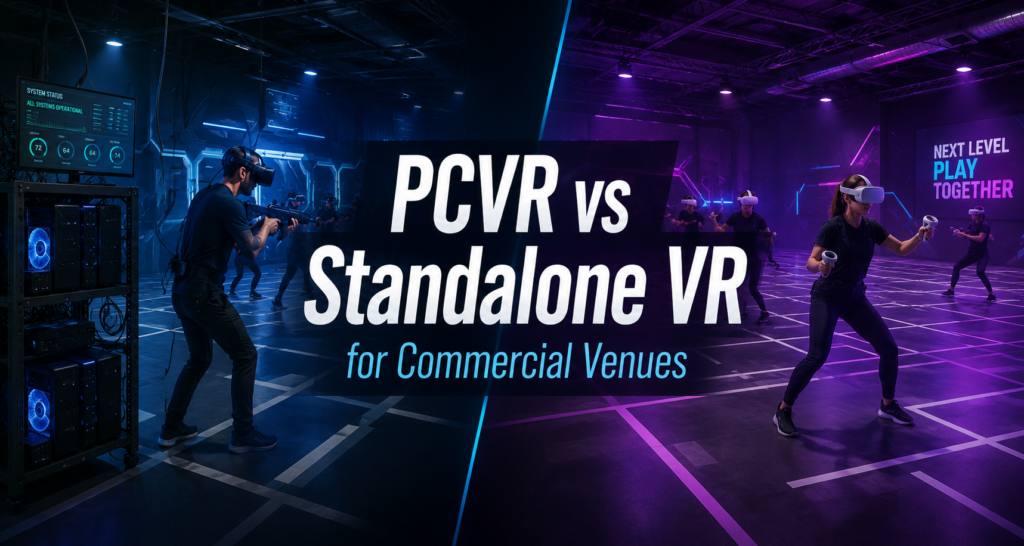
Choosing between PCVR and standalone VR used to be a tradeoff between quality and convenience. That tradeoff still exists, but it has changed shape, and most operators are no longer choosing one format from a blank slate. A large number of free-roam venues already run PCVR streamed wirelessly to the headset, and the real decision in front of them isn’t PCVR versus standalone. It’s whether adding standalone content alongside an existing PCVR setup makes sense, since the two can run side by side without requiring a venue to rebuild what it already has. Cables are no longer the dividing line PCVR headsets connect to an external computer that handles rendering, which still gives PCVR an edge in visual complexity and access to the broader Steam-based VR library. For years, that meant a physical tether, and tethers limited how freely a player could move, which made pure tethered PCVR a poor fit for arena-scale free-roam venues. That constraint has loosened. Wireless PCVR streaming, first popularized through headsets like the HTC Vive Focus 3 and now common on PICO devices, lets a PC render the game and stream it to the headset over the network instead of through a cable. A free-roam arena can run wireless PCVR streaming and get full, untethered movement while keeping PCVR’s rendering quality and library access. Plenty of arenas already operate exactly this way, and they run well. Standalone headsets take a different path to the same cable-free result. The headset renders the game itself, with no PC involved in the loop at all beyond whatever admin or server setup manages the fleet. The practical difference between standalone and wireless PCVR streaming isn’t cables anymore, since both can move freely around a free-roam space. It’s where the processing happens, and what that does to cost, hardware footprint, and content. What processing location actually changes The technical difference between the two formats comes down to what travels over the network. A standalone headset running free-roam renders the game locally on the device. The WiFi connection only carries session data: player positions, game state, and synchronization signals between headsets. Wireless PCVR streaming works the opposite way. A PC renders every frame and sends the full video stream to the headset over WiFi, which makes PCVR streaming considerably more bandwidth-intensive than standalone, even though both can run cable-free in the same arena. That bandwidth difference carries real infrastructure consequences. Wireless PCVR streaming still needs a capable gaming PC behind every station, or a shared rendering setup serving multiple headsets, plus the network capacity to carry that video traffic reliably, along with PC-side preparation: network configuration, and ongoing PC maintenance. Standalone needs none of that on the rendering side. The headset is the whole system for content, aside from the lighter admin infrastructure that coordinates the fleet and the session data passing between headsets. Setup reflects that same split. PCVR stations need a wired or properly configured wireless network connection and, for Steam-distributed titles, an individual Steam account per station, since Steam otherwise limits a licensed title to one machine at a time. Titles distributed through a dedicated content delivery network rather than Steam skip that requirement entirely, no Steam account needed at all, but you still need SteamVR running on all the PCs since SteamVR will be used to connect to the headsets wirelessly along with a program respective of the headset. For PICO it would be PICO BUSINESS STREAMING, for HTC FOCUS headsets you will use VIVE BUSINESS STREAMING etc. Standalone headsets need wireless debugging enabled and a shared network with the venue’s admin system, but carry no per-station account structure, since installation pushes directly to the headset. Neither path is harder than the other so much as different in where the complexity sits. PCVR, tethered or streamed, pushes more of it into PC, bandwidth, and account management per station. Standalone pushes more of it into device and connectivity management per headset. A venue running both ends up managing both kinds of complexity at once, which is one of the reasons centralized management tools matter more as a venue’s hardware mix grows rather than stays single-format. Content availability is the part hardware comparisons usually skip Most PCVR-versus-standalone comparisons stop at specs and never get into what an operator can actually deploy. This is the part that matters most for a venue planning content rotation, and it has changed faster than the hardware conversation has caught up with. A few things are true at the same time, and operators planning content strategy should hold all of them together: That last point matters for how operators should plan content rotation in practice. Checking format availability against current marketplace listings, rather than assuming based on a title’s reputation or its original platform, avoids building a rotation plan around a game that is not actually available in the format a venue runs. Licensing applies the same way to both Whichever format a venue runs, content needs commercial licensing rights, not consumer or personal-use licensing. This applies to PCVR and standalone titles equally, streamed or tethered. A venue running either format off a consumer content library carries legal and operational risk that has nothing to do with which headset is in the box, and everything to do with what rights came attached to the content itself. SynthesisVR’s content marketplace, the largest VR content marketplace for location-based entertainment, licenses titles across both PCVR and standalone through one system, with both formats installed and managed from the same Local Manager regardless of whether a station is a streaming PC setup or a standalone headset. That single management layer is part of why checking current availability by format is worth doing directly in the marketplace rather than relying on general reputation. Adding standalone to an existing PCVR venue Most operators evaluating standalone today are not starting from scratch. They are running a free-roam arena on wireless PCVR streaming already, and the real question is whether adding standalone headsets expands what the venue can offer without requiring
What Entertainment Venues Should Know Before Adding VR Attractions
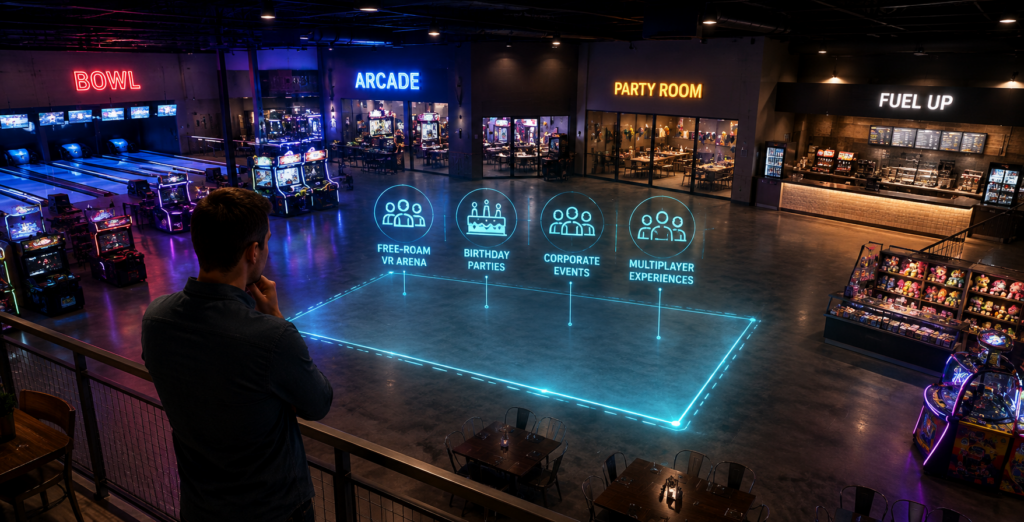
More family entertainment centers, arcades, trampoline parks, bowling venues, and attraction operators add VR every year, and the reasons are often similar. Some are looking to modernize aging attractions. Others want a weather-independent activity that performs during heatwaves, rainy weekends, and slower tourism periods. Many are searching for ways to attract group bookings, birthday parties, and younger audiences looking for social experiences rather than individual gameplay, building on the weekday utilization question this series covered last week. What surprises many first-time operators is how differently commercial VR behaves once the headsets start running daily sessions. A consumer who buys a headset for home manages a single device and a personal game library. A venue operating multiple headsets across hundreds of guests each week is managing a commercial attraction, with licensing requirements, content management, staff workflows, multiplayer coordination, and ongoing operational decisions layered on top. The hardware is the visible part of the investment, while the operational layer underneath it usually determines whether the attraction earns its floor space. Why Operators Keep Adding VR A decade ago, many venues treated VR as a novelty attraction. Today, commercial VR is an established category within location-based entertainment, and operators keep adding it because it solves several business challenges at once. Compared to many traditional attractions, VR often requires less physical space. It can help venues attract group bookings, provide an indoor entertainment option during extreme weather, and create experiences that guests cannot easily replicate at home. Many operators also value the flexibility VR introduces. A bowling lane delivers essentially the same experience year after year, and an escape room eventually reaches a point where returning guests already know the solution. VR attractions can evolve instead, through new content, seasonal experiences, different attraction formats, and multiplayer experiences that appeal to changing audiences over time. That flexibility becomes increasingly valuable as operators look for ways to keep guests returning throughout the year. Licensing Is Where Many First-Time Operators Get Stuck One of the most common surprises for new operators is discovering that consumer VR and commercial VR run on very different licensing models. A game available on a consumer storefront is not automatically approved for commercial use. Some developers offer separate commercial licenses, some work through dedicated commercial platforms, and others may not offer commercial licensing at all. For operators opening a venue, sorting through this becomes one of the most time-consuming parts of the research process. Questions that seemed simple at the planning stage get complicated fast: whether a title can run in a paid attraction, whether the license covers multiple headsets, whether multiplayer is included, and what happens when the developer pushes a content update. These questions rarely come up during early conversations about adding VR, yet they tend to become critical once operators move from planning into deployment. It’s one reason many commercial venues choose centralized content platforms that simplify licensing access and provide a larger catalog of commercially approved experiences through a single system. Operators who want the deeper mechanics of commercial licensing, including how studio agreements differ from consumer terms and what to check before signing, can find that covered in more detail in how VR content licensing works for LBE venues. What Makes a VR Attraction Commercially Viable A common mistake among new operators is treating headset selection as the primary business decision. Hardware matters, but it rarely determines long-term attraction performance on its own. The operators who get the strongest results tend to focus elsewhere: how quickly a session launches, how many guests can participate at once, what brings people back for a second visit, how often the content library gets refreshed, how much staff involvement a session actually requires, and how easily the attraction adapts to a birthday party one day and a corporate group the next. A technically impressive attraction can still struggle commercially if it creates bottlenecks at the booking desk, serves only a narrow audience, or gives guests no reason to return. The operators who do well tend to evaluate the entire guest experience rather than the device spec sheet alone. How VR Changes the Business Model This is where VR starts to diverge from many traditional attractions. A bowling lane generates revenue through scheduled games, an escape room typically serves one group at a time, and an arcade spreads revenue across dozens of individual machines. VR works differently: the same hardware can support cooperative adventures, competitive experiences, educational content, team-building activities, family-friendly games, and seasonal experiences without operators needing to replace the underlying attraction. For many venues, that changes how attraction value gets measured. Instead of evaluating a single game, operators end up evaluating the overall flexibility of the attraction itself. One content mix might perform well during summer tourism season, another might appeal more to birthday parties, and a different lineup might suit corporate events or school groups better, all while the physical infrastructure stays largely the same. The guest experience evolves around demand instead of the venue needing to rebuild around it. Free roam formats push this flexibility further, since the same tracked space can host different team sizes, mission types, and difficulty levels without new hardware. The tradeoff is that free roam introduces its own planning questions around arena layout and design and network setup, which matter enough that they deserve separate research before committing to a footprint. The Attraction Mix Question Many successful venues don’t add VR to replace an existing attraction. They add it to strengthen the overall mix. Some use VR to complement bowling, laser tag, escape rooms, or arcade floors. Others use it to create an indoor option during periods when weather affects attendance, expand birthday party offerings, or reach audiences who weren’t engaging strongly with the rest of the venue. The strongest implementations tend to fit into a broader venue strategy rather than operate in isolation, so before investing, operators benefit from getting clear on exactly what role VR will play inside the wider business. The goal usually isn’t to own VR equipment for
Cooperative VR Adventures Worth Exploring in 2026
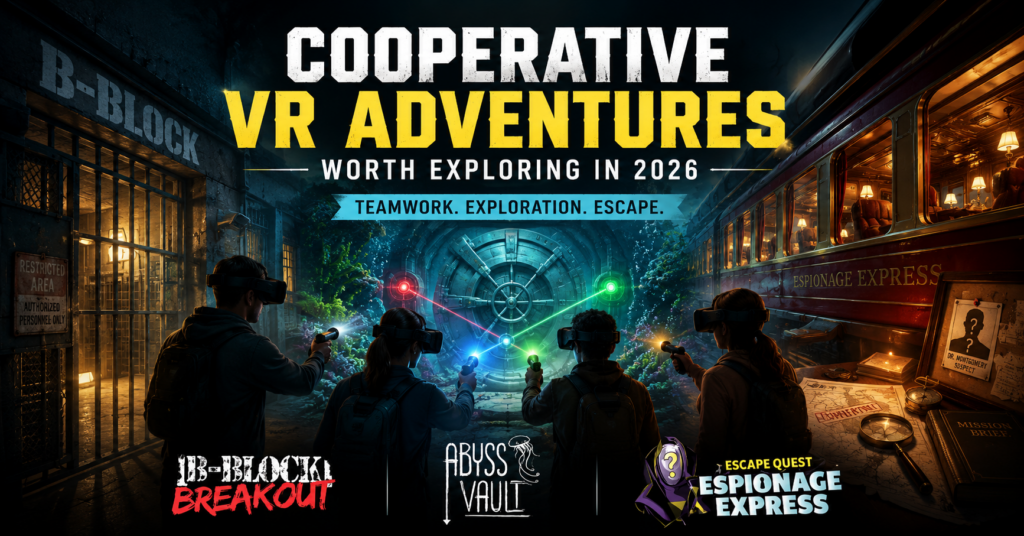
Competitive shooters and wave-based action games still dominate a lot of conversation around location-based VR content, but cooperative adventures hold a steady, important place in most successful attraction libraries. Operators running a single-genre lineup often miss a segment of guests who are not looking to compete at all. For families, corporate teams, birthday parties, and mixed-experience groups, a shared objective creates an easier entry point than direct competition. Instead of measuring individual performance, players solve problems together, explore an environment as a unit, and move through challenges as a team. Nobody has to “win.” The group either escapes, or it does not. Three current titles on the SynthesisVR marketplace show just how differently cooperative multiplayer can approach that same basic goal. Abyss: Vault: Exploration Through Teamwork Abyss: Vault drops a rebel squad into an underwater vault to recover what its owners hoarded. The vault fights back. Players carry different coloured light weapons (red, blue, or green) and have to combine beams to open doors and power systems as they push deeper. A mechanical crab guards the final stretch, and the game makes a point that lone players do not make it out. Coordinated squads do. This is a free roam title built for Pico, Quest, and Focus 3 headsets, with a footprint of roughly 19.7 x 19.7 ft (6.0 x 6.0 m) for 2 to 6 players. Operator angle: Groups looking for a longer-form adventure, rather than a high-intensity action session, tend to gravitate toward this kind of pacing. The colour-coded mechanic also gives operators an easy way to explain the experience to first-time players in under a minute. Escape Quest: Espionage Express: Solving Problems Together Escape Quest: Espionage Express puts players on a hacked train, chasing a saboteur named Dr. Montgomery through physics-based puzzles and a ticking clock. It leans on logic and observation rather than combat, and the studio built it specifically for players who are new to VR and still getting comfortable with the medium. The title runs on PCVR and standalone room-scale setups (Pico, Quest, Focus 3). A June 2026 update moved the game to a fully offline, LAN-based multiplayer system, removed the separate spectator subscription requirement, and added native support for standalone Pico headsets, so server and spectator-screen setup is simpler than it used to be. Operator angle: Escape-room style experiences often appeal to guests who do not think of themselves as gamers at all. It is a useful bridge title for venues trying to convert non-gaming groups, like a birthday party booked by a parent who has never picked up a controller. B Block Breakout: Collaboration Under Pressure B Block Breakout sends a group of scoundrels through a high-security prison they need to escape together. The game leans into atmosphere first: detailed prison interiors, a tense pace, and puzzles that depend on logic, deduction, and the occasional bit of luck. An auto-hint system can run on its own or be controlled by a Game Master watching the session, which gives operators flexibility on how hands-on they want staff to be during a playthrough. B Block Breakout supports both free roam (16.4 x 18.0 ft / 5.0 x 5.5 m, 2 to 6 players) and standalone or PCVR room-scale play across Pico, Quest, and Focus 3 headsets, giving operators flexibility depending on arena size. Operator angle: The strongest cooperative experiences tend to create their memorable moments through group problem-solving rather than combat, and this title is a clean example. The flexibility between free roam and room-scale setups also means it can fit venues that have not built out a larger free roam arena yet. Why Cooperative Experiences Matter for Commercial Venues This is the part that actually moves the needle for a venue’s calendar. Families do not always want to compete against each other, especially with a wide age range in the group. Birthday parties tend to book better when the activity does not single out a “winner” and a string of “losers” among ten-year-olds. Corporate groups often specifically request team-building framing, and a cooperative VR session delivers that without anyone needing to plan a contrived exercise. Mixed-age and mixed-experience groups, where a grandparent and a teenager are playing side by side, benefit when the format rewards communication over speed or precision. Cooperative titles also carry strong spectator appeal. A family member watching the action on a monitor screen is more engaged with a heist or escape unfolding than with a leaderboard updating. That spectator moment often turns into the next booking, since the person watching today is frequently the one calling to book a session next month. For VR arcade and FEC operators building a content rotation, the mix matters more than any single title. A LBE VR platform like SynthesisVR makes it straightforward to license titles like Abyss: Vault, Escape Quest: Espionage Express, and B Block Breakout alongside the rest of a venue’s catalogue, so operators can balance cooperative and competitive content without managing several separate vendor relationships. Final Takeaway Successful multiplayer attractions do not all rely on competition. Cooperative adventures offer a different kind of social experience, one built on communication, teamwork, and shared achievement rather than individual scorekeeping. For most venues, keeping a mix of competitive and cooperative content on the schedule means there is something that fits every group that walks through the door, whether that is a stag party looking for a shootout or a family of five who just want to escape a train together. Related Reading What Is the Difference Between Room-Scale and Free-Roam VR?How VR Arcades Fill Empty Weekday Sessions Without Discounting VR Room-Scale Classics Every VR Arcade Operator Should Know About
How Much Space Do You Need for a Free-Roam VR Arena? A Practical Guide for Operators
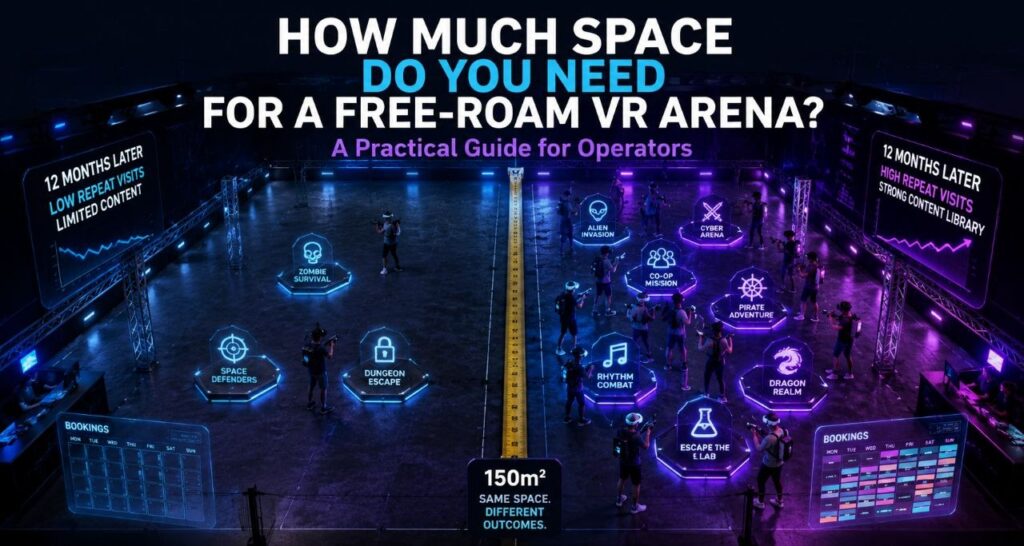
Two operators can open with the same floor plan and end up running completely different businesses. One launches with a handful of compatible experiences, burns through them within a few months, and watches repeat visit rates fall. The other builds a content rotation that supports birthday parties, corporate bookings, and returning regulars well into the second year. The space did not determine that outcome. The relationship between space, hardware, and content compatibility did. Most operators approaching this question want a number: minimum dimensions, something concrete for a lease negotiation or venue layout conversation. That number exists, and this article covers it. But the more important question is whether the footprint you choose gives you enough content range to run a profitable attraction twelve months after opening. What free-roam VR actually requires from a space Free-roam VR differs from room-scale in one practical way: players move independently through a shared physical space rather than standing in fixed positions. That movement creates simultaneous requirements for safety clearance, tracking reliability, and enough floor area that players are not colliding with each other or the play zone boundaries mid-session. Tracking systems, whether PCVR with external base stations or standalone inside-out on headsets like the PICO 4 Enterprise or HTC Vive Focus 3, need consistent line of sight across the full arena floor, low surface reflectivity, and adequate ceiling height. These requirements do not change with arena size, but they become harder to satisfy as the space grows and tracking zones multiply. The practical floor area question comes down to what the content itself requires. Across the commercial free-roam catalogue, 6x6m (20x20ft) is the standard minimum that the majority of titles are built around. Some compact titles run at 5x5m (16x16ft) or even 4x4m (13x13ft), but those represent a narrower selection. The 6x6m (20x20ft) threshold is where the bulk of available experiences become accessible. Arena size tiers and what each unlocks Commercial free-roam setups generally fall into four size bands. Each one changes not just capacity but content access. Entry: 5x5m / 16x16ft (25 sqm / 270 sq ft) A small number of titles are purpose-built for this footprint, typically compact shooters, escape room formats, and experiences designed for 2 to 4 players in tighter spaces. Great Train Outlaws, for example, runs at 5x5m for up to 4 players on PCVR. These setups can work as introductory or add-on attractions inside larger venues, but the content catalogue at this size is limited and operators tend to exhaust it faster than expected. Standard: 6x6m / 20x20ft (36 sqm / 390 sq ft) This is the most common minimum specification across the commercial free-roam catalogue, on both PCVR and standalone platforms. At 6x6m (20x20ft), the majority of available titles become accessible. Arizona Sunshine Remake: Free-Roam starts at 6x6m (20x20ft) for up to 4 players, available on both PCVR and standalone, and scales to 10x10m (33x33ft) for 8. Most operators opening a dedicated free-roam attraction should treat 6x6m as the baseline, not the floor. Mid: 8x8m / 26x26ft (64 sqm / 690 sq ft) Moving to 8x8m opens a meaningful jump in both player count and title variety. A significant portion of the catalogue lists 8x8m as the threshold for 6 to 8 player configurations. This is where team-based formats, competitive gameplay, and larger group bookings become viable without requiring a full large-arena footprint. Large: 10x10m / 33x33ft (100 sqm / 1,075 sq ft) The 10x10m tier unlocks the widest content library and the strongest commercial formats. After The Fall: Free-Roam illustrates the pattern clearly: at 6x6m (20x20ft) it supports 4 players, but the 8-player configuration requires 10x10m (33x33ft). Titles requiring this footprint tend to be the premium, high-capacity experiences, competitive league formats, large co-op missions, longer session durations, that justify higher ticket prices and drive stronger group booking performance. Why content compatibility matters as much as floor area When an operator locks in a footprint, they are also locking in a content ecosystem. Free-roam titles are built for specific arena dimensions, player counts, and hardware configurations. A game designed for 10x10m (33x33ft) with 8 players does not scale down to 6x6m (20x20ft) with 4. Content requiring PCVR tracking with external base stations cannot run on a standalone-only deployment. In practice, the titles available to a compact standalone arena are a genuine subset of what is available to a larger PCVR setup, and that subset narrows further at the entry tier. The question operators tend to underestimate is not “How many experiences do I have at launch?” It is “How long before my regular customers have played all of them?” A broader content library, and the ability to rotate in new titles regularly, is what extends the commercial life of the attraction past the initial novelty period. Operators who plan content strategy and footprint together tend to build more durable attractions than those who treat the two decisions separately. How space affects the commercial variables Session throughput is the first number most operators calculate: a 4-player session at 30 minutes plus 10 minutes of onboarding and reset gives roughly four sessions per hour per arena. Moving to 6 or 8 players changes the math, but it also changes which titles are accessible and which audience segments can be booked. Corporate groups, school trips, and birthday parties all have different minimum viable player counts, and a 4-player cap excludes a meaningful share of group booking demand. Audience flexibility follows from content range. A larger arena with diverse title options lets operators serve casual first-timers and returning experienced players on the same day by rotating experience types. A smaller arena with a narrower library tends to converge toward one primary audience, which limits growth when that segment is saturated. Infrastructure scalability is worth considering earlier than most operators do. A 6x6m arena built on an expandable PCVR backbone is relatively straightforward to grow. An arena built on standalone-only hardware may require a full equipment change to access the content catalogue that larger formats unlock. The setup decision often determines
How VR Arcades Fill Empty Weekday Sessions Without Discounting
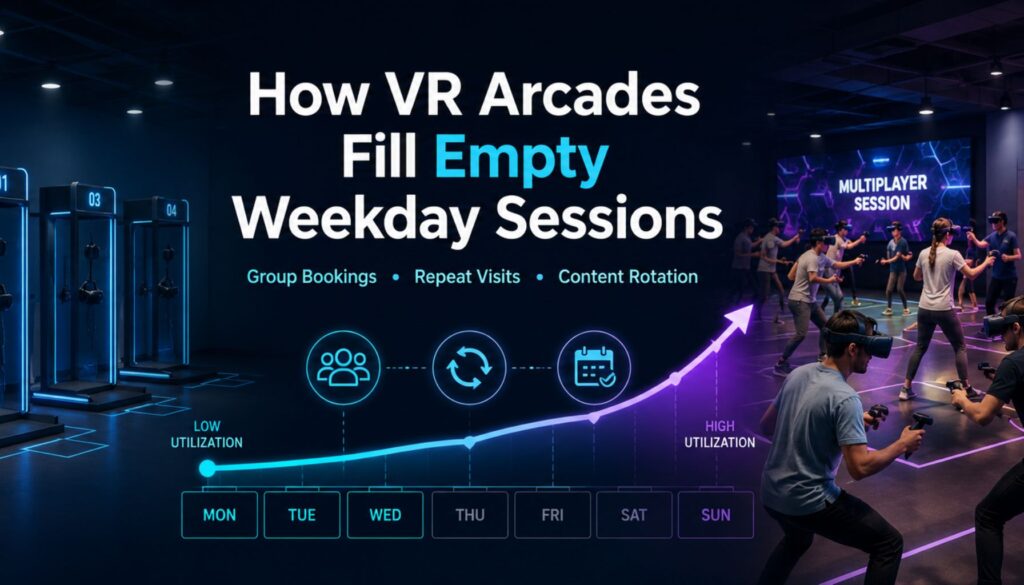
For most VR arcades, family entertainment centers (FECs), and location-based entertainment (LBE) venues, Friday evenings and weekends take care of themselves. The real operational challenge begins on Monday morning. Every empty VR session between Monday and Thursday represents revenue that can never be recovered. Unlike retail inventory, unused attraction capacity expires forever. Once a 3:00 PM session passes without players, that opportunity is gone. Many operators respond by introducing weekday discounts. While discounts may increase short-term bookings, they rarely solve the underlying problem. Over time, they can even reduce profitability by training customers to wait for lower prices. The strongest operators take a different approach. Rather than lowering prices, they redesign how weekday demand is created, packaged, and managed. They treat weekday utilization as an operational challenge—not simply a marketing one. Why Weekday Utilization Matters More Than It Looks A single underperforming weekday can offset gains from a strong Saturday. Across an entire year, consistent weekday gaps compound into a meaningful revenue shortfall, particularly for venues carrying fixed overhead on VR hardware and dedicated attraction space. Analysts estimate the location-based VR market will reach approximately $2.76 billion in 2026 and continue growing rapidly through the end of the decade. As more operators enter the market, long-term performance increasingly depends on operational consistency rather than novelty alone. Utilization influences several areas that operators often underestimate: A quieter Tuesday session often provides a better guest experience than a fully booked Saturday. That difference can influence reviews, referrals, and future bookings long after the session ends. Why Many VR Venues Struggle to Fill Weekday Sessions Empty weekdays rarely reflect a lack of interest in VR. More often, they reflect a mismatch between how the attraction is offered and how people organize their time during the week. Weekday audiences behave differently from weekend visitors. Families work around school schedules. Friend groups need low-friction planning and simple booking. Students coordinate around evening availability. Corporate groups require a clear reason to justify an outing during business hours. Tourists operate on unpredictable schedules and shorter decision windows. Many venues build their booking structure around peak weekend behavior and then expect those same systems to perform throughout the week. Across commercial VR venues, free-roam and room-scale attractions often attract different audiences and booking behaviors. Operators who understand those patterns tend to build more balanced attraction portfolios and create offers that fit specific weekday audiences rather than treating all bookings the same. Common friction points include: Operators regularly use group pricing for schools, sports teams, corporate outings, and social groups because those audiences can help fill capacity that would otherwise remain unused during off-peak periods. How Can VR Arcades Increase Weekday Bookings? Discounting can increase attention, but it does not always address the reasons people delay or avoid booking. Operators often discover that price is only one part of the equation. Weekday attendance depends just as heavily on how easily groups can organize, book, and commit to an experience. Across the broader FEC industry, structured group experiences consistently outperform discount-heavy approaches. Birthday packages, corporate events, school programs, and group offers simplify decision-making for organizers and reduce booking friction. The same principle applies directly to VR. A group of six friends can easily postpone a VR outing if one person must coordinate payments, explain the experience, and organize schedules. That same group is more likely to commit when presented with a simple package: “Six-player session. One booking. Clear pricing. Clear experience.” Tying package benefits to off-peak windows, school calendars, or local community schedules can help smooth demand throughout the week without reducing prices across the board. Operators in bowling centers, laser tag venues, and escape rooms have applied this approach for years. VR arcades that design around group booking behavior often see stronger weekday utilization because they make participation easier to organize. Why Repeat Visits Create More Stable Revenue Than Acquisition Spikes One-time visitors are difficult to predict. Repeat visitors create more consistent demand patterns and often generate greater value over time. Operators frequently focus on acquiring new players while underestimating how much weekday utilization depends on giving existing customers a reason to return. A local customer who visits twice per month often contributes more revenue across a year than a tourist who visits once during a holiday. One recurring pattern across commercial VR venues is that players rarely ask how many titles are available. They ask whether there is something new to try since their last visit. The challenge for many VR venues is content fatigue. VR experiences are highly immersive, but they are also finite. Once visitors feel they have experienced everything available, motivation to return declines. Content rotation helps address this challenge. Venues that regularly introduce new experiences, seasonal content, multiplayer options, or fresh attraction formats create natural opportunities for return visits. Over time, this helps shift the venue from being perceived as a one-time activity into a recurring social destination. Promoting new experiences through social media, email campaigns, loyalty programs, and in-venue signage gives operators a practical way to convert content updates into measurable return traffic. The Role of Attraction Variety and Social Session Design The strongest operators rarely depend on a single experience type to support weekday traffic. An attraction mix that includes competitive multiplayer experiences, shorter repeatable sessions, free-roam attractions, and room-scale content provides flexibility when serving different audience segments. Weekday utilization rates for entertainment venues often fall between 40% and 50%, compared to 75% to 85% during weekends. Successful operators plan around that reality rather than treating it as a temporary problem. Multiplayer VR experiences naturally align with how social groups plan activities. A group of friends, a student organization, a sports team, or a corporate department all require a reason to commit and a simple booking process. Clearly packaged multiplayer experiences remove barriers that often prevent those groups from converting. Operator Reality Check Several operators invested heavily in new hardware while weekday utilization remained inconsistent. Attendance often improved temporarily before returning to previous patterns. Many operators expect new equipment or newly
Free-Roam VR vs Room-Scale VR: What Commercial Operators Actually Need to Know
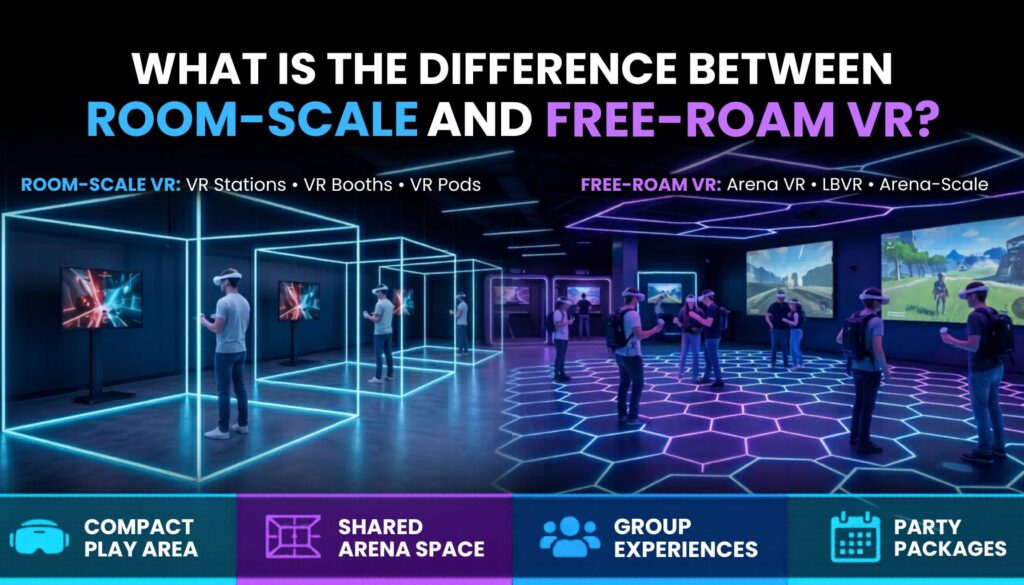
When people compare room-scale VR and free-roam VR, the discussion usually starts with space. Room-scale uses a smaller tracked area. Free-roam uses a larger physical arena where players walk naturally. That explanation is technically accurate. For commercial operators, it is also incomplete. Room-scale VR and free-roam VR are different attraction formats, each serving a different operational and commercial role inside a venue. They affect staffing requirements, player capacity, content strategy, floor plan decisions, and how a business generates revenue. Data from hundreds of commercial VR venues shows that operators rarely choose one format over the other: they build around free-roam as the primary investment, then layer room-scale around it to serve a different part of the guest experience. Understanding why that pattern works is more useful than debating which format is “better.” What Does Room-Scale VR Mean? The debate around free-roam VR vs room-scale VR usually starts with space. Room-scale VR refers to experiences that take place within a defined tracked play area, typically a minimum of 2×2 meters and ideally 2.5×2.5 meters per player or group. Within that space, players can walk, crouch, turn, and interact physically rather than sitting or standing in a fixed position. The setup can take several forms. Some operators build enclosed rooms with solid walls. Others use curtain dividers or open floor plans with clearly marked boundaries. A monitor facing outward so waiting guests can watch gameplay in progress is standard across all configurations. The experience may support a single player or a small multiplayer group, as long as all players share the same tracked area. Across the industry this format goes by several names: VR stations, VR booths, VR pods. These are not distinct attraction categories. They describe different ways of delivering the same format, whether that means an open play position on a venue floor, a partitioned booth for privacy and organization, or a branded enclosed unit with custom theming. The format is consistent: compact, defined play space with flexible deployment. Because room-scale setups require relatively little floor area and integrate into most existing layouts, operators use them to add attraction variety, increase density, or introduce new content without major venue redesigns. That flexibility matters most when a venue is already anchored by a larger attraction and needs to fill the surrounding floor plan productively. What Does Free-Roam VR Mean? Free-roam VR allows multiple players to walk through a shared virtual environment together, each wearing a wireless headset, navigating the same physical arena at the same time. Where room-scale defines a boundary for each player, free-roam removes that boundary. Everyone in the experience occupies one shared arena space, physically moving alongside each other while interacting inside the same virtual world. The format is commonly referred to as free-roam VR, arena VR, or arena-scale VR. Within the industry, location-based VR and LBVR are broader terms that often apply here as well. The technology behind free-roam has changed significantly over the past several years. Early commercial setups relied on backpack PCs: players wore full computing rigs on their backs through the experience, and tracking depended on external sensor arrays that required significant setup time between sessions. Modern free-roam operates differently. Standalone headsets with inside-out tracking have largely replaced backpack systems. Arenas are designed specifically to support stable tracking: floor markers, aruco patterns, and walls with non-repeating visual textures give headsets consistent reference points as players move. The result is more reliable tracking, faster resets, and simpler day-to-day operations. Arena size in free-roam is not fixed by a single standard. Most commercial free-roam titles are designed around a 6x6m (20x20ft) play space, which has become the practical baseline for operators because it unlocks the widest range of available content. Larger arenas, typically around 10x10m, support more simultaneous players or give players more physical room, though player counts do not always scale with the additional space. Some titles allow operators to adapt the experience to a different play space size, but that flexibility is less common across the catalog. The practical starting point for most operators is sizing the arena around the content library they want to run, not the other way around. Free-roam experiences are built around what the format does well: multiplayer cooperation and competition, physical exploration across a large shared space, and social play where every participant is present in the same environment at once. The Practical Difference: Movement and Play Area The most visible difference between the two formats is how players move. In room-scale VR, movement stays within a compact tracked area per player. In free-roam VR, walking is central to the experience: players navigate the arena physically and the virtual world responds to where they actually are. From an operator perspective, that produces meaningfully different venue requirements. The choice is rarely about which format is technically superior. It is about which format fits the venue being built and the audience it serves. Why Free-Roam Draws Stronger Commercial Interest Several factors have made free-roam VR the more discussed format among venue operators, and data from commercial deployments reflects that priority consistently. The clearest factor is replicability. A consumer at home can buy a headset, clear some furniture, and run a room-scale experience. The quality differs from a commercial setup, but the format is accessible. Free-roam arenas are not. No home environment accommodates a shared arena with multiple simultaneous players, calibrated tracking walls, and the session infrastructure a venue provides. Content reinforces that gap in a specific way. Titles like Arizona Sunshine Remake: Free-Roam and After the Fall: Free-Roam are built exclusively for commercial venue deployment. They have no consumer release. A guest who already owns a home headset still has a clear reason to book: the experience they want does not exist on any device they can buy. That content exclusivity also has a less obvious commercial benefit. VR content licensing structured through a commercial platform closes the route that consumer versions leave open. Room-scale content that exists in consumer ecosystems can be acquired and run by any venue regardless
3 PCVR Games That Keep Competitive Groups Coming Back This Summer
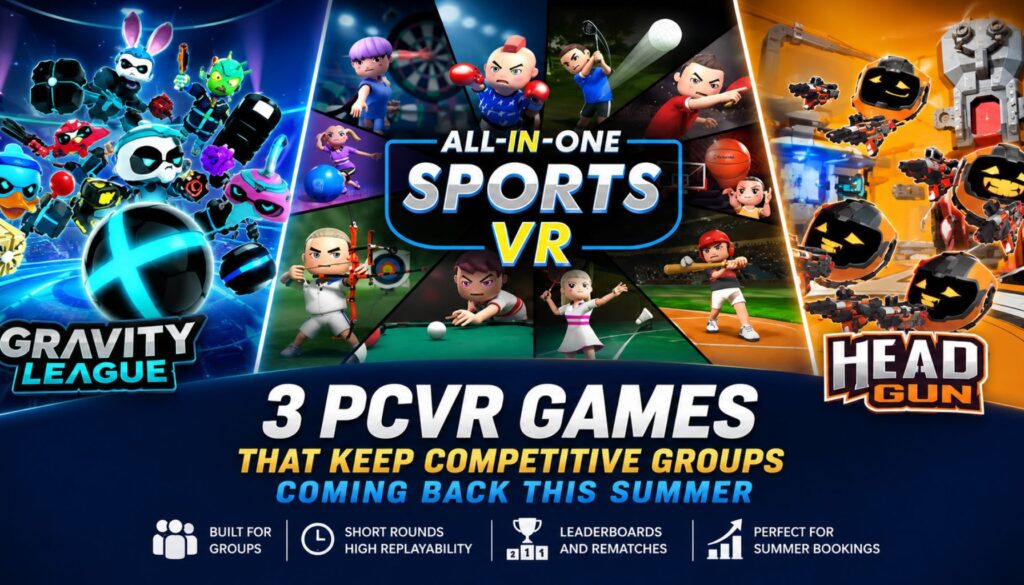
Competitive PCVR games often appeal to a different type of guest than narrative-driven experiences. Some groups walk into a VR session ready to explore. Others walk in ready to compete, compare scores, and ask for a rematch. For those groups, the best games are the ones that create momentum fast. Clear rules, short rounds, and visible progress keep players engaged because the goal feels close, the outcome feels fair, and every round gives them a new chance to do better. That pattern lines up with what motivation research has shown for decades: people tend to increase effort as they get closer to a goal, and the presence of a rival raises that effort further. Clark Hull first documented the goal-gradient effect in 1932, finding that effort accelerates as a goal comes within reach. Gavin J. Kilduff at New York University later confirmed that competing directly against someone raises both motivation and measurable performance, even when no prize is involved. In a venue setting, that combination translates into rematches, leaderboard chases, and groups that book again because the last match did not go the way they wanted. A birthday group with mixed experience levels, a summer camp operating on a schedule, or a corporate booking looking for team-based competition often responds well to the same formula: short rounds, simple rules, and enough variety to make the next match feel worth taking. When players can see their progress and immediately try again, the session becomes more than a one-time playthrough. These three PCVR room-scale titles are built around that logic. Why Competitive PCVR Games Perform Differently in Commercial Venues Not every multiplayer VR experience creates the same booking behavior. Multiplayer score-driven formats introduce a different dynamic because players leave with a clear outcome. Someone wins, someone loses, and someone usually wants another chance. For VR arcade operators, that often translates into longer engagement within a booking, stronger replayability, and easier tournament-style programming for birthdays, camps, corporate events, and group outings. A three-minute match can generate multiple rounds within a single session, allowing venues to keep groups engaged without extending booking times. Competitive experiences also simplify onboarding. Players typically understand the objective immediately, which reduces explanation time and allows staff to focus on session management rather than lengthy game briefings. For venues managing multiple groups throughout the day, those small time savings can compound across dozens of sessions. The result is often a content category that supports throughput, repeat visits, and social competition without requiring complex setup or extensive staff intervention. Gravity League PCVR room-scale | Pico | Quest | Focus 3 | 1-4 players | 3 minutes per match | No age limit | Network Veteran Zero-gravity sports where players use Gravity Gloves to drive a ball into the opposing goal. The mechanics read like full-body air hockey: the objective is visible immediately, the physics respond the way guests expect, and nobody needs to ask what they are supposed to do. A group of four understands the game within thirty seconds of putting on a headset, which means staff spend that time watching rather than explaining. Matches run three minutes. A birthday group can run a full round-robin bracket inside a single booking slot and still have time for a rematch. Standalone support across Pico 4 Enterprise, Quest, and Focus 3 alongside PCVR room-sacle version gives operators flexibility across different station configurations without a separate licensing decision. Wacky Party Mode widens the appeal for mixed-skill groups where guests range from experienced players to first-timers. For operators, the three-minute match structure creates flexibility throughout the day. A venue can run quick rematches, mini-tournaments, or round-robin formats without affecting booking schedules. That makes Gravity League particularly useful for birthday parties, youth groups, and competitive corporate sessions where participants want multiple opportunities to improve their score. Players describe it as competitive, customization-friendly, and easy to replay. The Network Veteran badge on the SynthesisVR marketplace reflects an established performance track record across the network. Game page: deployreality.com/synthesisvr/games/gravity-league HeadGun PCVR Room Scale | 2-10 players | No age limit | No blood | SynthesisVR CDN Optimized Ten players competing simultaneously is an unusual spec for a room scale title. HeadGun supports it through transformable maps that reconfigure based on player count, so a group of four and a group of ten are each playing a version sized for their session rather than the same map at different densities.Three modes give staff a natural structure for longer group sessions: Deathmatch to warm up, Team Deathmatch once the group has found its footing, then Capture the Flag for guests who want a shared team objective over a personal kill count. The ability to support between two and ten players also gives operators flexibility when group sizes vary. Rather than building separate programming around different attendance levels, venues can accommodate smaller and larger groups within the same attraction, helping maintain attraction utilization throughout the day without requiring different content setups. Single-button controls and an integrated tutorial back the zero-learning-curve claim with something concrete: players do not need a staff briefing to start. The September 2024 update added operator-configurable motion sickness controls and French and Chinese Simplified localization, relevant for venues with multilingual guests or international group bookings. Rated 0+ with no blood and no aggression, which removes the age conversation at the front desk entirely. Reviewer coverage frames it as a smooth-running arcade shooter with accessible controls. For operators, that translates to a title that works across birthday groups, camp sessions, and corporate bookings without requiring a different setup or briefing for each audience. Game page: deployreality.com/synthesisvr/games/headgun All-In-One Sports VR PCVR Room Scale | Pico | Quest | 1-2 players per station | No age limit | SynthesisVR CDN Optimized Ten sports disciplines under a single license: Baseball, Archery, Ping Pong, Basketball, Bowling, Badminton, Golf, Darts, Billiards, Boxing. Real-time PvP across most disciplines. The mechanics transfer because guests already know the movement vocabulary: a darts throw, a basketball arc, a tennis return. That prior knowledge compresses the learning curve