More family entertainment centers, arcades, trampoline parks, bowling venues, and attraction operators add VR every year, and the reasons are often similar. Some are looking to modernize aging attractions. Others want a weather-independent activity that performs during heatwaves, rainy weekends, and slower tourism periods. Many are searching for ways to attract group bookings, birthday parties, and younger audiences looking for social experiences rather than individual gameplay, building on the weekday utilization question this series covered last week.
What surprises many first-time operators is how differently commercial VR behaves once the headsets start running daily sessions. A consumer who buys a headset for home manages a single device and a personal game library. A venue operating multiple headsets across hundreds of guests each week is managing a commercial attraction, with licensing requirements, content management, staff workflows, multiplayer coordination, and ongoing operational decisions layered on top.
The hardware is the visible part of the investment, while the operational layer underneath it usually determines whether the attraction earns its floor space.
Why Operators Keep Adding VR
A decade ago, many venues treated VR as a novelty attraction. Today, commercial VR is an established category within location-based entertainment, and operators keep adding it because it solves several business challenges at once.
Compared to many traditional attractions, VR often requires less physical space. It can help venues attract group bookings, provide an indoor entertainment option during extreme weather, and create experiences that guests cannot easily replicate at home.
Many operators also value the flexibility VR introduces. A bowling lane delivers essentially the same experience year after year, and an escape room eventually reaches a point where returning guests already know the solution. VR attractions can evolve instead, through new content, seasonal experiences, different attraction formats, and multiplayer experiences that appeal to changing audiences over time. That flexibility becomes increasingly valuable as operators look for ways to keep guests returning throughout the year.
Licensing Is Where Many First-Time Operators Get Stuck
One of the most common surprises for new operators is discovering that consumer VR and commercial VR run on very different licensing models. A game available on a consumer storefront is not automatically approved for commercial use. Some developers offer separate commercial licenses, some work through dedicated commercial platforms, and others may not offer commercial licensing at all.
For operators opening a venue, sorting through this becomes one of the most time-consuming parts of the research process. Questions that seemed simple at the planning stage get complicated fast: whether a title can run in a paid attraction, whether the license covers multiple headsets, whether multiplayer is included, and what happens when the developer pushes a content update.
These questions rarely come up during early conversations about adding VR, yet they tend to become critical once operators move from planning into deployment. It’s one reason many commercial venues choose centralized content platforms that simplify licensing access and provide a larger catalog of commercially approved experiences through a single system.
Operators who want the deeper mechanics of commercial licensing, including how studio agreements differ from consumer terms and what to check before signing, can find that covered in more detail in how VR content licensing works for LBE venues.
What Makes a VR Attraction Commercially Viable
A common mistake among new operators is treating headset selection as the primary business decision. Hardware matters, but it rarely determines long-term attraction performance on its own.
The operators who get the strongest results tend to focus elsewhere: how quickly a session launches, how many guests can participate at once, what brings people back for a second visit, how often the content library gets refreshed, how much staff involvement a session actually requires, and how easily the attraction adapts to a birthday party one day and a corporate group the next.
A technically impressive attraction can still struggle commercially if it creates bottlenecks at the booking desk, serves only a narrow audience, or gives guests no reason to return. The operators who do well tend to evaluate the entire guest experience rather than the device spec sheet alone.
How VR Changes the Business Model
This is where VR starts to diverge from many traditional attractions. A bowling lane generates revenue through scheduled games, an escape room typically serves one group at a time, and an arcade spreads revenue across dozens of individual machines. VR works differently: the same hardware can support cooperative adventures, competitive experiences, educational content, team-building activities, family-friendly games, and seasonal experiences without operators needing to replace the underlying attraction.
For many venues, that changes how attraction value gets measured. Instead of evaluating a single game, operators end up evaluating the overall flexibility of the attraction itself. One content mix might perform well during summer tourism season, another might appeal more to birthday parties, and a different lineup might suit corporate events or school groups better, all while the physical infrastructure stays largely the same. The guest experience evolves around demand instead of the venue needing to rebuild around it.
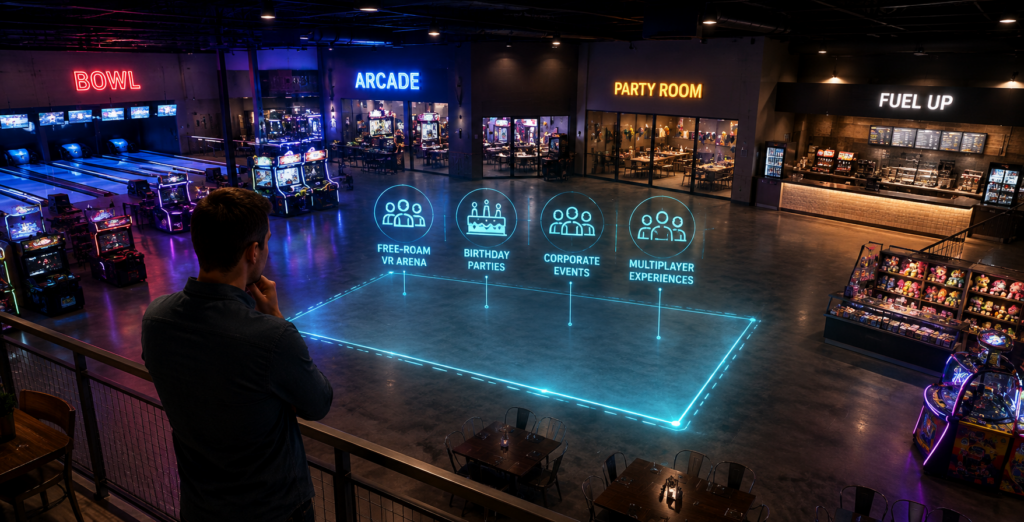
Free roam formats push this flexibility further, since the same tracked space can host different team sizes, mission types, and difficulty levels without new hardware. The tradeoff is that free roam introduces its own planning questions around arena layout and design and network setup, which matter enough that they deserve separate research before committing to a footprint.
The Attraction Mix Question
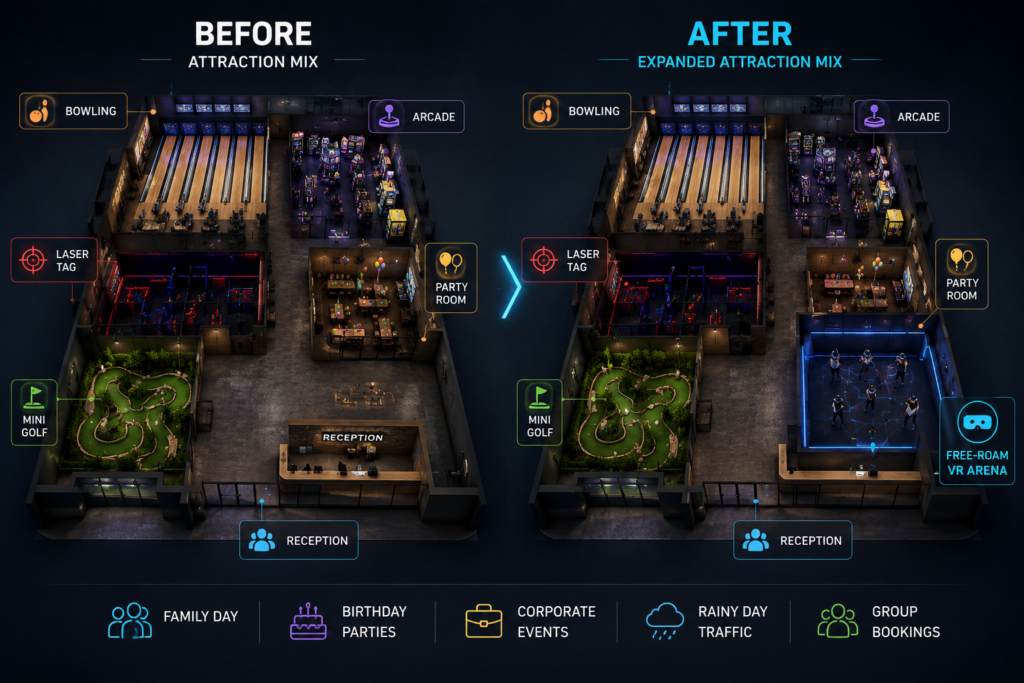
Many successful venues don’t add VR to replace an existing attraction. They add it to strengthen the overall mix. Some use VR to complement bowling, laser tag, escape rooms, or arcade floors. Others use it to create an indoor option during periods when weather affects attendance, expand birthday party offerings, or reach audiences who weren’t engaging strongly with the rest of the venue.
The strongest implementations tend to fit into a broader venue strategy rather than operate in isolation, so before investing, operators benefit from getting clear on exactly what role VR will play inside the wider business. The goal usually isn’t to own VR equipment for its own sake. It’s to solve a specific business challenge, open a new revenue line, improve guest engagement, or round out the venue’s attraction portfolio.
Multiplayer Changes Guest Expectations
One trend operators consistently notice is that guests increasingly expect shared experiences. Families, friend groups, birthday parties, and corporate teams often judge an attraction by what they can do together rather than what one person can experience alone, which helps explain why multiplayer formats have become increasingly central to commercial VR. The ability to play together often shapes a booking decision as much as the content itself does.
We’ll explore this dynamic in more depth in the next article in this series.
The Operational Mistakes That Show Up After Launch
The attraction itself is only one part of running a commercial VR business. What tends to catch operators off guard is how much operational complexity builds up after launch. The content library grows. Different audiences want different experiences. Staff turnover creates training gaps. Multiplayer sessions need consistent coordination. Updates need managing, and licensing terms shift as new content arrives.
Several operators entered the market expecting VR to behave like a traditional arcade attraction, only to discover after launch that licensing, content management, attraction rotation, staffing consistency, and multiplayer coordination demanded a different operational framework than simply buying hardware and opening for bookings. The venues that adapt most successfully tend to plan for this before launch rather than scrambling to fix it afterward.
Questions to Ask Before Adding VR
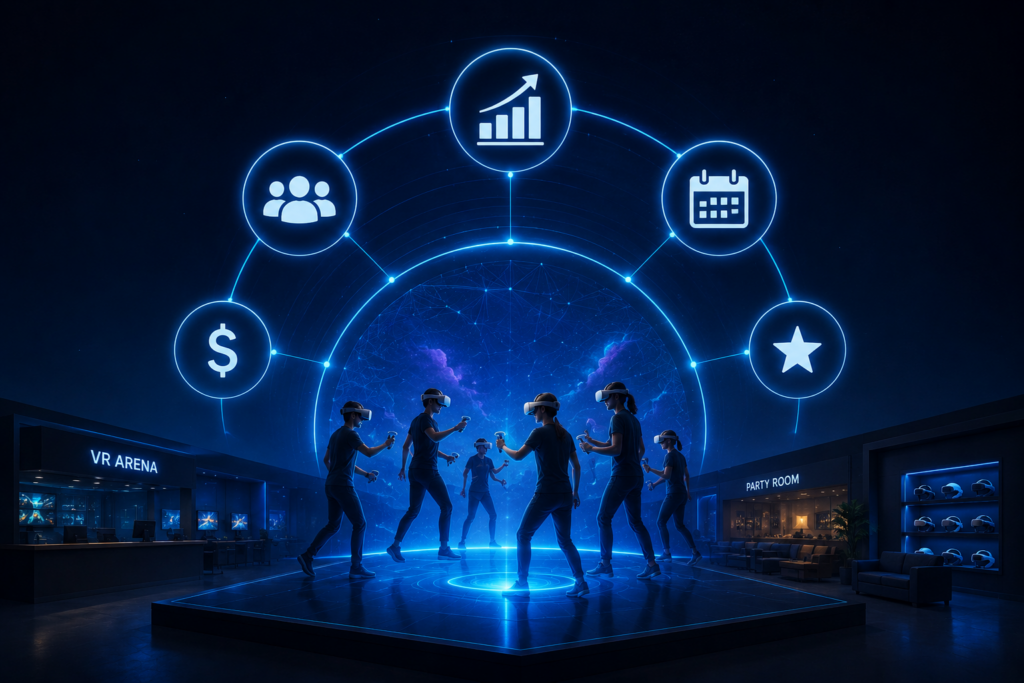
Before investing in a VR attraction, it helps to work through a few practical questions: who the primary audience is, what role VR will play inside the existing attraction mix, how the venue plans to encourage repeat visits, how content will get refreshed over time, whether staff can run the attraction consistently during busy periods, and which licensing model actually fits the venue’s goals.
As VR offerings expand, many operators find that managing content libraries, commercial licenses, multiplayer experiences, and attraction updates by hand gets harder fast. That’s one reason many venues eventually move to dedicated VR management platforms that centralize content access, session management, and operational workflows as their attractions grow.
Looking Beyond the Launch
Adding VR is usually the start of a longer operational journey rather than a one-time purchase. The venues that get the strongest long-term results tend to focus on flexibility, repeatability, and guest retention from day one, thinking past launch day to how the attraction will keep serving the business months and years out.
As commercial VR matures as a category, operators increasingly find that long-term success depends less on the headset itself and more on how well the attraction fits into the wider venue strategy.
Next in the Series
Why Multiplayer VR Attractions Drive Repeat Visits and Higher Utilization
We’ll look at why multiplayer experiences consistently outperform solo attractions on repeat bookings, guest retention, and long-term venue utilization.