
The Lobby: what your guests see before the game starts
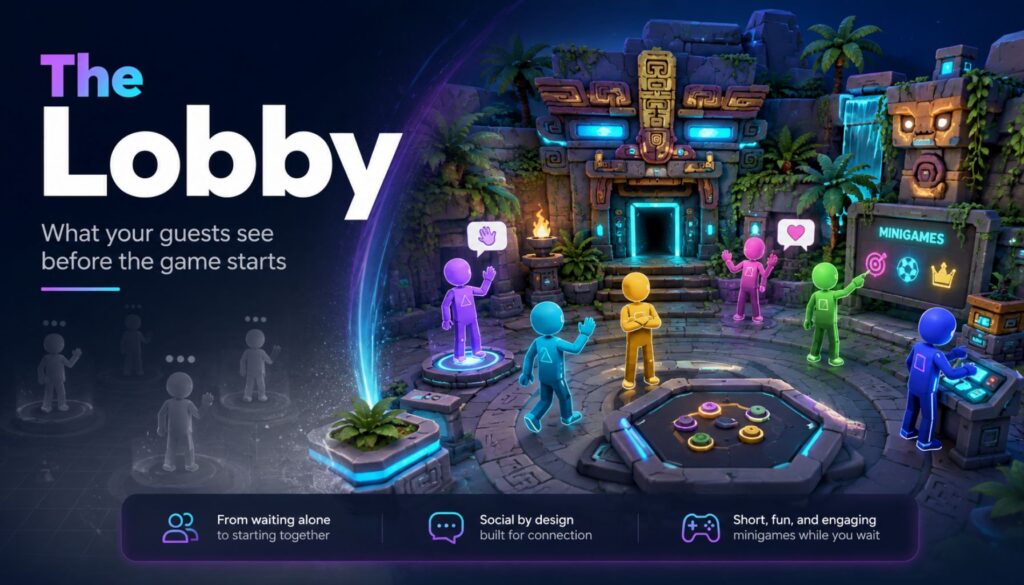
Six friends walk in together. They’ve been talking the whole drive over. Then the headsets go on, and for the next four minutes they stop being a group. Each one stands alone in a grey void, hearing muffled voices somewhere behind them, waiting for something to happen. That’s the part of the session nobody sells and every guest experiences. The Lobby is SynthesisVR’s launcher, released in September 2025, and it fills exactly those minutes. Guests land in a small 3D space together instead of in nothing. They walk around, talk, and play a few simple minigames while your staff finish getting everyone else geared up. When you launch the main session, The Lobby closes and the game starts. It runs on PCVR and on every standalone Android headset you’re likely to have on the shelf: Quest, Pico, HTC Focus. It’s included in your SynthesisVR subscription with no additional licensing. How it works Enable it once per device at my.synthesisvr.com under Devices. On Windows, open the Access Point app and click Refresh, and the installation runs itself. On Android, connect each headset to the Local Manager PC once so it can collect the installation permissions, then use Update The Lobby from the three dots menu next to the device. The first Android install takes three or four minutes depending on your bandwidth. The rest are faster, because the installer is cached. From there you have two ways to run it. You can launch it as a game, selecting it from the dropdown like any other title. The more useful option is In-Content Activation. Pick your main game and your stations, and if every station has The Lobby installed you get a second set of controls and an Activate Lobby button. Press it and nothing launches yet. The system waits, and each headset starts The Lobby on its own the moment a guest puts it on and the device wakes from idle. That waiting behaviour is the operational point. You set the session up, walk away, and help the next person. Each guest’s experience begins as they gear up, without a staff member standing over them to press play at the right second. Use case 1: the free-roam changeover A group of six books your 6×6 metre space. Waivers are signed, the safety brief is done, and now it’s the physical work of fitting six headsets. Straps, lens spacing, boundary check. Guest one is ready in forty seconds. Guest six takes four minutes. Guest one has now spent more than three minutes standing still in the dark, and it’s the first impression of a session they paid for. With The Lobby running, guest one is in a shared space, moving around, and guests two through six appear as they join. The group stays a group. Free-roam sizing runs from 5×5 metres for up to six players through to 10×10 metres for up to sixteen, and room scale supports up to sixteen as well. There’s a small admin benefit here too. If a player doesn’t already have a name assigned, The Lobby asks them to enter one, and that name is stored in SynthesisVR and carries into whatever you launch next. One less thing to type at the desk. Use case 2: parties, school groups, and anything over eight people Large bookings have a structural problem. Somebody is always waiting. Sixteen kids at a birthday party, a corporate team, a school group rotating through a limited number of stations. The bigger the booking, the more of your venue’s time is spent on people who aren’t playing anything yet. The Lobby holds up to sixteen players in one space, so a full party stays together while your staff work down the line. Turn on spectator mode and you get the second half of this. The session mirrors to an external display, so the parents in your waiting area, the siblings who came along, and the walk-in traffic passing your window all have something to watch. Spectator mode is optional, and The Lobby runs normally without it, but for party and group bookings it’s worth switching on. Use case 3: the guest who has never worn a headset This is where the money is. A first-timer’s opening sixty seconds of VR usually involves darkness, disorientation, and a stranger adjusting the straps on their head. Some of them decide right there that VR isn’t for them, and you find out when they pull the headset off eight minutes into a title they paid for. Drop them into The Lobby instead and they get a low-stakes space with nothing to fail at. They learn to look around. They work out what the triggers do. They see their friends’ avatars and realise they can still talk to each other. By the time the main title loads they’ve completed a tutorial without anyone calling it a tutorial. Fewer people quit mid-session. Fewer refunds at the desk. And the reviews you get online tend to come from exactly this guest, the nervous one who was talked into it by a friend. Where The Lobby fits in your setup The Lobby works best as the shared space between putting on the headset and launching the main experience. It handles pre-game social time, basic orientation, and the few minutes when different players become ready at different speeds. It does not replace every launcher workflow. If you want guests to browse your content library and choose what to play themselves, use a dedicated self-service launcher for that part of the venue. SynthesisVR Operation Settings let you assign different 3D environments to different experience types, so you can use The Lobby for free-roam sessions while keeping a different launcher or workflow elsewhere. There is also one setting to consider on standalone Android headsets. Kiosk Mode keeps The Lobby in control of the headset so guests cannot accidentally leave the intended experience. If another launcher on the same headset also needs kiosk-level control, the two will compete. In that case, leave Kiosk Mode off
What Is LBVR (Location-Based VR)? A Guide for Operators
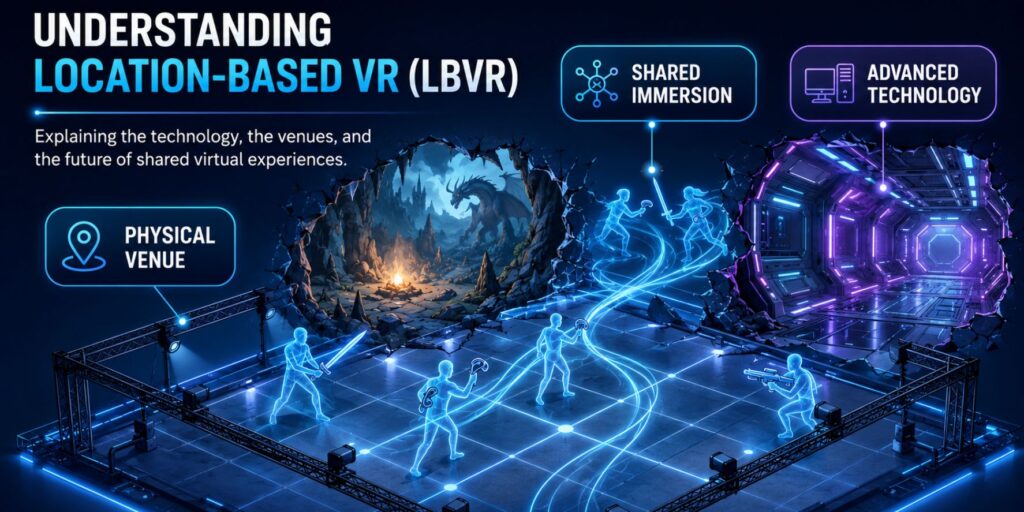
LBVR stands for location-based virtual reality, and it describes commercial VR delivered in a dedicated venue rather than in someone’s living room. The term shows up constantly in industry press, at trade shows, and in vendor pitches, usually without anyone stopping to define it. That leaves prospective operators trying to evaluate hardware, space, and content decisions before they have a clear picture of the category those decisions sit inside. The definition matters more than it first appears. How an operator understands LBVR shapes what they compare their business to, how they price it, and what they tell a landlord or an investor about what they are building. The definition, in plain terms LBVR is the commercial sector that delivers virtual reality experiences in purpose-built physical venues. VR arcades, free-roam arenas, VR escape rooms, and VR installations inside family entertainment centers all fall under it. The venue is what defines the category. A guest at home puts on a headset in whatever floor space they have cleared. A guest at an LBVR venue walks into a room that was designed around the experience: tracked, mapped, sized to the title, staffed, and turned over between sessions on a schedule. The headset might even be the same model in both cases. That distinction produces a handful of practical differences: The formats that fall under LBVR Operators often use “LBVR” and “VR arcade” interchangeably. The VR arcade is one format inside the category, and treating them as the same thing narrows how an operator thinks about their own venue. Room-scale and station-based VR. Compact footprints, seated or standing play, sometimes with motion platforms. The lowest space requirement and the easiest format to add to an existing venue. Our breakdown of room-scale versus free-roam VR covers where the line between the two sits. Free-roam arenas. Open floor space with full-body tracking, letting groups move physically through the virtual environment. Player counts commonly run from four to twelve depending on the title and the arena size. Space requirements are the main planning constraint, and we have covered how much space a free-roam arena actually needs in detail. VR escape rooms. Story-driven, puzzle-focused, built around cooperative problem solving. A natural format for traditional escape room venues adding a VR line, since the booking model and session length already match. Arena-scale VR. Large-format free-roam, often built around competitive or esports-style play, running in considerably larger footprints than a standard free-roam room. This format has its own planning considerations, which we will cover in a dedicated article. A single venue frequently runs more than one of these. A family entertainment center might operate room-scale stations for walk-ins and a free-roam arena for booked parties, because the two formats capture different guests at different price points. Why the category framing changes operator decisions An operator who thinks of their business as “a VR arcade” tends to benchmark against other VR arcades. An operator who understands they are in LBVR benchmarks against the rest of out-of-home entertainment: bowling, laser tag, escape rooms, mini golf, axe throwing. That second framing is more useful, and more accurate. A family choosing a Saturday afternoon activity is not comparing VR venues to each other. They are choosing between VR and the trampoline park down the road. Pricing, session length, party packages, and marketing all get sharper once the competitive set is drawn correctly. It also changes the conversation with landlords and investors. LBVR positioned as an emerging technology category invites questions about whether VR is a passing trend. Positioned as an out-of-home entertainment format that happens to use VR, it sits alongside established attraction businesses with understood economics. What the category looks like at scale Market research firms currently size location-based VR and immersive entertainment somewhere in the multi-billion dollar range, with growth forecasts in the 25 to 35 percent annual range through the early 2030s. Those figures vary widely between firms depending on whether they count VR alone or all immersive out-of-home entertainment, so they are better read as directional than precise. The more useful picture comes from operational data. SynthesisVR runs 600+ locations worldwide across free-roam, room-scale, and seated formats, with a content marketplace of 400+ commercial VR titles. That spread across formats tells you something a market size figure cannot: LBVR has not converged on one venue type, and there is no sign it is heading that way. Our analysis of what 600+ locations reveal about free roam found two distinct content strategies that both sustain profitable venues. Some operators run a tight catalog of five to ten titles, train staff deeply on every scenario, and rotate slowly. Others run fifteen to twenty-five titles, refresh regularly, and lean on visual appeal and recognizable IP to pull first-time visitors. Both models work. Operators who struggle are usually the ones running a hybrid of the two without having chosen either on purpose. That finding says something about the category as a whole. LBVR is broad enough to support genuinely different business models, which is why a definition that collapses it into “VR arcade” costs operators more than it saves them. Common misconceptions worth clearing up LBVR always means free-roam. It does not. Seated and room-scale formats are LBVR, and for many venues they are the more practical entry point. LBVR and AR attractions are the same category. Press coverage often groups them together. The technology, the space requirements, and the content pipelines are different. Consumer headsets and home content transfer directly to commercial use. This is the assumption that causes the most expensive surprises. Warranty terms, software licensing, and device management all work differently once a headset is running paying customers. We covered the specifics in whether consumer VR headsets can be used commercially. Hardware selection is the decision that determines the outcome. Most new operators spend the majority of their planning effort choosing a headset. Across our locations, content strategy and operational consistency separate profitable venues from struggling ones far more reliably than hardware choice does. Where to go from here Understanding
How VR arcades actually make money
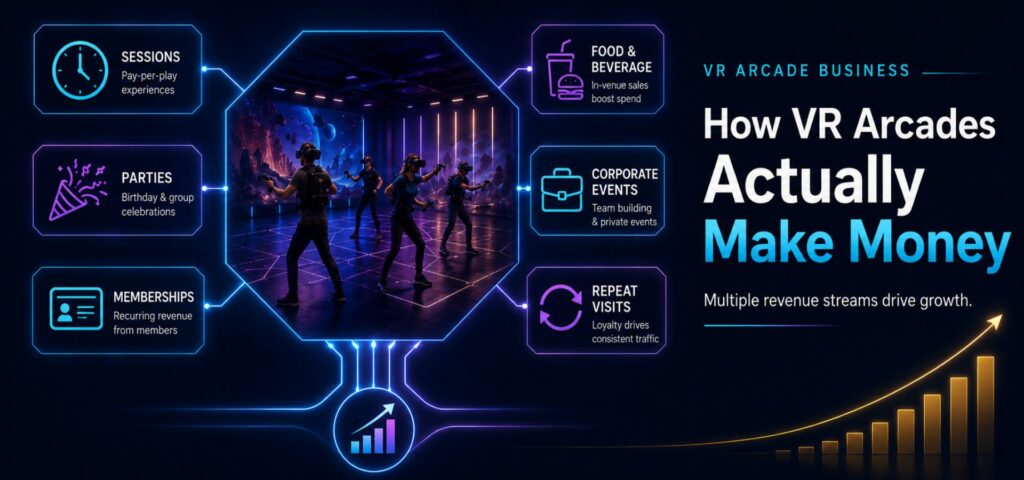
Ask five VR arcade owners how they make money and four will say the same thing: charge per session, then add parties and merch when margins get tight. That answer describes a booth arcade. It doesn’t describe a free-roam arena, and treating the two as one business is why so much advice on this topic falls apart the moment an operator tries to apply it. Room-scale sells time. Free-roam sells an experience A room-scale booth needs roughly 2 x 2 m to 3 x 3 m per player (about 6.5 x 6.5 ft to 10 x 10 ft), low staffing, and a 30 to 60 minute sessions. It’s a throughput business: revenue is seats per hour times price. A free-roam arena needs a shared floor of 20 x 20 ft (6 x 6 m) or more. Eight players push that past 33 x 33 ft (10 x 10 m). Figure roughly 200 sq ft (about 18 m²) of tracked space per person. It sells a group a full narrative arc rather than a slot, so it charges by the head and by the story, not by the minute. A six-person free-roam booking at around $50 a head is a $300 transaction in one time slot. Large free-roam arenas average close to $50 per person for a 45 to 60-minute mission and lean on corporate and private bookings for up to 40% of revenue at some locations. These aren’t competing formats. The industry has quietly demoted the isolated booth from headline product to supporting player. It’s a demo station now, a party filler, a way to occupy a group before or after their arena slot. We’ve written about how to weigh room-scale against free-roam and what free-roam actually requires to run in 2026. The short version for revenue: booth for frequency and low-commitment walk-ins, arena for the higher ticket and longer dwell time, both feeding each other in one venue instead of splitting your marketing budget. The shared-headset moment is a funnel, not a revenue line Every operator has watched this happen: a group walks in, two of them try a headset while the rest watch on a monitor, laugh, heckle, and wait their turn. That mixing and mingling rarely shows up as a line on the receipt. What it does is convert a skeptical non-gamer into a customer without asking them to commit to a 45-minute arena booking on their first visit. The better-run venues build this into the layout on purpose, with lounge seating where groups watch an instant replay of their session together after playing. The waiting and watching becomes part of what they paid for, not dead time between transactions. Treat the shared-headset moment as a nuisance to clear out fast and you remove the exact mechanic that turns a walk-in into a booking for the bigger-ticket experience next door. Customers often interpret changing prices as unfair Plenty of pricing advice lists surge pricing as a growth lever. The evidence from adjacent industries now runs the other way. Disney has spent the past year fielding backlash over what commentators call “dynamic ratcheting,” pricing that moves with demand until guests pay more for a worse day at the park. WWE raised standard show pricing from around $75 to $118 in a single year after its TKO merger and drew public criticism from its own fanbase for it. Across ticketed entertainment, about half of consumers call dynamic pricing unfair, and in markets like the UK and Canada that runs past 60%. Artists who publicly opt out of surge pricing for tours are getting credit for it. A VR venue depends on repeat visits from the same neighborhood far more than a theme park depends on any single guest coming back. Trading a short-term revenue bump for the reputation of “the arcade that charges more when you’re busiest” is a bad trade for a business built on locals returning six or more times a year. One distinction is worth making precisely: fixed, published tiers (weekday versus weekend pricing, group rates, advance-purchase discounts) aren’t the problem. A posted weekday/weekend split, set ahead of time rather than by a real-time algorithm, is a legitimate pricing tool. What backfires is pricing that moves based on how full you are right now or who’s asking. Customers notice, and they stop trusting the number on your website. Marketing in the right order: content, then search, then ads The content that travels for a VR venue is almost never the polished trailer. A 12-second clip of four friends failing a co-op mission does more, and so does the reaction shot from the person who just ripped off a headset laughing. Spectator screens showing the headset view double as a content pipeline: bystanders record what’s already on the screen for you. Nano and micro-influencers with 5,000 to 50,000 local followers convert better than a big name with no connection to your neighborhood. Underneath that, local SEO fundamentals still decide whether anyone finds you: a complete, actively-managed Google Business Profile carries a large share of local map-pack ranking, and review recency matters more than review count. The piece almost nobody in this niche is writing about yet is generative engine optimization: whether ChatGPT, Perplexity, or Google’s AI Overviews cite your venue when someone asks “VR arcade near me for a birthday party.” The longer, question-style searches people use to find a venue return an AI summary more than half the time. AI Overviews already show on roughly a quarter of Google searches, and that share keeps climbing. Content built with clear statistics, direct answers, and specific details gets pulled into those AI answers at meaningfully higher rates than vague marketing copy. Your game pages, party package pages, and pricing FAQ need to read like a direct answer to a question, not a sales pitch, because an AI answer engine is now a real referral source. The one number to check before you buy ads Paid ads come last, once organic and search are working, and before you
3 Active VR Games to Round Out Your Arcade Lineup
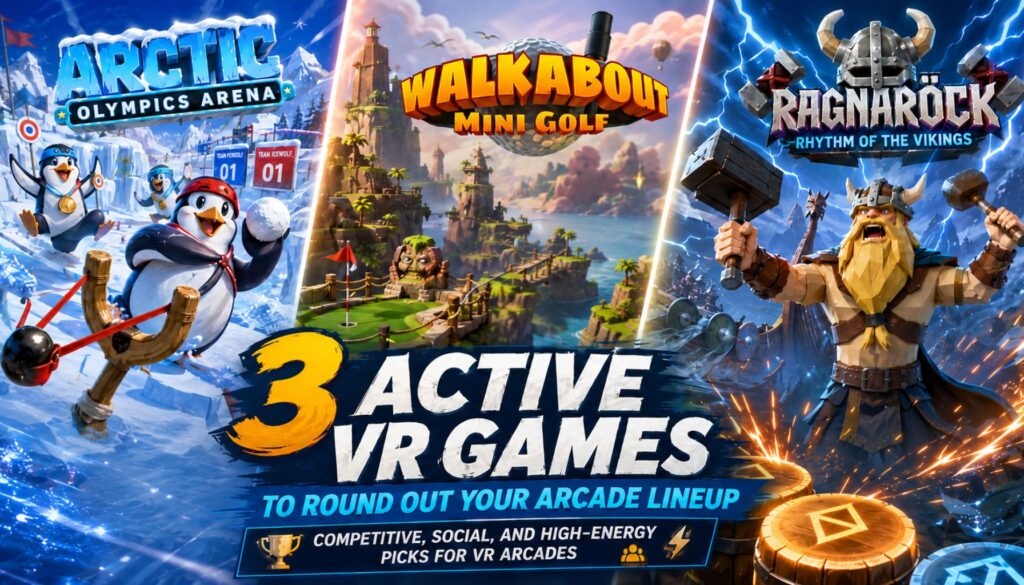
Active VR games for VR arcades ask something most of a library does not: get the player standing, swinging, and competing instead of sitting through a story. Three titles now on SynthesisVR fill that slot, and each pulls from a different corner of active play, casual sport, multiplayer competition, and rhythm, so a venue can point a booking at whichever one fits the group. The category has a name now: exergaming, VR content built to disguise physical effort as gameplay rather than present itself as a workout. A 2025 study in the International Journal of Obesity found VR-based exergames produced measurable improvements in body weight, BMI, and body fat percentage compared to sedentary controls. Separate 2026 reporting on home VR fitness apps found exergames hold 2.3 times the retention of video-led workouts. Players come back because the session is fun rather than prescribed, and that’s the same mechanism an arcade is already selling with every other title in the library. None of the three games below need a health pitch to earn a rebooking. What they need is the right group in front of them: a corporate team, a birthday party, a Friday night crowd looking for something with more energy than the horror room next door. Each one also plugs a genre a lot of arcade libraries are missing entirely, rather than adding a fourth zombie shooter or a third escape room. Walkabout Mini Golf VR Walkabout Mini Golf turns real mini golf into a room-scale sport with accurate physics. Each course runs a full 18 holes set in a larger-than-life location, and the holes interconnect, so a group explores the whole environment instead of only lining up putts. Full crossplay puts up to 8 players in one private room no matter which headset they hold, and Night Mode redesigns every course once a group has cleared it, so a returning party never replays the exact same round. This is the low-barrier entry point in the lineup. Nobody needs prior VR or gaming experience to swing a club, so a mixed-skill group shares a course without anyone feeling lost or outmatched. It also does quiet warm-up work: a first-time visitor who settles into Walkabout is far more likely to try something more physical next. The game holds an Overwhelmingly Positive rating across thousands of Steam reviews, so plenty of guests already know the name before they walk in. Runs on PCVR room-scale. View Walkabout Mini Golf VR on SynthesisVR Arctic Olympics Arena Arctic Olympics Arena puts 2 to 8 players on the ice for a snowball-launcher slingshot competition, hunting moving targets and hidden gadgets for points. It’s a full free-roam title, built for Pico, Quest, and Focus 3, and scales its footprint from a 4x4m box up to 10x10m depending on group size, so the same license covers a small station or a larger arena slot. The publisher rates it for ages 7 and up. Where it fits: this is the multiplayer, competitive slot in the lineup, built for a group that wants to play against each other rather than take turns. The wide age rating and standalone hardware make it an easy fit for birthday and family bookings that already run Pico or Quest headsets, and the scalable footprint means it can slot into a smaller arena without operators needing to build out a full free-roam room first. View Arctic Olympics Arena on SynthesisVR Ragnaröck Ragnaröck turns a viking ship race into a two-handed drumming game. Players crush oncoming runes in time with a soundtrack that runs from Celtic rock to viking power metal, racing rival crews across six environments drawn from Norse mythology. It runs solo or multiplayer on PCVR room-scale. Where it fits: rhythm games pull in players who wouldn’t otherwise book VR, and a library without one is missing a proven draw. Ragnaröck fills that slot with continuous two-handed arm movement rather than a seated tap-along, closer in energy to Arctic Olympics than to a passive rhythm title. It also gives staff an easy answer for a guest who wants something less combat-focused without dropping into a slower family title, and the escalating difficulty curve gives regulars a reason to keep chasing a better run. View Ragnaröck on SynthesisVR How Operators Turn Active VR Games Into Bookings Stocking active content is the easy half. The return comes from who gets pointed at it. Birthday and family blocks lean on Walkabout Mini Golf. Low intimidation and room for up to 8 players sharing a session means nobody sits out waiting for a turn, and the course variety gives a venue something new to offer a repeat birthday customer next year. Arctic Olympics Arena earns its slot with groups that want to compete against each other directly rather than take turns on a leaderboard. A birthday party or corporate group can split into teams, run a few rounds, and finish with a clear winner, the same rematch pull that makes a booking easy to sell on the phone before the group even arrives. Ragnaröck earns its slot as the party centerpiece, the game a group gathers around to watch as much as play. It works as a between-round palate cleanser at an arcade running longer sessions, or as the anchor booking for an evening built around one high-energy title. A weekly leaderboard reset gives regulars a reason to come back and beat last week’s score. None of these three need to be marketed as a workout to work as one. The pitch stays the same as any other active VR game in the lineup: replayable, competitive, worth a second round. Players move through a full session without either side calling it exercise, and the operator gets the same repeat booking a fitness angle would have promised, without the harder sell. Licensing These Titles Through SynthesisVR All three run through SynthesisVR’s commercial licensing, so an operator adds a title and the license terms attach in the same dashboard as everything else already on the floor. No separate
Can Consumer VR Headsets Be Used Commercially?
You can use consumer VR headsets commercially. But whether the warranty, the software license, and the fleet management tools remain valid depends on the headset and the vendor’s terms. HTC and Meta both exclude commercial use from their standard consumer warranty outright. PICO and HTC’s enterprise lines exist specifically to restore that coverage. Meta discontinued its dedicated commercial Quest hardware in February 2026, and that made the distinction more relevant, not less. Operators buying Quest now are buying consumer units by default, with the same warranty exclusion attached. The honest answer splits into four separate questions. Does the manufacturer allow it? Does the warranty survive it? Does the software license cover it? Can an operator manage the headset like a fleet asset instead of a personal device? A venue can clear one of those questions and still get caught out on the other three. What the Warranty Actually Says HTC draws the line directly. Its own support documentation says using a consumer VIVE system commercially voids the warranty. It also breaks the terms and conditions. Running a VR arcade on consumer VIVE hardware means running it uninsured the moment something breaks. HTC’s Business Edition and its Business Warranty & Services program exist specifically to restore that coverage. Together they add a commercial-use license plus a two- or three-year warranty built for continuous operation. Meta’s standard limited warranty explicitly excludes commercial use, and any use connected to a trade, business, or profession. A separate Commercial Terms document covers commercial, business, or non-personal use of Meta hardware instead. A Quest bought at retail carries that consumer warranty at home. Put it on an arcade floor and the coverage doesn’t follow, no matter what game is running on it. Two of the largest headset makers treat commercial use as a warranty exclusion, not a gray area. That’s the actual rule. The device turning on is not evidence that it’s covered. Meta Discontinuing Quest for Business Makes This Rule Harder to Avoid As of February 20, 2026, Meta stopped selling commercial Quest SKUs and stopped onboarding new customers to Horizon Managed Services, its device management subscription. Existing HMS customers keep the tool at no monthly cost. It now runs as a standalone product that pairs with consumer Quest 3 and 3S hardware rather than a dedicated business bundle. Meta has set a full shutdown of the program, HMS included, for January 2030. For operators, this doesn’t loosen the commercial-use rule. It removes the hardware SKU that used to sit between the operator and that rule. Anyone deploying Quest headsets going forward is buying consumer units by default, because that’s the only thing Meta sells now. Those units still carry a warranty that excludes commercial use. Managed deployment through HMS is still technically possible on consumer hardware. Warranty protection under commercial conditions is not, unless the operator is working under Meta’s separate Commercial Terms with eyes open. PICO and HTC have gone the other direction. Both still sell dedicated enterprise SKUs: the PICO 4 Enterprise line, and HTC’s VIVE Focus and Business Edition hardware. Both ship built specifically for continuous commercial deployment, with the license and support to match. Owning the Headset Legally Is a Different Question From Owning the Right to Run the Games on It Hardware terms and content licenses are separate agreements with separate rights holders. A consumer game purchase, on any headset, licenses one person playing on their own device. Running that same title across multiple arcade stations for paying customers, session after session, is a different use case. Consumer purchase terms do not extend to it. This holds whether the headset itself carries full commercial licensing and warranty coverage or not. We’ve covered the content side of this in detail separately, including why pay-per-minute licensing exists. That piece also covers what happens to a venue’s content strategy once it’s running at scale. The short version that matters here: clearing the hardware license does not clear the software license. Both have to hold up independently. A developer audit or a warranty claim checks each one separately if either comes knocking. The Cost Shows Up in Running Headsets Day to Day A headset tied to a personal consumer account behaves like a personal device. It comes with individual sign-in, an individual app library, and individual settings that reset or drift between sessions. That’s manageable for one unit. It becomes a staffing problem across six or eight stations running back-to-back groups on a Saturday. Enterprise-tier hardware exists to avoid exactly that. PICO’s Business Suite and LBE-grade operating environment support account-free deployment and kiosk configuration that defines what launches at power-on. They also give operators centralized control across an entire fleet from one console. HTC’s enterprise stack offers comparable fleet and kiosk tooling through VIVE Business+. Consumer-tier Quest hardware, now the only Quest hardware Meta sells, depends on HMS for anything close to that level of control. HMS itself is winding down toward its 2030 end date. The commercial-use question and the fleet-management cost are separate. A headset can clear the license and warranty checks and still cost an operator staff time every session. Someone still has to reset, troubleshoot, and manually manage devices that no one designed to run as a fleet. When It’s Fine to Run Consumer Hardware A consumer headset can be the right trade for a single-station pilot or a short-term activation. It also works for early testing, before committing capital to a full lineup. The warranty exposure and lack of fleet tools matter less when the deployment is small, temporary, or low-throughput. The savings can justify the risk while an operator is still validating demand. But one consumer VR device answers a narrower question than most operators think it does. It tells you whether VR itself is fun, whether guests respond to it, and whether the concept has legs. Call it the “hey, this is fun for a business” test. It does not tell you whether the management platform, the content library, and player access controls hold up
3 VR Education Experiences Worth Adding to Your Arcade Lineup in 2026
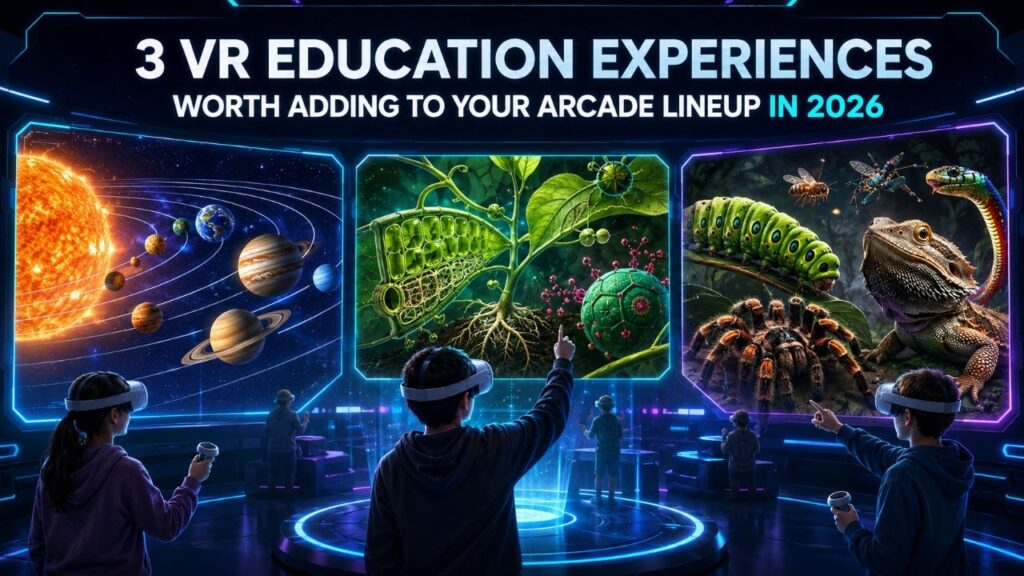
A VR attraction venue already owns the hard part. The fleet is bought, the booking system runs, and staff can start a session on their own. Maybe your weekday hours run lighter than your weekends. VR education content is one way to fill them, and it uses the setup you already have. The demand is there to meet. Curriculum VR runs in well over 200,000 schools now, and a 2025 Museums Association survey found 79 percent of the public interested in using digital tools to reach things they cannot otherwise see. The results back the interest up: Stanford research found students who learned in VR retained about 30 percent more than students taught the same material the usual way. What most schools, camps, and small museums do not want is to buy the gear, manage it, and train staff to run it. That is the exact part an operator has already solved. So the opportunity runs two ways. Package a school outing at your venue, or load a few headsets into a case and run a session in a classroom. Camp organizers and event planners will pay for a rainy-day activity with real substance. A museum or library can offer a pop-up VR station without owning the hardware. All three titles below run on the Pico, Quest, or Focus 3 headsets most fleets already carry. Each one anchors a different kind of booking. VictoryXR Science Curricula: Anatomy & Physiology – Body Awesome VictoryXR built the first VR science curriculum aligned to the Next Generation Science Standards. Body Awesome maps to NGSS standards HS-LS2-3 and HS-LS4-1, plus the matching Texas (TEKS) and Florida (CPALMS) standards. That alignment does the selling for you before a buyer asks. Inside the lesson, students pull organs out to full size and rotate them. Open the heart, kidney, or brain and you see how each structure drives its system. A nationally recognized science teacher narrates each organ as students double-tap to trigger it. Every organ carries two activity prompts that push past looking: predicting, sketching, comparing, answering. The lab manual ships with a glossary and pronunciation guide. The Teacher’s Edition includes 60 assessment questions with answers, so a teacher can run it graded rather than as a demo. Where it fits: Body Awesome is one lesson inside a catalog of 48 units and 240 VR experiences. Those span Earth and space science, engineering, life science, and physical science. That scale turns a one-off school visit into a repeat booking across subjects and terms. It runs on PCVR room-scale and standalone Quest. That suits a high school biology block, a homeschool co-op, or a university department testing a shared lab. Sell it with a standards checklist, and the catalog answers “what’s next” for you. View VictoryXR Science Curricula on SynthesisVR VR Plant Journey VR Plant Journey turns a biology lesson into a throwing and archery game. Players shrink inside a canola plant and move through three chapters: root, leaf, and seed. Each one is built on a real process. The leaf level has you throwing carbon dioxide and water to run photosynthesis. Down in the root, you assemble ammonium and nitrate, the nutrients the plant feeds on. The seed level asks you to hit oil bodies with a bow and arrow so they grow. Get the balance right and the plant develops. Get it wrong and it stalls. The content came out of a collaboration with plant researchers at the Leibniz Institute of Plant Genetics and Crop Plant Research, and the design has picked up nominations at the VR Awards, the Auggie Awards, Laval Virtual, and the VRnow Awards for education and training. Where it fits: the throwing and archery mechanics give this one more energy than a lab-style title. That matters with younger visitors, who lose interest fast in passive content. Its three short levels fit a walk-in group’s attention span. It slots into a summer camp afternoon, a library’s family hour, or a museum’s school-group rotation as easily as a classroom. It runs on PCVR room-scale and standalone Quest. Lead with this one when the group is mixed ages or the booking is more field-day than field trip. View VR Plant Journey on SynthesisVR Creepy Crawly Zoo 2.0 Creepy Crawly Zoo 2.0 shrinks players to about two inches tall and drops them inside a macro-scale insect and reptile exhibit. It is built on a real collection: creator Antonio Gustin shot it with an 8K macro VR camera alongside Dan Capps, whose private insect collection was once the largest in the world and appeared at Disney’s Epcot. The experience carries 100 display cases and more than 30 macro encounters, including scorpions, tarantulas, lizards, snakes, and a freshwater pond, with Capps appearing on video to guide guests through the specimens himself. Where it fits: this is the least game-like of the three, closer to a walkable exhibit than a title with a win state. Gustin describes it as a place to explore rather than a game, made to raise questions and hold attention. That reads as a natural fit for a science center, a nature center, or a school running a biology or ecology unit, and it gives a VR arcade something visually distinct to round out an education slot. It is standalone Quest only, so it drops straight into any venue already running a Quest fleet with nothing extra to buy. View Creepy Crawly Zoo 2.0 on SynthesisVR How Operators Turn This Into Bookings Adding the content is the easy half. The revenue comes from who you put in front of it. Package a school outing at your venue and sell it on the schedule that already suits you: a class-length 45 to 60 minute session, students rotating through the arena in small teams while the rest work with a teacher. Full-venue exclusivity is far easier to promise on a Wednesday afternoon than a Saturday night, and that midweek slot is the one you are trying to fill anyway. If the school cannot travel, bring
Wanadev Studio Experiences on SynthesisVR: a Complete Octopod VR Catalogue Spotlight
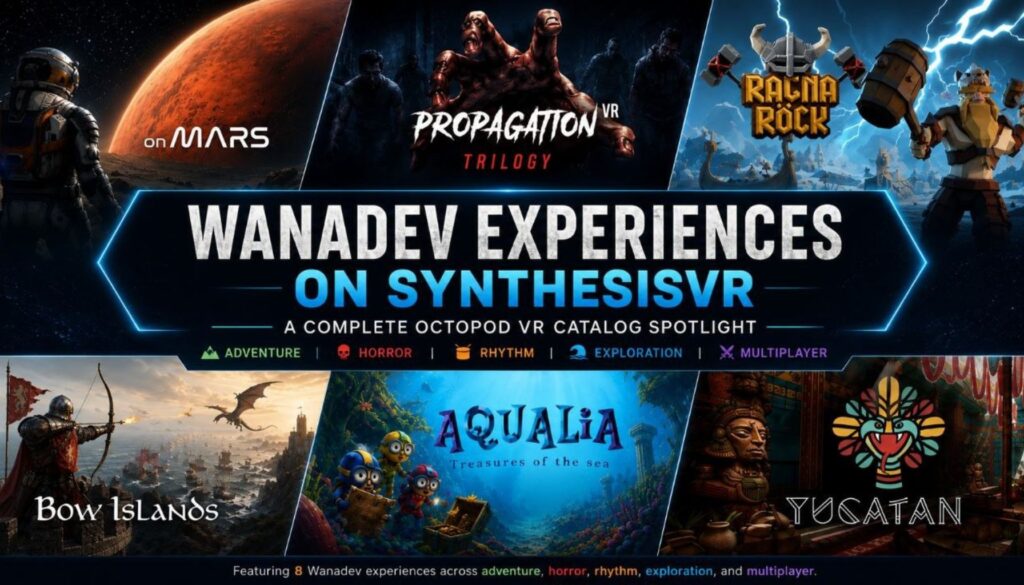
Octopod VR’s arcade catalog is migrating to SynthesisVR. Wanadev, the studio behind the games, announced the change directly: their flagship VR arcade experiences have joined the SynthesisVR ecosystem, which becomes the exclusive distribution platform for the titles going forward. Wanadev continues to build and support the games. What changes is where operators go to license and manage them. Ten titles are live on SynthesisVR today: Aqualia, Bow Islands, On Mars, Yucatan, the Propagation trilogy, Ragnarock, Propagation: Top Squad, Propagation: Top Survivors. All run on PCVR, built for room-scale and free-roam VR arcade spaces. Why Wanadev chose SynthesisVR Wanadev’s decision to move distribution to SynthesisVR came down to focus. Running the Octopod platform alongside game development and publishing was pulling resources away from the side of the business Wanadev wanted to grow, and moving distribution to a partner frees that time up for building and publishing games instead of maintaining a distribution platform. SynthesisVR’s feature set was close enough to what Octopod customers already used that the switch could happen without asking operators to learn an entirely new way of managing licenses, which is part of why Wanadev has called the transition seamless. For operators coming over from Octopod, the move also opens up more than the ten titles covered here. SynthesisVR’s catalog spans a broader range of studios and genres, so an Octopod customer moving over gains a wider selection to draw from, not just a new home for the games they already ran. And for venues thinking beyond PCVR, the same account handles standalone titles too, so a location built around Octopod’s PCVR catalog has a path to add standalone content later without bringing in a second platform to manage it. Switching from Octopod? The transition is already built. This matters differently depending on where an operator is starting from. If you’re currently licensing through Octopod VR The transition has been set up to run without interrupting service. Operators already running these titles do not need to pull them from rotation or wait for a hard cutover date. The practical next step is to contact SynthesisVR support through the contact page to get the catalog attached to an existing account, or set one up if the venue is new to the platform. You can also follow full migration guide here: Migrate from OctopodVR to SynthesisVR Bringing the licensing partnership to SynthesisVR also brings a pricing benefit for some locations, with select venues seeing a reduction in licensing costs as part of the move. If you’ve never licensed Octopod VR titles before For operators who evaluated these games in the past and never brought them into a venue, or who are only discovering the catalog now, the appeal is the same as it always was. The table above covers player count, format, and space for each title. Now let´s dive in each title a bit more. The Propagation trilogy Propagation is built as a three-part arc rather than three standalone titles, and operators get to decide whether to run it that way. Stage 1 drops one or two players into a supermarket overrun by a zombie swarm, using that contained setting to teach movement, aiming, and pacing before the difficulty ramps up. Stage 2 opens the format to four players and hands the group a sniper rifle, moving the fight into a bigger street-level battle where coordination between players starts to matter as much as aim. Stage 3 takes the survivors underground into a new set of monster encounters, closing the arc in a tighter, more claustrophobic space than the first two stages. All three run on PCVR, in free-roam or room scale depending on the space available, with footprints between 4x5m and 5x5m. The 18+ recommendation across the trilogy makes it a stronger fit for an evening booking than an afternoon one, and operators running it as a three-part session have a built-in reason to bring a group back for the next stage rather than treating each part as a one-off. Bow Islands Bow Islands puts two teams of up to three players on opposing ships, firing arrows at each other’s vessels and the dragons circling above. It runs on PCVR room scale in a standard box footprint, which keeps the setup consistent with whatever else is already running in that space. The format is the reason it earns a spot as a first-time title. A new player can understand “shoot the other team’s ship” in the time it takes to hand them a bow, and the same structure holds up for a group that already plays competitively and wants a tighter, faster match. That range, from a birthday party group picking up a headset for the first time to a league night rematch, makes it one of the easier titles to schedule without needing to know the group’s experience level in advance. On Mars On Mars is built for scale. At up to 12 players, it handles a corporate outing or a large friend group in a single session where most box-format titles in the catalog would need to split the group in two. The sci-fi exploration and escape format runs on PCVR room scale in a standard box, so it slots into the same physical footprint as smaller-capacity titles without extra setup. For weekday bookings especially, the capacity is the operational advantage. A single 12-player session covers ground that would otherwise take two or three back-to-back sessions with a smaller-format game, which matters more on a Tuesday afternoon corporate booking than it does on a weekend walk-in. Yucatan Yucatan runs in pairs, up to four pairs at once, through a Mayan exploration and cooperation format built around PCVR free-roam. The footprint scales with the venue: 4x5m per pair at the low end, up to 8x10m if the space and group size support it, which gives operators some room to fit it into venues that couldn’t take a fixed large-format free-roam title. That flexibility, combined with a cooperative structure rather than a competitive one, makes it a
How VR Entertainment Centers Attract Student Groups and Young Adult Audiences
Weekday afternoons and evenings are the hardest slots for most VR arcades to fill. Family bookings cluster around weekends, birthday parties book out Saturdays, and the middle of the week sits half empty. VR arcade student groups and young adult audiences can fill that slower stretch, but most venue marketing doesn’t match how they discover, evaluate, and book entertainment. University groups and young adults planning a night out are solidly Gen Z. School groups can run a little younger, into Gen Alpha, though most VR attractions set an age floor around ten anyway. Across that range, the discovery and booking habits line up closely enough to plan around: social-first content, mobile booking, fast decisions. The old approach of a group discount and a Facebook post won’t reach any of them. The two segments still behave differently once they show up, though, and a venue that treats them as one generic “young people” bucket will misjudge both. Students need structure, whereas young adults seek social proof A school group, a scout troop, or a university club needs a decision-maker to feel confident before anyone books. That person, a teacher, parent, or club organizer, is asking whether the visit is safe, properly timed, and easy to approve. Clear group pricing, defined session blocks, supervised operations, and age-appropriate content answer that question before the group ever walks in. Young adults booking a night out care about a different set of things: whether they can play together, whether the format is competitive or cooperative, whether a spectator screen lets the waiting group watch and laugh, and whether the whole booking can happen from a phone in the same group chat where the plan started. For this audience, the venue is selling a shared moment, not a novelty. A 2024 study in Royal Society Open Science found that intense emotions produced stronger bonding between strangers only when both people were aware they were sharing the experience together, not just physically present for it. A spectator screen and a shared scoreboard create exactly that condition. Gen Z finds venues socially first Traditional local ads and static promo photos do a poor job of showing what a VR visit actually feels like. Gen Z audiences discover entertainment through short-form video, group chats, and peer recommendations, so the content that converts them looks different from a polished trailer. A twelve-second clip of four friends reacting after a failed co-op mission tells the story faster than a cinematic render ever could. Practical starting points for a venue’s content mix: Mobile booking is where the plan disappears Some operators found that students abandoned bookings once group coordination and payment got difficult on mobile, even when interest in the attraction itself was strong. Young adults organize plans in a group chat and expect to finish the booking from the same phone. If the flow forces someone to switch devices, call the venue, or guess the group size, the plan often dies before anyone pays. A booking page built for this audience shows group size and session length clearly, prices the visit in one scannable number, and lets the group confirm without a phone call. Reducing that friction is one of the more direct ways a VR gaming center management setup, or any location-based entertainment VR venue running its own booking page, can protect bookings that already had real intent behind them. Multiplayer content is what brings them back Student night packages and young adult social bookings both lean on the same mechanic: shared, replayable multiplayer formats. Co-op missions, team battles, and leaderboard nights give a group a reason to return that a single-player attraction cannot match. A university society running a monthly VR night wants rotating titles and a simple group payment process, not a single flagship experience they already tried. This is also where the two audiences create an operational challenge. A school group in the afternoon needs approachable, teacher-friendly content. A young adult group that evening wants competitive or horror titles with higher intensity. Running both well in the same day depends on how quickly a venue can rotate its lineup between sessions. Where SynthesisVR fits Serving a school group at 2pm and a student social night at 8pm is less a marketing problem than an execution one. Operators need to launch sessions reliably, rotate content by audience type, and keep the headset fleet ready across very different booking formats without rebuilding the setup each time. SynthesisVR gives venues that operational layer, drawing on a VR content marketplace to swap titles between sessions, whether the operator runs a single location based VR business or a multi-room arcade managing several concurrent groups. Learn how SynthesisVR helps venues create scalable group experiences. Related Reading How VR Arcades Fill Empty Weekday Sessions Without DiscountingHow Family Entertainment Centers Use VR Attractions During Heatwaves and Rainy DaysHow VR Arcade Operators Build a Balanced Attraction Mix
Why Multiplayer VR Attractions Drive Repeat Visits and Higher Utilization
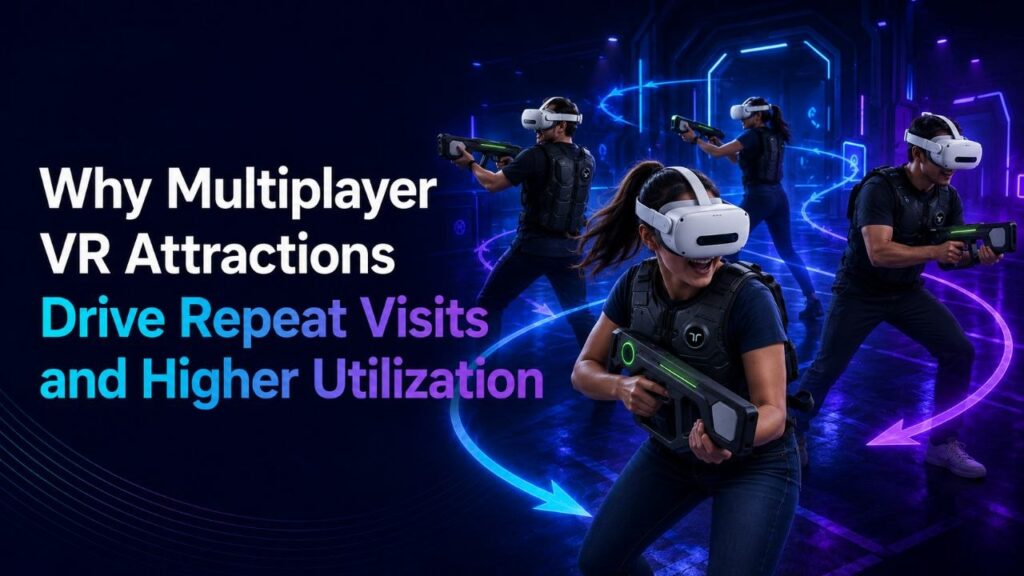
Some venues find their best-performing attraction is not the newest title on the floor. It is the multiplayer experience that the same group of friends books again three weeks later, then again after that. One operator running a six-headset free-roam arena noticed this directly: a yearSome venues find their best-performing attraction is not the newest title on the floor. It is the multiplayer experience that the same group of friends books again three weeks later, then again after that. One operator running a six-headset free-roam arena noticed this directly: a year-old multiplayer title outsold two new solo releases for three straight months, driven almost entirely by repeat group bookings. That pattern shows up across the LBE VR industry often enough to matter for how operators think about attraction mix. A solo VR experience can deliver a strong first visit. It rarely creates a second one, because the player has already seen what the headset shows them. A multiplayer experience changes shape every time a different group walks in. The teamwork shifts, the score resets, the in-jokes from last time carry over, and the session becomes a plan to repeat rather than a box to check. The simple equation still holds for VR arcades: more immersive experiences create higher customer satisfaction, and higher satisfaction creates stronger returning business. Multiplayer helps because it increases immersion through shared presence. Players do not only react to the virtual world. They react to each other inside it. Why solo VR struggles to generate repeat bookings A single-player VR attraction is usually built around a fixed narrative or a fixed challenge. Once a player finishes it, the core reason to return drops sharply. Operators running solo-heavy lineups often see strong opening weeks followed by a falloff in repeat traffic, because the content has less to offer a returning customer beyond a slightly faster completion time. Multiplayer content has a different ceiling. A four-player co-op title or a competitive free-roam shooter changes with every group composition. Two friends playing together create a different session than four coworkers on a team outing, and both create a different session from the same four coworkers coming back a month later with two new colleagues. The content stays the same. The experience does not. For first-time visitors, the headset itself often creates the initial “wow” moment. Returning customers need a different reason to feel that again. Multiplayer gives them that reason because the next session includes new players, new team dynamics, new competition, and a fresh chance to improve. Content rotation and replayability Replayability is not only a property of the game itself. It also depends on how often the venue rotates what is on offer. A venue with a static lineup of three multiplayer titles will eventually exhaust even its most social customers. A venue that rotates four or five multiplayer experiences through its schedule, swapping in new titles every few weeks while retiring others temporarily, gives returning groups a reason to book again even when the social dynamic alone would have been enough. This is where attraction mix becomes an operational decision rather than a content decision. A six-bay arena running one anchor multiplayer title alongside two rotating secondary titles can support a wider range of group sizes and repeat patterns than the same arena running six different solo experiences. The rotation does not need to be constant. A monthly refresh of one or two titles, timed against booking data, is often enough to keep returning groups engaged without requiring a full content overhaul. The strongest multiplayer titles for repeat visits usually share two traits: they are simple to start and they leave room for improvement. Players should understand what to do quickly, especially in a paid commercial session, but they should also feel they could perform better next time. That learning curve matters. A group that finishes a session saying, “we almost had it,” or “next time we beat that score,” already has a reason to return. Why social experiences generate stronger repeat traffic The social mechanism behind repeat visits is straightforward. A solo experience is something a person does. A multiplayer experience is something a group plans. Group plans get rebooked because the social commitment, not just the content, drives the decision to return. A birthday group, a corporate team, or a regular friend group treats a strong multiplayer session the way they would treat a favorite bowling night or trivia night: a recurring plan built around people, with the attraction as the setting rather than the sole draw. Competition strengthens that effect. If one team wins the first round and the other wins the second, the unfinished tiebreaker becomes part of the experience. Some groups extend the session immediately. Others leave with a reason to come back. Co-op formats can create the same effect when players fall just short of completing a mission or decide they want to bring a different group next time. This shows up directly in what operators ask for. Across requests we see from venues evaluating new content, “does it support multiplayer” is one of the most common requirements, often ranked above genre or theme. Operators are not asking for multiplayer because it is a trend. They are asking because they have already seen what happens to repeat bookings when a title only supports one player at a time. It also shows up in internal platform usage data across SynthesisVR and SpringboardVR. The titles with the highest total play time are overwhelmingly multiplayer experiences, not solo ones. That pattern holds across genres, from competitive shooters to cooperative survival games to multiplayer sports titles. Solo experiences still have a place in a lineup, especially for specific audiences or lower-capacity windows, but they rarely account for the bulk of usage once a venue has several multiplayer options in rotation. This is also why multiplayer formats tend to perform well across different group sizes. A 2-player co-op format and an 8-player competitive format can pull from the same content library but serve very different
Running 360 Video in a Commercial VR Venue
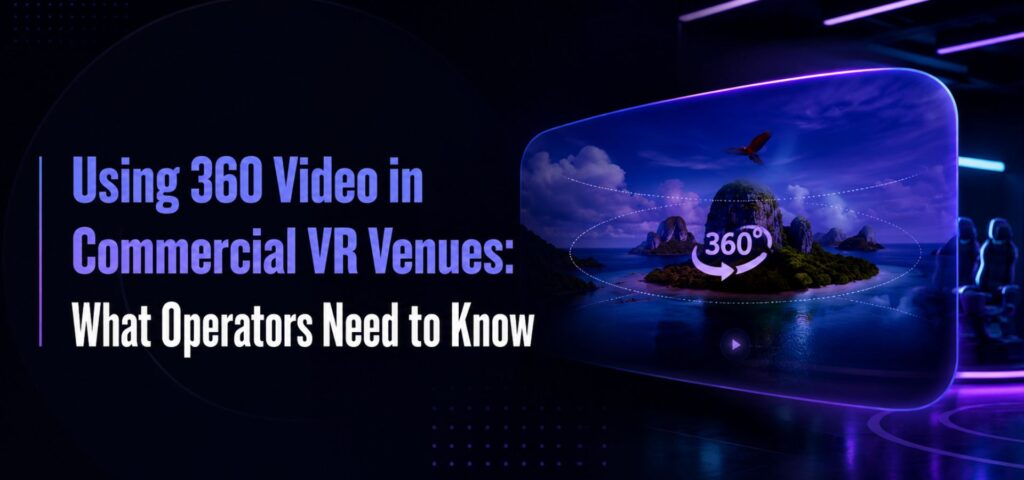
Most VR venue planning starts with the catalog: which games pull the best crowds, which titles support the most players, which escape rooms keep groups coming back. Game-led content carries the core of the business for VR arcades and LBVR locations. There are sessions, though, where a guided viewing experience fits the room better than a competitive multiplayer title. A school group on a tight schedule, a corporate booking that needs a consistent walkthrough, a trade show booth running the same content every fifteen minutes, a tourism partner showing off a destination: these all call for content that repeats cleanly, guides easily, and asks almost nothing of a first-time user. That is where 360 video earns a place in the attraction mix. Why 360 video still works in a venue 360 video suits sessions where the goal is controlled viewing rather than active play. It needs no complex controls, no deep onboarding, and no full game loop, which makes it a low-friction option for audiences who have never put on a headset. For school groups, corporate teams, museum guests, or booth visitors with five minutes to spare, a short immersive clip often lands better than a session that asks them to learn a game first. The commercial backdrop supports the format. Location-based VR sits inside a broader out-of-home immersive market that analysts expect to keep growing through the rest of the decade, even though their estimates of its size vary widely. For an operator, the practical read is steady demand for varied, low-friction immersive content that a venue can put in front of mixed audiences. What Deploy Reality Player is Deploy Reality Player is a commercial VR video player built by Deploy Reality, the parent company of SynthesisVR. It plays monoscopic, stereoscopic, and 360-degree video on PCVR room-scale rigs and on standalone headsets including Pico, Quest, and Focus 3 / Vision. The real value sits in the commercial layer around playback: one operator launching the same content across a bank of headsets, keeping viewers in sync, and running a session without handing a controller to every guest. Where it fits in a venue For VR arcade and LBVR operators, 360 video widens what the headset fleet can do between game sessions. It supports seasonal programming, short intro experiences (demo sessions) for first-timers, travel and destination content, and add-on viewings before or after a main booking. The operational payoff is utilization, since you get more reasons to keep headsets earning across the day rather than only during peak game slots. For training and education providers, the value sits in repeatability. A safety walkthrough, an equipment familiarization clip, or a guided site tour plays the same way for every participant, which is what institutional learning content needs. The format also holds up under study: a peer-reviewed experiment with primary school pupils found that 360-degree video field trips produced consistently higher content recall than standard video, with stronger engagement and a greater sense of immersion. Schools running virtual field trips and corporate teams running onboarding get a consistent experience without building a game around it. For events, trade shows, and brand activations, time is the constraint. Staff need content that starts fast, explains itself, and repeats all day. A 360 tour of a property, factory, or destination works even when a visitor only has a few minutes, and a booth can keep the queue moving without a technical operator minding each headset. Museums, tourism boards, and cultural venues use the same workflow to place guests inside locations that are otherwise hard, costly, or impossible to reach: heritage sites, protected nature, historical reconstructions, or remote destinations. The evidence here is encouraging. A study in the journal Sensors evaluated a VR experience that used 360-degree storytelling to take users through a submerged archaeological site, and recorded high levels of presence, immersion, and engagement using both participant questionnaires and EEG brain-activity readings. The operational side of playing 360 video commercially Playing a single 360 video on one headset is trivial, but running it across a venue is a different job. A staff member may need to launch the same clip on several headsets at once, start everyone together, sequence a playlist, and keep playback steady when venue Wi-Fi is unreliable. A consumer video app does none of this, while Deploy Reality Player runs every part of it from one control point. Session synchronization keeps a group watching the same frame at the same time, which matters when a guide is narrating or a class is meant to react together. Spectator view mirrors the headset feed onto a PC screen, so staff, parents, or waiting guests can follow along and a presenter can talk to what the group sees. Offline playback runs from locally stored files, so a busy session never depends on a live connection. Controller-free operation lets a guest get in and start viewing without a tutorial, and a centralized control panel runs play, pause, and seek across every active station from one place. Seeking through the timeline works while playback is paused, which keeps a guided session from drifting out of sync. Formats, platforms, and two limits to plan around The player handles monoscopic, stereoscopic, and 360-degree footage, with support for equirectangular 360, equirectangular 180, and 3:2 cubemap projections. It runs on PCVR room-scale setups through SteamVR and on standalone Pico, Quest, and Focus 3 / Vision headsets. The community page documents the full codec, container, and streaming reference, along with hardware notes and step-by-step setup. Two limits are worth knowing before you plan content. The player works only with your own VR videos, so you need the rights to anything you run through it. And it does not accept direct YouTube URLs; SynthesisVR includes YouTubeVR automation for Meta Quest headsets only, and any commercial use of YouTube content remains your responsibility to license with the rights holder. Licensing and setup Deploy Reality Player is available through the SynthesisVR content marketplace and runs on the free SynthesisVR Essential Access subscription, so an operator