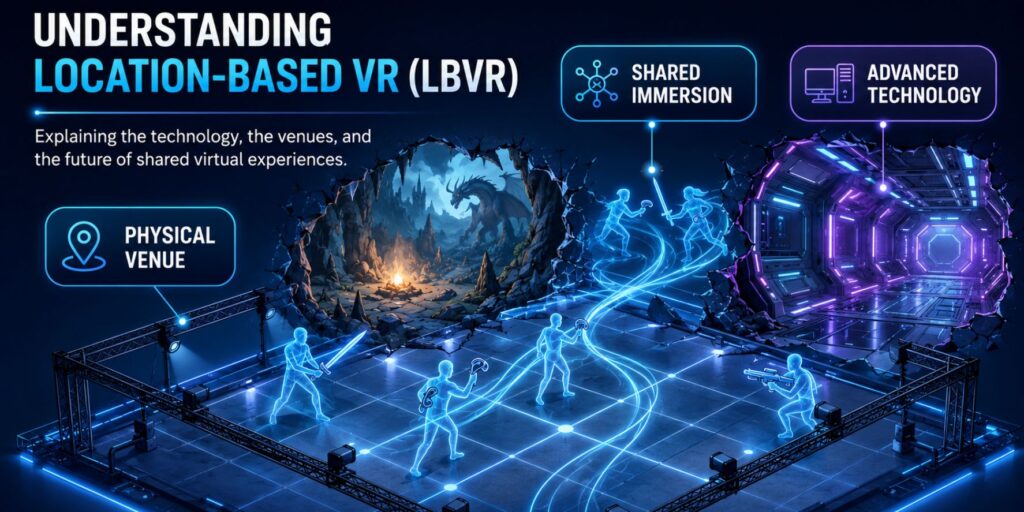
LBVR stands for location-based virtual reality, and it describes commercial VR delivered in a dedicated venue rather than in someone’s living room. The term shows up constantly in industry press, at trade shows, and in vendor pitches, usually without anyone stopping to define it. That leaves prospective operators trying to evaluate hardware, space, and content decisions before they have a clear picture of the category those decisions sit inside.
The definition matters more than it first appears. How an operator understands LBVR shapes what they compare their business to, how they price it, and what they tell a landlord or an investor about what they are building.
The definition, in plain terms
LBVR is the commercial sector that delivers virtual reality experiences in purpose-built physical venues. VR arcades, free-roam arenas, VR escape rooms, and VR installations inside family entertainment centers all fall under it.
The venue is what defines the category. A guest at home puts on a headset in whatever floor space they have cleared. A guest at an LBVR venue walks into a room that was designed around the experience: tracked, mapped, sized to the title, staffed, and turned over between sessions on a schedule. The headset might even be the same model in both cases.
That distinction produces a handful of practical differences:
- Physical space is part of the product. The arena dimensions, the mapping, and the boundary setup are as much a part of what the guest pays for as the software.
- Sessions are staffed and scheduled. Someone briefs the group, launches the session, handles the reset, and helps when a player gets stuck. Throughput is a real operating constraint.
- Hardware runs many users a day, not one. Commercial deployments deal with battery cycles, sanitation, device management across multiple units, and licensing terms written for business use.
- Most LBVR content is built for groups. Multiplayer and social play are the default rather than an option, because a venue’s economics depend on booking parties, not individuals.
- Sensory and physical elements are common. Props, haptics, motion platforms, and environmental effects show up in LBVR precisely because they are impractical to replicate at home.
The formats that fall under LBVR
Operators often use “LBVR” and “VR arcade” interchangeably. The VR arcade is one format inside the category, and treating them as the same thing narrows how an operator thinks about their own venue.
Room-scale and station-based VR. Compact footprints, seated or standing play, sometimes with motion platforms. The lowest space requirement and the easiest format to add to an existing venue. Our breakdown of room-scale versus free-roam VR covers where the line between the two sits.
Free-roam arenas. Open floor space with full-body tracking, letting groups move physically through the virtual environment. Player counts commonly run from four to twelve depending on the title and the arena size. Space requirements are the main planning constraint, and we have covered how much space a free-roam arena actually needs in detail.
VR escape rooms. Story-driven, puzzle-focused, built around cooperative problem solving. A natural format for traditional escape room venues adding a VR line, since the booking model and session length already match.
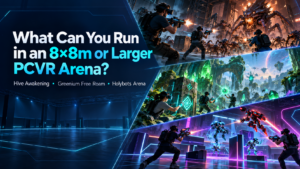
Arena-scale VR. Large-format free-roam, often built around competitive or esports-style play, running in considerably larger footprints than a standard free-roam room. This format has its own planning considerations, which we will cover in a dedicated article.
A single venue frequently runs more than one of these. A family entertainment center might operate room-scale stations for walk-ins and a free-roam arena for booked parties, because the two formats capture different guests at different price points.
Why the category framing changes operator decisions
An operator who thinks of their business as “a VR arcade” tends to benchmark against other VR arcades. An operator who understands they are in LBVR benchmarks against the rest of out-of-home entertainment: bowling, laser tag, escape rooms, mini golf, axe throwing.
That second framing is more useful, and more accurate. A family choosing a Saturday afternoon activity is not comparing VR venues to each other. They are choosing between VR and the trampoline park down the road. Pricing, session length, party packages, and marketing all get sharper once the competitive set is drawn correctly.
It also changes the conversation with landlords and investors. LBVR positioned as an emerging technology category invites questions about whether VR is a passing trend. Positioned as an out-of-home entertainment format that happens to use VR, it sits alongside established attraction businesses with understood economics.
What the category looks like at scale
Market research firms currently size location-based VR and immersive entertainment somewhere in the multi-billion dollar range, with growth forecasts in the 25 to 35 percent annual range through the early 2030s. Those figures vary widely between firms depending on whether they count VR alone or all immersive out-of-home entertainment, so they are better read as directional than precise.
The more useful picture comes from operational data. SynthesisVR runs 600+ locations worldwide across free-roam, room-scale, and seated formats, with a content marketplace of 400+ commercial VR titles. That spread across formats tells you something a market size figure cannot: LBVR has not converged on one venue type, and there is no sign it is heading that way.
Our analysis of what 600+ locations reveal about free roam found two distinct content strategies that both sustain profitable venues. Some operators run a tight catalog of five to ten titles, train staff deeply on every scenario, and rotate slowly. Others run fifteen to twenty-five titles, refresh regularly, and lean on visual appeal and recognizable IP to pull first-time visitors. Both models work. Operators who struggle are usually the ones running a hybrid of the two without having chosen either on purpose.
That finding says something about the category as a whole. LBVR is broad enough to support genuinely different business models, which is why a definition that collapses it into “VR arcade” costs operators more than it saves them.
Common misconceptions worth clearing up
LBVR always means free-roam. It does not. Seated and room-scale formats are LBVR, and for many venues they are the more practical entry point.
LBVR and AR attractions are the same category. Press coverage often groups them together. The technology, the space requirements, and the content pipelines are different.
Consumer headsets and home content transfer directly to commercial use. This is the assumption that causes the most expensive surprises. Warranty terms, software licensing, and device management all work differently once a headset is running paying customers. We covered the specifics in whether consumer VR headsets can be used commercially.
Hardware selection is the decision that determines the outcome. Most new operators spend the majority of their planning effort choosing a headset. Across our locations, content strategy and operational consistency separate profitable venues from struggling ones far more reliably than hardware choice does.
Where to go from here
Understanding LBVR as a category is the starting point for the decisions that follow: which format fits the space and the market, how much room the format actually requires, which hardware supports the operating model, and how the venue makes money once it opens. Each of those has its own answer, and none of them resolve well until the category question is settled.
If you are working through those decisions now, how VR arcades actually make money is a reasonable next read, since revenue model tends to constrain everything else.