Week 1 – What Free Roam Actually Means (And Why It Breaks So Often)
The 10-Year Journey: Why This Series Exists
In 2016, we opened VR Territory in Los Angeles to solve a problem: making high-end VR accessible. What we didn’t realize then was that we were building a laboratory for the next decade of Location-Based Entertainment (LBE). That experience became the foundation of SynthesisVR, and following our acquisition of SpringboardVR in early 2025, we now support over 700 locations globally.
We aren’t writing this series to reminisce about the early days of cables, base stations and tracking issues. We are writing it because we are seeing a specific trend now moving into the 2026 market.
Too many platform providers are pushing “short-term profit” models, bundling a few games with consumer-grade headsets like the Meta Quest and selling them as “turnkey free roam.” They focus on the low entry cost but fail to educate operators on the operational traps that follow: account restrictions, tracking drift, inconsistent resets and the hidden labor costs of keeping everything running smoothly.
We have managed millions of minutes of gameplay, we’ve seen what makes money and, more importantly, what causes a business to struggle within its first year. This 12-part series is our effort to pull back the curtain. Our goal is to help you skip the “experimental” phase and move straight to a high-throughput, reliable arena by choosing the right hardware: such as the PICO 4 Ultra Enterprise, and the right operational systems from day one.
A Quick Introduction to Free Roam (Arena) and How It´s Different From Room scale (POD) VR
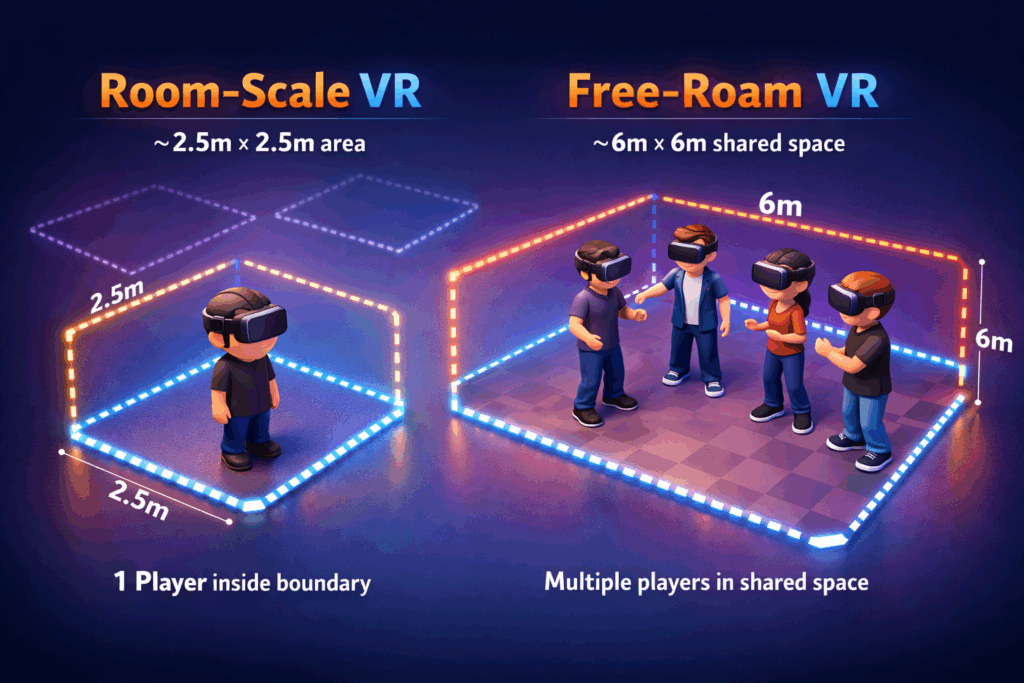
Free roam VR allows multiple players to move freely within a shared physical space while interacting with each other in real time. This has become one of the most attractive formats in LBE VR because it enables experiences that are typically only accessible in commercial environments, requires physical space most consumers do not have at home, and creates a strong social dynamic that cannot be replicated in private settings.
Room scale VR places each player in a separate, defined play area with limited movement. Players may participate in single-player or multiplayer experiences, but each station operates independently. Operators typically sell time based sessions, and if a technical issue occurs, it usually affects only one player or station. This model powered the first wave of VR arcades starting around 2016, when venues rapidly expanded worldwide.
How The Industry Is Shifting to Free Roam And The Role Of Inside-out Tracking
The industry´s shift toward free roam has been accelerated by improvements in inside-out tracking, lighter headsets, and untethered hardware. What once required external trackers and complex installations can now be set up more flexibly in a much wider range of venues.
We see this shift every day in our conversations with operators. When venue owners contact SynthesisVR, whether they are just starting out or looking to upgrade an existing business, most inquiries are now about standalone VR. That is not a coincidence.
In our experience, this preference is closely tied to cost. New businesses are attracted by lower startup investment, while existing venues see clearer, more affordable paths to scaling and expansion. Standalone systems make adding more players, arenas, or locations feel far less intimidating than it used to.
This evolution has made it much easier for operators to offer free roam, and it has made it accessible at a lower overall cost. More venues are also seeing higher demand for free roam compared to traditional room-scale stations. For many operators, free roam has become a way to stand out, attract groups, and increase engagement.
At the same time, easier hardware does not automatically mean easier operations. For sessions to run smoothly, venues still need to get the setup right from the very beginning. Once multiple players start moving freely together, small inconsistencies become very visible, very fast.
We have seen this play out repeatedly. Tracking alignment drift, boundary mismatches, delayed session starts, and inconsistent reset times all create a weaker experience for players and more stress for staff.
That is why success in free roam ultimately depends on three things. Consistent setup. Reliable mapping. And repeatable workflows that work the same way every session, even during peak hours.
Two Main Free Roam Experiences and their Differences
- PCVR Free Roam Arena
- Standalone Free Roam Arena
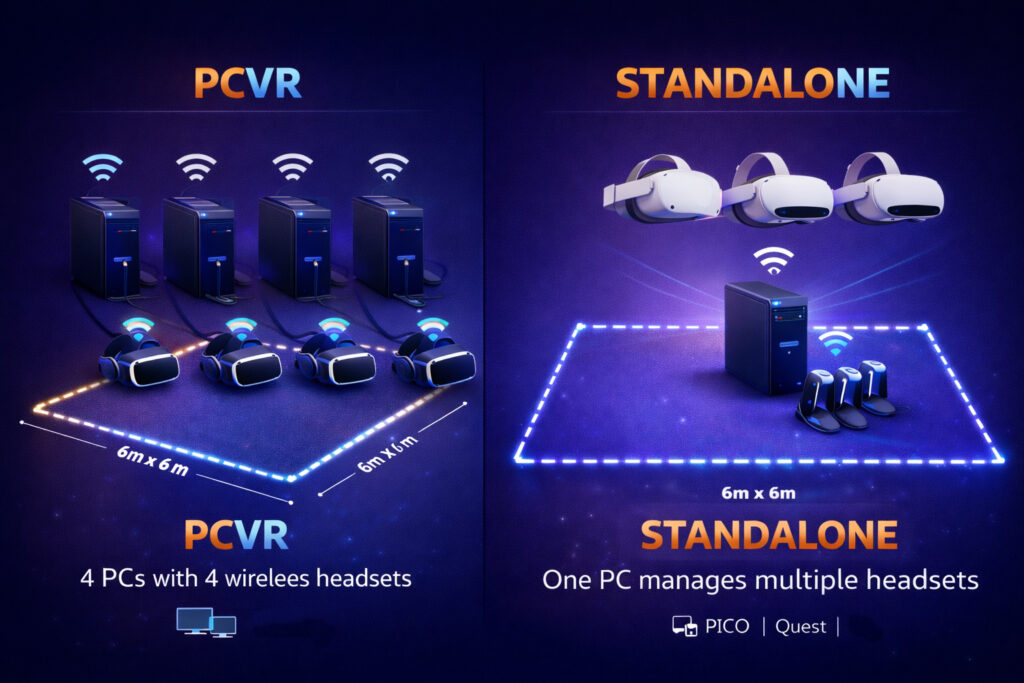
Traditional PCVR free roam often relies on backpack PCs or tethered systems, external networking infrastructure, and extensive cabling. While this approach can deliver strong graphical performance, it introduces significant operational overhead. There is more hardware to maintain, longer reset times, more potential points of failure, and higher staff complexity as player counts increase.
Thankfully, with the recent advancements in inside-out tracking and headsets like the PICO 4 Ultra Enterprise, PCVR free roam has become significantly easier. The primary distinction lies in the fact that each headset is wirelessly connected to a PC, and the game rendering is processed on the PC before being streamed wirelessly to the headset. In essence, the headset functions as a monitor for the user.
Standalone VR integrated processing, tracking, and rendering directly into the headset, eliminating the need for high-end PCs and external tracking systems. This streamlined installation and daily operations. Inside-out tracking provided reliable six-degree-of-freedom movement without external sensors, making true free-roaming layouts more accessible to diverse venues. Essentially, with a single PC, operators can manage multiple headsets. In a typical setup, operators would run one PC with eight headsets in a single free-roaming arena.
Wireless operation also removed physical constraints on movement, improved player comfort, and reduced safety risks related to cables and wear. Faster setup times and simplified device handling lowered staff training requirements and allowed venues to turn sessions more efficiently. Portability further enabled temporary activations, mobile events, and flexible floor layouts without major infrastructure investment.
As standalone hardware matured, enterprise-focused manufacturers such as PICO began optimizing devices specifically for commercial environments. Beyond hardware improvements, PICO has also signaled its intent to engage more directly with the location-based entertainment sector, including joining an industry LBE association as a founding member. This move reflects a broader shift toward recognizing the distinct needs of commercial venues rather than treating them as simply larger consumer users.
More importantly for operators, PICO has been adapting its devices and software toward LBE use cases through enterprise features and an LBE-oriented mode that better supports multi-headset venues, device management, and repeatable operations. This includes closer collaboration with game developers and operational platforms, such as SynthesisVR, to ensure that standalone headsets integrate smoothly into real-world venue workflows.
The PICO 4 Ultra Enterprise represents this maturity phase. It combines advanced inside-out tracking, balanced ergonomics for longer sessions, and enterprise-grade device management capabilities designed for multi-headset venues. This makes it well suited for venues that require predictable performance, fast resets, and a consistent player experience at scale.
Why Movement Stresses Tracking, Synchronization, Safety, And Staff Simultaneously
Free roam environments introduce continuous motion across multiple players in the same physical space. Unlike room-scale setups, where movement remains confined and predictable, free roam requires systems to maintain accurate tracking, shared boundaries, synchronized sessions, and safe player behavior at all times.
We consistently see this become the biggest hurdle when venues transition from room-scale to free roam, particularly when they rely on consumer-grade Meta Quest devices. These headsets often perform well for single-player or station-based experiences, but once multiple players are moving together in a shared arena, inconsistencies in tracking and mapping tend to surface quickly.
What many operators discover is that issues rarely appear when testing with one player. The problems emerge only when a full group is inside the space at the same time. Small tracking drift, misaligned boundaries, or slight positional differences between headsets suddenly become noticeable and disruptive.
This is one of the reasons venues that switch to enterprise-grade standalone headsets report such a noticeable operational difference. Unlike consumer devices that typically require individual calibration and maintain separate maps per headset, enterprise solutions such as PICO support a shared free-roam map across all devices. This reduces variability between headsets, minimizes repeated calibration work, and creates a more stable, predictable play space for multi-player sessions.
As player count increases, the complexity of managing free roam grows rapidly. Headsets must maintain consistent spatial alignment with one another. Network synchronization must remain stable across every device. Staff must monitor player flow, prevent collisions, manage resets, and keep sessions moving on schedule. Small delays or inaccuracies compound quickly when multiple players are involved.
This is why free roam exposes operational weaknesses that remain hidden in smaller or single-station deployments. What works perfectly in room-scale does not automatically translate to free roam without the right hardware, shared mapping, and well-designed operational workflows.
Common Failure Points Once Multiple Players Move Freely
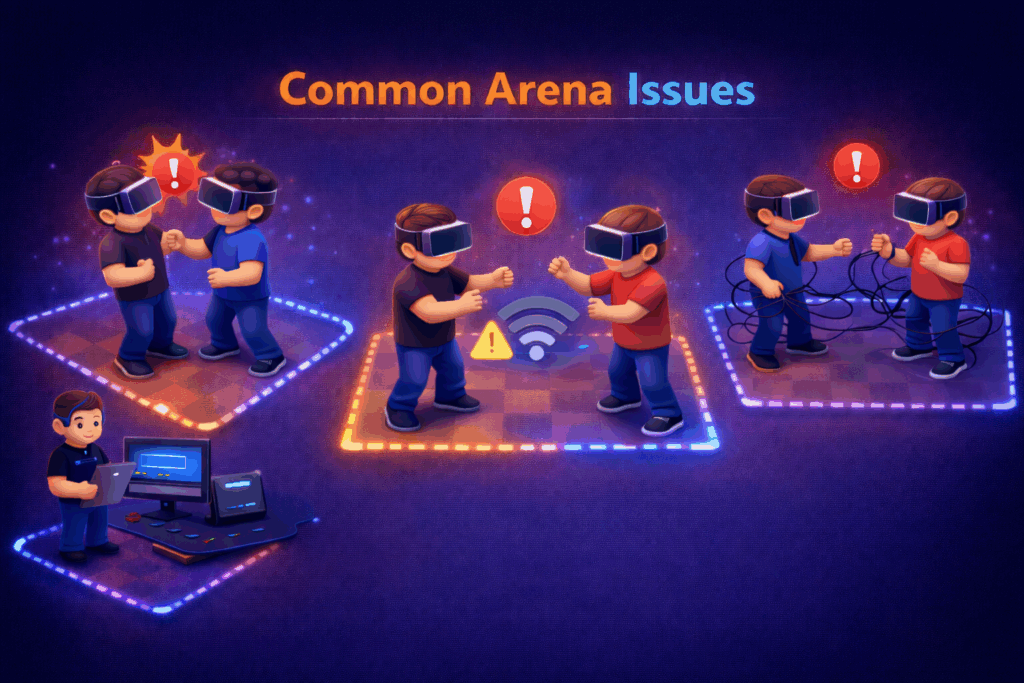
When several players move freely at the same time, common issues begin to surface:
- Tracking drift that causes player positions to slowly misalign
- Boundary mismatches between headsets leading to safety risks
- Session launch delays due to manual coordination
- Increased reset time between groups
- Network congestion affecting synchronization and stability
- Higher staff workload during peak hours
These challenges rarely appear during small-scale testing but emerge quickly under real operational conditions. This aligns with independent technical research on inside-out tracking and multi-user VR systems.
Benchmarks of commercial XR devices show that tracking accuracy can vary significantly depending on lighting, movement patterns, and environmental features, meaning small positional errors are more likely to surface in larger, more dynamic spaces. This helps explain why issues often remain invisible in single-player demos but become noticeable in full free-roam sessions. (XR Reality Check: What Commercial Devices Deliver for Spatial Tracking, arXiv).
Academic studies on SLAM-based inside-out tracking further confirm that positional drift can accumulate over time unless systems are continuously realigned with shared reference points. In multi-player free-roam environments, where several headsets must remain perfectly aligned within the same physical map, this limitation becomes operationally significant. (Co-Located VR with Hybrid SLAM-based HMD Tracking and Motion Capture Synchronization, arXiv).
Similarly, independent performance assessments of consumer standalone headsets indicate that tracking precision tends to degrade under less controlled real-world conditions, such as feature-poor environments or inconsistent lighting. These findings support what many venue operators report in practice when scaling from room-scale to multi-player free roam. (A Universal Method for Performance Assessment of Meta Quest XR Devices, ResearchGate).
Taken together, this research explains why free roam places far greater demands on tracking stability, shared mapping, and synchronization than room-scale VR, and why enterprise-grade solutions designed for shared spaces tend to perform more consistently in high-throughput venue environments.
These technical and operational pressures also point to an important insight that many venues only discover after going live. When something goes wrong in free roam, the instinct is often to blame the game or the headset itself. In reality, the root causes are far more likely to sit beneath the surface, in the infrastructure, workflows, and systems that support the experience. This is why, in practice, most free roam problems are not actually about the content at all.
Why Most Free Roam Problems Are Not Game Related
When free roam fails, it is rarely the content. In practice, most breakdowns trace back to systems and processes: calibration and mapping, device management, network stability, and fragmented operational workflows. Small errors in these layers compound quickly once multiple players are active, and that is what turns a smooth demo into a chaotic session.
This does not mean issues in calibration are never game related but in most cases it may not be game related.
Technical studies show exactly why. Benchmarks of commercial XR devices find that spatial tracking accuracy can vary significantly with lighting, motion, and environmental features, so positional errors that do not appear in single-player demos can emerge in dynamic, multi-user arenas.
Academic research on colocated SLAM tracking warns that mismatches between virtual and real user positions can cause safety risks in shared spaces. In short: if headsets build separate maps or drift independently, players can be misaligned in the physical space.
Industry guidance and vendor documentation emphasize that enterprise deployments benefit when hardware and software are designed for the venue environment. For example, commercial LBE solutions advertise that standalone, enterprise-focused headsets and integrated location-management systems help reduce operating costs and minimize reconfiguration time between sessions. (VIVE Business: “Minimize operating costs.”)
Put together, this evidence explains why operators who centralize device control, session launches and mapping into a single operational layer tend to experience far fewer interruptions. Once teams pass the short onboarding curve, their focus shifts back to content, marketing and guest experience instead of constant troubleshooting.
Operator Reality Check
As soon as larger groups of players joined a free roam experience, many operators began noticing issues that were not primarily due to the games themselves. Instead, most common problems were tied to hardware setup, device management, tracking calibration, and operational coordination under pressure.
Small demos and single-player tests rarely reveal these challenges. They tend to appear only when real customers, real timelines, and real throughput demands enter the picture. This pattern aligns with broader industry insights showing that infrastructure, system integration, and operational workflows matter more for consistent performance in high-use environments than any single piece of content or headset alone.
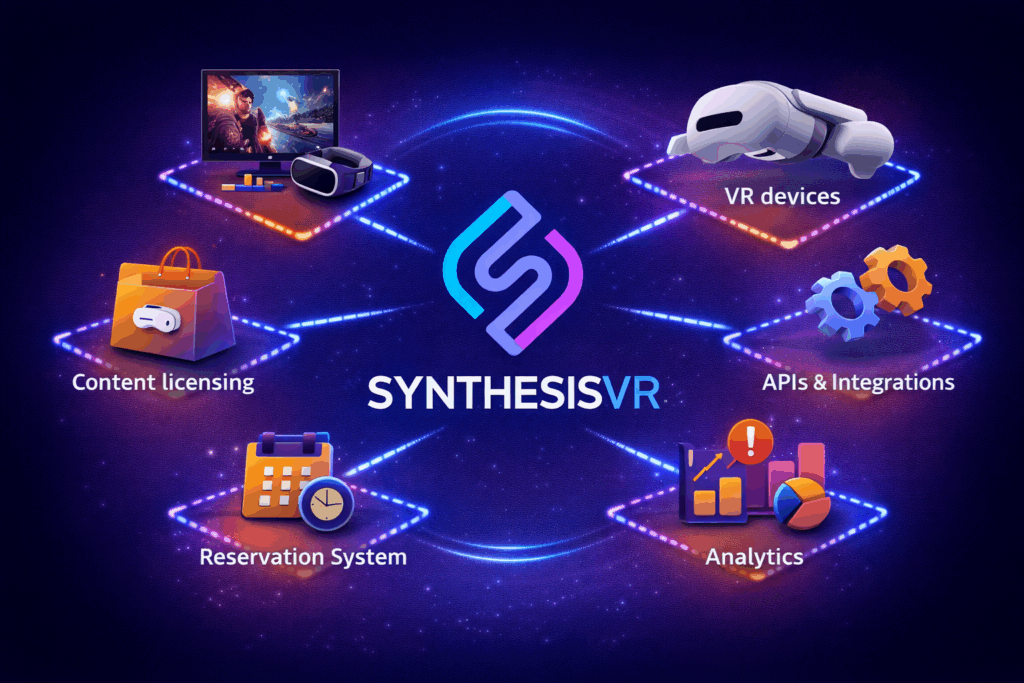
Operators often initially blame the platform, content, hardware, or staff performance. In reality, many frustrations stem from trying to manage free roam without centralized control, predictable workflows, and a unified operational platform. This has been one of the most consistent reasons that early free roam launches have felt frustrating for venues.
What Comes Next
Free roam is becoming a core attraction for modern VR venues, but long-term success depends on how the entire system is designed, operated, and scaled.
Over the next articles, we will break down the operational layers that determine real world performance. From hardware choices and device control to networking, mapping, automation, staffing, and profitability, each article will focus on practical decisions that impact stability, throughput, and long term growth.
If you are building or expanding a free roam operation, this series is designed to help you avoid costly trial and error and move faster toward predictable, profitable operations.
If you would like to see how SynthesisVR and the PICO 4 Ultra Enterprise work together to simplify free roam operations, contact us to schedule a demo call at your convenience.
If you found this article helpful, we invite you to explore the rest of the series.
Week 1: Free Roaming with PICO
Week 2: The Consumer Trap: When Wrong Assumptions Costs Money!
Week 3: Why PICO Became the LBE Standard for Free Roam
Week 4: The Math of a Successful Free Roam Arena
Week 5: Designing a Free Roam Space That Actually Works
Week 6: Networking: The Invisible Backbone of Free Roam
Week 6.5: Networking for VR Venues: What You Need to Know Before You Build
Week 7: Mapping and Calibration: Ending the Drift Problem
Week 8: Launching Games Without Breaking the Flow