
Wanadev Studio Experiences on SynthesisVR: a Complete Octopod VR Catalogue Spotlight
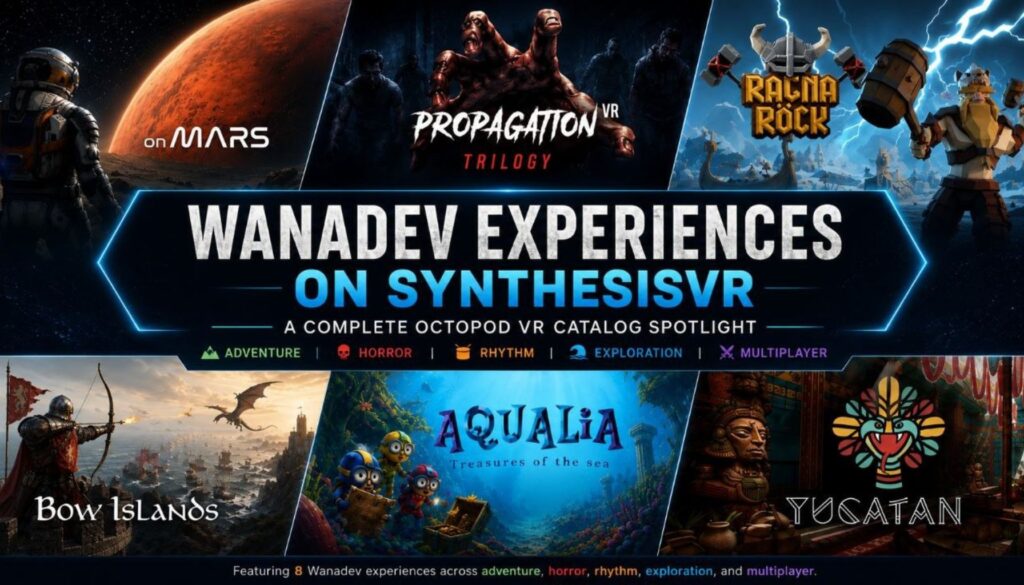
Octopod VR’s arcade catalog is migrating to SynthesisVR. Wanadev, the studio behind the games, announced the change directly: their flagship VR arcade experiences have joined the SynthesisVR ecosystem, which becomes the exclusive distribution platform for the titles going forward. Wanadev continues to build and support the games. What changes is where operators go to license and manage them. Ten titles are live on SynthesisVR today: Aqualia, Bow Islands, On Mars, Yucatan, the Propagation trilogy, Ragnarock, Propagation: Top Squad, Propagation: Top Survivors. All run on PCVR, built for room-scale and free-roam VR arcade spaces. Why Wanadev chose SynthesisVR Wanadev’s decision to move distribution to SynthesisVR came down to focus. Running the Octopod platform alongside game development and publishing was pulling resources away from the side of the business Wanadev wanted to grow, and moving distribution to a partner frees that time up for building and publishing games instead of maintaining a distribution platform. SynthesisVR’s feature set was close enough to what Octopod customers already used that the switch could happen without asking operators to learn an entirely new way of managing licenses, which is part of why Wanadev has called the transition seamless. For operators coming over from Octopod, the move also opens up more than the ten titles covered here. SynthesisVR’s catalog spans a broader range of studios and genres, so an Octopod customer moving over gains a wider selection to draw from, not just a new home for the games they already ran. And for venues thinking beyond PCVR, the same account handles standalone titles too, so a location built around Octopod’s PCVR catalog has a path to add standalone content later without bringing in a second platform to manage it. Switching from Octopod? The transition is already built. This matters differently depending on where an operator is starting from. If you’re currently licensing through Octopod VR The transition has been set up to run without interrupting service. Operators already running these titles do not need to pull them from rotation or wait for a hard cutover date. The practical next step is to contact SynthesisVR support through the contact page to get the catalog attached to an existing account, or set one up if the venue is new to the platform. You can also follow full migration guide here: Migrate from OctopodVR to SynthesisVR Bringing the licensing partnership to SynthesisVR also brings a pricing benefit for some locations, with select venues seeing a reduction in licensing costs as part of the move. If you’ve never licensed Octopod VR titles before For operators who evaluated these games in the past and never brought them into a venue, or who are only discovering the catalog now, the appeal is the same as it always was. The table above covers player count, format, and space for each title. Now let´s dive in each title a bit more. The Propagation trilogy Propagation is built as a three-part arc rather than three standalone titles, and operators get to decide whether to run it that way. Stage 1 drops one or two players into a supermarket overrun by a zombie swarm, using that contained setting to teach movement, aiming, and pacing before the difficulty ramps up. Stage 2 opens the format to four players and hands the group a sniper rifle, moving the fight into a bigger street-level battle where coordination between players starts to matter as much as aim. Stage 3 takes the survivors underground into a new set of monster encounters, closing the arc in a tighter, more claustrophobic space than the first two stages. All three run on PCVR, in free-roam or room scale depending on the space available, with footprints between 4x5m and 5x5m. The 18+ recommendation across the trilogy makes it a stronger fit for an evening booking than an afternoon one, and operators running it as a three-part session have a built-in reason to bring a group back for the next stage rather than treating each part as a one-off. Bow Islands Bow Islands puts two teams of up to three players on opposing ships, firing arrows at each other’s vessels and the dragons circling above. It runs on PCVR room scale in a standard box footprint, which keeps the setup consistent with whatever else is already running in that space. The format is the reason it earns a spot as a first-time title. A new player can understand “shoot the other team’s ship” in the time it takes to hand them a bow, and the same structure holds up for a group that already plays competitively and wants a tighter, faster match. That range, from a birthday party group picking up a headset for the first time to a league night rematch, makes it one of the easier titles to schedule without needing to know the group’s experience level in advance. On Mars On Mars is built for scale. At up to 12 players, it handles a corporate outing or a large friend group in a single session where most box-format titles in the catalog would need to split the group in two. The sci-fi exploration and escape format runs on PCVR room scale in a standard box, so it slots into the same physical footprint as smaller-capacity titles without extra setup. For weekday bookings especially, the capacity is the operational advantage. A single 12-player session covers ground that would otherwise take two or three back-to-back sessions with a smaller-format game, which matters more on a Tuesday afternoon corporate booking than it does on a weekend walk-in. Yucatan Yucatan runs in pairs, up to four pairs at once, through a Mayan exploration and cooperation format built around PCVR free-roam. The footprint scales with the venue: 4x5m per pair at the low end, up to 8x10m if the space and group size support it, which gives operators some room to fit it into venues that couldn’t take a fixed large-format free-roam title. That flexibility, combined with a cooperative structure rather than a competitive one, makes it a
Why Multiplayer VR Attractions Drive Repeat Visits and Higher Utilization
Some venues find their best-performing attraction is not the newest title on the floor. It is the multiplayer experience that the same group of friends books again three weeks later, then again after that. One operator running a six-headset free-roam arena noticed this directly: a yearSome venues find their best-performing attraction is not the newest title on the floor. It is the multiplayer experience that the same group of friends books again three weeks later, then again after that. One operator running a six-headset free-roam arena noticed this directly: a year-old multiplayer title outsold two new solo releases for three straight months, driven almost entirely by repeat group bookings. That pattern shows up across the LBE VR industry often enough to matter for how operators think about attraction mix. A solo VR experience can deliver a strong first visit. It rarely creates a second one, because the player has already seen what the headset shows them. A multiplayer experience changes shape every time a different group walks in. The teamwork shifts, the score resets, the in-jokes from last time carry over, and the session becomes a plan to repeat rather than a box to check. The simple equation still holds for VR arcades: more immersive experiences create higher customer satisfaction, and higher satisfaction creates stronger returning business. Multiplayer helps because it increases immersion through shared presence. Players do not only react to the virtual world. They react to each other inside it. Why solo VR struggles to generate repeat bookings A single-player VR attraction is usually built around a fixed narrative or a fixed challenge. Once a player finishes it, the core reason to return drops sharply. Operators running solo-heavy lineups often see strong opening weeks followed by a falloff in repeat traffic, because the content has less to offer a returning customer beyond a slightly faster completion time. Multiplayer content has a different ceiling. A four-player co-op title or a competitive free-roam shooter changes with every group composition. Two friends playing together create a different session than four coworkers on a team outing, and both create a different session from the same four coworkers coming back a month later with two new colleagues. The content stays the same. The experience does not. For first-time visitors, the headset itself often creates the initial “wow” moment. Returning customers need a different reason to feel that again. Multiplayer gives them that reason because the next session includes new players, new team dynamics, new competition, and a fresh chance to improve. Content rotation and replayability Replayability is not only a property of the game itself. It also depends on how often the venue rotates what is on offer. A venue with a static lineup of three multiplayer titles will eventually exhaust even its most social customers. A venue that rotates four or five multiplayer experiences through its schedule, swapping in new titles every few weeks while retiring others temporarily, gives returning groups a reason to book again even when the social dynamic alone would have been enough. This is where attraction mix becomes an operational decision rather than a content decision. A six-bay arena running one anchor multiplayer title alongside two rotating secondary titles can support a wider range of group sizes and repeat patterns than the same arena running six different solo experiences. The rotation does not need to be constant. A monthly refresh of one or two titles, timed against booking data, is often enough to keep returning groups engaged without requiring a full content overhaul. The strongest multiplayer titles for repeat visits usually share two traits: they are simple to start and they leave room for improvement. Players should understand what to do quickly, especially in a paid commercial session, but they should also feel they could perform better next time. That learning curve matters. A group that finishes a session saying, “we almost had it,” or “next time we beat that score,” already has a reason to return. Why social experiences generate stronger repeat traffic The social mechanism behind repeat visits is straightforward. A solo experience is something a person does. A multiplayer experience is something a group plans. Group plans get rebooked because the social commitment, not just the content, drives the decision to return. A birthday group, a corporate team, or a regular friend group treats a strong multiplayer session the way they would treat a favorite bowling night or trivia night: a recurring plan built around people, with the attraction as the setting rather than the sole draw. Competition strengthens that effect. If one team wins the first round and the other wins the second, the unfinished tiebreaker becomes part of the experience. Some groups extend the session immediately. Others leave with a reason to come back. Co-op formats can create the same effect when players fall just short of completing a mission or decide they want to bring a different group next time. This shows up directly in what operators ask for. Across requests we see from venues evaluating new content, “does it support multiplayer” is one of the most common requirements, often ranked above genre or theme. Operators are not asking for multiplayer because it is a trend. They are asking because they have already seen what happens to repeat bookings when a title only supports one player at a time. It also shows up in internal platform usage data across SynthesisVR and SpringboardVR. The titles with the highest total play time are overwhelmingly multiplayer experiences, not solo ones. That pattern holds across genres, from competitive shooters to cooperative survival games to multiplayer sports titles. Solo experiences still have a place in a lineup, especially for specific audiences or lower-capacity windows, but they rarely account for the bulk of usage once a venue has several multiplayer options in rotation. This is also why multiplayer formats tend to perform well across different group sizes. A 2-player co-op format and an 8-player competitive format can pull from the same content library but serve very different
Running 360 Video in a Commercial VR Venue
Most VR venue planning starts with the catalog: which games pull the best crowds, which titles support the most players, which escape rooms keep groups coming back. Game-led content carries the core of the business for VR arcades and LBVR locations. There are sessions, though, where a guided viewing experience fits the room better than a competitive multiplayer title. A school group on a tight schedule, a corporate booking that needs a consistent walkthrough, a trade show booth running the same content every fifteen minutes, a tourism partner showing off a destination: these all call for content that repeats cleanly, guides easily, and asks almost nothing of a first-time user. That is where 360 video earns a place in the attraction mix. Why 360 video still works in a venue 360 video suits sessions where the goal is controlled viewing rather than active play. It needs no complex controls, no deep onboarding, and no full game loop, which makes it a low-friction option for audiences who have never put on a headset. For school groups, corporate teams, museum guests, or booth visitors with five minutes to spare, a short immersive clip often lands better than a session that asks them to learn a game first. The commercial backdrop supports the format. Location-based VR sits inside a broader out-of-home immersive market that analysts expect to keep growing through the rest of the decade, even though their estimates of its size vary widely. For an operator, the practical read is steady demand for varied, low-friction immersive content that a venue can put in front of mixed audiences. What Deploy Reality Player is Deploy Reality Player is a commercial VR video player built by Deploy Reality, the parent company of SynthesisVR. It plays monoscopic, stereoscopic, and 360-degree video on PCVR room-scale rigs and on standalone headsets including Pico, Quest, and Focus 3 / Vision. The real value sits in the commercial layer around playback: one operator launching the same content across a bank of headsets, keeping viewers in sync, and running a session without handing a controller to every guest. Where it fits in a venue For VR arcade and LBVR operators, 360 video widens what the headset fleet can do between game sessions. It supports seasonal programming, short intro experiences (demo sessions) for first-timers, travel and destination content, and add-on viewings before or after a main booking. The operational payoff is utilization, since you get more reasons to keep headsets earning across the day rather than only during peak game slots. For training and education providers, the value sits in repeatability. A safety walkthrough, an equipment familiarization clip, or a guided site tour plays the same way for every participant, which is what institutional learning content needs. The format also holds up under study: a peer-reviewed experiment with primary school pupils found that 360-degree video field trips produced consistently higher content recall than standard video, with stronger engagement and a greater sense of immersion. Schools running virtual field trips and corporate teams running onboarding get a consistent experience without building a game around it. For events, trade shows, and brand activations, time is the constraint. Staff need content that starts fast, explains itself, and repeats all day. A 360 tour of a property, factory, or destination works even when a visitor only has a few minutes, and a booth can keep the queue moving without a technical operator minding each headset. Museums, tourism boards, and cultural venues use the same workflow to place guests inside locations that are otherwise hard, costly, or impossible to reach: heritage sites, protected nature, historical reconstructions, or remote destinations. The evidence here is encouraging. A study in the journal Sensors evaluated a VR experience that used 360-degree storytelling to take users through a submerged archaeological site, and recorded high levels of presence, immersion, and engagement using both participant questionnaires and EEG brain-activity readings. The operational side of playing 360 video commercially Playing a single 360 video on one headset is trivial, but running it across a venue is a different job. A staff member may need to launch the same clip on several headsets at once, start everyone together, sequence a playlist, and keep playback steady when venue Wi-Fi is unreliable. A consumer video app does none of this, while Deploy Reality Player runs every part of it from one control point. Session synchronization keeps a group watching the same frame at the same time, which matters when a guide is narrating or a class is meant to react together. Spectator view mirrors the headset feed onto a PC screen, so staff, parents, or waiting guests can follow along and a presenter can talk to what the group sees. Offline playback runs from locally stored files, so a busy session never depends on a live connection. Controller-free operation lets a guest get in and start viewing without a tutorial, and a centralized control panel runs play, pause, and seek across every active station from one place. Seeking through the timeline works while playback is paused, which keeps a guided session from drifting out of sync. Formats, platforms, and two limits to plan around The player handles monoscopic, stereoscopic, and 360-degree footage, with support for equirectangular 360, equirectangular 180, and 3:2 cubemap projections. It runs on PCVR room-scale setups through SteamVR and on standalone Pico, Quest, and Focus 3 / Vision headsets. The community page documents the full codec, container, and streaming reference, along with hardware notes and step-by-step setup. Two limits are worth knowing before you plan content. The player works only with your own VR videos, so you need the rights to anything you run through it. And it does not accept direct YouTube URLs; SynthesisVR includes YouTubeVR automation for Meta Quest headsets only, and any commercial use of YouTube content remains your responsibility to license with the rights holder. Licensing and setup Deploy Reality Player is available through the SynthesisVR content marketplace and runs on the free SynthesisVR Essential Access subscription, so an operator
PCVR vs Standalone VR for Commercial Venues
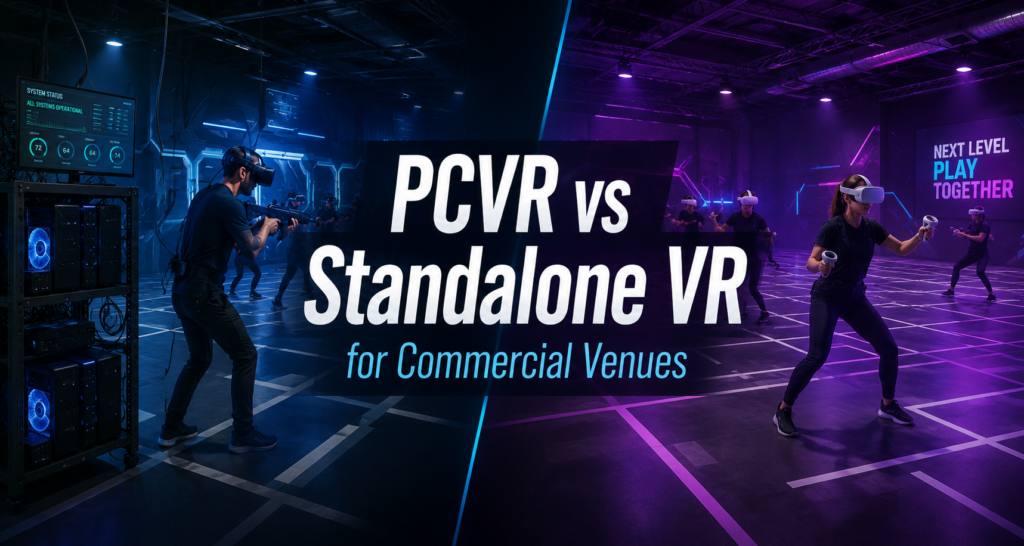
Choosing between PCVR and standalone VR used to be a tradeoff between quality and convenience. That tradeoff still exists, but it has changed shape, and most operators are no longer choosing one format from a blank slate. A large number of free-roam venues already run PCVR streamed wirelessly to the headset, and the real decision in front of them isn’t PCVR versus standalone. It’s whether adding standalone content alongside an existing PCVR setup makes sense, since the two can run side by side without requiring a venue to rebuild what it already has. Cables are no longer the dividing line PCVR headsets connect to an external computer that handles rendering, which still gives PCVR an edge in visual complexity and access to the broader Steam-based VR library. For years, that meant a physical tether, and tethers limited how freely a player could move, which made pure tethered PCVR a poor fit for arena-scale free-roam venues. That constraint has loosened. Wireless PCVR streaming, first popularized through headsets like the HTC Vive Focus 3 and now common on PICO devices, lets a PC render the game and stream it to the headset over the network instead of through a cable. A free-roam arena can run wireless PCVR streaming and get full, untethered movement while keeping PCVR’s rendering quality and library access. Plenty of arenas already operate exactly this way, and they run well. Standalone headsets take a different path to the same cable-free result. The headset renders the game itself, with no PC involved in the loop at all beyond whatever admin or server setup manages the fleet. The practical difference between standalone and wireless PCVR streaming isn’t cables anymore, since both can move freely around a free-roam space. It’s where the processing happens, and what that does to cost, hardware footprint, and content. What processing location actually changes The technical difference between the two formats comes down to what travels over the network. A standalone headset running free-roam renders the game locally on the device. The WiFi connection only carries session data: player positions, game state, and synchronization signals between headsets. Wireless PCVR streaming works the opposite way. A PC renders every frame and sends the full video stream to the headset over WiFi, which makes PCVR streaming considerably more bandwidth-intensive than standalone, even though both can run cable-free in the same arena. That bandwidth difference carries real infrastructure consequences. Wireless PCVR streaming still needs a capable gaming PC behind every station, or a shared rendering setup serving multiple headsets, plus the network capacity to carry that video traffic reliably, along with PC-side preparation: network configuration, and ongoing PC maintenance. Standalone needs none of that on the rendering side. The headset is the whole system for content, aside from the lighter admin infrastructure that coordinates the fleet and the session data passing between headsets. Setup reflects that same split. PCVR stations need a wired or properly configured wireless network connection and, for Steam-distributed titles, an individual Steam account per station, since Steam otherwise limits a licensed title to one machine at a time. Titles distributed through a dedicated content delivery network rather than Steam skip that requirement entirely, no Steam account needed at all, but you still need SteamVR running on all the PCs since SteamVR will be used to connect to the headsets wirelessly along with a program respective of the headset. For PICO it would be PICO BUSINESS STREAMING, for HTC FOCUS headsets you will use VIVE BUSINESS STREAMING etc. Standalone headsets need wireless debugging enabled and a shared network with the venue’s admin system, but carry no per-station account structure, since installation pushes directly to the headset. Neither path is harder than the other so much as different in where the complexity sits. PCVR, tethered or streamed, pushes more of it into PC, bandwidth, and account management per station. Standalone pushes more of it into device and connectivity management per headset. A venue running both ends up managing both kinds of complexity at once, which is one of the reasons centralized management tools matter more as a venue’s hardware mix grows rather than stays single-format. Content availability is the part hardware comparisons usually skip Most PCVR-versus-standalone comparisons stop at specs and never get into what an operator can actually deploy. This is the part that matters most for a venue planning content rotation, and it has changed faster than the hardware conversation has caught up with. A few things are true at the same time, and operators planning content strategy should hold all of them together: That last point matters for how operators should plan content rotation in practice. Checking format availability against current marketplace listings, rather than assuming based on a title’s reputation or its original platform, avoids building a rotation plan around a game that is not actually available in the format a venue runs. Licensing applies the same way to both Whichever format a venue runs, content needs commercial licensing rights, not consumer or personal-use licensing. This applies to PCVR and standalone titles equally, streamed or tethered. A venue running either format off a consumer content library carries legal and operational risk that has nothing to do with which headset is in the box, and everything to do with what rights came attached to the content itself. SynthesisVR’s content marketplace, the largest VR content marketplace for location-based entertainment, licenses titles across both PCVR and standalone through one system, with both formats installed and managed from the same Local Manager regardless of whether a station is a streaming PC setup or a standalone headset. That single management layer is part of why checking current availability by format is worth doing directly in the marketplace rather than relying on general reputation. Adding standalone to an existing PCVR venue Most operators evaluating standalone today are not starting from scratch. They are running a free-roam arena on wireless PCVR streaming already, and the real question is whether adding standalone headsets expands what the venue can offer without requiring
What Entertainment Venues Should Know Before Adding VR Attractions
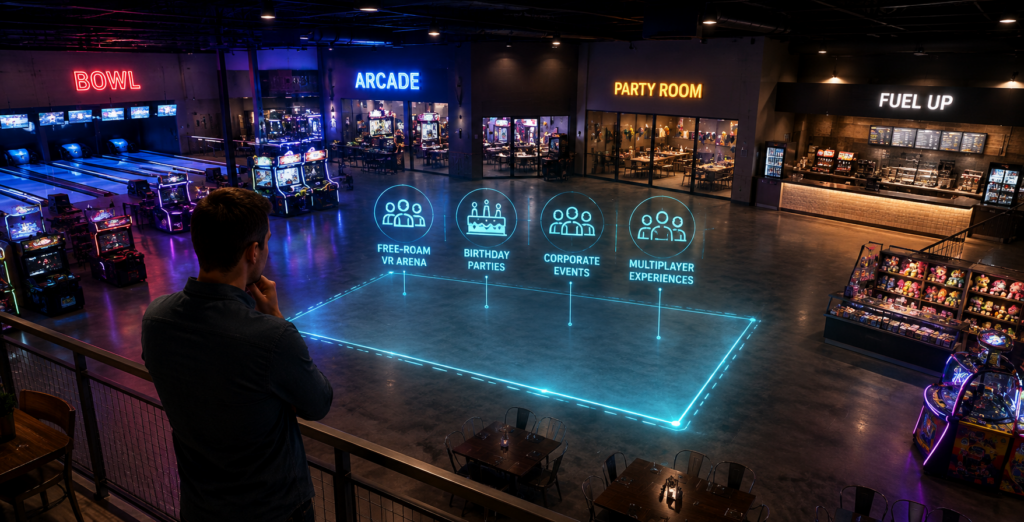
More family entertainment centers, arcades, trampoline parks, bowling venues, and attraction operators add VR every year, and the reasons are often similar. Some are looking to modernize aging attractions. Others want a weather-independent activity that performs during heatwaves, rainy weekends, and slower tourism periods. Many are searching for ways to attract group bookings, birthday parties, and younger audiences looking for social experiences rather than individual gameplay, building on the weekday utilization question this series covered last week. What surprises many first-time operators is how differently commercial VR behaves once the headsets start running daily sessions. A consumer who buys a headset for home manages a single device and a personal game library. A venue operating multiple headsets across hundreds of guests each week is managing a commercial attraction, with licensing requirements, content management, staff workflows, multiplayer coordination, and ongoing operational decisions layered on top. The hardware is the visible part of the investment, while the operational layer underneath it usually determines whether the attraction earns its floor space. Why Operators Keep Adding VR A decade ago, many venues treated VR as a novelty attraction. Today, commercial VR is an established category within location-based entertainment, and operators keep adding it because it solves several business challenges at once. Compared to many traditional attractions, VR often requires less physical space. It can help venues attract group bookings, provide an indoor entertainment option during extreme weather, and create experiences that guests cannot easily replicate at home. Many operators also value the flexibility VR introduces. A bowling lane delivers essentially the same experience year after year, and an escape room eventually reaches a point where returning guests already know the solution. VR attractions can evolve instead, through new content, seasonal experiences, different attraction formats, and multiplayer experiences that appeal to changing audiences over time. That flexibility becomes increasingly valuable as operators look for ways to keep guests returning throughout the year. Licensing Is Where Many First-Time Operators Get Stuck One of the most common surprises for new operators is discovering that consumer VR and commercial VR run on very different licensing models. A game available on a consumer storefront is not automatically approved for commercial use. Some developers offer separate commercial licenses, some work through dedicated commercial platforms, and others may not offer commercial licensing at all. For operators opening a venue, sorting through this becomes one of the most time-consuming parts of the research process. Questions that seemed simple at the planning stage get complicated fast: whether a title can run in a paid attraction, whether the license covers multiple headsets, whether multiplayer is included, and what happens when the developer pushes a content update. These questions rarely come up during early conversations about adding VR, yet they tend to become critical once operators move from planning into deployment. It’s one reason many commercial venues choose centralized content platforms that simplify licensing access and provide a larger catalog of commercially approved experiences through a single system. Operators who want the deeper mechanics of commercial licensing, including how studio agreements differ from consumer terms and what to check before signing, can find that covered in more detail in how VR content licensing works for LBE venues. What Makes a VR Attraction Commercially Viable A common mistake among new operators is treating headset selection as the primary business decision. Hardware matters, but it rarely determines long-term attraction performance on its own. The operators who get the strongest results tend to focus elsewhere: how quickly a session launches, how many guests can participate at once, what brings people back for a second visit, how often the content library gets refreshed, how much staff involvement a session actually requires, and how easily the attraction adapts to a birthday party one day and a corporate group the next. A technically impressive attraction can still struggle commercially if it creates bottlenecks at the booking desk, serves only a narrow audience, or gives guests no reason to return. The operators who do well tend to evaluate the entire guest experience rather than the device spec sheet alone. How VR Changes the Business Model This is where VR starts to diverge from many traditional attractions. A bowling lane generates revenue through scheduled games, an escape room typically serves one group at a time, and an arcade spreads revenue across dozens of individual machines. VR works differently: the same hardware can support cooperative adventures, competitive experiences, educational content, team-building activities, family-friendly games, and seasonal experiences without operators needing to replace the underlying attraction. For many venues, that changes how attraction value gets measured. Instead of evaluating a single game, operators end up evaluating the overall flexibility of the attraction itself. One content mix might perform well during summer tourism season, another might appeal more to birthday parties, and a different lineup might suit corporate events or school groups better, all while the physical infrastructure stays largely the same. The guest experience evolves around demand instead of the venue needing to rebuild around it. Free roam formats push this flexibility further, since the same tracked space can host different team sizes, mission types, and difficulty levels without new hardware. The tradeoff is that free roam introduces its own planning questions around arena layout and design and network setup, which matter enough that they deserve separate research before committing to a footprint. The Attraction Mix Question Many successful venues don’t add VR to replace an existing attraction. They add it to strengthen the overall mix. Some use VR to complement bowling, laser tag, escape rooms, or arcade floors. Others use it to create an indoor option during periods when weather affects attendance, expand birthday party offerings, or reach audiences who weren’t engaging strongly with the rest of the venue. The strongest implementations tend to fit into a broader venue strategy rather than operate in isolation, so before investing, operators benefit from getting clear on exactly what role VR will play inside the wider business. The goal usually isn’t to own VR equipment for
Unlock Weekday Revenue with Step into Webb on SynthesisVR: Free-Roam VR School Field Trips
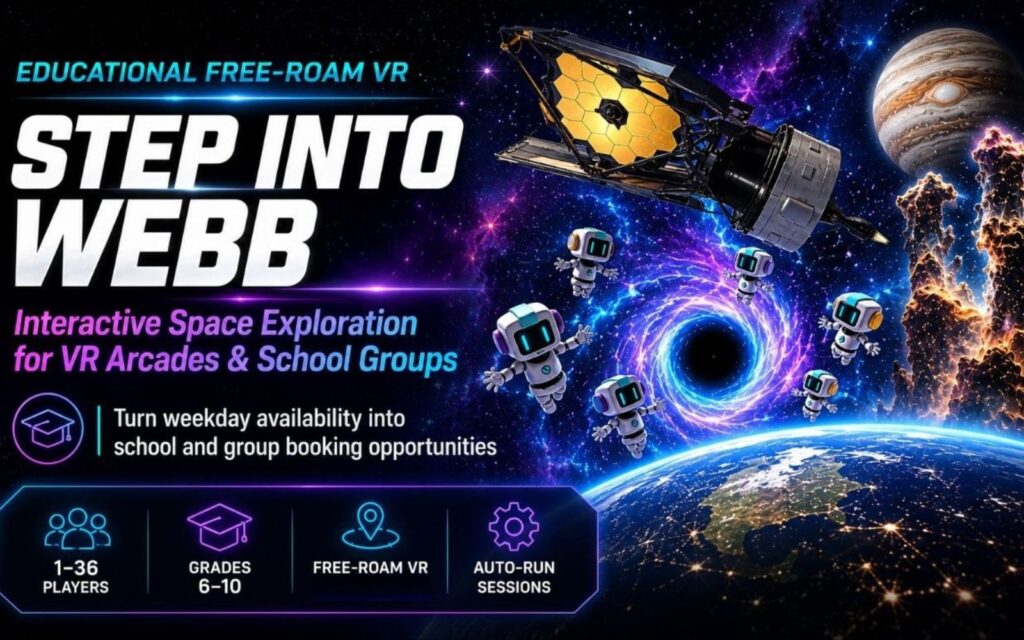
Weekday Schedules Often Look Different from Weekend Traffic Many VR arcades and family entertainment centers eventually run into the same pattern. Weekend sessions stay busy while weekday schedules often leave unused capacity between bookings. Operators usually try filling those gaps with discounts, shorter promotions, or social campaigns. School field trips and educational group bookings create another opportunity because they bring structured visits during periods that are often quieter. The challenge is operational. Educational experiences only work when venues can run them without creating additional complexity for staff. Step Into Webb joins SynthesisVR as an educational free-roam VR experience designed around interactive space exploration, multiplayer participation, and structured group experiences. Practical Ways Venues Can Introduce Educational VR Experiences Operators looking at educational programming usually evaluate a few practical areas before adding new content. Create booking packages around structured schedules Schools and educational groups often operate around fixed time windows. Step Into Webb supports approximately 15–20 minute VR sessions, while the broader activity flow can support experiences around 60 minutes, making it easier to structure larger group visits. Build offers around group participation Support for 1–36 players gives venues flexibility for school trips, STEM programs, camps, and educational events. Support educational outcomes alongside entertainment Teachers and organizers often need reasons beyond entertainment alone. Space exploration, teamwork, discovery, and collaborative objectives create stronger value for educational groups. Keep onboarding simple for staff Additional staffing requirements quickly create operational friction. Educational VR content works best when staff can run sessions consistently without extensive training. Step Into Webb: Interactive Space Exploration in Free-Roam VR Step Into Webb places players inside an interactive journey inspired by the James Webb Space Telescope. Built using authentic NASA-based assets and models, players physically move through space environments and explore locations including: The experience combines movement, multiplayer exploration, and collaborative discovery inside a free-roam VR environment. Mission Control Simplifies Session Flow Educational content frequently raises one operational question first: “How much staff involvement will this require?” Mission Control helps reduce coordination requirements by allowing operators to: Students rotate between VR exploration and supporting activities while virtual guides manage progression and pacing. The goal is straightforward operation without requiring staff members to become classroom instructors or dedicated game masters. Dedicated Game Community Resources for Operators Launching new content often creates practical questions that go beyond installing a title. Operators may need guidance around setup, troubleshooting, deployment, or ideas for structuring larger educational groups. Step Into Webb includes access to a dedicated Game Community directly within the platform where operators can access: For operators introducing educational VR into an existing attraction mix, these resources can reduce onboarding time and create a smoother path from installation to live operation. Technical Specifications Supported Platforms: Licensing Models: Supporting Educational Programming Across Different Venue Types Operators running location-based entertainment VR venues rarely rely on one attraction type alone. Educational VR can fit naturally alongside birthday parties, family activities, group bookings, and traditional entertainment content while helping venues create additional weekday opportunities. Within the SynthesisVR VR content marketplace, operators can manage educational content alongside broader free-roam VR and multiplayer experiences across standalone environments. Looking to expand your attraction mix with educational free-roam VR experiences designed for school groups and structured group bookings? Explore Step Into Webb on SynthesisVR.
The Ultimate Adrenaline Rush: Swarms on SynthesisVR Revolutionizes Free-Roam VR for Your PCVR Arcade!
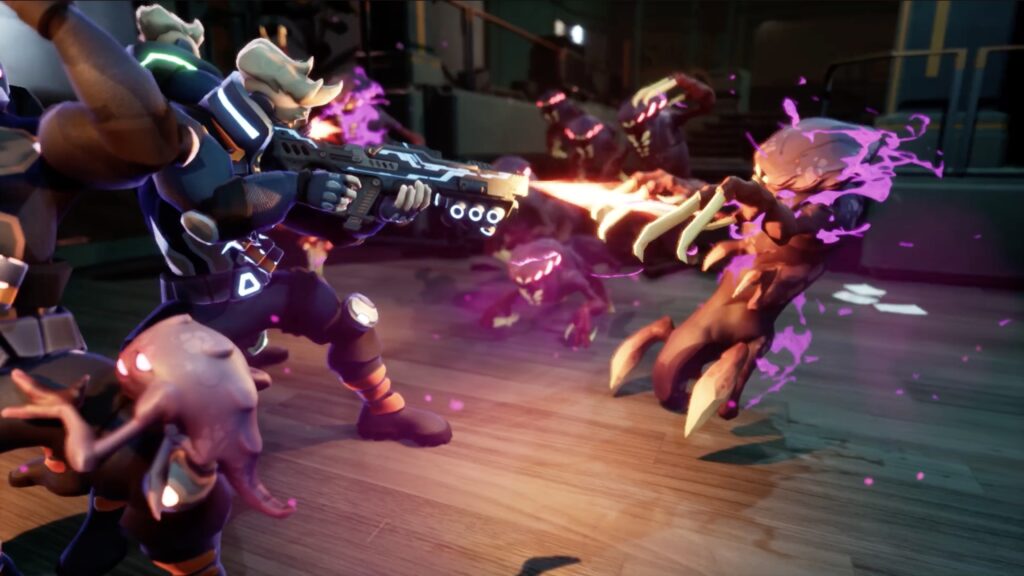
Forget passive entertainment! To dominate the multiplayer VR arcade market, you need high-octane, replayable experiences that generate buzz and loyalty. Swarms is the next-generation VR arena game built for peak adrenaline and player engagement. It’s fully integrated into SynthesisVR, the most powerful platform for managing PCVR venues with the largest library of top-tier free-roam VR experiences in this category. SWARMS: Hive Awakening – Cooperative Game Design at Its Finest Dive headfirst into Hive Awakening, a cooperative campaign masterwork that sets the standard for free roam VR. This isn’t just a simple shooter; it’s a meticulously designed progression experience where strategy, communication, and teamwork are paramount. You and your elite team are dropped onto Corigis-B12, battling relentless creatures and conquering massive alien encounters together. This dynamic experience is the premier choice for: Unleash the Power of the Striker Mavrik Pro Elevate the action with unparalleled immersion! Swarms: Hive Awakening is one of the elite free roam VR games offering dedicated support for the Striker Mavrik Pro gun. The realistic weight and incredible haptic feedback of the Mavrik Pro transform every shot, blast, and alien encounter into a visceral thrill. This seamless integration is essential for delivering a premium room scale VR arcade experience. Horde Mode: The Hunt for High Scores is ON! For competitive groups addicted to continuous action, Horde Mode offers pure survival intensity. This wave-based gauntlet is designed for maximum replayability, increasing the pressure with every wave as players chase higher scores. This mode is perfect for maximizing revenue from repeat visitors and quickly delivering high-energy replay sessions. SynthesisVR: Your Operational Command Center Swarms provides the operational flexibility needed for any customer profile, supporting arenas from 8x8m up to a massive 16x12m. Its seamless deployment is guaranteed thanks to the collaboration between Fishing Cactus and SynthesisVR. If you run a PCVR venue, SynthesisVR is the absolute go-to platform, offering unmatched free roam VR management and the largest game library in the category. Whether you’re running a room scale VR setup, managing a VR escape game with its included VR escape game management and VR escape room software, or even considering a standalone VR management transition, SynthesisVR is the most powerful solution to streamline your operations. Technical Specs: Join the Swarms Revolution! Stop settling for average—it’s time to bring your venue a truly amazing game that thrills players and drives your business! Explore the Swarms Universe: Try SynthesisVR now, no credit card necessary!
MetaExperiences Bundle on SynthesisVR: Free Roam Escape Adventures Designed for Modern LBVR Venues
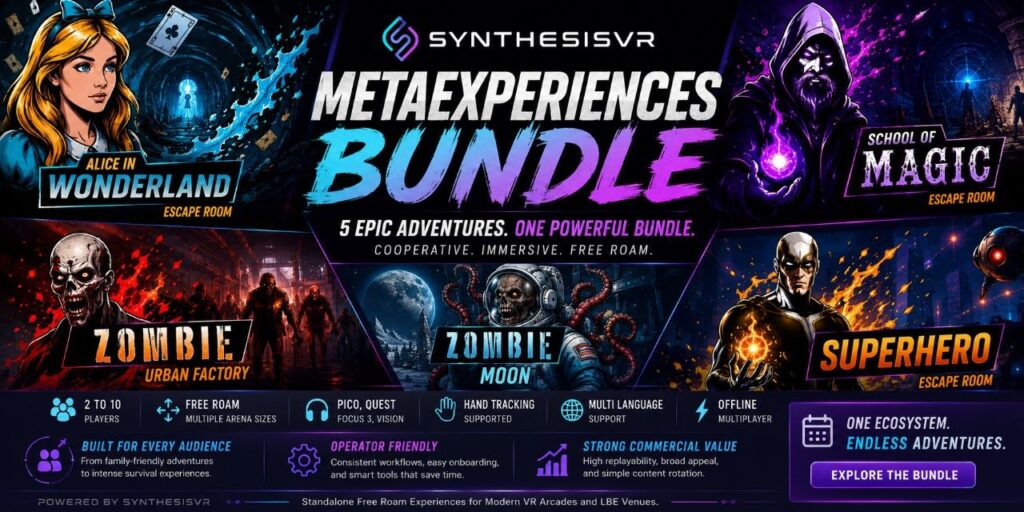
Free roam VR continues to evolve beyond simple tech demonstrations. The venues seeing the strongest repeat engagement are usually the ones offering experiences that groups can understand quickly, enjoy together, and talk about afterward. That is one of the reasons guided escape-room-style adventures continue to perform strongly in location-based VR. Families, birthday groups, corporate teams, first-time VR visitors, and casual audiences often respond better to cooperative progression than highly competitive gameplay. Instead of focusing purely on score chasing, guided adventures create shared objectives, group communication, puzzle solving, exploration, and narrative progression that naturally fit social entertainment environments. The MetaExperiences Bundle on SynthesisVR was built around that model. The collection combines multiple standalone free roam adventures into a single operational ecosystem, allowing venues to rotate between fantasy adventures, puzzle escape rooms, superhero experiences, and zombie survival gameplay while maintaining consistent onboarding flow and deployment structure across all titles. Supported Hardware and Free Roam Arena Sizes The MetaExperiences Bundle supports: Several experiences also support both Quest Hand Tracking and Pico Hand Tracking, allowing operators to choose between controller-based gameplay and more immersive gesture-driven interaction depending on the audience and headset deployment. The experiences support multiple free roam arena sizes ranging from compact 4x4m deployments for smaller groups up to 10x10m arenas supporting as many as 10 simultaneous players depending on the title. This flexibility allows the same content ecosystem to scale across: Operationally, all titles follow similar multiplayer flow and onboarding logic, reducing staff retraining and helping operators rotate themes without rebuilding workflows for each game. Why Escape-Room-Style VR Experiences Continue to Perform in LBVR Escape-room-style VR experiences solve several important commercial challenges for operators. First, they are easy to explain. Most players already understand the concept of exploring environments, solving puzzles, surviving encounters, or progressing through a shared story. Second, cooperative gameplay works particularly well for mixed-skill groups. Experienced players stay engaged while first-time VR users still feel included instead of overwhelmed. Third, guided progression creates stronger group memories. Players leave discussing moments from the adventure itself rather than simply comparing scores after a competitive round. That dynamic is particularly valuable for: For many LBVR venues, those audiences represent a large percentage of long-term repeat business. The Experiences Included in the Bundle Zombie Moon Zombie Moon is the newest addition to the MetaExperiences Bundle and introduces a large-scale cooperative zombie survival experience set inside a lunar research colony. Players are kidnapped, transported to Moon Base Alpha-13, and forced into survival experiments by a mad scientist who unleashes waves of infected creatures while observing the group’s behavior. The reduced-gravity setting changes movement pacing and gives the experience a distinct atmosphere compared to traditional zombie shooters. Gameplay focuses on cooperative survival, scalable combat difficulty, weapon progression, and wave-based action that works well for repeat group sessions. Internal DeployReality testing highlighted strong weapon balancing and smooth gameplay flow across different difficulty levels. Because the gameplay objective is immediately recognizable, onboarding remains relatively simple while still delivering enough progression to keep groups engaged throughout the session. The experience supports 2–10 players across multiple free roam arena sizes and includes broad language support including English, French, German, Italian, Polish, and Spanish. The latest update also integrated additional SynthesisVR controls and operational improvements requested through operator feedback. Urban Factory Urban Factory takes a more direct arcade-survival approach focused on immediate cooperative combat. Players are trapped inside an abandoned industrial facility while fighting through relentless zombie waves created by the same scientist behind the lunar experiments. Unlike puzzle-heavy escape adventures, Urban Factory focuses almost entirely on action pacing and survival pressure. The game’s positioning is commercially useful because it serves audiences looking for: The description itself summarizes the experience clearly:“No puzzles. Just pure survival.” For operators, that simplicity matters. Sessions are easier to explain at the front desk, throughput remains predictable, and casual visitors understand the gameplay objective almost immediately. Urban Factory also supports smaller free roam footprints starting at 4x4m deployments, making it accessible for venues that want free roam zombie content without requiring warehouse-scale arenas. The experience supports Pico, Quest, Focus 3, and Vision headsets along with offline multiplayer for groups of up to 10 players depending on arena configuration. Superhero Superhero shifts the bundle toward cinematic free roam adventure gameplay with stronger narrative pacing and guided progression. Players step into a cooperative superhero-themed experience that combines exploration, puzzle interaction, environmental storytelling, and action-driven sequences across a 45–55 minute session structure. The superhero theme gives the experience broad commercial appeal because it is easy for mixed-age audiences to understand and market around. One of the strongest operational features is support for both traditional controllers and hand tracking on Quest and Pico devices. Hand tracking helps create a more immersive experience for first-time users while reducing the intimidation factor that some casual visitors feel when learning controller layouts. The guided structure also helps reduce confusion during gameplay, making sessions easier for staff to manage even when hosting players with limited VR experience. Recent updates improved overall stability and resolved issues related to room markers and progression flow, helping operators maintain smoother session reliability. School of Magic School of Magic expands the fantasy-adventure side of the bundle with a cooperative wizard-themed escape experience focused on magical interaction, exploration, and guided progression. Players move through mystical environments, uncover secrets, solve puzzles, and interact with magical elements while progressing through a story-driven adventure designed around cooperative participation rather than competitive gameplay. The Quest and Pico hand tracking support aligns particularly well with the magic-casting mechanics, creating a more intuitive interaction system for players unfamiliar with VR controllers. Operationally, School of Magic benefits from the same deployment consistency as the rest of the MetaExperiences ecosystem. Venues can rotate between action, fantasy, puzzle, and survival themes while maintaining similar onboarding flow and free roam management structure. The experience runs across multiple arena sizes and supports groups ranging from small family sessions up to larger multiplayer deployments with 10 simultaneous players. Alice in Wonderland Alice in Wonderland is one of the strongest
Standalone VR Arena Games Worth Adding to Your Lineup in 2026
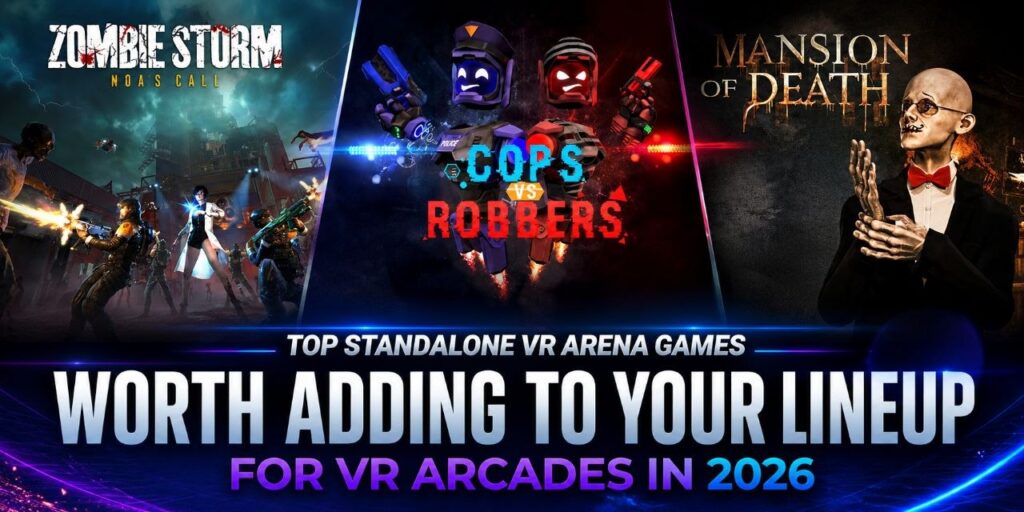
Action free roam titles tend to generate a particular kind of session energy. Groups get loud, they communicate, and they leave with a shared story rather than just a score. That dynamic is one of the most reliable drivers of rebooking and referral. This post covers three standalone free roam action titles available on the SynthesisVR content marketplace for Pico, Quest, and Focus 3 hardware. A PvP bank heist that has been one of the most consistently booked standalone titles across venues worldwide. A horror escape with active combat and a boss fight that received a major content update in February 2026. And a co-op zombie survival experience built around a narrative mission that gives teams a shared goal beyond just staying alive. All three run through the same interface as the rest of your library, with no additional platform switching or separate session management required. Game Highlight: Cops vs Robbers Cops vs Robbers is the kind of title that earns its place on the booking sheet week after week. The premise is simple enough to explain at the front desk in one sentence: pick a side, Cop or Robber, and fight it out inside a bank vault. Walk-in groups understand it immediately. Competitive groups love it. First-timers get into it fast. The V2 update in October 2024 added meaningful depth without complicating the experience. A new PvE story-driven mode gives groups that prefer co-op an entirely different way to play the same title, which means one license covers both competitive and cooperative bookings. A new networking solution reduced latency and improved stability for back-to-back sessions. Multiple gun options in PvE add replay value for returning guests. Arena configurations scale from 4.5×4.5m up to 10x10m with 2 to 10 players. Cross-play between PICO, Meta Quest, and HTC Focus 3/ Vision is supported, so venues running mixed hardware fleets can run it across their full headset inventory without workarounds. Learn more: Cops vs Robbers Cops vs Robbers Community Page Alongside the game, SynthesisVR is keen to build communities based on games using Community Pages, an initiative designed specifically for Location-Based Entertainment VR operators, developers, and industry professionals. Check our Cops vs Robbers: Community Page These pages are built to serve as living knowledge hubs, where operators can: Unlike traditional consumer-focused communities, SynthesisVR Community Pages are purpose-built for professionals, helping operators make informed decisions, improve uptime, and deliver better experiences to guests. This initiative reflects SynthesisVR’s long-standing commitment to not just distributing content, but supporting the businesses that run it. About SynthesisVR SynthesisVR is a VR management platform built for LBE operators, with 350+ experiences available through one content marketplace. Every title here runs through the same interface as the rest of your library, with no additional platform switching or separate session management required. SynthesisVR has been supporting commercial VR venues since 2016 and operates across 600+ venues worldwide. Browse the full standalone free roam catalog Try SynthesisVR, No credit card required!
Week 10: Content Licensing: The Legal Minefield Most Operators Ignore
From First Headset to Fully Operational VR Arena Most operators figure out their content strategy by accident. They launch with a few titles, add games when players ask for something new, and build a library over time based on instinct and availability. It works well enough in the early months. The problems appear later, usually when the venue is busier, the library is larger, and making changes is harder. Licensing is the last thing operators think about and the first thing that can create problems at scale. Why commercial licensing is not optional When a developer publishes a VR game for home use, the consumer license covers one person playing on their own headset. A venue running that same title across multiple stations for paying customers, session after session, is operating under a completely different use case. Commercial use is a separate licensing category, and consumer licenses do not cover it. The value of a title changes in a commercial setting. In a venue, a game can generate thousands of hours of billable session time over its lifetime. Consumer pricing is built around personal use. Commercial licensing reflects the actual value the content delivers when it is running as part of a revenue-generating business. This is not a grey area. UploadVR’s guide on starting a VR arcade legally is direct on this: regular game purchases do not cover commercial arcade use. Developers or licensing programs must grant permission before a title runs commercially. The risks of buy once, play forever thinking The assumption behind most early content decisions is that a game purchase is a permanent unlock. Buy the title, install it, run it indefinitely. In a home context, that is accurate. In a commercial venue, it is not. Several operators have assumed a one-time purchase covered commercial use until developers reached out directly. Licensing problems usually surface late and they are rarely cheap to fix. By the time the issue appears, the venue may need retroactive licensing, a content cleanup across multiple stations, and a revised operating process. None of that is straightforward when the business is already running at volume. The venues that avoided that situation did not do anything complicated. They built a licensing framework before they needed one, chose a platform that handled the mechanics automatically, and made decisions based on usage data rather than instinct. How pay-per-minute aligns developers and operators Pay-per-minute works because it connects cost to actual usage. Operators pay for the value they consume, and developers get compensated in proportion to how often their content runs commercially. The logic is straightforward: flat purchases disconnect payment from use, which gives developers no signal about how their content performs in venue environments and no financial reason to maintain it there. That model also fits venue economics better than fixed purchases. Some titles drive high repeat play. Others work better as short-session or event content. Usage-based licensing gives operators more flexibility to test titles before committing, and gives developers a reason to maintain and expand content that is performing well in commercial environments. Why transparent usage tracking protects everyone If a venue can see which title runs, where it runs, and how often, the operator can choose the right licensing model with real data instead of guesswork. That visibility also changes how operators think about their content library. Venues that track usage start asking different questions before adding a title: does this fit our session lengths, our reset cycle, our throughput targets? That thinking compounds over time. Venues with deliberate libraries run fewer titles more effectively. They know which games their audience returns for, which titles justify a lifetime license, and which are worth testing on pay-per-minute before committing to a fixed fee. Transparent tracking also protects developers. When developers see consistent commercial usage, they can trust that the content is generating fair value, which supports ongoing updates and future releases. SynthesisVR’s dashboard gives operators exactly that visibility: usage tracked automatically by title and station, available in real time. The SynthesisVR knowledge base covers the operational flow for starting commercial licensing, managing balance, and keeping billing aligned with actual use. What licensed operators access that others do not The practical difference between licensed and unlicensed operation is not just legal exposure. It is access. Developers who see consistent, fairly compensated usage on a platform invest in maintaining and updating their titles. Operators inside the licensing ecosystem get those updates. They get early access to new releases. They get a content relationship with developers that simply does not exist for venues running consumer builds commercially. SynthesisVR’s marketplace covers 400+ titles built specifically for location-based entertainment use. Every title carries the commercial rights needed to run it legally. The library grows because developers see real commercial value in contributing to it. That value depends on operators participating in the system correctly. A full breakdown of how the licensing models work, including pay-per-minute, fixed station and location fees, lifetime licenses, and event access, is covered in the SynthesisVR commercial licensing overview. The standalone licensing blog on the SynthesisVR site covers how the licensing models work in practical detail, including pay-per-minute, fixed station and location fees, lifetime licenses, and event access. If you want the mechanical breakdown, that is the right place to start. What it does not cover is what happens to your content strategy when licensing is treated as an operational layer rather than an afterthought. Multi-location operators face a different version of this problem A single venue can manage content informally and stay on top of it. Multiple locations cannot. The inconsistency surfaces quickly: different titles at different sites, different billing arrangements, different staff making different decisions about what to install and remove. Franchises and multi-site operators who have not centralized content management discover that each location has effectively built its own library with its own licensing status, and none of it is visible from one place. Centralized content management is one of the clearest operational advantages SynthesisVR offers at scale. Operators managing multiple locations