
How VR Education Bundles Work for Arcades and Entertainment Venues
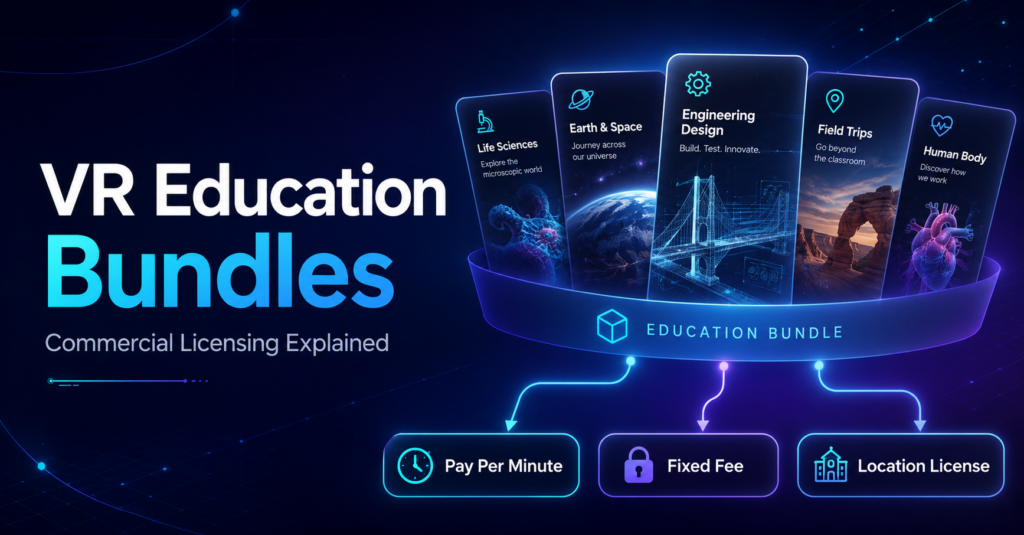
Adding educational VR to a commercial venue raises a practical question: do you license individual experiences as you need them, or choose a broader collection of educational content? Both approaches can make sense. The SynthesisVR marketplace includes individual educational experiences alongside commercial content bundles and curriculum packages. Operators can therefore choose licensing based on the type of program they want to offer, how many stations they need, and how regularly they expect to use the content. What is a VR content bundle? A commercial VR bundle groups related content into a licensing offer. The exact structure varies. Some bundles bring together games from the same developer. Others organize content around a particular use case, such as education. Licensing periods and billing models can also differ between packages. The SynthesisVR Commercial License Bundles marketplace currently includes developer collections such as the Resolution Games Bundle and Survios Bundle, alongside education-focused options including an Education Bundle, Middle School Curriculum, High School Curriculum, Dissection Curriculum, and VR Field Trips. That variety matters because an operator looking for entertainment content has a different objective from a venue building a program for school visits. Education bundles give operators another way to build a school offering Educational VR can involve much more content than a typical entertainment session. VictoryXR’s educational catalog, for example, includes science experiences covering subjects such as Earth and space science, engineering, life science, and physical science. An operator may only need one particular experience, or they may want a wider curriculum that can support several lessons, subjects, or repeat school visits. The SynthesisVR marketplace currently lists several education-focused packages for up to 25 stations, including: This gives venues a way to evaluate educational content at the program level instead of approaching every school visit as a completely separate content decision. Do you have to license the whole bundle? Individual titles can still have their own licensing options. For example, the VictoryXR experience Engineering Design: Delimiting – Wright and Ferris currently shows three licensing choices in the SynthesisVR marketplace: Pay Per Minute: 6¢ per minute. Fixed Fee: $5 per station every month. Location License: access to the Middle School Curriculum, listed for up to 25 stations. This is a useful example of how an operator can approach the same content in different ways. A venue that wants to test or occasionally use a particular experience may prefer usage-based licensing. A venue expecting regular use of one specific title can evaluate a fixed station license. An operator building a broader educational program can explore the curriculum-level option. The exact licensing choices depend on the individual content, so operators should check the options shown for the experience or bundle they plan to use. Fixed Station Fee vs. Fixed Location Fee Understanding the difference between these two licensing models helps when comparing individual titles with larger content packages. Fixed Station Fee With a Fixed Station Fee, operators pay a flat monthly fee for each VR station they license. Usage on that station does not change the fee during the licensing period. SynthesisVR describes this model as particularly useful for dedicated setups where hardware sees consistent use and operators want predictable licensing costs. For example, if an individual educational title costs $5 per station per month, an operator can choose how many stations they want to license for that title. Learn how Fixed Station Fee licensing works Fixed Location Fee A Fixed Location Fee uses one flat period rate for the venue, up to the maximum number of stations supported by the content. Instead of calculating the license separately for every station or tracking usage minute by minute, the operator pays the applicable location fee for the licensing period. SynthesisVR identifies this model as useful for multi-station locations that want predictable costs and unlimited access to the licensed content within the terms of that license. Learn how Fixed Location Fee licensing works Neither licensing model applies to every title. The available options depend on the content and publisher. Which licensing option makes sense for your venue? There is no single licensing structure that fits every VR attraction. The better question is how you expect the content to be used. Occasional or uncertain use: Pay Per Minute can reduce the commitment required to make a title available while you evaluate demand. Regular use of selected experiences: A Fixed Station Fee can give the venue a predictable monthly cost for the stations running those titles. A broader program across multiple stations: A location or curriculum-based option may make more sense when the venue wants access to a larger collection and expects to use it regularly. Educational programming makes this especially relevant. A school may visit for an engineering lesson one week and return for Earth science or life science later in the term. A broader curriculum gives the operator more material to build those programs around. The licensing decision should therefore start with the offering you want to build, rather than simply choosing the lowest individual content price. Bundles also extend beyond education The same idea applies to entertainment content. The SynthesisVR marketplace currently includes packages such as the Resolution Games Bundle and Survios Bundle, both listed with monthly fixed-fee licensing. Other bundles use different periods or licensing structures, including multi-month fixed plans and Pay Per Minute offers. For operators, the useful part of the Bundles section is the ability to explore content as a collection. A venue can compare a developer catalog, an educational curriculum, or another grouped content offer against licensing individual experiences separately. What to check before choosing a VR content bundle Before subscribing, look beyond the word “bundle.” These questions help determine whether licensing individual titles or selecting a wider bundle better matches the way the venue plans to use the content. Explore commercial VR bundles on SynthesisVR Education is one example of where bundled content can simplify the process of building a broader VR offering. Operators can also find entertainment, developer, free-roam, and other commercial licensing packages in the SynthesisVR marketplace. Because the content
What Is Arena-Scale VR?
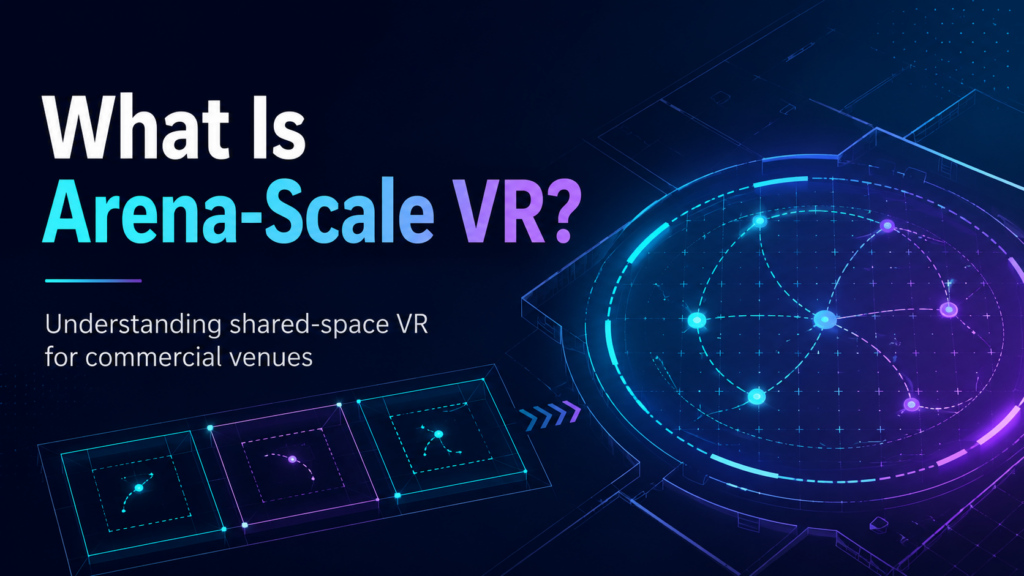
Arena-scale VR is a commercial virtual reality format where multiple players physically move through a shared tracked space while experiencing the same virtual environment. Players can walk, turn, communicate, and interact with each other without relying entirely on joystick movement to cross the virtual world. You may also see the format described as free-roam VR, arena VR, or free-roaming VR. These terms often overlap, and the industry does not use one fixed floor size to define when free-roam becomes “arena-scale.” For a venue operator, that distinction matters less than the actual configuration. The important questions are how much usable space the attraction needs, how many players it supports, which content can run in that footprint, and how efficiently staff can move one group out and the next group in. Is Arena-Scale VR the Same as Free-Roam VR? In practice, the terms frequently describe the same underlying concept: several players moving naturally inside one shared physical play area. There is still a useful distinction when planning a commercial venue. Free-roam VR describes the movement model. Players physically walk through a shared tracked space instead of remaining inside individual stations. Arena-scale VR often describes the attraction built around that movement model, particularly when the shared space supports larger groups or a larger physical footprint. There is no universal square-footage threshold where one suddenly becomes the other. That is why operators should look beyond the label. A six-player 20 × 20 ft arena and an eight-player 33 × 33 ft arena can both qualify as arena-scale VR, while creating very different requirements for floor space, content, staffing, and group bookings. For a deeper comparison of the movement formats, see Free-Roam VR vs Room£-Scale VR for Commercial Venues. Arena-Scale VR vs Room-Scale VR The biggest operational difference is how players use the physical space. With room-scale VR, four guests may play together while each remains inside a separate physical boundary. In an arena-scale experience, those same four players can occupy one shared 6 × 6 m (20 x 20 ft) area. Their real-world positions correspond with their positions inside the experience, so a teammate standing two meters away virtually should also be standing in the correct relative position physically. That changes more than the amount of floor space required. Tracking, player positioning, calibration, networking, session launches, and safety all become part of one coordinated attraction. How Much Space Does Arena-Scale VR Need? There is no single arena size that works for every commercial VR experience. A 6 × 6 m, or roughly 20 × 20 ft, play area has become a common starting point across the commercial free-roam catalog. Some experiences support smaller footprints, while others scale to 8 × 8 m, 10 × 10 m, or different rectangular configurations. The relationship between space and player capacity is especially important. Take After the Fall: Free-Roam as one current example. Its 6 × 6 m configuration supports up to four players. A 10 × 10 m configuration increases that capacity to eight. Other commercial titles use several layouts rather than only two fixed sizes. This means an operator choosing a footprint is also making a decision about which content configurations will remain available to the venue. A larger arena can unlock additional content and higher player capacities. It also consumes more revenue-producing floor space, and higher theoretical capacity only helps when customer demand can fill it. That is why the better planning question is rarely: “How large can we make the arena?” It is: “What combination of space, player count, content, and booking demand makes sense for this venue?” We break down the footprint question in more detail in How Much Space Do You Need for a Free-Roam VR Arena?. Bigger Does Not Automatically Mean Better Arena capacity looks attractive on a specification sheet. An eight-player attraction can accept a large birthday group, corporate team, or group of friends in one session. During a busy Saturday, that capacity may be useful. A normal weekday can tell a different story. If most bookings arrive as groups of two, three, or four, one large arena may leave a substantial part of its capacity unused. Two smaller attractions could give an operator more scheduling flexibility and allow two bookings to run at the same time. The reverse can also happen. A venue built around school groups, parties, corporate events, or other larger bookings may benefit significantly from keeping more players together in one attraction. This is why we recommend treating player count as the result of several planning decisions rather than the starting point. Space, audience, content, hardware, booking behavior, and session flow all affect the useful capacity of the attraction. How Many Players Should a VR Attraction Support? looks at that decision in more detail. What Makes Arena-Scale VR More Complex to Operate? The guest sees a headset, an open floor, and a virtual world. The operator has to make several systems work together before that guest walks onto the arena floor. 1. Shared-space tracking Every headset needs an accurate understanding of the physical play area. A tracking problem affecting one player can interrupt an experience for the whole group. Operators therefore need a stable environment, clearly defined boundaries, reliable mapping, and a repeatable calibration process. 2. Multiplayer synchronization Players need to enter the same experience together and remain synchronized throughout the session. This makes network reliability more important than it may be for independent room-scale stations. 3. Session launches Starting six or eight headsets individually adds staff actions to every booking. Those steps may seem minor during a quiet shift. Repeated across a full operating day, small delays can extend turnaround times and create queues during peak periods. 4. Reset and turnover The commercial session includes more than gameplay. Staff need time for onboarding, fitting equipment, launching the experience, ending the session, cleaning hardware, checking batteries, and preparing the next group. A 30-minute game therefore occupies more than 30 minutes of the venue’s operating schedule. 5. Content configuration Arena games have specific requirements for player
How Much Does It Cost to Start a VR Arcade? Build Your Own Startup Budget
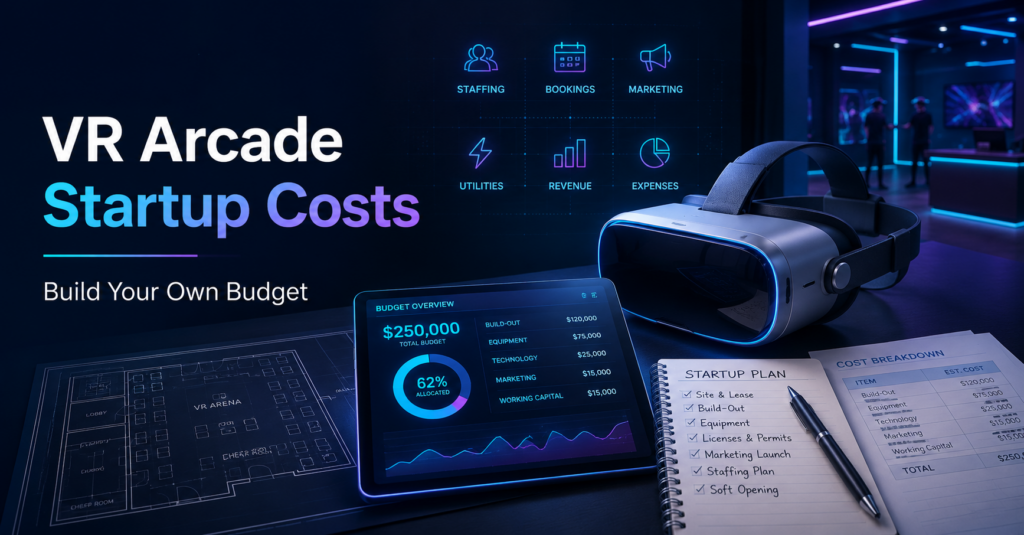
VR arcade startup costs can look completely different from one location to the next. Rent changes by city. Labor costs change by country. A four-headset standalone setup has a different cost structure from a PCVR arcade, a free-roam arena, or a family entertainment center adding VR to an existing attraction mix. That makes a single “average cost to open a VR arcade” difficult to use for serious planning. A better approach is to build the budget from your own market, venue, hardware, staffing, software, content, and revenue assumptions. We created a VR Arcade Startup Budget & Revenue Calculator to help you do exactly that. Use it alongside this guide to estimate your startup requirements, monthly operating costs, revenue potential, and break-even point. Start With the Local Market Before You Buy a Headset Hardware is one of the easier costs to identify. The local business case takes more work. Before choosing a venue or deciding how many stations to install, research what customers already pay for entertainment in your area. Look beyond other VR arcades. Your customers may also compare you with: Record the price, session length, group size, package structure, reviews, and target audience for each relevant attraction. Then ask a more useful question: What can your VR venue offer that the local market currently handles poorly? A university area may have demand for affordable multiplayer activities during weekday evenings. A family market may create more opportunity around birthdays and school breaks. An entertainment district may support longer social bookings, corporate groups, or competitive experiences. Your local demand should influence the venue before the equipment list does. Our guide to [VR arcade pricing, session prices, packages, and promotions] explains this process in more detail. 1. Calculate the Cost of the Venue For a new VR arcade, the premises usually create several expenses before the first customer arrives. Add the costs that apply to your location: An existing family entertainment center may already carry many of these costs. In that case, calculate the additional cost of adding VR rather than assigning the entire building expense to the attraction. A new standalone VR arcade needs to account for the full venue overhead. Keep the fit-out connected to the customer experience It is easy to spend heavily on futuristic décor before proving the business model. Customers still notice the basics first. Is the venue clean? Are staff helpful? Does the session start on time? Is the booking process clear? Does the group understand what to do? A simpler venue with excellent service, reliable operations, and the right experiences for its audience can build a stronger reputation than a more expensive space that struggles with those fundamentals. 2. Decide How Many Players You Actually Need to Serve Start with the booking model. A venue that expects groups of four has different hardware needs from an arena designed around eight-player birthday parties. A mixed venue may combine smaller room-scale stations with one larger multiplayer attraction. Work through this sequence: Space → audience → content → player capacity → hardware → booking model Our guide to [how many players a VR attraction should support] goes deeper into this decision. Once you know the sellable capacity, you can build the hardware budget. 3. Budget for More Hardware Than Your Sellable Capacity If you plan to sell six-player sessions, owning exactly six headsets creates a fragile operation. A damaged controller, charging issue, failed headset, or maintenance problem can immediately reduce the number of customers you can serve. Build spare capacity into the budget. For a standalone commercial setup, operators can evaluate devices such as the PICO 4 Ultra Enterprise. PICO positions the headset for enterprise use and supports tools designed for business and location-based entertainment deployments. Your hardware worksheet may include: Accessories can also support operational comfort. For example, BOBOVR offers optional battery straps compatible with the PICO 4 Ultra Enterprise. These add an external battery system that operators can swap while another battery charges. BOBOVR P4U Battery Strap They are optional. Include them only if they solve a real operating need in your setup. The same rule applies to every accessory: buy it because the venue needs it, rather than because it exists. 4. Include VR Management Software in the Monthly Model Running several headsets manually may appear manageable during a quiet test session. The workload changes when customers arrive together. Staff need to manage bookings, customers, sessions, content, station status, waivers, memberships, and different attraction formats while also taking care of the people standing in front of them. That is where a VR arcade management system becomes part of the operating model. SynthesisVR’s Ultimate plan currently combines tools including booking, online waivers, customer management, content control, memberships, discounts, gift vouchers, integrations, and station management. Rather than placing a fixed software price in a business plan that may become outdated, use the current SynthesisVR pricing page and calculate the cost for the number of stations you intend to operate. The important calculation is: Management platform cost per station × number of stations Software also affects the staffing model. Centralized station and session management can reduce repetitive manual work, giving staff more time to help customers. 5. Build Staffing Around the Work That Actually Happens Labor deserves more thought than simply entering an hourly wage. Calculate the fully loaded employment cost where possible, including employer costs that apply in your location. Then estimate: Opening hours per week × average staff required on shift × loaded hourly cost A small venue might test a model with one person during quieter periods and additional staff during evenings, weekends, or parties. A larger FEC, food-and-beverage operation, or high-throughput attraction may need considerably more. Ask what staff need to handle during the busiest hour: Automation can reduce repetitive work. It cannot replace hospitality. A technically impressive attraction with poor customer service creates a weak reason to return. 6. Plan for Commercial VR Content Licensing Commercial VR content also belongs in the operating budget. Consumer game purchases generally do not provide the
What Is the Difference Between VR Arcades, FECs, and Entertainment Centers?
A venue can call itself a VR arcade while running a free-roam arena, a party room, a full bar, and a birthday package that barely mentions headsets. Another venue can run twenty arcade machines and a snack counter and call itself an entertainment center. The name on the door tells you almost nothing. What matters is what the venue sells and how it builds the visit. A VR arcade earns most of its attraction revenue from VR sessions. An FEC spreads the visit across several attractions, events, food, and other revenue streams. For operators, the useful question isn’t which label fits. It’s what business model you’re actually running. A VR Arcade Runs on Session Revenue A VR arcade makes virtual reality the main reason to visit. The setup varies. One location runs six room-scale PCVR stations. Another runs a four-player free-roam arena. A larger arcade combines room-scale, free-roam, racing simulators, and several multiplayer formats. What connects them is the role VR plays in the business. The venue earns most of its attraction revenue by selling access to VR experiences. Staff spend their time managing headsets, launching sessions, onboarding players, maintaining equipment, selecting commercial content, and moving groups through available capacity. That makes a specific set of numbers matter: A six-headset arcade with one empty station loses sellable VR capacity. A free-roam venue that turns away six-player groups because its strongest experiences only support four faces a different capacity problem. Either way, VR sits at the center of the operating model. Related reading: How Do VR Arcades Actually Make Money? A Family Entertainment Center Sells the Whole Visit A family entertainment center, usually shortened to FEC, gives guests several activities in one location. The mix varies by venue: arcade and redemption games, bowling, laser tag, mini-golf, climbing, trampolines, indoor play, VR, party rooms, food and beverage. IAAPA treats family entertainment centers and location-based entertainment venues as major parts of the attractions industry, and its current FEC resources include immersive VR and interactive gaming within the attraction mix. That wider mix changes the business. A family arrives for a birthday party, spends time in the arcade, plays a VR attraction, orders food, and finishes with another activity. The operator has several chances to earn revenue during one visit, and more moving parts to coordinate: staffing, floor allocation, maintenance, food service, party schedules, attraction capacity, guest flow. VR has to work within that larger system, not run it. “Entertainment Center” Doesn’t Mean Much on Its Own People use the term for many location-based entertainment businesses, including FECs, arcades, immersive attractions, bowling venues, escape-room businesses, and mixed entertainment concepts. The name alone tells an operator very little. A business called an “entertainment center” might run twenty arcade machines and a snack counter. Another might cover several thousand square feet with bowling, VR, event rooms, food service, and multiple ticketed attractions. Look at attraction mix and revenue model before relying on the category name. VR Arcade vs FEC: Where the Business Models Split The clearest distinction shows up when you follow the customer journey and the money behind it. There’s no attraction count that automatically turns a VR arcade into an FEC. A venue can run several types of VR and stay a VR-first business. Room-scale PCVR, standalone free-roam, escape experiences, and racing can all serve different audiences while VR stays at the center of the visit. The shift happens when the wider venue starts carrying more of the customer experience and more of the revenue. The Sign Above the Door Can Stay the Same While the Business Changes Picture a venue that opens with eight room-scale VR stations. Customers book headset time, choose games, leave when the session ends. The operator adds a four-player free-roam arena. That changes the content mix and opens larger group bookings, though VR still drives the business. Then birthday demand grows. The venue adds a party room and builds two-hour group packages. Guests now spend part of the booking playing and part of it socializing. Food and drinks follow, because it works well while one group waits for the arena. The business still has “VR Arcade” on Google Maps. Operationally, it now behaves much more like a mixed entertainment venue. Each additional revenue line changes what the operator needs to optimize. Headset utilization still matters, but so do dwell time, package value, attraction flow, party capacity, and how much each group spends across the whole visit. Why VR Arcades Often Expand Their Attraction Mix A VR-only business has one clear advantage: focus. Staff learn one category deeply. Marketing stays clear. A small venue can concentrate its capital and floor space around a limited number of systems. That focus also creates a limit. A first-time customer can have a strong session and still ask a hard question three months later: what would I come back to do next? Content rotation solves part of that. Multiplayer formats, free-roam VR, VR escape rooms, competitive games, and different session lengths create variety without asking the operator to enter another attraction category. That’s why content strategy matters so much in a VR arcade. Some venues go further and add events, food, spectator areas, party space, or non-VR activities, because their customers are buying a wider occasion. The birthday parent wants a complete party. The corporate organizer wants a two-hour team event. A group of friends wants somewhere to spend the evening. At that point, selling headset minutes alone can undersell what the customer is actually buying. Related reading: How Often Should VR Arcades Rotate Their Content? Where VR Fits Inside an FEC The same VR attraction plays a different role once it enters an existing FEC. Take an FEC that already has bowling, redemption games, food, and birthday rooms. It doesn’t need VR to carry the venue. The attraction can instead give the business a premium multiplayer option, pull in older kids and adults, add another slot to party packages, or give repeat guests something new to book. That changes what the operator
How Many Players Should a VR Attraction Support?
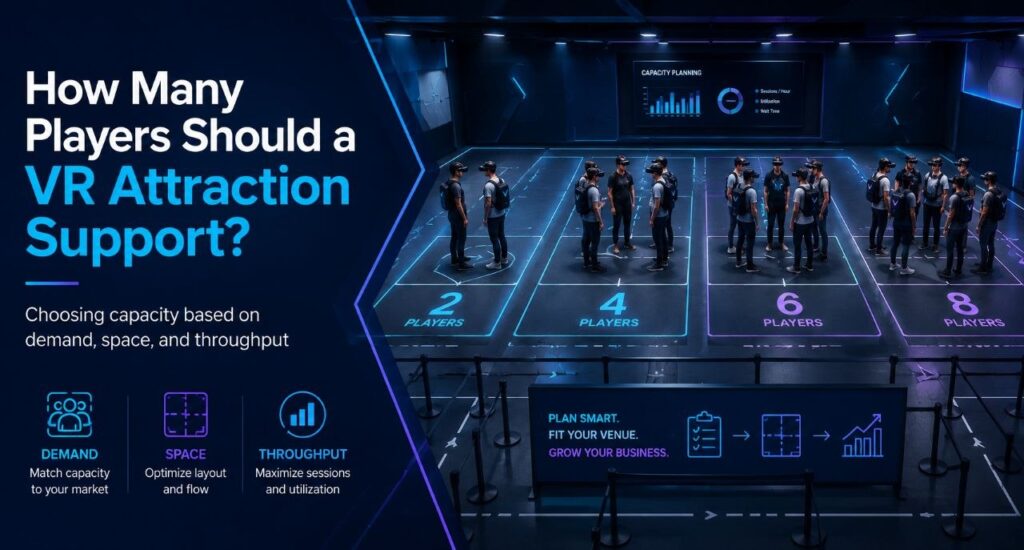
Often operators start this question backward. They decide they want to serve eight guests at once, then go looking for an eight-player attraction. But eight simultaneous guests can mean an eight-player arena, two four-player arenas, a six-player arena plus two room-scale stations, or eight independent room-scale units. Same peak capacity, four completely different businesses. Player count is what falls out at the end of a chain of choices that starts with your building and ends with your content. The decision chain Venue type sits inside this chain as context, not as the formula. A bowling center adding VR, a dedicated VR arcade, and an FEC building around group bookings all answer these questions differently, but none of them get to skip straight to “buy for six” or “buy for eight.” Start with the space you actually have Square footage sets the physical ceiling before anything else gets decided. It determines whether you’re looking at room-scale stations, one free-roam arena, several smaller arenas, or some mix of the two. A venue with 400 square feet to spare is choosing between formats before it ever gets to player count. This is also where the first real tradeoff shows up. The same footprint that holds one eight-player arena can often hold two four-player arenas instead, and those two setups behave nothing alike once you get past the headline number. Hardware, platform, and content: a triangle, not a checklist These three choices constrain each other, and there’s no clean order to work through them. Already own PICO headsets? That narrows content options before player count ever comes up. Chasing one specific title instead? PCVR might be the only place it runs, so hardware follows the content rather than the other way around. Running multiple locations changes the order again: many operators pick the management platform first, since one system across different hardware types matters more than any single game. Whichever one you decide first, it limits what the other two can be. Content needs specific hardware. Hardware needs a platform that can run it and report on it. The platform needs to support whatever mix of standalone, PCVR, wired, or streamed setups the content demands. What your audience actually needs from content This is usually the missing step in capacity planning, and it’s the one that should come before arena size gets decided. Birthdays, families with young kids, teenagers, enthusiasts, corporate groups, school trips, escape-room fans, and casual walk-ins all pull the content mix in different directions. A venue built around birthday packages needs different titles, and different group sizes, than one built around enthusiast repeat visits. Once you know who’s walking in, the content question gets specific. What do those guests want to play, and how many of them want to play it together? What that content requires Content is where the constraint actually bites. Free roam versus room scale, PCVR versus standalone, arena dimensions, and player count all come from the title itself, not from how many headsets you own. Most free-roam titles top out at four or six players in a single configuration. Buying eight headsets doesn’t change that. It just means eight headsets sitting on a shelf while the content that fits your audience runs four at a time. Take the two four-player arenas versus one eight-player arena question from the top of this piece. The two-arena setup gives an operator more compatible titles at that smaller player count, two bookings running at once, and better use of small-group demand on a normal Tuesday, while still hitting eight total players when both arenas are booked together on a Saturday. The eight-player arena gives up all of that flexibility for a configuration that only earns its keep when a full group of eight actually shows up. Neither is automatically the right call. It depends on what your audience actually books. Peak capacity and weekday utilization are different problems VR attraction planning works better when you separate peak demand from utilisation. This is the commercial core of the whole decision, and it’s easy to miss. Picture a Tuesday afternoon. A group of three arrives at a venue built as one eight-player arena. The operator can run that group at three of eight positions filled, or hold the session and wait for another group to fill the rest. Either way, most of that capacity sits idle for a slot that will never come close to selling out again before Friday. The same group at a venue built as two four-player arenas gets a session at three of four positions filled, close to full, while the second arena stays open for the next booking or for maintenance. Same total headset count as the eight-player venue. Very different Tuesday. A big configuration built for the weekend peak can leave a lot of equipment sitting unused Monday through Thursday. A modular setup, several smaller arenas or stations instead of one large one, can often handle the same peak while giving staff something sellable on a slow afternoon. Getting people through the building midweek is usually the harder problem than filling Saturday, and configuration is one of the few levers that actually moves it. The fleet model: capacity that changes shape A venue with a larger headset fleet doesn’t have to run the same configuration all week. The same hardware can be deployed differently depending on who’s booking: Capacity, in other words, doesn’t have to be fixed. It can flex by day and by booking type, which is a very different planning question than “large FEC equals eight to sixteen players.” This is also where a management platform earns its cost. Running PICO, Quest-compatible, and PCVR hardware side by side, and reconfiguring which content runs where as bookings change, needs one operational layer that can see and control all of it. SynthesisVR is built for exactly that: managing hardware, content, and session formats as one system instead of as separate silos an operator has to reconcile by hand. Configuring the venue around your content Once space,
What Makes a Good Multiplayer VR Experience for Out-of-Home Venues?
Six players can enter the same virtual environment and still have six disconnected experiences. One player understands the controls immediately. Two are waiting to join the correct session. Another misses the opening instructions. By the time the full group is ready, the most experienced player has already taken control of the game. Strong multiplayer VR prevents that separation. It gets the group into the experience quickly, makes each player relevant to the outcome, and gives everyone a clear reason to play again. For an out-of-home VR venue, the experience begins before the first objective appears. Headset assignment, player pairing, session launch, recovery, and reset all influence whether a multiplayer title works as a commercial attraction. Good multiplayer begins before gameplay Guests usually see a simple process: put on the headset and start playing. The operator may see a much longer sequence. Staff need to assign the correct devices, identify the players, create the session, connect every headset, confirm tracking, choose the game settings, and ensure that everyone reaches the same starting point. Each additional menu or confirmation adds time. A step that takes only 20 seconds on one headset can create several minutes of delay across a group of six or eight players. That makes time to action one of the most useful ways to evaluate multiplayer VR for a venue. It measures the interval between assigning the group’s headsets and the moment every player begins meaningful gameplay. A commercially strong experience keeps that interval short. Players join the correct session easily, staff can confirm that every device has connected, and the full group enters the game together. The process should remain consistent across different employees and successive bookings. A visually impressive title can still become a difficult venue product when staff spend too much of the session preparing it. Visual 1 placement: Time to Action Headsets assigned → Players paired → Session joined → Tracking confirmed → Game launched → First meaningful action Show common friction points below the flow: manual lobby codes, repeated headset checks, individual calibration, and delayed players. The group should enter as one unit Multiplayer sessions lose energy when players begin at different times. One person may reach the lobby immediately while another remains on a loading screen. A third player may enter the wrong room. Staff then move between headsets, repeat instructions, and delay everyone who connected correctly. A strong multiplayer workflow treats the group as one operational unit. Each headset should be easy to identify, every player should enter the correct session, and staff should see when the group is ready without checking each device individually. This becomes particularly important during birthday parties, corporate events, school visits, and back-to-back weekend bookings. One delayed player can affect the timing of the whole group and every booking that follows. A smooth launch creates confidence. Players begin together, understand that the experience has started, and focus on the activity rather than the equipment. Room-scale and free-roam require different standards Room-scale and free-roam VR can both support multiplayer, although they create different relationships between the players, the hardware, and the physical venue. Room-scale multiplayer In a room-scale setup, each player normally remains inside an individual station or defined play area. The players connect through a shared virtual session while avatars, voice, objectives, and scoring create the multiplayer experience. Room-scale VR also exists in consumer environments. For a commercial venue, its value often comes from flexibility. The same stations may support multiplayer games, solo content, escape experiences, and other attraction categories. That flexibility does not remove the need for a strong operational workflow. Staff still need to connect the correct stations, place every player in the same lobby, launch the session together, and recover an individual device when something goes wrong. The gameplay must also justify the additional coordination. Players should see, hear, help, challenge, or depend on one another. Several people playing alongside each other with separate objectives may share a server without creating a meaningful group experience. Free-roam multiplayer Free-roam changes the connection between the physical venue and the virtual environment. Players walk through the same real space while seeing a shared virtual world. Their physical position, direction, and movement become part of the group interaction. Commercial free-roam depends on dedicated floor space, mapped boundaries, coordinated hardware, safety procedures, and operator-managed sessions. These requirements make it specifically an out-of-home format. The shared arena can create strong social presence, but it also raises the operational standard. Player alignment, tracking, boundary setup, headset assignment, server connection, and session synchronization all need to work together. A configuration problem on one room-scale station may affect one player. In free-roam, one tracking or alignment issue can delay the entire arena. The strongest free-roam experiences reduce repeated setup and make the arena behave predictably between sessions. Staff should not need to recalibrate the space, rebuild the lobby, or guide each headset through a separate joining process for every group. Guests may never see the full configuration process. They still experience every delay it creates. Visual 2 placement: Room-Scale vs. Free-Roam A two-column visual showing: Room-scale: individual stations, shared virtual session, flexible content rotation, station-level recovery. Free-roam: shared physical arena, coordinated tracking and boundaries, spatial group interaction, group-level operational impact. Every player should affect the outcome Shared space alone does not create meaningful multiplayer. Research into collaborative VR describes co-presence, the feeling of being together with another person in the same virtual environment, as a central part of multi-user experience design. The quality of collaboration also changes according to the task, communication methods, and feedback available to players. The other players need to matter. One person may defend an area while another completes an objective. Teammates might revive one another, solve connected puzzles, share resources, or contribute individual results to a team score. The structure can remain simple. Players only need to understand how their actions affect the rest of the group. This matters because commercial venues regularly serve mixed-skill audiences. One booking may include experienced players, first-time headset users, children, parents,
What Is LBVR (Location-Based VR)? A Guide for Operators
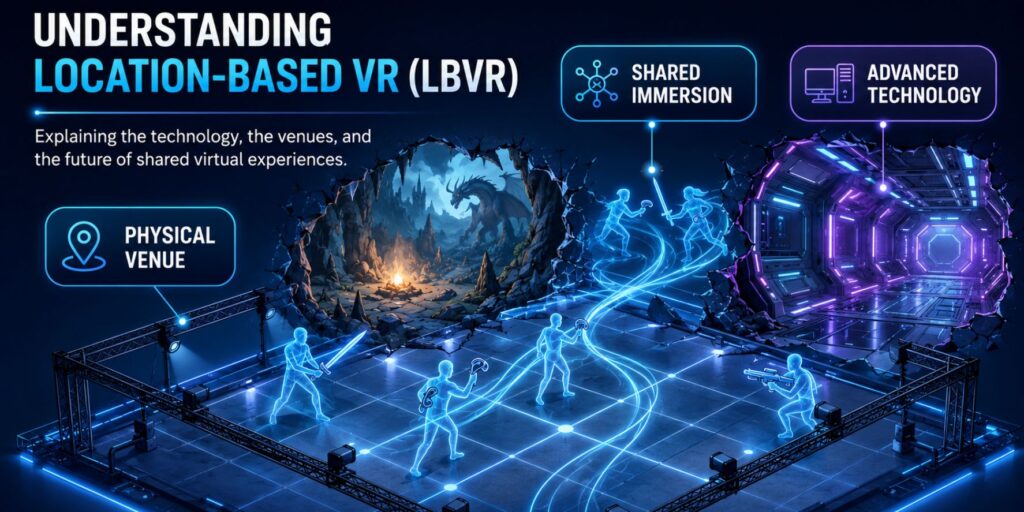
LBVR stands for location-based virtual reality, and it describes commercial VR delivered in a dedicated venue rather than in someone’s living room. The term shows up constantly in industry press, at trade shows, and in vendor pitches, usually without anyone stopping to define it. That leaves prospective operators trying to evaluate hardware, space, and content decisions before they have a clear picture of the category those decisions sit inside. The definition matters more than it first appears. How an operator understands LBVR shapes what they compare their business to, how they price it, and what they tell a landlord or an investor about what they are building. The definition, in plain terms LBVR is the commercial sector that delivers virtual reality experiences in purpose-built physical venues. VR arcades, free-roam arenas, VR escape rooms, and VR installations inside family entertainment centers all fall under it. The venue is what defines the category. A guest at home puts on a headset in whatever floor space they have cleared. A guest at an LBVR venue walks into a room that was designed around the experience: tracked, mapped, sized to the title, staffed, and turned over between sessions on a schedule. The headset might even be the same model in both cases. That distinction produces a handful of practical differences: The formats that fall under LBVR Operators often use “LBVR” and “VR arcade” interchangeably. The VR arcade is one format inside the category, and treating them as the same thing narrows how an operator thinks about their own venue. Room-scale and station-based VR. Compact footprints, seated or standing play, sometimes with motion platforms. The lowest space requirement and the easiest format to add to an existing venue. Our breakdown of room-scale versus free-roam VR covers where the line between the two sits. Free-roam arenas. Open floor space with full-body tracking, letting groups move physically through the virtual environment. Player counts commonly run from four to twelve depending on the title and the arena size. Space requirements are the main planning constraint, and we have covered how much space a free-roam arena actually needs in detail. VR escape rooms. Story-driven, puzzle-focused, built around cooperative problem solving. A natural format for traditional escape room venues adding a VR line, since the booking model and session length already match. Arena-scale VR. Large-format free-roam, often built around competitive or esports-style play, running in considerably larger footprints than a standard free-roam room. This format has its own planning considerations, which we will cover in a dedicated article. A single venue frequently runs more than one of these. A family entertainment center might operate room-scale stations for walk-ins and a free-roam arena for booked parties, because the two formats capture different guests at different price points. Why the category framing changes operator decisions An operator who thinks of their business as “a VR arcade” tends to benchmark against other VR arcades. An operator who understands they are in LBVR benchmarks against the rest of out-of-home entertainment: bowling, laser tag, escape rooms, mini golf, axe throwing. That second framing is more useful, and more accurate. A family choosing a Saturday afternoon activity is not comparing VR venues to each other. They are choosing between VR and the trampoline park down the road. Pricing, session length, party packages, and marketing all get sharper once the competitive set is drawn correctly. It also changes the conversation with landlords and investors. LBVR positioned as an emerging technology category invites questions about whether VR is a passing trend. Positioned as an out-of-home entertainment format that happens to use VR, it sits alongside established attraction businesses with understood economics. What the category looks like at scale Market research firms currently size location-based VR and immersive entertainment somewhere in the multi-billion dollar range, with growth forecasts in the 25 to 35 percent annual range through the early 2030s. Those figures vary widely between firms depending on whether they count VR alone or all immersive out-of-home entertainment, so they are better read as directional than precise. The more useful picture comes from operational data. SynthesisVR runs 600+ locations worldwide across free-roam, room-scale, and seated formats, with a content marketplace of 400+ commercial VR titles. That spread across formats tells you something a market size figure cannot: LBVR has not converged on one venue type, and there is no sign it is heading that way. Our analysis of what 600+ locations reveal about free roam found two distinct content strategies that both sustain profitable venues. Some operators run a tight catalog of five to ten titles, train staff deeply on every scenario, and rotate slowly. Others run fifteen to twenty-five titles, refresh regularly, and lean on visual appeal and recognizable IP to pull first-time visitors. Both models work. Operators who struggle are usually the ones running a hybrid of the two without having chosen either on purpose. That finding says something about the category as a whole. LBVR is broad enough to support genuinely different business models, which is why a definition that collapses it into “VR arcade” costs operators more than it saves them. Common misconceptions worth clearing up LBVR always means free-roam. It does not. Seated and room-scale formats are LBVR, and for many venues they are the more practical entry point. LBVR and AR attractions are the same category. Press coverage often groups them together. The technology, the space requirements, and the content pipelines are different. Consumer headsets and home content transfer directly to commercial use. This is the assumption that causes the most expensive surprises. Warranty terms, software licensing, and device management all work differently once a headset is running paying customers. We covered the specifics in whether consumer VR headsets can be used commercially. Hardware selection is the decision that determines the outcome. Most new operators spend the majority of their planning effort choosing a headset. Across our locations, content strategy and operational consistency separate profitable venues from struggling ones far more reliably than hardware choice does. Where to go from here Understanding
How VR arcades actually make money
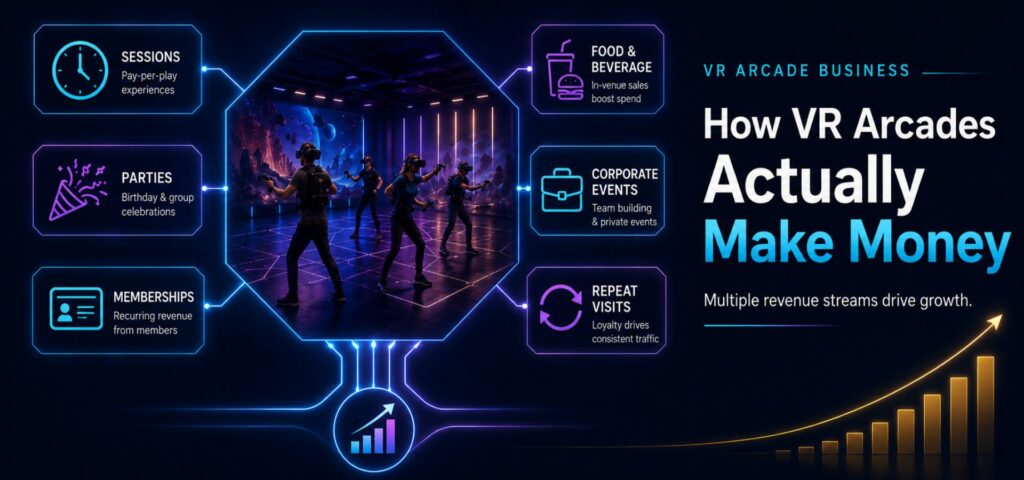
Ask five VR arcade owners how they make money and four will say the same thing: charge per session, then add parties and merch when margins get tight. That answer describes a booth arcade. It doesn’t describe a free-roam arena, and treating the two as one business is why so much advice on this topic falls apart the moment an operator tries to apply it. Room-scale sells time. Free-roam sells an experience A room-scale booth needs roughly 2 x 2 m to 3 x 3 m per player (about 6.5 x 6.5 ft to 10 x 10 ft), low staffing, and a 30 to 60 minute sessions. It’s a throughput business: revenue is seats per hour times price. A free-roam arena needs a shared floor of 20 x 20 ft (6 x 6 m) or more. Eight players push that past 33 x 33 ft (10 x 10 m). Figure roughly 200 sq ft (about 18 m²) of tracked space per person. It sells a group a full narrative arc rather than a slot, so it charges by the head and by the story, not by the minute. A six-person free-roam booking at around $50 a head is a $300 transaction in one time slot. Large free-roam arenas average close to $50 per person for a 45 to 60-minute mission and lean on corporate and private bookings for up to 40% of revenue at some locations. These aren’t competing formats. The industry has quietly demoted the isolated booth from headline product to supporting player. It’s a demo station now, a party filler, a way to occupy a group before or after their arena slot. We’ve written about how to weigh room-scale against free-roam and what free-roam actually requires to run in 2026. The short version for revenue: booth for frequency and low-commitment walk-ins, arena for the higher ticket and longer dwell time, both feeding each other in one venue instead of splitting your marketing budget. The shared-headset moment is a funnel, not a revenue line Every operator has watched this happen: a group walks in, two of them try a headset while the rest watch on a monitor, laugh, heckle, and wait their turn. That mixing and mingling rarely shows up as a line on the receipt. What it does is convert a skeptical non-gamer into a customer without asking them to commit to a 45-minute arena booking on their first visit. The better-run venues build this into the layout on purpose, with lounge seating where groups watch an instant replay of their session together after playing. The waiting and watching becomes part of what they paid for, not dead time between transactions. Treat the shared-headset moment as a nuisance to clear out fast and you remove the exact mechanic that turns a walk-in into a booking for the bigger-ticket experience next door. Customers often interpret changing prices as unfair Plenty of pricing advice lists surge pricing as a growth lever. The evidence from adjacent industries now runs the other way. Disney has spent the past year fielding backlash over what commentators call “dynamic ratcheting,” pricing that moves with demand until guests pay more for a worse day at the park. WWE raised standard show pricing from around $75 to $118 in a single year after its TKO merger and drew public criticism from its own fanbase for it. Across ticketed entertainment, about half of consumers call dynamic pricing unfair, and in markets like the UK and Canada that runs past 60%. Artists who publicly opt out of surge pricing for tours are getting credit for it. A VR venue depends on repeat visits from the same neighborhood far more than a theme park depends on any single guest coming back. Trading a short-term revenue bump for the reputation of “the arcade that charges more when you’re busiest” is a bad trade for a business built on locals returning six or more times a year. One distinction is worth making precisely: fixed, published tiers (weekday versus weekend pricing, group rates, advance-purchase discounts) aren’t the problem. A posted weekday/weekend split, set ahead of time rather than by a real-time algorithm, is a legitimate pricing tool. What backfires is pricing that moves based on how full you are right now or who’s asking. Customers notice, and they stop trusting the number on your website. Marketing in the right order: content, then search, then ads The content that travels for a VR venue is almost never the polished trailer. A 12-second clip of four friends failing a co-op mission does more, and so does the reaction shot from the person who just ripped off a headset laughing. Spectator screens showing the headset view double as a content pipeline: bystanders record what’s already on the screen for you. Nano and micro-influencers with 5,000 to 50,000 local followers convert better than a big name with no connection to your neighborhood. Underneath that, local SEO fundamentals still decide whether anyone finds you: a complete, actively-managed Google Business Profile carries a large share of local map-pack ranking, and review recency matters more than review count. The piece almost nobody in this niche is writing about yet is generative engine optimization: whether ChatGPT, Perplexity, or Google’s AI Overviews cite your venue when someone asks “VR arcade near me for a birthday party.” The longer, question-style searches people use to find a venue return an AI summary more than half the time. AI Overviews already show on roughly a quarter of Google searches, and that share keeps climbing. Content built with clear statistics, direct answers, and specific details gets pulled into those AI answers at meaningfully higher rates than vague marketing copy. Your game pages, party package pages, and pricing FAQ need to read like a direct answer to a question, not a sales pitch, because an AI answer engine is now a real referral source. The one number to check before you buy ads Paid ads come last, once organic and search are working, and before you
How VR Entertainment Centers Market After-School and Autumn Group Activities
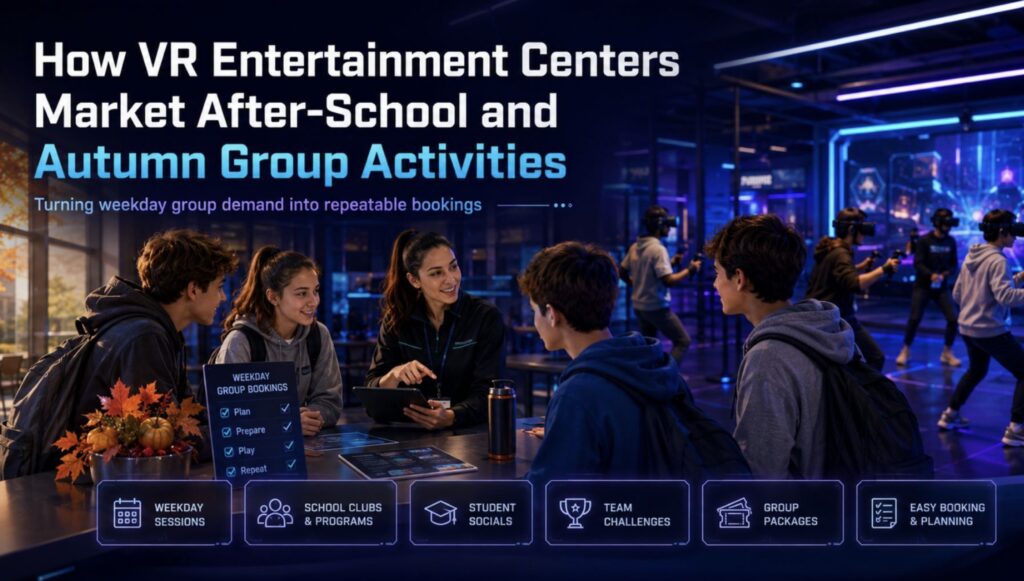
Summer traffic finds you, but autumn traffic has to be booked. The families and walk-ins that filled a Tuesday afternoon in July are back in classrooms and offices by late September, and the weekday hours that once ran near capacity turn into the quietest, least profitable stretch of your week. Advertising harder rarely moves them, because the people worth reaching now don’t buy on impulse. They buy against a calendar and a budget. Autumn belongs to organized groups. After-school clubs, youth organizations, sports teams, student societies, and parents planning something for a dozen kids usually book ahead, and they are the demand that can carry weekday utilization from October through the holidays. Winning that demand takes a different playbook than a summer promotion aimed at whoever happens to be nearby. Sell to the buyer, not the crowd Every group booking has one person who approves it, and that person has a single question standing between you and a confirmed slot. A teacher needs to know your venue is safe and supervised before she brings thirty students across town. A five-a-side coach wants to hear that all eighteen players get a real turn inside the hour he’s paying for. A student society organizer cares whether the night is competitive enough to be worth posting about. Send all three the same “group discount” email and you have answered none of them. Sort your prospects by who signs off on the booking, then lead with the thing that unblocks them: The session behind all four offers can be identical. What converts is opening with the buyer’s real concern instead of your price list. Weekday afternoons are inventory, not leftovers The reflex is to discount quiet weekday hours until something fills them. Fencing them off as group-only inventory works better. Attach rules: a fixed block, a minimum head count that makes staffing the room worthwhile, a deposit to hold the date, and a release deadline so an unconfirmed group frees the slot in time to resell it. That changes the conversation with an organizer completely. You stop asking whether you can squeeze thirty kids in somewhere on a busy floor. You start offering a defined product with a capacity, a price, and a booking window, which is exactly what an organization planning three weeks out needs before it can commit. Groups book an outcome, never a headset No coordinator wants to rent VR headsets. They want a result they can defend to whoever signed the check. Enrichment coordinators book structured learning and teamwork. A coach books a session that carries back to the pitch. A society books a competitive night with a leaderboard and a clear winner. Package around what the group walks out with, and price that outcome rather than the hardware. Present these as sample formats, not house standards. A forty-minute cooperative session for a youth club and a ninety-minute competitive bracket for a society give an organizer something concrete to picture, without you pretending there’s an industry rulebook behind it. Six stations can host eighteen people The objection that quietly kills group bookings is capacity. An organizer counts your six stations, divides eighteen players by six, and decides you’re too small for the group. You aren’t, and walking them through why is the most persuasive thing you can put on a booking page, because almost no venue bothers to explain it. Here is the math on six stations and eighteen players. Split them into three teams of six. One team plays while the other two track the leaderboard, plan their runs, and coach from the sideline. Run three rounds of twelve to fifteen minutes and rotate a fresh team in between each one, and every player gets a full turn inside the hour. The waiting teams are not dead weight; the heckling and the rivalry between rounds are where a group session gets its energy, and free-roam multiplayer and arena titles are built for exactly this team-versus-team format. That rotation is what lets a modest room sell to a party of eighteen with a straight face, and it hands your staff one structure they can run identically every time. When an organizer is deciding whether to trust you with a class of thirty, a clear plan beats raw station count every time. Group bookings come from a list, not a landing page Waiting for a coordinator to stumble onto your booking page is not a plan. Group business comes from a short, worked list of nearby schools, youth clubs, sports leagues, and student societies, and from getting their organizer through your door before they commit anyone. Invite coordinators in for a fifteen-minute preview so they see the space and the supervision for themselves. Send them off with a one-page pack covering capacity, timing, pricing, and suitability, plus a parent email they can forward without rewriting a line. Then follow up, because this cycle is slow by design. A coordinator who previews in September and books a Halloween tournament in October is a normal sale, not a lost lead. Add a ten-second clip of a live session to everything you hand over. A real group mid-game closes the booking better than any paragraph describing it. One format, a whole season of names You do not need a new offer every month. One group format, re-skinned, covers the entire autumn calendar. The same cooperative-or-competitive session becomes a back-to-school challenge in September, a Halloween tournament in October, a student league that runs through term, a sports-team social whenever a coach asks, and an early holiday team event in December. The operating process underneath never changes. Only the theme on the flyer does, which is what keeps the season profitable instead of exhausting. The booking only repeats if the delivery holds A group format earns its place only if any staff member can run it the same way on a full Saturday. That means the unglamorous layer most venues skip: saved content playlists, a fixed briefing script, clear age and intensity labels, a spectator
Can Consumer VR Headsets Be Used Commercially?
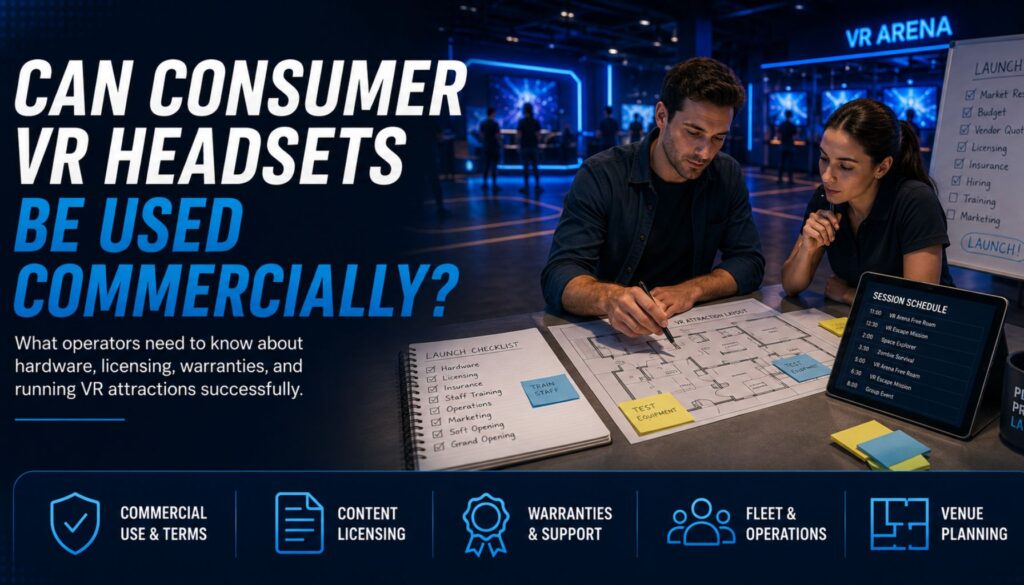
You can use consumer VR headsets commercially. But whether the warranty, the software license, and the fleet management tools remain valid depends on the headset and the vendor’s terms. HTC and Meta both exclude commercial use from their standard consumer warranty outright. PICO and HTC’s enterprise lines exist specifically to restore that coverage. Meta discontinued its dedicated commercial Quest hardware in February 2026, and that made the distinction more relevant, not less. Operators buying Quest now are buying consumer units by default, with the same warranty exclusion attached. The honest answer splits into four separate questions. Does the manufacturer allow it? Does the warranty survive it? Does the software license cover it? Can an operator manage the headset like a fleet asset instead of a personal device? A venue can clear one of those questions and still get caught out on the other three. What the Warranty Actually Says HTC draws the line directly. Its own support documentation says using a consumer VIVE system commercially voids the warranty. It also breaks the terms and conditions. Running a VR arcade on consumer VIVE hardware means running it uninsured the moment something breaks. HTC’s Business Edition and its Business Warranty & Services program exist specifically to restore that coverage. Together they add a commercial-use license plus a two- or three-year warranty built for continuous operation. Meta’s standard limited warranty explicitly excludes commercial use, and any use connected to a trade, business, or profession. A separate Commercial Terms document covers commercial, business, or non-personal use of Meta hardware instead. A Quest bought at retail carries that consumer warranty at home. Put it on an arcade floor and the coverage doesn’t follow, no matter what game is running on it. Two of the largest headset makers treat commercial use as a warranty exclusion, not a gray area. That’s the actual rule. The device turning on is not evidence that it’s covered. Meta Discontinuing Quest for Business Makes This Rule Harder to Avoid As of February 20, 2026, Meta stopped selling commercial Quest SKUs and stopped onboarding new customers to Horizon Managed Services, its device management subscription. Existing HMS customers keep the tool at no monthly cost. It now runs as a standalone product that pairs with consumer Quest 3 and 3S hardware rather than a dedicated business bundle. Meta has set a full shutdown of the program, HMS included, for January 2030. For operators, this doesn’t loosen the commercial-use rule. It removes the hardware SKU that used to sit between the operator and that rule. Anyone deploying Quest headsets going forward is buying consumer units by default, because that’s the only thing Meta sells now. Those units still carry a warranty that excludes commercial use. Managed deployment through HMS is still technically possible on consumer hardware. Warranty protection under commercial conditions is not, unless the operator is working under Meta’s separate Commercial Terms with eyes open. PICO and HTC have gone the other direction. Both still sell dedicated enterprise SKUs: the PICO 4 Enterprise line, and HTC’s VIVE Focus and Business Edition hardware. Both ship built specifically for continuous commercial deployment, with the license and support to match. Owning the Headset Legally Is a Different Question From Owning the Right to Run the Games on It Hardware terms and content licenses are separate agreements with separate rights holders. A consumer game purchase, on any headset, licenses one person playing on their own device. Running that same title across multiple arcade stations for paying customers, session after session, is a different use case. Consumer purchase terms do not extend to it. This holds whether the headset itself carries full commercial licensing and warranty coverage or not. We’ve covered the content side of this in detail separately, including why pay-per-minute licensing exists. That piece also covers what happens to a venue’s content strategy once it’s running at scale. The short version that matters here: clearing the hardware license does not clear the software license. Both have to hold up independently. A developer audit or a warranty claim checks each one separately if either comes knocking. The Cost Shows Up in Running Headsets Day to Day A headset tied to a personal consumer account behaves like a personal device. It comes with individual sign-in, an individual app library, and individual settings that reset or drift between sessions. That’s manageable for one unit. It becomes a staffing problem across six or eight stations running back-to-back groups on a Saturday. Enterprise-tier hardware exists to avoid exactly that. PICO’s Business Suite and LBE-grade operating environment support account-free deployment and kiosk configuration that defines what launches at power-on. They also give operators centralized control across an entire fleet from one console. HTC’s enterprise stack offers comparable fleet and kiosk tooling through VIVE Business+. Consumer-tier Quest hardware, now the only Quest hardware Meta sells, depends on HMS for anything close to that level of control. HMS itself is winding down toward its 2030 end date. The commercial-use question and the fleet-management cost are separate. A headset can clear the license and warranty checks and still cost an operator staff time every session. Someone still has to reset, troubleshoot, and manually manage devices that no one designed to run as a fleet. When It’s Fine to Run Consumer Hardware A consumer headset can be the right trade for a single-station pilot or a short-term activation. It also works for early testing, before committing capital to a full lineup. The warranty exposure and lack of fleet tools matter less when the deployment is small, temporary, or low-throughput. The savings can justify the risk while an operator is still validating demand. But one consumer VR device answers a narrower question than most operators think it does. It tells you whether VR itself is fun, whether guests respond to it, and whether the concept has legs. Call it the “hey, this is fun for a business” test. It does not tell you whether the management platform, the content library, and player access controls hold up