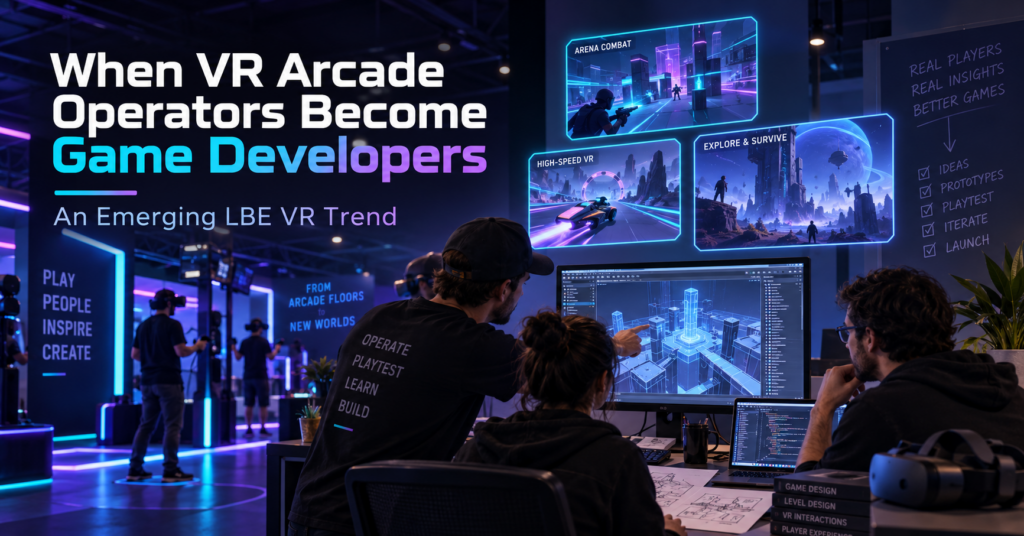
For years, one of the main content questions for a VR arcade operator was simple: What games can we license for our venue?
Lately, we have seen a different question appear inside the SynthesisVR ecosystem.
What if we build the experience we wish we had?
Several games that have reached SynthesisVR have come from people who also operate VR venues. Their reasons differ. One operator wanted to replace an experience that customers kept asking for. Another started developing a game and asked us what tends to work in arcades before the project was ready for submission. Others have used problems they encounter during daily venue operations as the starting point for development.
A handful of projects is not enough to measure an industry-wide trend. It is enough for us to recognize a recurring pattern through game submissions, testing, and conversations with operators.
To understand why it is happening, it helps to look at how commercial VR content got here.
Commercial VR started with games built for home players
When the first wave of modern VR arcades opened around 2016, relatively little content had been created specifically for location-based entertainment.
SynthesisVR grew out of that period. VR Territory opened in June 2016, and the original SynthesisVR tools developed around the practical problems of managing a VR arcade. By September 2017, SynthesisVR had introduced its commercial licensing platform to help connect developers and arcades and support different commercial licensing models.
For early operators, getting legal access to commercially licensed VR content solved an important problem.
Running that content in paid sessions exposed another one.
A person playing at home can spend ten minutes learning controls, looking through menus, restarting a level, or working out what the game expects them to do. Their headset is still available afterward.
A customer in a VR arcade may have booked 30 minutes.
If five of those minutes disappear into explanations, menus, failed launches, or a tutorial that the player does not understand, the venue notices. So does the customer.
Developers started adapting to those conditions.
Then came arcade editions
In 2017, Fallen Planet Studios released an arcade version of AFFECTED: The Manor after working with VR arcades. The studio redesigned parts of the experience for faster throughput, replay value, and a commercial setting.
SUPERHOT VR: Arcade Edition took that thinking much further.
The studio had received feedback from operators running the consumer version in commercial locations. The resulting Arcade Edition added faster tutorials, scoring, local leaderboards, spectator tools, level selection, an administrator panel, time-based play, and controls that allowed staff to help a player who became stuck.
The gameplay remained recognizably SUPERHOT. The systems around it had to work differently because the environment was different.
Arcades care about how quickly a first-time player starts playing. They care about session length, recovery when something goes wrong, replay value, and how often staff need to enter the headset or explain a menu.
Over time, those considerations started appearing earlier in development.
In some recent cases, the person thinking about those problems is also running a VR venue.
When the operator is part of the development team
There is no single route from arcade operator to VR content developer.
Some operators have development skills on their own team. Others work with partners or contractors. Some begin with a game idea. Others start because something is missing from their current attraction mix.
Their advantage is exposure.
They already watch first-time customers use VR every week.
ORBEAT started by asking what works in arcades
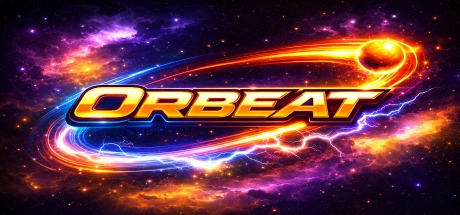
ORBEAT gives us one of the clearest examples because the conversation with SynthesisVR started before the game was ready for submission.
In February 2026, Seth from VR Adventures Zone contacted us while developing the project. He wanted to know what characteristics tend to determine whether a game performs well or struggles in commercial VR.
He was already thinking about ease of use, replayability, and multiplayer, and the game was being tested inside their own venue.
That led to months of discussion and testing.
Multiplayer was originally planned for later in the development roadmap. SynthesisVR recommended moving it forward because groups of friends and family make up an important part of arcade traffic. Player rejoining also mattered. If one headset drops during a multiplayer session, getting that player back into the same group quickly can make the difference between a short interruption and a disrupted booking.
Other issues only became obvious when people started using the builds.
One version had controller compatibility problems with Vive and Index hardware. Another environment had been built at a scale that made parts of the gameplay awkward in a typical room-scale area. It was resized.
Even the tutorial produced useful feedback.
At one point, a player entered the game with a tutorial panel visible alongside a large “Hit Me” prompt. During testing, the obvious action drew attention first. The player started playing and barely registered that there were instructions to read.
The onboarding changed.
Later builds added command-line options for player name, difficulty, and map selection. SynthesisVR connected those settings to operator-side launch controls, reducing the amount of configuration a customer needed to do inside the game.
ORBEAT eventually went live after several rounds of game testing, hardware checks, integration work, and launch automation.
Precise Force: Designing With the Arcade Floor in Mind
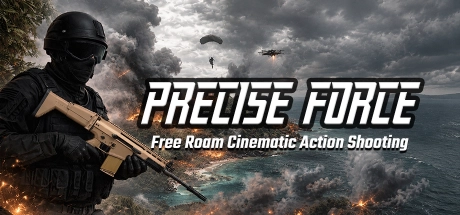
Precise Force is another example of an operator moving from running VR experiences to developing one. The project comes from someone already familiar with commercial VR and the practical realities of putting players into a headset in a location-based environment.
That background naturally influences the questions behind the experience. How does physical interaction work when different groups play throughout the day? How quickly can players understand what they need to do? Does the gameplay translate well from an interesting VR mechanic into something that works repeatedly in an LBE setting?
Precise Force approaches those questions through multiplayer action and physical interaction. Rather than going deep into its development process, the more interesting point for operators is where those decisions originate: firsthand experience with how people actually use VR in a commercial venue.
That distinction matters. A developer approaching LBE from outside the industry may need time to learn how session flow, player behavior, staff involvement, physical space, and repeat play affect an attraction. An operator who becomes a developer starts with many of those considerations already familiar.
Precise Force is still its own project, developed independently by its creator. Its place in this article is as another sign of a wider shift: people who have spent time operating VR venues are beginning to turn what they have learned on the arcade floor into new commercial VR content.
Explore Precise Force on SynthesisVR
VR Paintball Blast began with a missing game
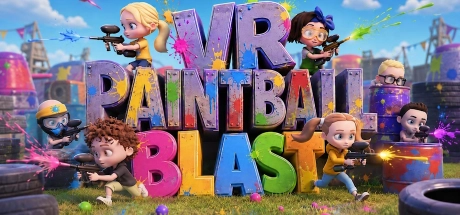
The newest example has one of the clearest origin stories.
Andrew Szczeszynski operates 5th Dimension VR. In August 2026, he contacted SynthesisVR and explained that his team had started developing games specifically for VR arcades.
Their first title is VR Paintball Blast.
Rec Room Paintball had previously been one of the most popular experiences at their location, particularly for parties. When that option disappeared, they had a gap in their content mix.
So they built their own paintball game.
By the time Andrew contacted us, VR Paintball Blast had already been running in their arcade for several weeks and getting feedback from customers.
Testing on our side produced a new set of questions.
The original maps worked better with larger groups, so smaller PvP maps were added for lower player counts. Recommended player numbers appeared in map selection.
SynthesisVR also looked at the parts an operator would encounter outside the headset: launching the correct map, automatically joining players into one game, controlling match duration, movement behavior, respawn timing, hardware support, and whether the experience could still work when only one or two customers wanted to play.
Command-line options were added for player names, game sessions, maps, player counts, and match length.
When testing exposed movement friction on PICO hardware, Andrew traced the issue through controller bindings and joystick behavior, added PICO-specific bindings, removed one cancellation action, and adjusted the input threshold.
Bots came later, allowing smaller groups and even a single player to run a fuller match.
Standalone versions followed for Meta Quest 3 and PICO 4 Ultra. The final configuration also allows PCVR and standalone headsets to participate in the same local multiplayer game.
VR Paintball Blast supports up to 20 players, with bots available when the human group is smaller. It has automatic team balancing, map rotation, simplified controls, and LAN multiplayer designed to reduce setup work during a commercial session.
The idea started with something much simpler:
Customers liked a type of experience. The arcade could no longer offer it. The operator decided to build an alternative.
Other operator-led projects are taking different routes
The same pattern appears in several other projects, although the development stories are different.
Warranty Not Included comes from VRXtra, a company that also operates VR locations. When VRXtra shared the pre-release build with SynthesisVR, the game already focused on accessible shooting, self-contained challenges, multiple weapons, and global leaderboards. The team specifically invited us to test the build before commercial distribution.
Explore Warranty Not Included on SynthesisVR
Riftbreak Arena came from another arcade operator. Its route changed considerably during development. An earlier version focused on mission-based gameplay, but testing raised issues around player direction, movement, multiplayer, and session flow. The developer eventually reworked the project around PvP arena play, followed by further changes to spawning, teleport movement, hit feedback, multiplayer behavior, and standalone deployment.
Explore Riftbreak Arena on SynthesisVR
Downshift started after Beyond Reality identified a missing attraction in its own operation. CEO Justin Able has explained that, as LBVR operators, they saw a need for an arcade racing game in their venue and set out to create one. The project also involved subcontracted development, showing another possible route for operators who identify a content opportunity without maintaining a complete game development team internally.
These six projects did not follow one formula. That is part of what makes them useful examples.
What venue operators notice after hundreds of sessions
Running a VR arcade gives operators a lot of informal product research.
They quickly learn where first-time players hesitate and which controller instructions staff repeat all day. A map that feels busy with eight players may feel nearly empty with two. A tutorial that made perfect sense during development may still require a staff member to explain it during every booking.
Operators also see what happens after the first play.
Some games create an immediate “one more round” response. Others get selected once and rarely again.
They see how birthday groups behave compared with experienced VR players. They know whether four customers can get into a multiplayer game easily or whether someone needs to walk between stations fixing the session.
Then there are the parts customers barely notice when everything works: calibration, boundaries, multiplayer joining, hardware compatibility, resets, server behavior, spectator displays, and session timing.
That experience can reveal a product problem long before anyone starts thinking about building a game.
Should VR arcade operators start developing games?
For most operators, probably not.
Game development adds an entirely different workload to running a venue.
Even a focused VR arcade title requires programming, design, art, testing, hardware compatibility, performance work, updates, support, and maintenance. Multiplayer introduces more opportunities for things to go wrong.
It begins to make sense when an operator keeps encountering the same missing use case and has the technical resources to address it. That could come from someone on the existing team, a development partner, or a subcontracted studio.
The first goal can be solving the problem at one location.
If the experience works there, the operator can find out whether other venues have the same need.
Commercial licensing can eventually create another revenue stream, although there is no predictable return. Other operators still need to discover the game, test it, see a fit for their customers, and decide that it deserves space in their content mix.
An operator-built game has to earn usage just like every other title.
From one arcade floor to other venues
An operator’s own location makes a useful first testing ground.
Real customers find confusing controls, oversized maps, difficult tutorials, uncomfortable movement, and awkward session flow quickly.
The next test is whether the same experience works somewhere else.
That is where SynthesisVR has worked with projects such as ORBEAT, Precise Force, Warranty Not Included, Riftbreak Arena, and now VR Paintball Blast.
Our team can approach a build from the perspective of another operator.
How quickly does it launch? What happens with different player counts? Can the important settings be controlled outside the headset? Does it behave properly on common venue hardware? What happens when someone disconnects? How much staff intervention does an ordinary session require?
Sometimes that leads to a configuration change. Sometimes a new build follows. In other cases, testing can push part of the game in a different direction.
SynthesisVR itself came from the experience of operating a VR arcade, so that conversation between software, content, and day-to-day venue operations has been part of the platform from its early years.
There is still no guarantee that a finished title will find an audience after release. It has to earn its place alongside the other commercially licensed content available to VR arcades.
The starting point, however, is becoming familiar.
An operator runs sessions every week, keeps encountering the same missing experience or recurring problem, and eventually asks:
Could we build this ourselves?
For operators already working on commercial VR content, SynthesisVR can help test suitable projects, provide LBE-focused feedback, and support commercial integration, licensing, and distribution when the experience is ready to move beyond its original venue.