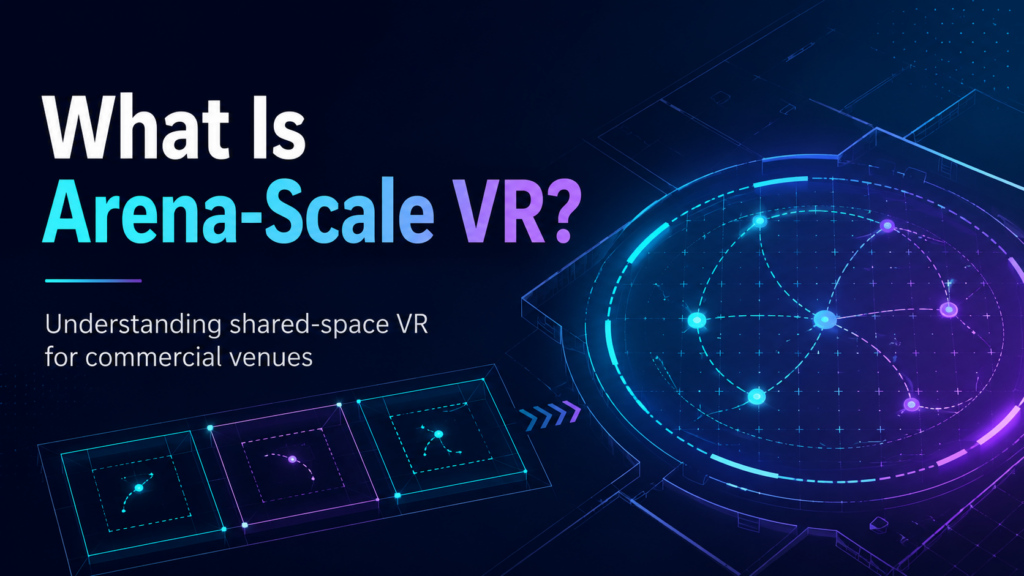
Arena-scale VR is a commercial virtual reality format where multiple players physically move through a shared tracked space while experiencing the same virtual environment. Players can walk, turn, communicate, and interact with each other without relying entirely on joystick movement to cross the virtual world.
You may also see the format described as free-roam VR, arena VR, or free-roaming VR. These terms often overlap, and the industry does not use one fixed floor size to define when free-roam becomes “arena-scale.”
For a venue operator, that distinction matters less than the actual configuration. The important questions are how much usable space the attraction needs, how many players it supports, which content can run in that footprint, and how efficiently staff can move one group out and the next group in.
Is Arena-Scale VR the Same as Free-Roam VR?
In practice, the terms frequently describe the same underlying concept: several players moving naturally inside one shared physical play area.
There is still a useful distinction when planning a commercial venue.
Free-roam VR describes the movement model. Players physically walk through a shared tracked space instead of remaining inside individual stations.
Arena-scale VR often describes the attraction built around that movement model, particularly when the shared space supports larger groups or a larger physical footprint.
There is no universal square-footage threshold where one suddenly becomes the other.
That is why operators should look beyond the label. A six-player 20 × 20 ft arena and an eight-player 33 × 33 ft arena can both qualify as arena-scale VR, while creating very different requirements for floor space, content, staffing, and group bookings.
For a deeper comparison of the movement formats, see Free-Roam VR vs Room£-Scale VR for Commercial Venues.
Arena-Scale VR vs Room-Scale VR
The biggest operational difference is how players use the physical space.
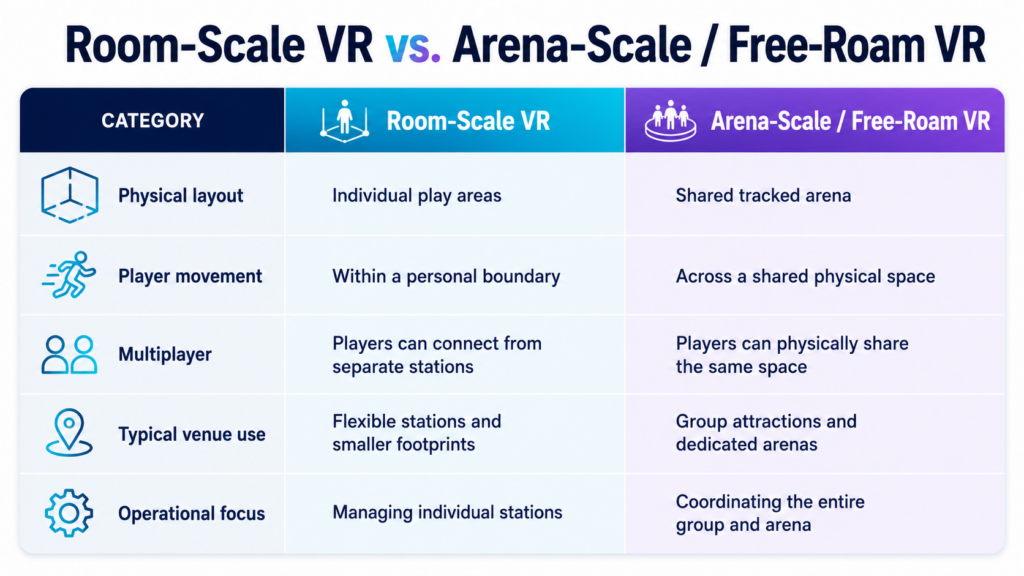
With room-scale VR, four guests may play together while each remains inside a separate physical boundary.
In an arena-scale experience, those same four players can occupy one shared 6 × 6 m (20 x 20 ft) area. Their real-world positions correspond with their positions inside the experience, so a teammate standing two meters away virtually should also be standing in the correct relative position physically.
That changes more than the amount of floor space required. Tracking, player positioning, calibration, networking, session launches, and safety all become part of one coordinated attraction.
How Much Space Does Arena-Scale VR Need?
There is no single arena size that works for every commercial VR experience.
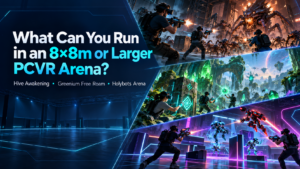
A 6 × 6 m, or roughly 20 × 20 ft, play area has become a common starting point across the commercial free-roam catalog. Some experiences support smaller footprints, while others scale to 8 × 8 m, 10 × 10 m, or different rectangular configurations.
The relationship between space and player capacity is especially important.
Take After the Fall: Free-Roam as one current example. Its 6 × 6 m configuration supports up to four players. A 10 × 10 m configuration increases that capacity to eight.
Other commercial titles use several layouts rather than only two fixed sizes. This means an operator choosing a footprint is also making a decision about which content configurations will remain available to the venue.
A larger arena can unlock additional content and higher player capacities. It also consumes more revenue-producing floor space, and higher theoretical capacity only helps when customer demand can fill it.
That is why the better planning question is rarely:
“How large can we make the arena?”
It is:
“What combination of space, player count, content, and booking demand makes sense for this venue?”
We break down the footprint question in more detail in How Much Space Do You Need for a Free-Roam VR Arena?.
Bigger Does Not Automatically Mean Better
Arena capacity looks attractive on a specification sheet.
An eight-player attraction can accept a large birthday group, corporate team, or group of friends in one session. During a busy Saturday, that capacity may be useful.
A normal weekday can tell a different story.
If most bookings arrive as groups of two, three, or four, one large arena may leave a substantial part of its capacity unused. Two smaller attractions could give an operator more scheduling flexibility and allow two bookings to run at the same time.
The reverse can also happen. A venue built around school groups, parties, corporate events, or other larger bookings may benefit significantly from keeping more players together in one attraction.
This is why we recommend treating player count as the result of several planning decisions rather than the starting point.
Space, audience, content, hardware, booking behavior, and session flow all affect the useful capacity of the attraction.
How Many Players Should a VR Attraction Support? looks at that decision in more detail.
What Makes Arena-Scale VR More Complex to Operate?
The guest sees a headset, an open floor, and a virtual world.
The operator has to make several systems work together before that guest walks onto the arena floor.
1. Shared-space tracking
Every headset needs an accurate understanding of the physical play area.
A tracking problem affecting one player can interrupt an experience for the whole group. Operators therefore need a stable environment, clearly defined boundaries, reliable mapping, and a repeatable calibration process.
2. Multiplayer synchronization
Players need to enter the same experience together and remain synchronized throughout the session.
This makes network reliability more important than it may be for independent room-scale stations.
3. Session launches
Starting six or eight headsets individually adds staff actions to every booking.
Those steps may seem minor during a quiet shift. Repeated across a full operating day, small delays can extend turnaround times and create queues during peak periods.
4. Reset and turnover
The commercial session includes more than gameplay.
Staff need time for onboarding, fitting equipment, launching the experience, ending the session, cleaning hardware, checking batteries, and preparing the next group.
A 30-minute game therefore occupies more than 30 minutes of the venue’s operating schedule.
5. Content configuration
Arena games have specific requirements for player count, physical dimensions, hardware, and sometimes accessories.
A venue cannot assume that every free-roam game will run in every free-roam arena.
This operational layer is one of the lessons that appears repeatedly across more than 600 locations using SynthesisVR. Hardware specifications matter, but long-term consistency depends heavily on the systems around the hardware: session coordination, content selection, licensing, staff workflows, and repeatable setup.
Can Arena-Scale VR Run on PCVR and Standalone Headsets?
Yes. Arena-scale VR does not describe where the game processing happens.
Commercial venues can run free-roam attractions using PCVR or standalone VR hardware.
A PCVR configuration processes the experience on gaming PCs or a rendering setup. Wireless streaming can still allow players to move freely through the arena, so PCVR no longer automatically means tethered gameplay.
Standalone headsets process the application on the headset itself. That can reduce the hardware footprint around each player and simplify some deployments, although the available content library and performance requirements differ from PCVR.
Both approaches can support commercial arena-scale VR.
The choice should follow the venue’s content requirements, existing infrastructure, budget, fleet-management needs, and plans for future expansion.
For that decision specifically, see PCVR vs Standalone VR for Commercial Venues.
Content Should Be Part of the Floor-Plan Decision
A common planning mistake is treating the venue layout and content library as separate decisions.
They are closely connected.
Commercial free-roam games specify supported arena dimensions and player counts. A game that supports eight players at 10 × 10 m may support only four at 6 × 6 m. Another title may offer several layouts between those two sizes. Some experiences may require a particular hardware platform or commercial deployment method.
That means committing to an arena footprint also defines part of the future content library.
Operators should therefore review available commercial content before finalizing construction.
Ask:
- How many titles support the proposed space?
- What group sizes can those titles accommodate?
- Does the library cover cooperative, competitive, family, escape, and other useful categories?
- Which titles support PCVR, standalone, or both?
- Can the attraction serve several audiences throughout the week?
- Will there still be enough content to rotate after regular customers have tried the launch lineup?
This last question becomes increasingly important once the initial novelty of a new attraction wears off.
A strong arena needs reasons for guests to return, which can come from new experiences, different game modes, competitive scores, events, or a carefully rotated content library.
Commercial Licensing Still Applies
A game being technically compatible with a headset does not automatically make it available for commercial use.
VR arcades and other location-based entertainment venues need appropriate commercial licensing for the experiences they sell to customers.
Operators evaluating an arena should therefore consider content licensing at the same time as hardware and floor space.
This becomes particularly important when the venue plans to rotate experiences regularly. The useful question is not simply how many games a headset can run. It is how many commercially licensed experiences fit the arena configuration and the audiences the venue expects to serve.
What Should an Operator Decide Before Building an Arena?
Before committing floor space or purchasing a headset fleet, work through the decisions in this order.
Available usable space
Measure the actual clear play area after accounting for walls, columns, doors, spectator zones, check-in areas, storage, and safe movement around the attraction.
Target customer groups
Look at the groups the venue expects to sell to most often.
A dedicated VR arcade, an FEC, an escape room venue, and a bowling center adding VR can all use arena-scale attractions differently.
Useful player capacity
Plan around realistic booking behavior rather than maximum capacity alone.
Four players used consistently can generate more value than eight-player capacity that rarely fills.
Compatible content
Review the commercial library against the proposed arena dimensions and hardware before fixing the layout.
PCVR or standalone deployment
Choose the processing model based on content requirements, infrastructure, management needs, and expansion plans.
Session workflow
Map the complete guest journey from arrival through onboarding, gameplay, cleaning, reset, and the next launch.
A technically impressive attraction can still create poor throughput if the operating workflow adds unnecessary minutes between every booking.
Future content rotation
Think beyond opening month.
Ask whether the arena gives the venue enough content options to serve returning customers six months or a year later.
Where Arena-Scale VR Fits in an LBE Venue
Arena-scale VR is one part of the wider location-based VR category.
Some dedicated VR arcades build their business primarily around a free-roam arena. Other venues combine an arena with room-scale stations, racing simulators, VR escape rooms, party space, or traditional FEC attractions.
The role of the arena changes with the venue.
For one operator, it may serve as the main booked attraction. For another, it can become a premium multiplayer option inside a wider entertainment mix.
Understanding that role before choosing the floor plan makes the hardware, capacity, and content decisions much easier.
For more on the wider category, read What Is LBVR? A Guide for Operators.
Plan the Arena as a Complete Attraction
Arena-scale VR starts with a shared tracked space, but square footage alone tells an operator very little about whether the attraction will work commercially.
The useful unit is the whole system: space, players, hardware, content, licensing, session flow, and staff workflow.
SynthesisVR brings commercial content, session management, device control, and free-roam operations into one VR management environment across PCVR and standalone setups. That lets operators evaluate and run different arena configurations without treating the content library and the operating system as separate parts of the attraction.
Before committing to an arena, start with the groups you expect to serve and the experiences you want to offer. Then build the physical and technical setup around those requirements.