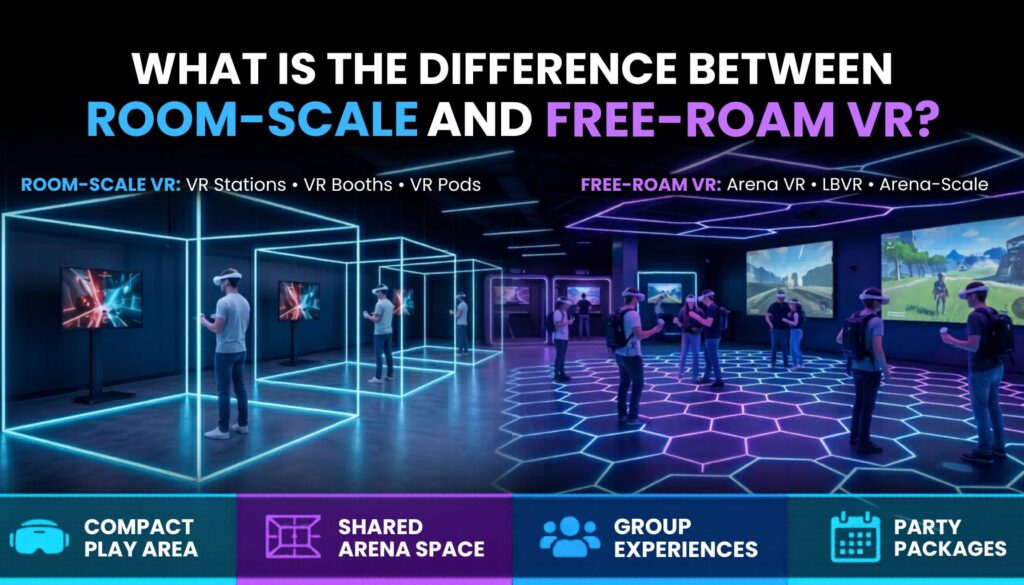
When people compare room-scale VR and free-roam VR, the discussion usually starts with space. Room-scale uses a smaller tracked area. Free-roam uses a larger physical arena where players walk naturally.
That explanation is technically accurate. For commercial operators, it is also incomplete.
Room-scale VR and free-roam VR are different attraction formats, each serving a different operational and commercial role inside a venue. They affect staffing requirements, player capacity, content strategy, floor plan decisions, and how a business generates revenue. Data from hundreds of commercial VR venues shows that operators rarely choose one format over the other: they build around free-roam as the primary investment, then layer room-scale around it to serve a different part of the guest experience. Understanding why that pattern works is more useful than debating which format is “better.”
What Does Room-Scale VR Mean?
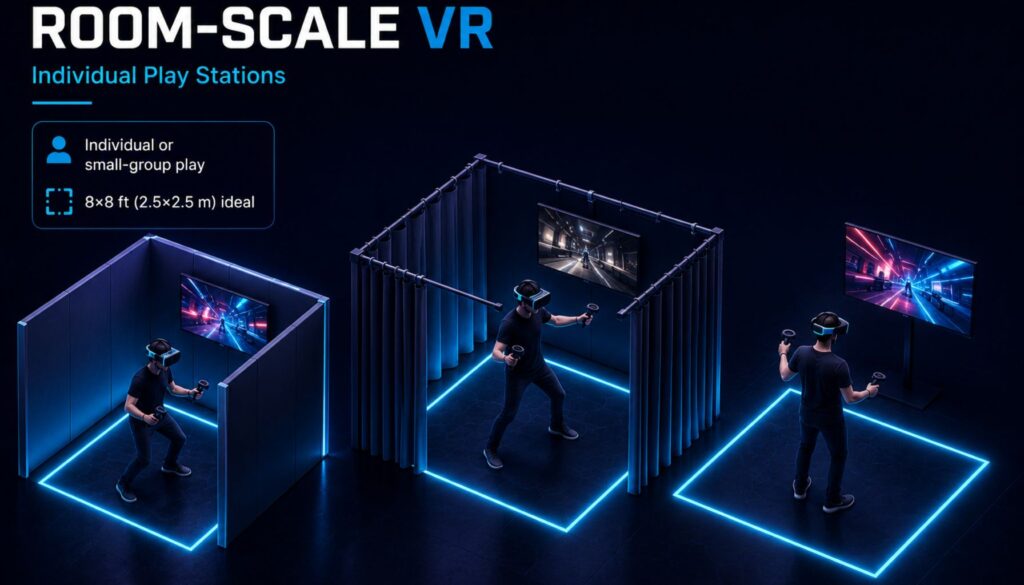
The debate around free-roam VR vs room-scale VR usually starts with space. Room-scale VR refers to experiences that take place within a defined tracked play area, typically a minimum of 2×2 meters and ideally 2.5×2.5 meters per player or group. Within that space, players can walk, crouch, turn, and interact physically rather than sitting or standing in a fixed position.
The setup can take several forms. Some operators build enclosed rooms with solid walls. Others use curtain dividers or open floor plans with clearly marked boundaries. A monitor facing outward so waiting guests can watch gameplay in progress is standard across all configurations. The experience may support a single player or a small multiplayer group, as long as all players share the same tracked area.
Across the industry this format goes by several names: VR stations, VR booths, VR pods. These are not distinct attraction categories. They describe different ways of delivering the same format, whether that means an open play position on a venue floor, a partitioned booth for privacy and organization, or a branded enclosed unit with custom theming. The format is consistent: compact, defined play space with flexible deployment.
Because room-scale setups require relatively little floor area and integrate into most existing layouts, operators use them to add attraction variety, increase density, or introduce new content without major venue redesigns. That flexibility matters most when a venue is already anchored by a larger attraction and needs to fill the surrounding floor plan productively.
What Does Free-Roam VR Mean?
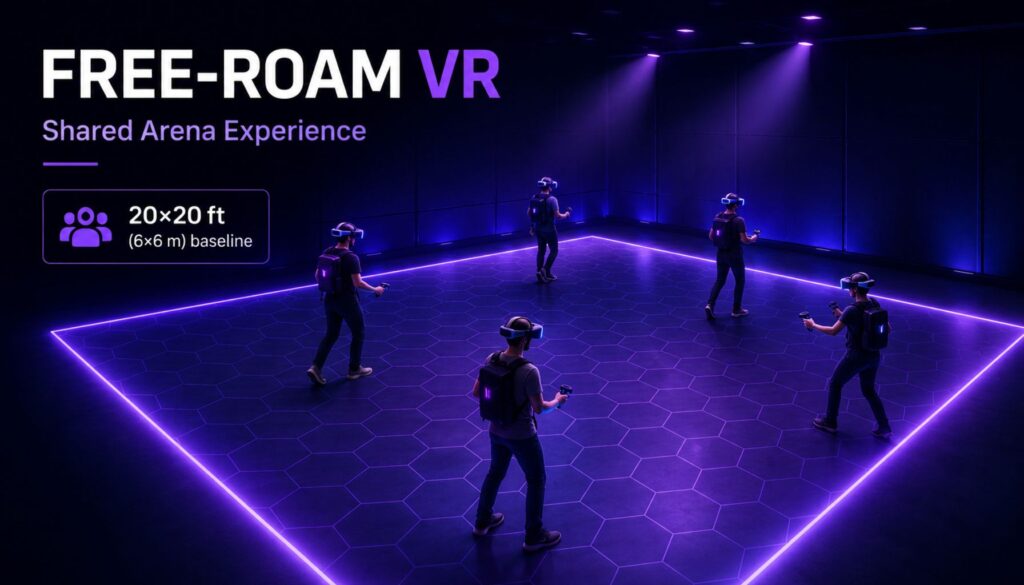
Free-roam VR allows multiple players to walk through a shared virtual environment together, each wearing a wireless headset, navigating the same physical arena at the same time.
Where room-scale defines a boundary for each player, free-roam removes that boundary. Everyone in the experience occupies one shared arena space, physically moving alongside each other while interacting inside the same virtual world.
The format is commonly referred to as free-roam VR, arena VR, or arena-scale VR. Within the industry, location-based VR and LBVR are broader terms that often apply here as well.
The technology behind free-roam has changed significantly over the past several years. Early commercial setups relied on backpack PCs: players wore full computing rigs on their backs through the experience, and tracking depended on external sensor arrays that required significant setup time between sessions. Modern free-roam operates differently. Standalone headsets with inside-out tracking have largely replaced backpack systems. Arenas are designed specifically to support stable tracking: floor markers, aruco patterns, and walls with non-repeating visual textures give headsets consistent reference points as players move. The result is more reliable tracking, faster resets, and simpler day-to-day operations.
Arena size in free-roam is not fixed by a single standard. Most commercial free-roam titles are designed around a 6x6m (20x20ft) play space, which has become the practical baseline for operators because it unlocks the widest range of available content. Larger arenas, typically around 10x10m, support more simultaneous players or give players more physical room, though player counts do not always scale with the additional space. Some titles allow operators to adapt the experience to a different play space size, but that flexibility is less common across the catalog. The practical starting point for most operators is sizing the arena around the content library they want to run, not the other way around.
Free-roam experiences are built around what the format does well: multiplayer cooperation and competition, physical exploration across a large shared space, and social play where every participant is present in the same environment at once.
The Practical Difference: Movement and Play Area
The most visible difference between the two formats is how players move. In room-scale VR, movement stays within a compact tracked area per player. In free-roam VR, walking is central to the experience: players navigate the arena physically and the virtual world responds to where they actually are.
From an operator perspective, that produces meaningfully different venue requirements.
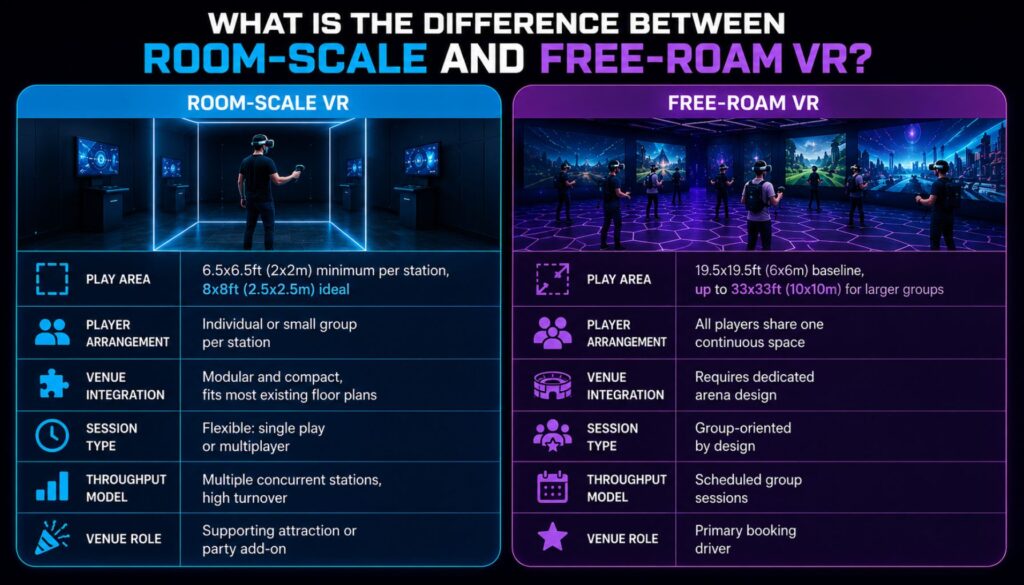
The choice is rarely about which format is technically superior. It is about which format fits the venue being built and the audience it serves.
Why Free-Roam Draws Stronger Commercial Interest
Several factors have made free-roam VR the more discussed format among venue operators, and data from commercial deployments reflects that priority consistently.
The clearest factor is replicability. A consumer at home can buy a headset, clear some furniture, and run a room-scale experience. The quality differs from a commercial setup, but the format is accessible. Free-roam arenas are not. No home environment accommodates a shared arena with multiple simultaneous players, calibrated tracking walls, and the session infrastructure a venue provides.
Content reinforces that gap in a specific way. Titles like Arizona Sunshine Remake: Free-Roam and After the Fall: Free-Roam are built exclusively for commercial venue deployment. They have no consumer release. A guest who already owns a home headset still has a clear reason to book: the experience they want does not exist on any device they can buy.
That content exclusivity also has a less obvious commercial benefit. VR content licensing structured through a commercial platform closes the route that consumer versions leave open. Room-scale content that exists in consumer ecosystems can be acquired and run by any venue regardless of whether proper licensing is in place, which means an operator paying for legitimate commercial access is potentially competing against venues that are not. Free-roam content distributed through commercial licensing platforms does not carry that exposure. The content lives within a managed ecosystem, licensing is built into how it is accessed, and there is no consumer version that creates a parallel route. For operators building a venue they intend to defend commercially, that distinction matters.
Free-roam also performs differently as a social product. Friends, families, corporate groups, and birthday parties participate together in a shared physical space where what one player does affects everyone else. The experience becomes a shared event rather than parallel individual sessions. That social dimension drives group bookings, repeat visits, and the kind of word-of-mouth that justifies marketing investment.
Data from hundreds of commercial VR venues consistently shows that room-scale multiplayer titles account for the majority of total playtime across the network, reflecting how continuously those stations run throughout the day. Free-roam titles hold strong positions within that data despite serving a smaller subset of venues, which points to something operators already understand: when a venue has a free-roam arena, it becomes the booking anchor. Everything else builds around it.
How the Formats Fit Inside a Venue
The more useful question for most operators is not which format to choose. It is how the two formats work together inside a single venue.
The pattern that appears consistently across commercial deployments is this: free-roam serves as the flagship attraction and the primary reason a group books. Room-scale stations handle the rest: walk-in players, individuals, overflow between group sessions, and the parts of the guest experience that happen around the main event rather than inside it.
One of the most practical uses of room-scale VR in a mixed venue is as a party package component. A group arrives for a birthday booking. The party room anchors the event. The free-roam arena is the headline experience. Room-scale stations fill the time before the arena session, after it, or for guests who want to keep playing while others rest. The format earns its floor space by extending guest dwell time and adding revenue to a booking that is already committed.
Throughput planning shapes how this works in practice. When session management runs cleanly, room-scale stations can cycle continuously between group sessions without pulling staff attention away from arena operations. When it does not, the floor feels disorganized even if the content is strong. Getting staff training right for both formats is a separate discipline from setting them up correctly.
The Shift Toward Mixed Entertainment Centers
The pure VR arcade model has become less common. Operators increasingly build venues that combine VR with other attraction types, and the pairings that appear most often alongside VR arenas follow a clear pattern. Minigolf, bowling, axe throwing, archery, and trampoline are the non-VR attractions operators most commonly add to a venue already anchored by free-roam VR. Food and beverage and a dedicated party room typically complete the picture.
Those combinations work for reasons that go beyond variety. Each of those attraction types supports group bookings independently. A venue that can sell a party package including a free-roam session, room-scale stations, a party room, and additional activities is selling a complete event. The revenue logic is different from selling individual VR sessions, the booking window is longer, and the repeat visit pattern reflects a guest who associates the venue with a full evening rather than a single experience.
Within that model, room-scale VR fits as the flexible, lower-footprint layer that fills gaps in the schedule, extends what a group booking can include, and keeps the floor productive between arena sessions. Free-roam remains the attraction that justifies the visit. For operators considering how that scales across multiple locations, the same format logic applies: free-roam anchors each site, room-scale fills around it.
What This Means for Operators Making the Decision
Room-scale and free-roam VR solve different problems. Room-scale offers flexibility, efficient use of space, and continuous throughput across a wide content catalog. Free-roam delivers the large-scale shared experience that becomes the reason a group books and returns.
The venues performing most consistently across commercial deployments are not choosing between them. They are using free-roam to anchor the attraction portfolio and room-scale to fill the surrounding experience, support party packages, and keep the floor productive between arena sessions.
For operators entering the market or expanding an existing venue, that is the decision worth getting right first: not which format is better, but how each format earns its place in the venue you are building.
Planning that mix involves more variables than format alone: content availability for your arena size, licensing structure, network infrastructure, and how different attraction types share a floor plan. The team at SynthesisVR works with 600+ venues worldwide across PCVR and standalone in a single platform, and the content marketplace covers more than 350 LBE VR experiences from 200+ developers. If you are working through those decisions, explore the platform or get in touch for a conversation. Demo SynthesisVR now and get $250 credit. No Credit Card needed!