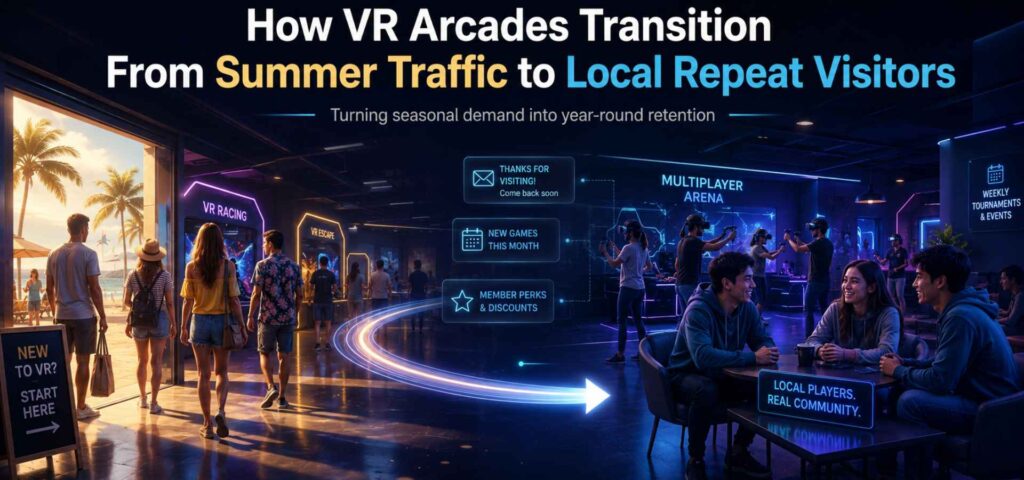
Summer walk-in traffic has an expiry date. Tourists go home in September, schools reopen, and the spontaneous bookings that filled your July calendar start to thin out. If your plan for autumn is to advertise harder and discount deeper, you’re paying to replace customers you already had.
The venues that stay busy year-round measure summer differently. Alongside door count and revenue, they track how many future customers the season produced. Every first visit is a chance to create a second one, and summer hands you more first visits than any other point in the year.
This applies well beyond VR. Family entertainment centers, trampoline parks, and museums all face the same seasonal cliff. What separates a busy summer from a sustainable business is the system built behind every booking.
Loyalty is built during the first visit
It’s tempting to start thinking about repeat business once the season winds down. By then the moment has passed.
A guest walking through your door in July is already deciding whether they’ll return. Was booking easy? Was the staff welcoming? Did the experience beat expectations? Is there an obvious reason to come back? Will they remember this in three months?
If that last answer is “probably not”, you earned a transaction, and it ends there. Operators who keep their summer crowd build retention into the guest experience from the first booking screen onwards.
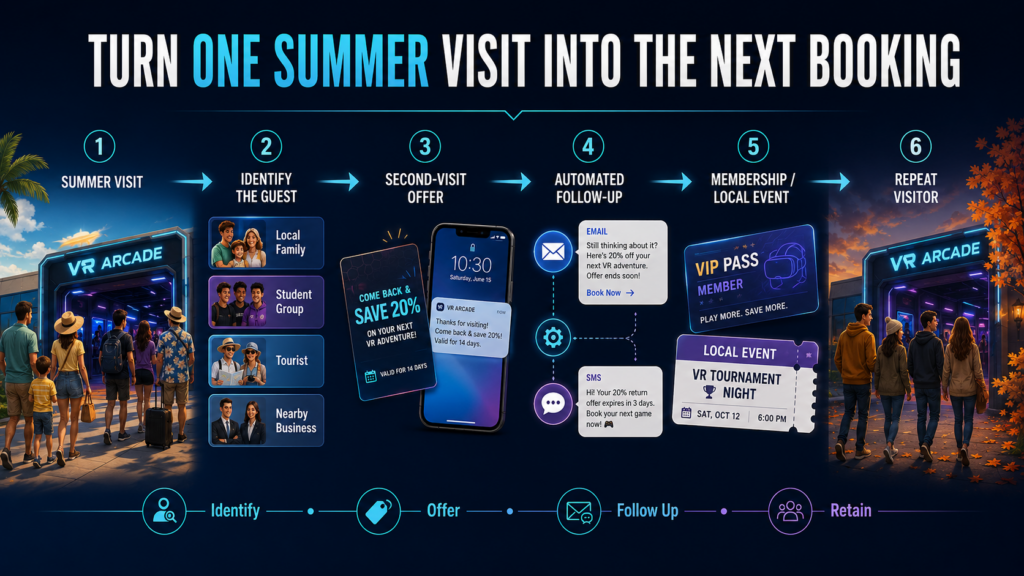
Step 1: find out who your summer visitors are
Treating every guest the same is the easiest mistake to make in August, precisely because there are so many of them.
A tourist from another country is unlikely to become a monthly regular. A family fifteen minutes away might. A student group could return several times during the academic year, and a local company that booked a team outing could turn into an annual corporate client. These groups have wildly different future value, and a follow-up campaign that treats them identically will land with none of them.
A postcode field at booking or a quick “are you local?” at check-in sorts this out with almost no friction. Instead of one mailing list, you finish the summer with distinct audiences: locals, families, students, nearby businesses. Every campaign you run afterwards gets sharper because of it.
Step 2: sell the second visit while they’re still in the building
The biggest drop-off in the attractions business happens between visit one and visit two. Operators spend real money convincing someone to come once, then leave the return visit to chance.
Better to start the next visit at checkout. The most effective tool here is the Bounce-Back Offer, a highly lucrative, time-sensitive promotion given only to paying customers as they leave.
If a group finishes a VR escape room today, hand them a physical card or send an instant text offering 30% off their next visit, provided they book within the next 14 days. Families get an automatic school-holiday upgrade offer. Students hear about weekly league nights.
Each follow-up has to answer one question: why should I come back when I can already say I’ve done this? If your message answers that, the second booking follows. If it just says “come back soon,” it won’t.
Step 3: Automate the post-visit sequence
You cannot rely on staff to manually follow up with every summer guest. A proven LBE strategy is setting up an automated email or SMS sequence that triggers exactly 24 hours after a guest’s visit.
A high-converting sequence typically follows a three-step structure:
| Timing | Email Objective | The Message |
| Day 1 | The “Thank You” | Thank them, ask for a quick review, and deliver a photo or digital scorecard from their visit. |
| Day 4 | The “Did You Know?” | Introduce them to something they didn’t do (e.g., “You played VR zombies, but did you see our laser tag arena?”). |
| Day 10 | The “Reason to Return” | Send a limited-time offer or invite them to a specific upcoming local event. |
By automating this, your summer traffic is constantly being pushed back toward your booking page without adding daily tasks to your management team.
Step 4: Convert players into members
The ultimate defense against the autumn drop-off is recurring revenue. Summer is the easiest time to upsell a one-off ticket into a monthly membership or a “Winter Pass.”
When a local family visits in August and has a great time, the friction to spend another $30 next month is high. But if you offer them a $15/month membership that includes one free monthly session, discounted food and beverage, and priority booking, you instantly lock in their autumn and winter attendance. Even if they don’t visit for one month, your revenue floor remains stable.
Step 5: give locals a reason to visit every month
Marketing one event at a time keeps you improvising. A yearly calendar answers the harder question in advance: what reason do locals have to visit next month?
- August: capture summer visitors and build the database
- September: back-to-school offers and student events
- October: Halloween horror experiences and themed multiplayer nights
- November: league competitions and community events
- December: corporate parties and festive family bookings
- January: new year challenges, memberships, and loyalty campaigns
Once this calendar exists, every month already has a purpose. The weekly “what should we promote?” scramble disappears, and your summer database has somewhere to go.
Fresh content beats new equipment
A concern that comes up whenever retention is discussed: doesn’t this mean constantly buying new attractions?
Rarely. Guests return when the visit will feel different, and in VR that’s achievable without touching your hardware. Rotate multiplayer titles. Run a monthly featured experience. Change the game combinations in your packages. Add score competitions and community tournaments around content you already license.
For a commercial VR venue, content rotation is one of the cheapest retention tools available. Someone who “did VR” in July has a reason to return in October if what’s running has changed.
Increase dwell time to build habit
People return to places where they feel comfortable lingering. If a family comes for a 45-minute VR session, plays, and immediately leaves because there is nowhere to sit, you are a purely transactional business.
FECs with high retention rates invest heavily in the “spaces between.” Comfortable lounge seating, a robust food and beverage offering, and secondary passive games (like arcades or pool tables) increase dwell time. The longer a guest stays in your venue after their primary activity is over, the more they begin to view your facility as a community hangout space rather than a one-off ticketed attraction.
Multiplayer is VR’s built-in retention engine
A VR session changes depending on who’s in it, which few traditional attractions can claim. People remember who they played with as much as what they played.
The guest who enjoyed a session with two friends is already picturing bringing four different ones next time. Your content stays the same. The group changes, and that’s enough to make the experience feel new. Build your follow-up offers around groups (bring-a-friend rates, team-vs-team formats, league seasons) and this effect starts working for you on schedule instead of by accident.
Read your summer data before you spend on autumn marketing
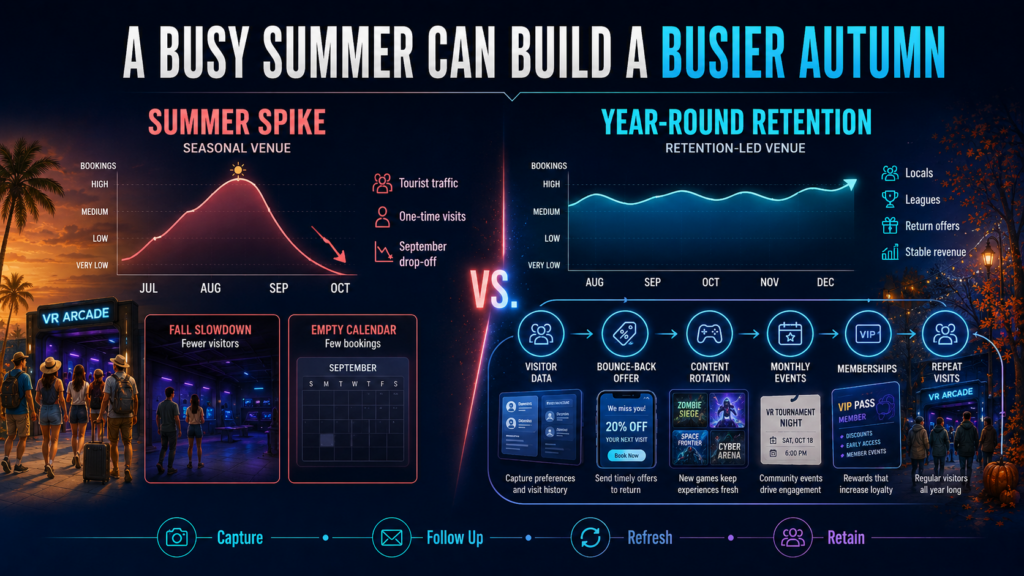
Summer is also your largest data harvest of the year. Counting bookings is the shallow end. The more useful questions: which experiences get replayed, which customer groups return fastest, which multiplayer games generate referrals, which first visits turn into birthday parties or corporate enquiries.
Those answers should shape your autumn promotions, your staffing plan, and your next content purchase. The busiest venues come out of summer with more than revenue. They come out knowing what brings their customers back.
The same playbook works beyond VR
The move from seasonal visitors to loyal locals looks remarkably similar across the attractions industry. VR arcades lean on multiplayer, rotating content, leagues, and memberships. FECs drive repeat family visits with seasonal passes, birthday packages, and bundled attractions. Trampoline parks fill weekdays with memberships, referral programmes, and school partnerships. Any local venue can use bounce-back offers and cross-promotions with nearby attractions.
Different businesses, same principle: the first visit should lead naturally to the second.
The September test
One number tells you whether your summer strategy worked: repeat visitor percentage. Total bookings and revenue won’t show it.
If September is carried entirely by new customers, summer was a busy season and nothing more. If September is full of people who first visited in July or August, you’ve built something that compounds year over year.
Where this leaves you
Summer traffic is temporary. What you do with it doesn’t have to be.
The operators who are still busy in November treated every summer booking as the start of a relationship, and that explains more of their results than location, weather, or venue size ever will. In practice it means they learned who their guests were, followed up with a specific reason to return, and kept the venue feeling fresh enough to justify the trip. For VR arcades, that means multiplayer experiences worth repeating, a content calendar locals can rely on, and booking data that actually gets read.
Do that, and summer stops being a spike. It becomes the biggest customer acquisition window you get all year.
Related Reading
What Information Should a VR Arcade Website Include to Convert More Visitors?
How VR Entertainment Centers Attract Student Groups and Young Adult Audiences
Why Multiplayer VR Attractions Drive Repeat Visits and Higher Utilization