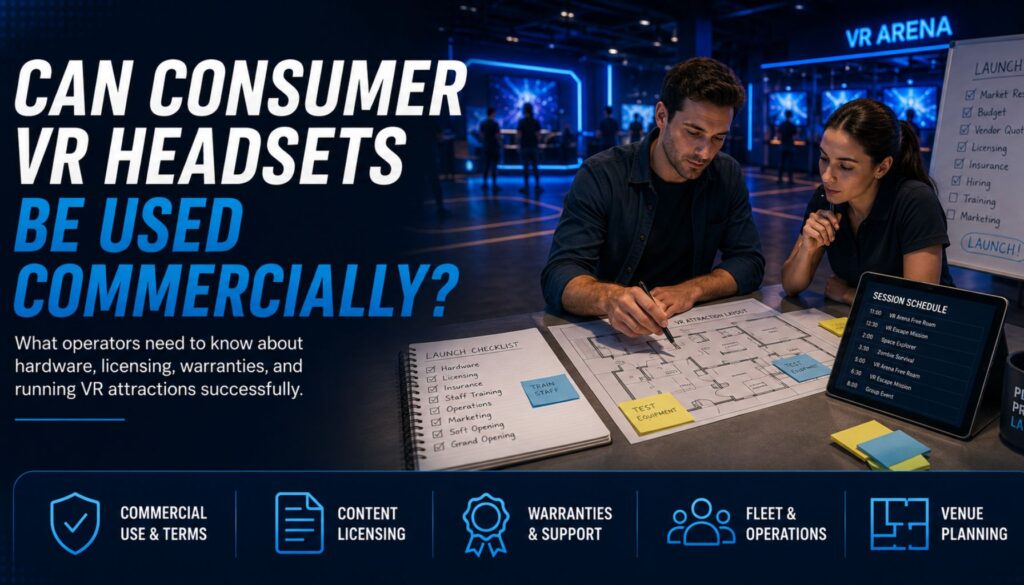
You can use consumer VR headsets commercially. But whether the warranty, the software license, and the fleet management tools remain valid depends on the headset and the vendor’s terms. HTC and Meta both exclude commercial use from their standard consumer warranty outright. PICO and HTC’s enterprise lines exist specifically to restore that coverage. Meta discontinued its dedicated commercial Quest hardware in February 2026, and that made the distinction more relevant, not less. Operators buying Quest now are buying consumer units by default, with the same warranty exclusion attached.
The honest answer splits into four separate questions. Does the manufacturer allow it? Does the warranty survive it? Does the software license cover it? Can an operator manage the headset like a fleet asset instead of a personal device? A venue can clear one of those questions and still get caught out on the other three.
What the Warranty Actually Says
HTC draws the line directly. Its own support documentation says using a consumer VIVE system commercially voids the warranty. It also breaks the terms and conditions. Running a VR arcade on consumer VIVE hardware means running it uninsured the moment something breaks. HTC’s Business Edition and its Business Warranty & Services program exist specifically to restore that coverage. Together they add a commercial-use license plus a two- or three-year warranty built for continuous operation.
Meta’s standard limited warranty explicitly excludes commercial use, and any use connected to a trade, business, or profession. A separate Commercial Terms document covers commercial, business, or non-personal use of Meta hardware instead. A Quest bought at retail carries that consumer warranty at home. Put it on an arcade floor and the coverage doesn’t follow, no matter what game is running on it.
Two of the largest headset makers treat commercial use as a warranty exclusion, not a gray area. That’s the actual rule. The device turning on is not evidence that it’s covered.
Meta Discontinuing Quest for Business Makes This Rule Harder to Avoid
As of February 20, 2026, Meta stopped selling commercial Quest SKUs and stopped onboarding new customers to Horizon Managed Services, its device management subscription. Existing HMS customers keep the tool at no monthly cost. It now runs as a standalone product that pairs with consumer Quest 3 and 3S hardware rather than a dedicated business bundle. Meta has set a full shutdown of the program, HMS included, for January 2030.
For operators, this doesn’t loosen the commercial-use rule. It removes the hardware SKU that used to sit between the operator and that rule. Anyone deploying Quest headsets going forward is buying consumer units by default, because that’s the only thing Meta sells now. Those units still carry a warranty that excludes commercial use. Managed deployment through HMS is still technically possible on consumer hardware. Warranty protection under commercial conditions is not, unless the operator is working under Meta’s separate Commercial Terms with eyes open.
PICO and HTC have gone the other direction. Both still sell dedicated enterprise SKUs: the PICO 4 Enterprise line, and HTC’s VIVE Focus and Business Edition hardware. Both ship built specifically for continuous commercial deployment, with the license and support to match.
Owning the Headset Legally Is a Different Question From Owning the Right to Run the Games on It
Hardware terms and content licenses are separate agreements with separate rights holders. A consumer game purchase, on any headset, licenses one person playing on their own device. Running that same title across multiple arcade stations for paying customers, session after session, is a different use case. Consumer purchase terms do not extend to it. This holds whether the headset itself carries full commercial licensing and warranty coverage or not.
We’ve covered the content side of this in detail separately, including why pay-per-minute licensing exists. That piece also covers what happens to a venue’s content strategy once it’s running at scale. The short version that matters here: clearing the hardware license does not clear the software license. Both have to hold up independently. A developer audit or a warranty claim checks each one separately if either comes knocking.
The Cost Shows Up in Running Headsets Day to Day
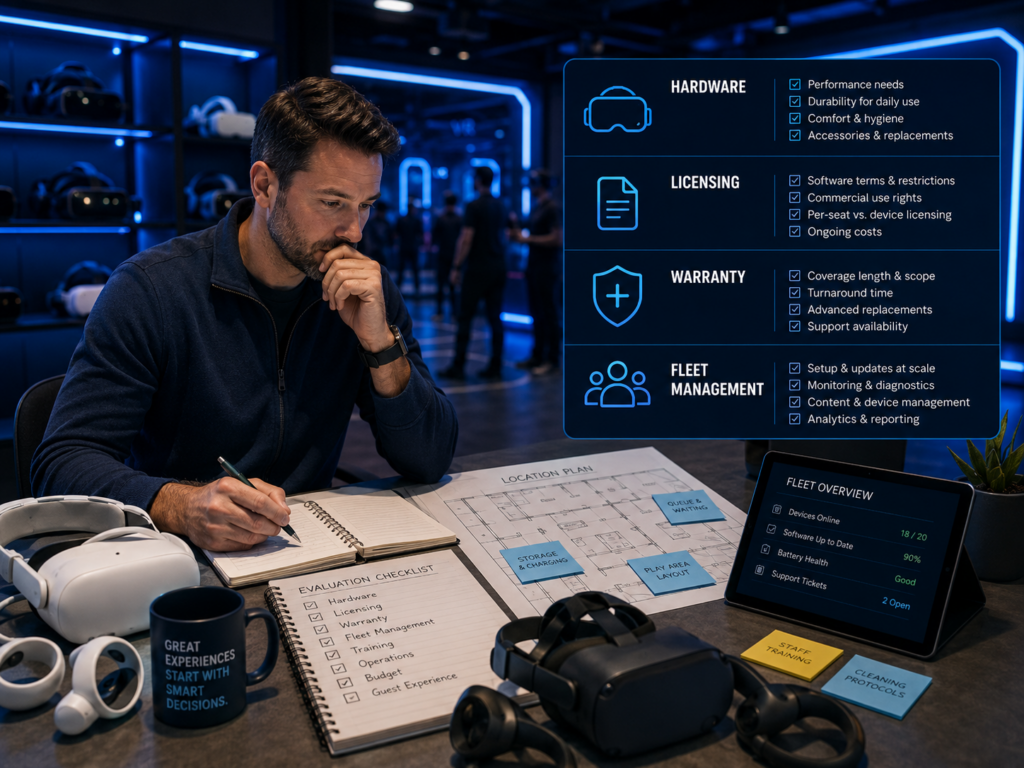
A headset tied to a personal consumer account behaves like a personal device. It comes with individual sign-in, an individual app library, and individual settings that reset or drift between sessions. That’s manageable for one unit. It becomes a staffing problem across six or eight stations running back-to-back groups on a Saturday.
Enterprise-tier hardware exists to avoid exactly that. PICO’s Business Suite and LBE-grade operating environment support account-free deployment and kiosk configuration that defines what launches at power-on. They also give operators centralized control across an entire fleet from one console. HTC’s enterprise stack offers comparable fleet and kiosk tooling through VIVE Business+. Consumer-tier Quest hardware, now the only Quest hardware Meta sells, depends on HMS for anything close to that level of control. HMS itself is winding down toward its 2030 end date.
The commercial-use question and the fleet-management cost are separate. A headset can clear the license and warranty checks and still cost an operator staff time every session. Someone still has to reset, troubleshoot, and manually manage devices that no one designed to run as a fleet.
When It’s Fine to Run Consumer Hardware
A consumer headset can be the right trade for a single-station pilot or a short-term activation. It also works for early testing, before committing capital to a full lineup. The warranty exposure and lack of fleet tools matter less when the deployment is small, temporary, or low-throughput. The savings can justify the risk while an operator is still validating demand.
But one consumer VR device answers a narrower question than most operators think it does. It tells you whether VR itself is fun, whether guests respond to it, and whether the concept has legs. Call it the “hey, this is fun for a business” test. It does not tell you whether the management platform, the content library, and player access controls hold up at scale. That’s the real test once a single device, or HMD, becomes ten. Multiplayer performance is a different test from one headset running solo in a back office. A consumer unit that feels solid alone can still fall short once the fleet is real. That’s exactly the load enterprise-grade VR headsets handle by design.
That’s the actual fork in the decision. Testing whether VR works as an attraction takes one device. Testing whether a specific headset is the right buy for ten units takes more than one unit, tested together. Operators should choose hardware for the end goal from the start: running VR attractions commercially, not performing well running alone.
That calculation changes once a headset is running daily, across multiple stations, for the general public. At that point the same shortfalls in warranty coverage, licensing, and device management compound with every session instead of staying theoretical.
The Takeaway
No rule blocks consumer VR headsets from commercial use outright. HTC blocks that assumption explicitly. Meta blocks it too, through its own warranty language: consumer terms don’t carry over once the headset starts earning revenue. The hardware question, the warranty question, the content licensing question, and the fleet management question are four different checks. A venue can pass one without passing the rest.
The rule of thumb: the more public, repetitive, and revenue-dependent the deployment, the more a commercial-grade path pays off. That path might mean enterprise hardware, a business warranty add-on, or knowingly accepting Meta’s Commercial Terms. Any of those options costs less over the headset’s life than the exposure of skipping it.
Whichever hardware a venue lands on, the license and fleet management questions don’t disappear. SynthesisVR handles the content licensing and device coordination layer across a station lineup. Operators aren’t tracking warranty terms and commercial rights headset by headset.
Related Reading
Why PICO Became the LBE Standard for Free Roam
Adding VR to Your Existing Venue: What Works in 2026
What 600+ Locations Teach You About Free Roam