Week 6 covered why network failures in free roam VR are almost always misdiagnosed as tracking problems. Week 6.5, the implementation companion, went deeper into the architecture behind a correctly configured venue network: the wired backbone, VLAN separation, access point count by setup type, and the specific configuration decisions that determine whether sessions hold under real operational pressure. If you have not read it yet, it is worth doing before this one. The two articles sit in the same layer of the operational stack.
Week 7 moves one step closer to the headset itself. Calibration drift is one of the most misunderstood problems in free roam VR, and one of the most operationally expensive. It rarely announces itself dramatically. It compounds quietly, session by session, until staff are recalibrating every morning as a matter of routine, without realising that routine is costing them hours of productive time every day.
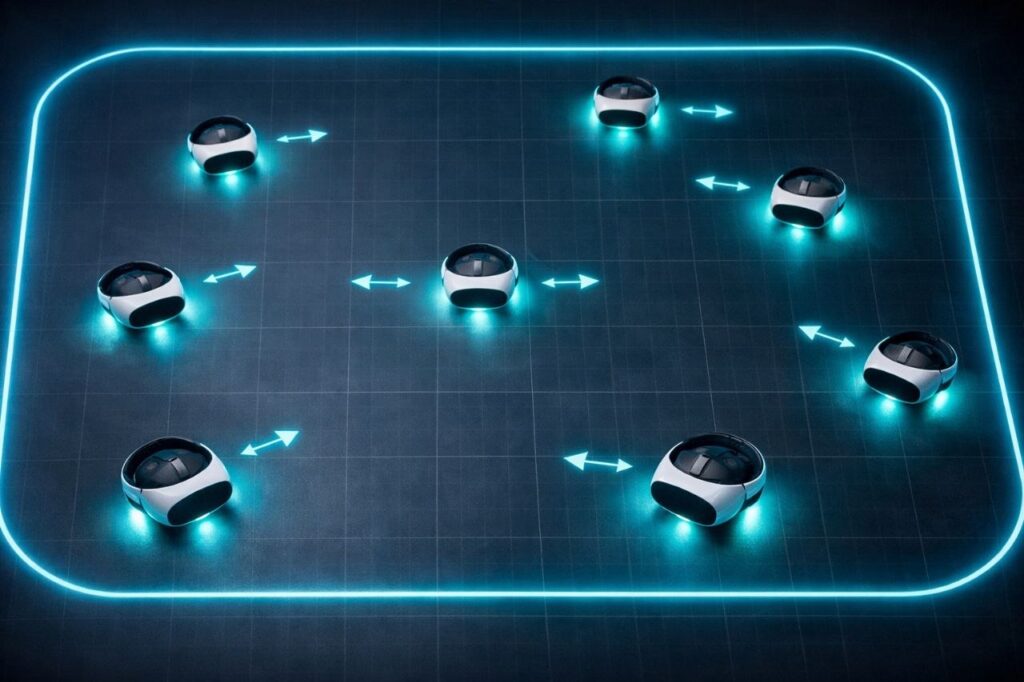
Every standalone VR headset running free roam uses a tracking method called visual simultaneous localisation and mapping, or vSLAM. The headset’s outward-facing cameras scan the surrounding environment and build a spatial map of the space. As the player moves, the system continuously compares what the cameras currently see against that stored map to estimate the headset’s position. Combined with data from onboard inertial measurement units, accelerometers and gyroscopes, the system produces the six-degrees-of-freedom positional data the game uses to place the player in the virtual environment.
The process is remarkably effective in stable, well-configured spaces. The problem is that it depends on the environment remaining consistent. Lighting changes, reflective surfaces, uniform walls with few distinguishable features any of these degrade the quality of the visual map the headset can build. When the map degrades, the headset’s estimated position drifts from its actual position in the physical space.
Published research on co-located SLAM tracking confirms that even small positional errors between headsets, mismatches between where a player actually is and where the system thinks they are, can create safety risks in shared physical spaces. In a single-player setup, minor drift is usually invisible. In a multi-player free roam arena with six or eight players moving simultaneously, small errors between headsets translate directly into players colliding with each other or with physical obstacles they cannot see.
Drift does not require dramatic environmental change to appear. Practical testing across Meta Quest, PS VR2, and SteamVR systems has found that abrupt changes in daylight, a smudge on a single headset camera, or furniture moved near the boundary can shift a virtual grid within minutes of a session starting. In a venue running back-to-back groups throughout the day, this accumulates.
There is also a network dimension to what operators experience as drift. Week 6.5 covers the latency requirements of PCVR streaming in detail, a headset running at 72 frames per second needs a new frame every 14 milliseconds, and total round-trip latency above 30 to 35 milliseconds produces visible judder. In a hybrid venue where PCVR streaming and standalone free roam run simultaneously, what presents as a positional mismatch mid-session can originate from either layer. This is why diagnosing the source accurately matters before reaching for a recalibration that will not solve a network problem.
Why Re-Mapping Every Morning Kills Throughput
The most common operator response to drift is recalibration. When something feels off, staff remap. When a new staff member sets up for the day, they remap. When a headset restarts after a firmware update, they remap. Over time this becomes a daily routine, an accepted cost of running the operation.
What most operators do not quantify is what that routine actually costs. Consumer-grade headsets can require up to 30 minutes of morning calibration per unit due to manual sync requirements, plus up to 15 additional minutes of ongoing drift and boundary troubleshooting throughout the day. On a 10-headset fleet running 365 days a year with staff at $20 per hour, that maintenance labour figure adds up to a number that rarely appears anywhere in the original business plan but shows up every month in the actual numbers.
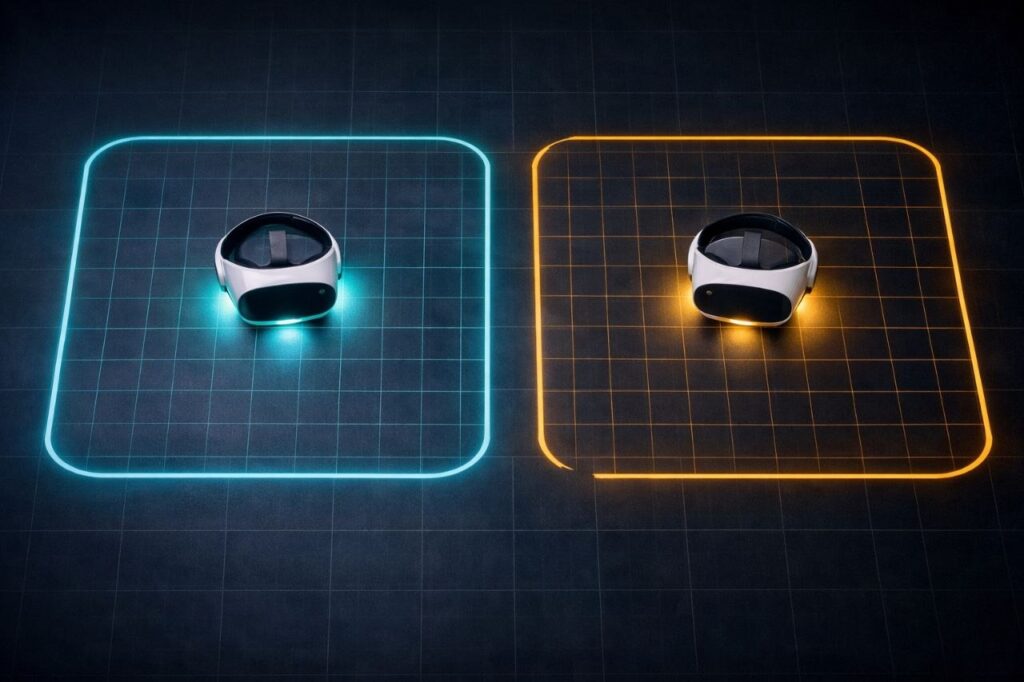
The problem runs deeper than time. Consumer headsets cannot share boundary maps. Each device builds and maintains its own independent spatial map. When a headset is turned off and back on, or when a different staff member puts it on and walks to a slightly different starting position, the coordinate space shifts. The result across a multi-headset fleet is that every device is operating from a slightly different understanding of where the play area is. Players can be perfectly aligned in the virtual world from their individual perspectives while physically moving in ways the game never intended.
The SynthesisVR knowledge base documents this directly: the Quest headset does not remember the previous player orientation after power cycling. Staff working around this problem manually mark starting positions on the floor and require every operator to wear each headset individually from the same marked spot, facing the same direction, before each session. That workflow is a symptom of a system not designed for commercial operation.
The parallel with networking is direct. Week 6.5 makes the same point about consumer mesh WiFi systems, they may appear to work during low-load testing and fail under peak session density. Consumer headsets present the same dynamic in the calibration layer: stable in single-player testing, unreliable at scale.
PICO Boundary Sharing and Multi-Player Alignment
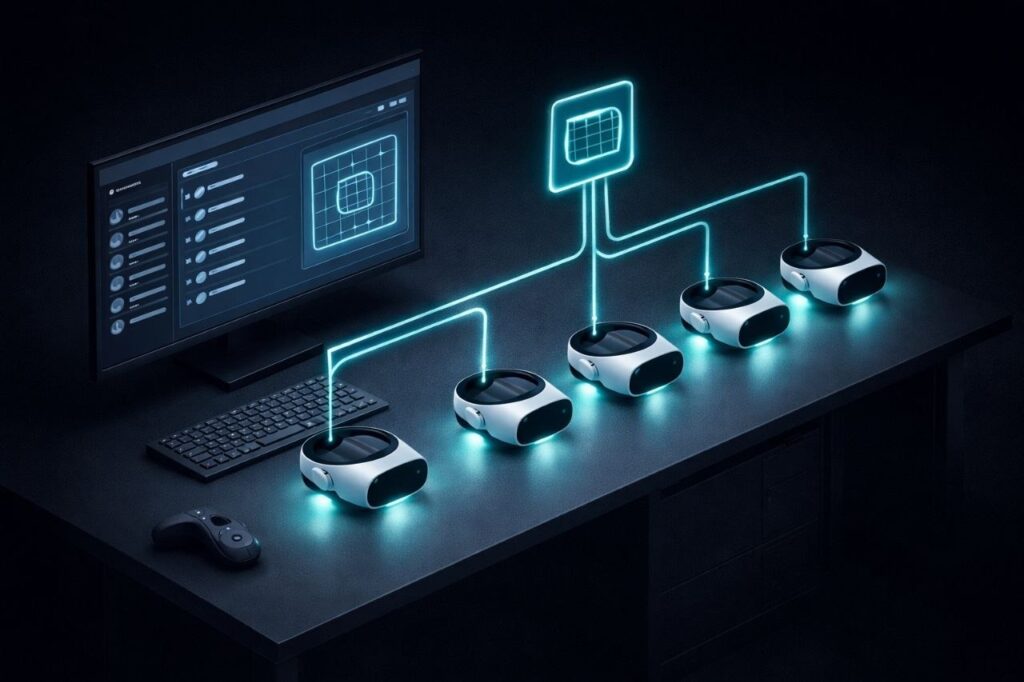
Enterprise headsets solve this at the operating system level. On the PICO 4 Ultra Enterprise, boundary sharing means the map created on one headset becomes the map for every headset in the fleet. The coordinate space is shared. Every device localises against the same spatial reference. Players’ virtual positions correspond accurately to their physical positions relative to each other.
HTC documented the same capability for the VIVE Focus 3 when they introduced map sharing for LBE customers: it allows multiple users to operate accurate co-location tracking in a shared space without having to individually set up or calibrate each headset. All headsets work from a single ground truth for localisation and tracking without extra calibration required.
The practical difference in operation is significant. For a ten-headset fleet, doing calibration manually on each device is an hour of work that can be reduced to minutes. One headset is calibrated. The map is exported to the Admin PC. From the SynthesisVR Local Manager, that map is pushed to every connected headset simultaneously. The fleet shares a single boundary. No redrawing. No starting position rituals. No staff member walks through a manual process on each device before the first group arrives.
For venues running both PICO and VIVE Focus hardware alongside consumer devices, the operational difference becomes visible immediately. On enterprise-focused devices such as PICO 4 Ultra Enterprise and VIVE Focus 3, physical space alignment is handled at the firmware and operating system level. An operator calibrates the space once on a single headset, then extracts that calibration and imports it to the rest of the fleet in a few clicks. On consumer-oriented headsets, there is no equivalent operating system-level support for this workflow.
The Multi-Player Alignment Problem
Co-location: multiple headsets sharing the same physical play space with the same virtual coordinate space, is technically complex. Academic research on SLAM-based co-location identifies a core challenge: each headset builds its own independent tracked map, not inherently shared with other devices. Without a mechanism for shared spatial reference, devices in the same room can drift relative to each other even when each individual headset is tracking accurately by its own measure.
The safety implications are not theoretical. Peer-reviewed research on co-located SLAM VR confirms that a mismatch between virtual and real relative user positions can lead to harmful events including physical collisions between users. In a commercial free roam environment with paying guests, this is not an acceptable failure mode.
Enterprise LBE solutions address this through shared spatial anchors and map distribution at the hardware level. The headsets share a ground truth. When drift occurs on one device, from a lighting change, a camera smudge, or accumulated positional error over a long session, the system can re-localise against the shared map rather than drifting independently. Marker-based drift prevention, used in VIVE’s LBSS, takes this further: ArUco markers placed in the environment provide fixed reference points the headset cameras can detect to actively correct positional error in real time during a session.
The Importance of Reusable, Consistent Environments
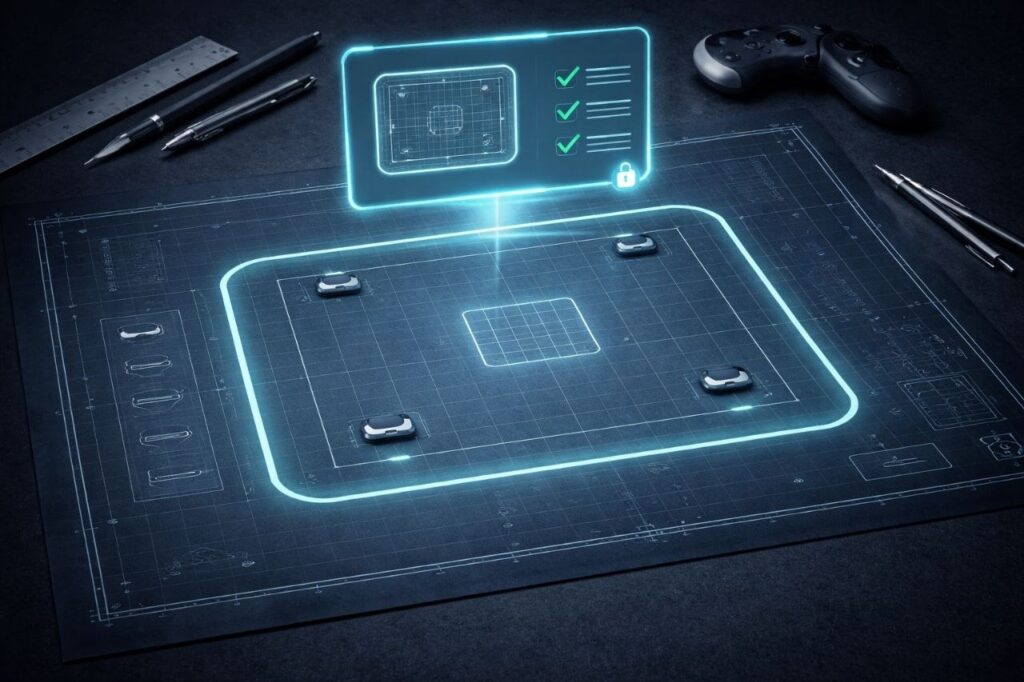
Getting a map right once and keeping it is more valuable than the ability to remap quickly. A well-calibrated environment that produces consistent, stable sessions is an operational asset. Losing it, because a firmware update ran overnight, because a new staff member rebuilt it from memory slightly differently, because a headset was factory-reset during troubleshooting, means starting the calibration process again and accepting instability until the new map settles.
Environment Profiles in SynthesisVR address this directly. Once a boundary configuration produces reliable sessions, that state can be saved: the specific map, the play area setup, and the headset configuration the team trusts. When something changes and sessions degrade, restoring a known-good configuration is the fastest first diagnostic step. The baseline is always recoverable.
For venues running more than one space configuration, a larger free roam footprint for evening groups and a tighter layout for daytime walk-ins, multiple profiles can be stored and deployed on a schedule without redrawing from scratch. For operators managing more than one physical location, a configuration that works at one site can be exported and used as the baseline at another.
The underlying principle is the same one that runs through the entire network series. Week 6.5 closes with it directly: the network is the one layer of a VR venue that is invisible when it works and blamed for everything else when it does not. Calibration sits in the same category. When the mapping infrastructure is right, it disappears from the daily conversation entirely. When it is wrong, it generates a constant stream of complaints that get attributed to everything except the actual cause.
What Mature Operations Do Differently
Locations that have eliminated daily recalibration share consistent practices. They treat the initial map as something worth investing time in: walking the full space carefully, confirming texture quality with a scan tool before finalising, and validating the map under real session conditions before saving it as a profile. They protect the environment that makes the map stable, consistent lighting, no new reflective surfaces introduced to the play area, no furniture moved near the boundary without a map review.
They also understand the relationship between staff and systems. Venues that depend on individual staff members knowing how to recalibrate from memory are vulnerable every time a team member leaves or a new person opens the venue for the first time. Venues where the baseline configuration lives in the system, not in a person’s head, are operationally resilient.
The same logic applies to the network layer. Week 6.5 notes that channel plans that worked at launch with four headsets begin struggling at eight, and that the network should be revisited whenever headset count, content type, or physical space changes. Calibration profiles need the same discipline, when the physical environment changes, the map needs to be reviewed, not assumed to still be valid.
Calibration drift is a solvable problem. The solution is not recalibrating faster. It is building an environment and a workflow where recalibration is rarely necessary.
Coming Up in Week 8
With the physical space, network, and calibration layers working consistently, the next constraint on throughput is the session launch itself. Week 8 covers why manual game launches destroy session flow, what the cost of headset-side menus and staff confusion looks like in actual group turnover times, and how automation changes both speed and the guest experience.
Demo SynthesisVR on PICO Hardware
See how the PICO 4 Ultra Enterprise and SynthesisVR work together to solve:
- Manual Sync: One-click launch for the entire fleet.
- Drift and Mapping: Instant boundary sharing across all headsets.
- Operational Visibility: Monitor devices, network, and battery life from one system.
If calibration has become part of your daily routine, it’s worth seeing what a setup looks like when it isn’t. Happy to walk through how operators are solving this today using PICO and SynthesisVR.
Built by operators, for operators. Trusted by 600+ locations
If you found this article helpful, we invite you to explore the rest of the series.
Week 1: Free Roaming with PICO
Week 2: The Consumer Trap: When Wrong Assumptions Costs Money!
Week 3: Why PICO Became the LBE Standard for Free Roam
Week 4: The Math of a Successful Free Roam Arena
Week 5: Designing a Free Roam Space That Actually Works
Week 6: Networking: The Invisible Backbone of Free Roam
Week 6.5: Networking for VR Venues: What You Need to Know Before You Build
Week 7: Mapping and Calibration: Ending the Drift Problem
Week 8: Launching Games Without Breaking the Flow