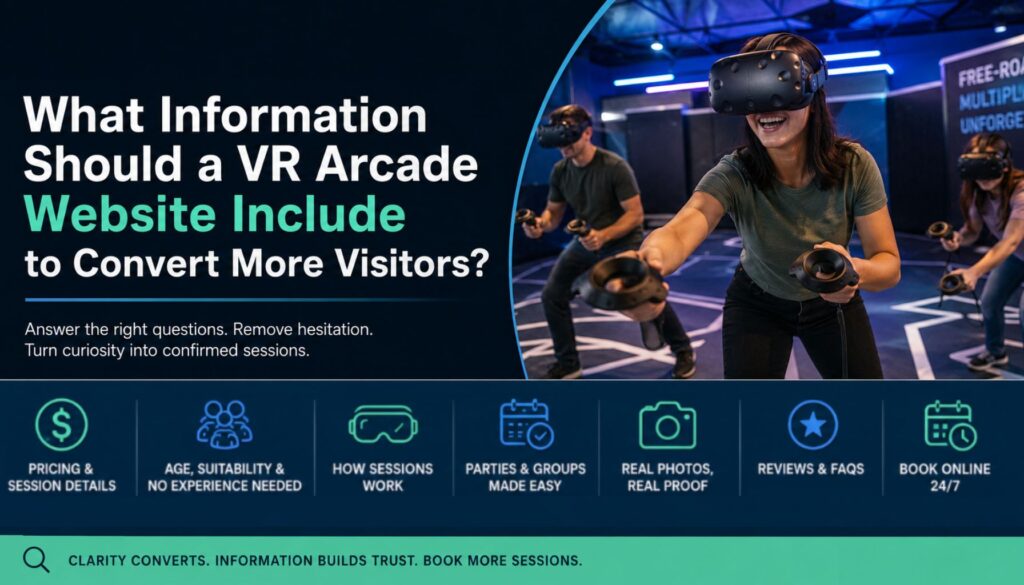
A guest does not need a prettier website. They need the answers that let them book with confidence, in the ten seconds before they decide to look elsewhere.
Most VR arcade websites are built to impress: cinematic hero video, a wall of game logos, a “Book Now” link tucked in the corner. What actually converts a first-time visitor is plainer than that. They land on the page with a short list of unanswered questions, and the site that answers those questions fastest gets the booking.
For a VR attraction, that list runs longer than it does for a restaurant or a movie theater, because most first-time guests do not fully understand what they are buying. They do not know how long a session runs, whether their kid is old enough, whether they need experience, or what actually happens once they walk in. Every one of those unknowns slows the guest down, and in Party Center Software’s 2025 study of family entertainment center bookings, nearly 80% of online reservations were completed on mobile, where a confused visitor is one thumb-swipe from gone.
The fix t is making sure the right information exists on the page, in plain language, where the guest can find it without hunting.
The information that actually convert a succesfful VR booking
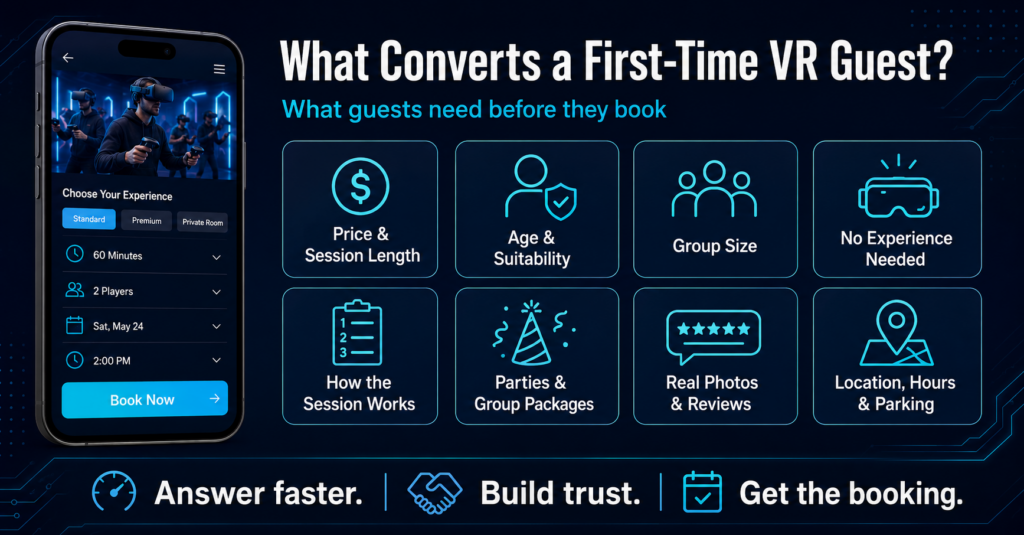
These are the details a first-time guest is checking for, in roughly the order they matter:
- Price, session length, and group size in plain numbers.
- “30-minute sessions, $35 per player, 2 to 8 players” beats a paragraph of atmosphere every time. A guest who has to guess at the price will not ask; they will leave.
- Minimum age and suitability.
- Age limits, height requirements, and a straight answer to “can younger kids play?” Parents will not book on a guess, and this is one of the first things they check.
- “No experience needed” reassurance.
- Most first-timers quietly worry they will look foolish or get motion sick. State plainly that staff set everyone up and that sessions suit complete beginners.
- How free-roam and multiplayer sessions actually work.
- If you run room-scale or free-roam VR, explain how a group plays together: same arena, same session, headsets and setup handled by staff. This is usually a venue’s biggest differentiator, so it needs plain-language explanation, not just a game list.
- Party and group package details.
- Birthdays and corporate groups are high-value bookings. They need their own page with capacity, inclusions, and a clear next step, not a paragraph buried under general booking info.
- Real photos or a short walkthrough clip.
- A guest deciding whether to drive across town wants to see the actual space, not a stock 3D render. Real photos answer “what does this place actually look like” faster than any copy can.
- Reviews and ratings, placed near the booking path.
- Proof works hardest right where the guest is already hesitating, not on a testimonials page three clicks away.
- An FAQ that answers real objections.
- “Do I need experience?” “Can kids play?” “What should I wear?” “What if I get motion sick?” “Can people watch?” “Do we sign a waiver?” “What time should we arrive?” Every answered question removes a reason to hesitate.
- Location, hours, parking, and accessibility.
- The last practical check before someone commits to the drive, and it needs to be visible text, not a map widget the guest has to zoom around.
- Booking availability around the clock.
- The same Party Center Software study attributes roughly 30% of lost party-booking potential to missed phone calls. A guest deciding at 9pm on a Tuesday cannot call, and if the site cannot take a booking outside business hours, that booking is usually gone by morning.
Where this information needs to live
Having the right information somewhere on the site is not the same as having it where the guest can find it. Pricing, session length, and age suitability need to sit above the fold or within one tap, not three pages deep. The booking button itself should be visible above the fold and repeated as the guest scrolls, reachable in two or three taps from any page.
The better attraction and FEC platforms now advertise a path from browsing to booked in under a minute, and that sets the baseline expectation for every visitor who lands on your page. Add a detour anywhere in that path and the guest reconsiders the whole visit, which is usually where the booking slips away.
Make the same information readable by search engines and AI tools
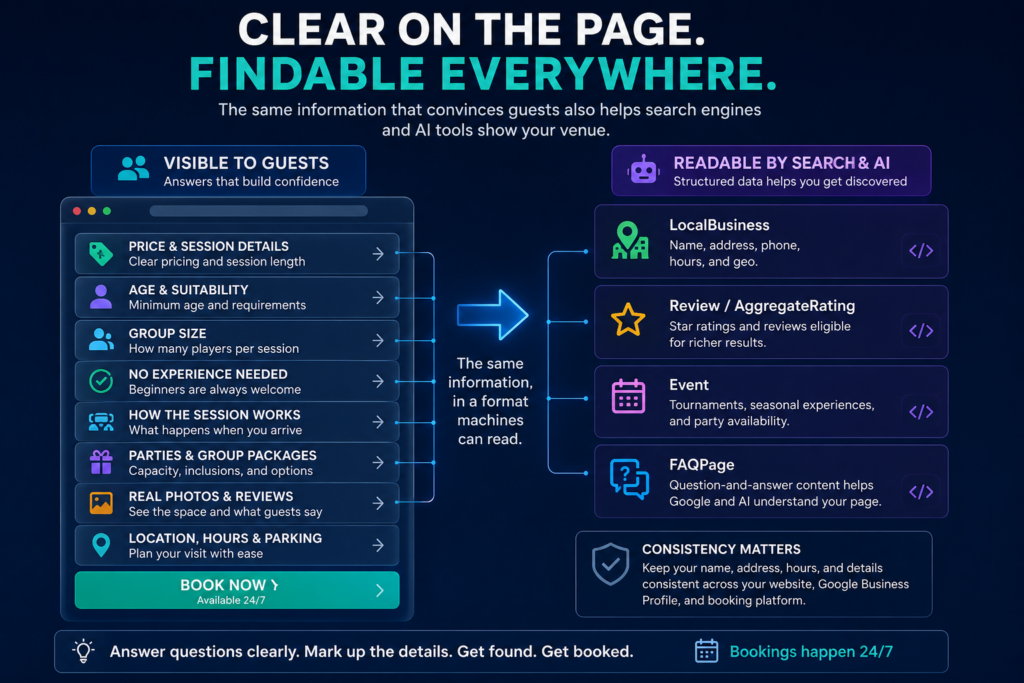
The clear, specific information that convinces a guest also makes a venue easier for search engines and AI tools to read when they decide what to show. When someone asks their phone “VR arcade near me open tonight,” you want your venue to be the answer that comes back, and that depends on the same details being labeled in a way machines can read without guessing.
That labeling is called structured data. Google’s own documentation states that LocalBusiness structured data can make pages eligible for richer search results and helps Google present details like hours, location, and reviews across Search and Maps. A few schema types are worth setting up for a VR venue:
- LocalBusiness. Name, address, phone, hours, and geo. Google supports this type directly and uses it in local results and Maps.
- Review or AggregateRating. Within Google’s rules, this can make a star rating eligible to appear in richer results.
- Event. For tournaments, seasonal experiences, and scheduled party availability.
- FAQPage. Google removed FAQ rich results from Search in May 2026, so this markup no longer earns a special search appearance. It still has value: Google says it continues to read FAQ markup to understand a page, and AI systems such as Google’s AI Overviews, ChatGPT, and Perplexity lean on clear question-and-answer content when they build their answers.
One rule matters more than the rest: keep everything consistent. Business name, address, and hours have to match across the website, Google Business Profile, and booking platform. Google’s guidelines are clear that structured data should reflect the content people actually see on the page, and when the details conflict, Google can discount or ignore the markup. Structured data does not replace clarity on the page; it just helps the right people find the page in the first place.
Google also added a reporting layer to Search Console in July 2026 called platform properties, which shows how existing Instagram, TikTok, X, and YouTube posts perform in Google Search and Discover, even for accounts with no website attached. It does not replace the site: none of those platforms can take a booking, hold a price, or carry LocalBusiness schema. What it does is show whether the walkthrough clips and free-roam footage covered above are actually earning search visibility on their own, and whether the same plain-language answers (price, age, session length) belong in the caption too, not just the video.
The VR operator’s website information checklist
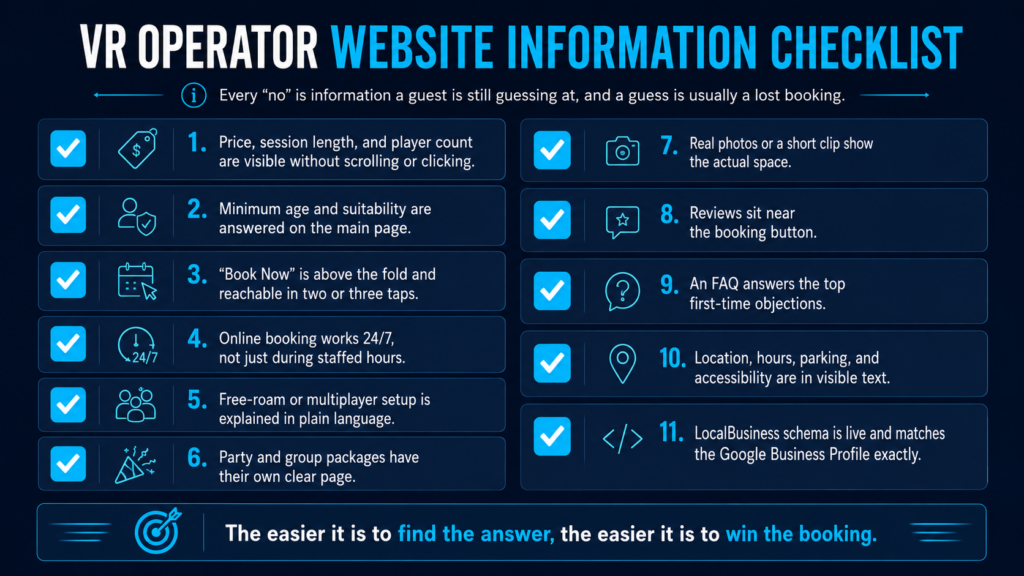
Run your own site against this list. Every “no” is information a guest is currently guessing at, and a guess is usually a lost booking:
- Price, session length, and player count are visible without scrolling or clicking.
- Minimum age and suitability are answered on the main page.
- “Book Now” is above the fold and reachable in two or three taps.
- Online booking works 24/7, not just during staffed hours.
- Free-roam or multiplayer setup is explained in plain language.
- Party and group packages have their own clear page.
- Real photos or a short clip show the actual space.
- Reviews sit near the booking button.
- An FAQ answers the top first-timer objections.
- Location, hours, parking, and accessibility are in visible text.
- LocalBusiness schema is live and matches the Google Business Profile exactly.
The takeaway
A guest does not leave a VR arcade site because the design is dated. They leave because the page never told them what they needed to know, and they were not willing to keep hunting for it. The venues pulling ahead are the ones that put price, age limits, session details, real photos, and a straight FAQ where the guest can see them immediately, then back it with structured data so the same information reaches search and AI tools too.
Answer the guest’s questions before they have to ask, and curiosity turns into a confirmed session.
SynthesisVR helps VR arcades and family entertainment centers run booking, waivers, content, and management from one platform, with an online reservation system built in and integrations for venues already booking through Checkfront or FareHarbor. Reach out to our team to schedule a product demo.
Related Reading
How to Market VR Arcade Birthday Parties for Summer Bookings
Why Multiplayer VR Attractions Drive Repeat Visits and Higher Utilization
How VR Arcades Fill Empty Weekday Sessions Without Discounting