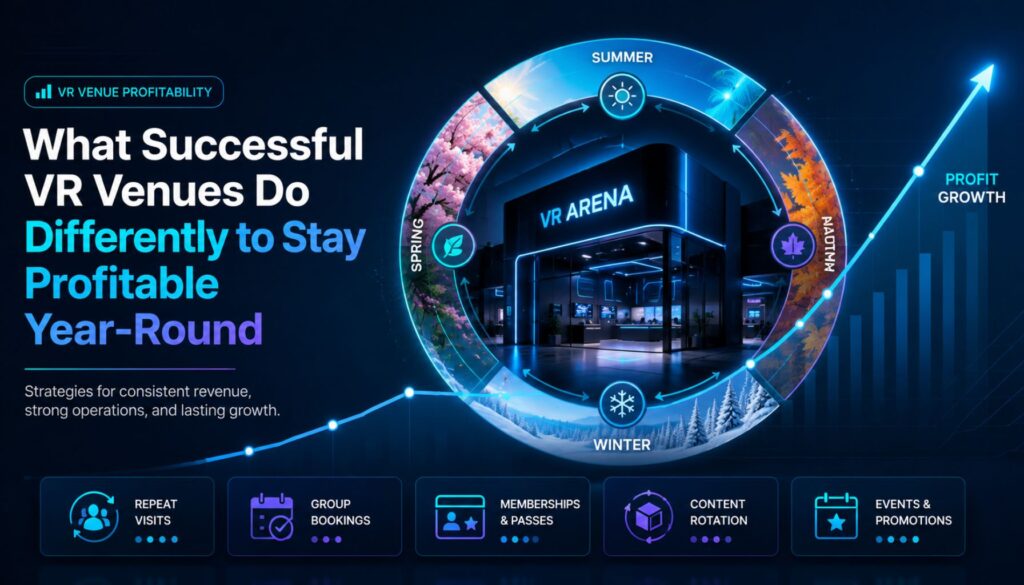
Most VR venues can attract attention when they first open. The harder test comes 12 to 24 months later, after launch coverage has faded and the first wave of local curiosity has passed.
Industry guides place mature, well-run VR venues within a broad net margin range of 20 to 40 percent. Headset choice affects costs, but it rarely explains the full distance between the bottom and top of that range. The larger differences usually appear in demand generation, booking behavior, staff workflows, session throughput, repeat visits, and revenue outside paid headset time.
That is where VR venue profitability becomes measurable. The 2026 attractions industry benchmark data, drawn from anonymized booking and transaction records across the sector, gives operators a useful way to compare their systems with wider market behavior.
Advance bookings make demand more valuable and more visible
Online bookings generate 45 percent of total revenue across attractions venues while accounting for only 33 percent of bookings. That means online bookings over-index on revenue by 12 percentage points.
The benchmark does not isolate the reason. Larger groups, higher-value packages, advance upgrades, and add-on purchases could all contribute. The operational conclusion remains useful: advance bookings carry more revenue per booking and give the venue time to plan around them.
A venue that reaches Wednesday with half its weekend sessions already committed can schedule staff against known demand, prepare for larger groups, and spot a soft weekend early enough to respond. A venue that relies mainly on walk-ins learns how the week performed while the week is already happening.
The practical improvements are straightforward:
- Shorten the booking path.
- Show live availability instead of relying on a contact form.
- Make session length, capacity, and total group cost easy to understand.
- Give guests a clear reason to reserve a slot now.
Advance rates and group pricing can help, although the commitment matters more than the discount itself.
Marketing keeps demand active throughout the year
A short booking path helps convert interest, but the venue still needs to create that interest. Once opening coverage and local curiosity decline, year-round performance depends on a repeatable way to reach new customers and bring previous guests back.
Attractions-industry guidance treats customer acquisition and retention as core revenue activities. Targeted campaigns, segmented guest communication, membership promotion, and post-visit follow-up can help venues generate bookings without depending entirely on walk-in traffic or seasonal demand.
For a VR venue, the strongest campaigns usually begin with a specific audience and occasion:
- Birthday packages for parents planning group events
- Corporate and team-building offers for local businesses
- Weekday packages for students and young adults
- School, camp, and community-group sessions
- Return offers tied to new content, higher scores, or a different multiplayer format
The marketing content should also make the experience easy to understand. Guests need to know how many people can play, how long the session lasts, whether players compete or cooperate, what age group it suits, and what makes the experience worth sharing. Generic headset footage creates awareness, but specific group scenarios give people a clearer reason to book.
Guest data turns one-time promotion into a repeatable system. Venues can track where bookings originated, which packages generated revenue, how many guests returned, and which audiences filled normally quiet periods. A campaign that reliably fills four Tuesday sessions may contribute more to profitability than a post that reaches thousands of people without producing bookings.
Marketing creates demand, the booking journey captures it, and venue operations determine how much of that revenue becomes margin and repeat business.
Consistency is whatever survives a staff change
Attractions venues often rely on seasonal and part-time staff, which limits how much operational quality can depend on one experienced employee.
Every critical process that exists only in an experienced employee’s head creates a business risk.
Guests experience that risk as waiting. Resets take longer. Briefings vary between staff members. Sessions start late because the person on shift is trying to remember which title launches in which way. A group that arrived on time spends part of its paid visit watching staff troubleshoot.
Venues that hold steady through turnover standardize session launches, headset preparation, guest briefings, resets, and basic fault recovery. They maintain the same approved content library across the headset fleet and build reset steps into the workflow.
By week ten, a new hire should be following the same operating pattern as an experienced team member.
We covered the throughput side of this in Launching Games Without Breaking the Flow.
Commercial VR content protects throughput
A consumer title can be entertaining and still be awkward to run in a commercial venue.
Venue-ready content needs clear onboarding, predictable session lengths, reliable multiplayer handling, simple reset behavior, and a commercial license. These elements determine how efficiently staff can move one group out and the next group in.
When they are missing, the commercial cost appears as friction:
- Sessions take longer to begin.
- Staff troubleshoot instead of hosting.
- Reset times vary between employees.
- Fewer groups move through the same floor space.
- Revenue per operating hour falls below the original model.
The exact throughput target depends on session length, attraction format, and the number of stations in the venue. The principle stays consistent. When actual session capacity falls below the floor plan’s model, margin disappears into setup and reset time.
Commercial licensing sits underneath the entire operation. Using a title in a paid venue requires more than access through a consumer storefront or commercial Steam account.
We explain the distinction in VR Commercial Licensing Explained.
The numbers that separate a steady venue from a seasonal one
Guest-level metrics such as repeat visit rate and time to second visit are covered in How VR Entertainment Venues Turn First-Time Visitors Into Repeat Customers.
The figures below answer a broader question: has the venue built enough recurring demand to hold through a quiet stretch?
Members visit nearly four additional times per year
Members visit 4.9 times per year, compared with 1.3 visits for non-members. That is an additional 3.6 visits per person annually.
Membership revenue gives the venue a base of customers who already have a reason to return. It also gives the operator a group that can support weekday sessions, content rotation, member events, and quieter calendar periods.
A membership still needs enough value to justify renewal. We cover the structure in How VR Arcades Actually Make Money.
Party programs create future customers
Guests return 41 percent of the time at venues that run parties, compared with 26 percent at venues that do not. That is a 15-point difference.
Party packages already appeal to operators because they can combine group pricing, food and beverage, private space, and predictable scheduling. The benchmark suggests another benefit: parties introduce the venue to guests who may not have chosen it themselves.
One parent makes the booking, but an entire group experiences the venue. Some of those guests return later with friends, family members, or their own celebration.
Guest expectations are rising across the sector
Average guest survey scores increased from 3.95 to 4.29 out of five in one year.
A venue that maintained a score of 4.0 may have delivered a similar experience while still losing ground relative to the rest of the sector. Stable internal performance can hide a widening gap when customer expectations rise around it.
Operators should review feedback by stage of the visit:
- Booking
- Arrival
- Briefing
- Headset setup
- Gameplay
- Changeover
- Checkout
A strong game cannot fully recover an experience that started late or felt disorganized.
Revenue can continue when no session is running
A venue that earns only when a headset is in use has limited ways to absorb quiet periods.
Two additions can widen the revenue model without changing the core VR attraction.
Rent the space as well as the experience
Hourly venue rental allows organizers to book the room first and add VR as part of the event.
This works for corporate groups, clubs, student societies, private gatherings, and community events that need a venue as much as they need an activity. It also creates a different pricing structure from a standard per-person session and can help fill blocks that individual bookings struggle to use.
Make food and beverage easier to buy
Mobile food and beverage orders average 3.3 times the value of counter purchases.
Guests browsing a digital menu at their own pace often order differently from guests making a quick decision at a counter with other people waiting behind them. Digital menus, preorders, and mobile ordering can increase basket size while reducing pressure on the front desk.
The strongest food and beverage offer fits naturally around the visit. Guests should be able to add items before arrival, during a break, or while waiting for the rest of their group.
What year-round profitability actually requires
Year-round profitability means the business can absorb its quietest stretch without losing operational control or cash discipline.
Strong venues maintain a measurable marketing rhythm that gives new and returning audiences a reason to book. They make that demand visible through advance reservations, protect consistency with standardized workflows, and choose commercial content that supports the throughput their floor plan was designed to deliver.
These systems are usually built during the months when the team has enough breathing room to improve them. The slow season simply reveals whether they exist.
Where SynthesisVR fits
Operators need content, launch processes, licensing rules, and device states to remain consistent across the building. SynthesisVR gives venues one system for managing content, launching sessions, and handling commercial licensing across free-roam, room-scale, and seated formats.
The platform currently supports more than 600 locations and provides access to over 400 commercial VR titles through the SynthesisVR marketplace.
See how SynthesisVR can help your venue standardize operations, protect throughput, and stay ready throughout the year.